The best colored pencils for kids are the Crayola 36-count set — vivid color, break-resistant leads, and a 4.8-star average from 50,000+ buyers for under $7. Crayola Twistables (50ct) are the easiest for young kids since they never need sharpening, and the Shuttle Art 80-count gives the most color per dollar.
Key takeaways
- Crayola 36-count is the best overall: 4.8 stars from 50,000+ buyers, under $7
- Twistables need no sharpening — easiest option for kids under 8
- Look for high pigment (rich color with light pressure) and break-resistant cores
- 24-36 colors is the sweet spot for ages 4-7; 50-80 for ages 7+
Affiliate Disclosure: This post contains affiliate links. If you buy through them, we may earn a small commission at no extra cost to you. Prices were checked in October 2026 and may vary on Amazon.
Short answer: The best colored pencils for kids are the Crayola 36-count set — vivid color, break-resistant leads, and a 4.8-star average from 50,000+ buyers, all for under $7. For kids who hate sharpening, Crayola Twistables (50-count) are the easiest pencils they will ever use, and the Shuttle Art 80-count gives the most color per dollar.
Colored pencils are a childhood staple, but the gap between waxy, faint pencils and rich, smooth ones is enormous, and kids feel it immediately. The right set lays down vivid color with light pressure, survives being dropped, and stays non-toxic. Below, we compare the most popular kids’ colored pencil sets on Amazon — checking color payoff, breakage reports, safety labelling, and verified buyer feedback — to find the ten best colored pencils for kids in 2026.
★ Our Top Pick: Crayola Colored Pencils, 36 Count
TL;DR — Pick by age and need:
- Ages 2–4: Colorations STUBPEN chubby pencils — made for tiny hands.
- Ages 4–7, first set: Crayola 36-count — the safest all-round buy.
- Hates sharpening: Crayola Twistables 50-count — twist up, no shavings, no snapped tips.
- Age 7+ and loves color: Shuttle Art 80-count — the most colors per dollar.
- Classroom or party: YEGEER 288-count or Cra-Z-Art 144-count bulk boxes.
- Gift: Shuttle Art 149-piece wooden-case set.
In this guide
1. Our Top 3 Picks at a Glance
★ Best Overall — Crayola Colored Pencils, 36 Count

4.8 stars from 50,000+ buyers. The classroom classic that just works — rich color, tough leads, and a price that makes replacements painless.
★ Easiest to Use — Crayola Twistables, 50 Count

Twist-up color, zero sharpening. The easiest pencils kids will ever use — no sharpener, no shavings, no tears when a point snaps.
★ Best Value — Shuttle Art 80 Colored Pencils

80 rich soft-core colors under $10. Maximum color per dollar, and a big step up for kids aged 7+ who have outgrown a basic 24-count.
2. Quick Comparison Table
| # | Product | Detail | Price* | Rating |
|---|---|---|---|---|
| 1 | Crayola 36ct | 36 colors | $6.57 | 4.8 |
| 2 | Crayola Twistables 50ct | 50 twist-up colors | $13.46 | 4.7 |
| 3 | Shuttle Art 80ct | 80 soft-core | $9.99 | 4.7 |
| 4 | Shuttle Art 149pc Deluxe | 149pc wooden case | $35.99 | 4.7 |
| 5 | Disney Stitch Set | Character set + case | $24.82 | 4.6 |
| 6 | SKKSTATIONERY 50ct | 50 vibrant colors | $8.79 | 4.6 |
| 7 | YEGEER 288ct Bulk | 24 x 12ct sets | $24.99 | 4.6 |
| 8 | Colorations STUBPEN 48ct | Chubby toddler pencils | $21.99 | 4.3 |
| 9 | KALOUR 72ct | 72 soft-core | $11.99 | 4.7 |
| 10 | Cra-Z-Art 144ct Bulk | 144 pre-sharpened | $17.92 | 4.7 |
*Prices checked October 2026; they change often on Amazon.
3. How to Choose Colored Pencils for Kids
What should you look for in kids’ colored pencils?
Three things matter most: pigment load, break resistance, and safety. High-pigment pencils lay down rich color with light pressure — kids press hard enough already, and faint waxy pencils only make them press harder, which snaps tips. Break-resistant cores (look for “break-resistant” or thicker 3.3mm+ cores in listings) survive drops and heavy hands. And every set should be labeled non-toxic, ideally with AP certification from the Art & Creative Materials Institute. Beyond that, match the format to the age: chubby pencils for toddlers, Twistables for ages 4–7, and standard wood pencils once their grip matures around age 6–8.
Quick definition: A “soft-core” pencil has a softer, waxier core that lays down more pigment with less pressure, so colors look richer and blending is easier — but it wears down faster and needs a gentler hand. A “hard-core” pencil stays sharp longer and suits detailed lines, but colors can look paler unless a child presses firmly.
How many colors does a child really need?
More than you would think, fewer than the marketing suggests. 24–36 colors is the sweet spot for ages 4–7 — full rainbow, skin tones, and neutrals, without decision paralysis. Around age 7–8, kids start noticing that “green” is not one color, and that is when 50–80 color sets earn their keep and teach real color awareness. Beyond 100 colors is enthusiast territory; fun, but no child needs it. One practical tip: sets with color names printed on each pencil (like Crayola) quietly teach color vocabulary every time a kid asks for “burnt sienna.”
| Age | Best count | Best format |
|---|---|---|
| 2–4 | 12–48 chubby pencils | Short, thick barrels that small hands can grip |
| 4–7 | 24–36 colors | Wood pencils or Twistables |
| 7–8+ | 50–80 colors | Soft-core sets for blending and shading |
| Classroom / party | Bulk 12-count sets | Pre-sharpened bulk boxes, one set per child |
Wood pencils, Twistables, or something else?
Classic wood pencils sharpen to the finest point and are cheapest per pencil — best for careful, detailed work with older kids. Twistables eliminate sharpening entirely and never snap, making them the lowest-friction option for young kids, at the cost of fine detail. Chubby toddler pencils are strictly for ages 2–4, with grips little hands can actually hold. There is no single winner: many families keep Twistables for everyday coloring and wood pencils for “serious” art time. Pair any of them with good paper — paper quality affects pencil color more than most people expect — so see our best sketchbooks for beginners guide, and check the complete art supplies guide for the rest of the kit. If you are building a school-at-home setup, our best art supplies for homeschool guide covers the full desk, not just pencils.
- Check the label: non-toxic, and AP certification where listed.
- Check the count honestly: a 24-count set a child actually uses beats an 80-count set that stays in the tin.
- Check the grip: thin pencils frustrate toddlers; chunky barrels frustrate detailed work for older kids.
- Check the sharpener plan: wood pencils need one; Twistables do not.
4. The 10 Best Colored Pencils for Kids in 2026
1. Crayola Colored Pencils, 36 Count — Best Overall
Our verdict: There is a reason Crayola has owned the classroom for generations: these pencils simply work. The colors go on smooth and vivid rather than waxy and faint, the leads resist breaking under kid-pressure, and at $6.57 for 36 colors the value is almost silly. With a 4.8-star average from over 50,000 buyers — one of the most-reviewed art products on Amazon — this is the safest first colored pencil set you can buy. If you only get one, get this one.
Try this: Draw a rainbow with one light layer first, then go over each band a second time with the same pencil. Kids can see, in under a minute, why two light layers beat one hard press — richer color, no broken tip.
- What we like: 50,000+ buyer reviews at 4.8 stars; rich color payoff, easy to sharpen; unbeatable price.
- Keep in mind: Basic cardboard box, not a case; 36 colors may limit older kids.
Check Price on Amazon — $6.57, 4.8/5 verified buyer rating (checked October 2026).
2. Crayola Twistables Colored Pencils, 50 Count — Easiest to Use
Our verdict: Twistables solve the two things kids hate about colored pencils: sharpening and broken tips. The plastic barrel twists up fresh color — no sharpener, no shavings, no tears when the point snaps mid-masterpiece. With 50 colors and a 4.7-star average from nearly 30,000 buyers, they are a proven classroom favorite. They are chunkier than wood pencils, so very detailed work is harder, but for kids under 8 the convenience wins by a mile.
Try this: Give a child a Twistable and a wood pencil and ask them to color one small square with each. Most young kids finish the Twistable square first — that speed difference is exactly why these suit homework, travel, and car rides.
- What we like: Never needs a sharpener; tips do not snap like wood pencils; huge color range for kids.
- Keep in mind: Bulkier for fine details; cannot sharpen to a fine point.
Check Price on Amazon — $13.46, 4.7/5 verified buyer rating (checked October 2026).
3. Shuttle Art 80 Colored Pencils — Best Value
Our verdict: Eighty soft-core pencils for under ten dollars — the per-pencil math here is the best on this list. The soft cores lay down richer color than hard school pencils, which kids notice immediately: coloring feels smoother and looks brighter. With 27,000+ buyers rating them 4.7 stars, they are proven far beyond the price tag. Marketed for adult coloring, but older kids (7+) who have outgrown the basic 24-count will love the range. Just know soft cores need a gentler hand.
Try this: Color a leaf half in yellow, half in blue, then lightly layer blue over the yellow edge. The green that appears teaches blending without any lecture — and it only works well with soft, pigmented cores like these.
- What we like: Best price per pencil here; vivid color kids love; 27,000+ happy buyers.
- Keep in mind: Soft cores break if pressed hard; best for ages 7+.
Check Price on Amazon — $9.99, 4.7/5 verified buyer rating (checked October 2026).
4. Shuttle Art 149-Piece Deluxe Art Set — Best Gift

Our verdict: This is the gift that makes a kid gasp: 149 pieces — colored pencils, crayons, paints and more — in a real wooden case. It turns “art supplies” into an event, and at $35.99 it looks far more expensive than it is. Buyers rate it 4.7 stars, with parents praising it as the ultimate birthday or holiday gift for creative kids. It is more than any beginner needs to start, but as a gift, abundance is the whole point. For more present ideas, see our best gifts for artists under $50.
- What we like: Huge wow factor for gifting; everything in one organized case; great value per piece.
- Keep in mind: Overkill as a first set; wooden case is bulky for travel.
Check Price on Amazon — $35.99, 4.7/5 verified buyer rating (checked October 2026).
5. Disney Stitch Colored Pencils Set — Best for Kids Who Love Characters
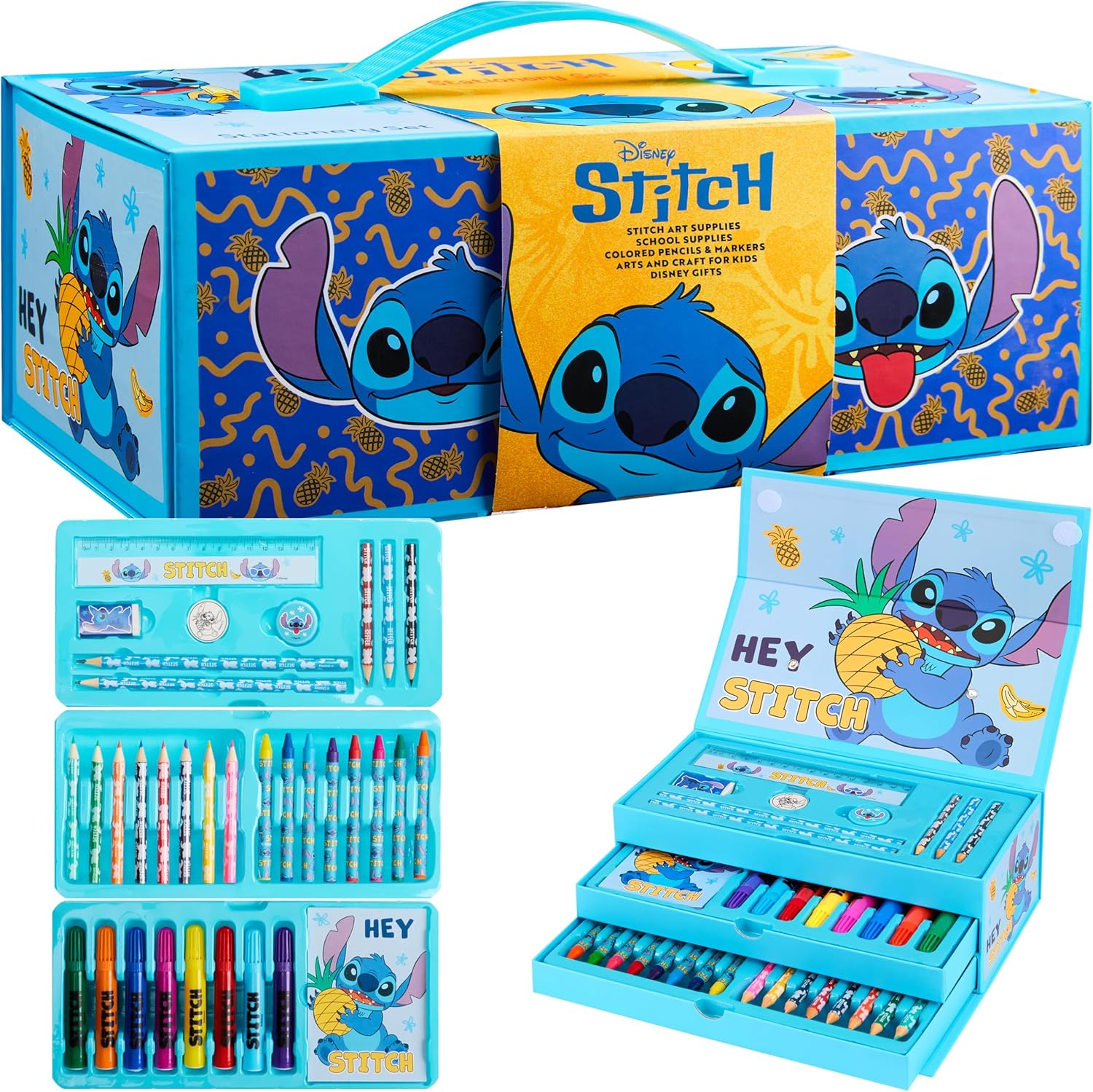
Our verdict: Sometimes the best art supply is the one a kid actually reaches for — and Stitch on the case guarantees that. This Disney set bundles colored pencils with school-ready stationery in a travel case kids love carrying. The 4.6-star rating from 1,200+ buyers reflects genuine kid approval, not just parent hope. You are paying a character premium versus plain sets, but if it gets them drawing daily, it is money well spent.
- What we like: Kids genuinely love using it; great for school & travel; fun gift pick.
- Keep in mind: Character premium in the price; fewer pencils than plain sets.
Check Price on Amazon — $24.82, 4.6/5 verified buyer rating (checked October 2026).
6. SKKSTATIONERY 50 Colored Pencils — Best for Beginners

Our verdict: Fifty vibrant colors for under nine dollars from a brand built specifically for kids’ stationery. The color range hits the sweet spot for beginners — enough variety to feel exciting, not so many it is overwhelming. Buyers give them 4.6 stars, praising the bright payoff for the price. They will not match Crayola’s consistency stick for stick, but as a starter set for a curious kid, the value is hard to argue with.
Try this: Sort the 50 pencils into warm colors, cool colors, and neutrals before the first drawing. It takes five minutes and turns a new set into a first color-theory lesson.
- What we like: Great variety for the price; bright, fun colors; perfect starter quantity.
- Keep in mind: Less consistent than big brands; basic packaging.
Check Price on Amazon — $8.79, 4.6/5 verified buyer rating (checked October 2026).
7. YEGEER 288-Count Bulk Colored Pencils — Best Bulk
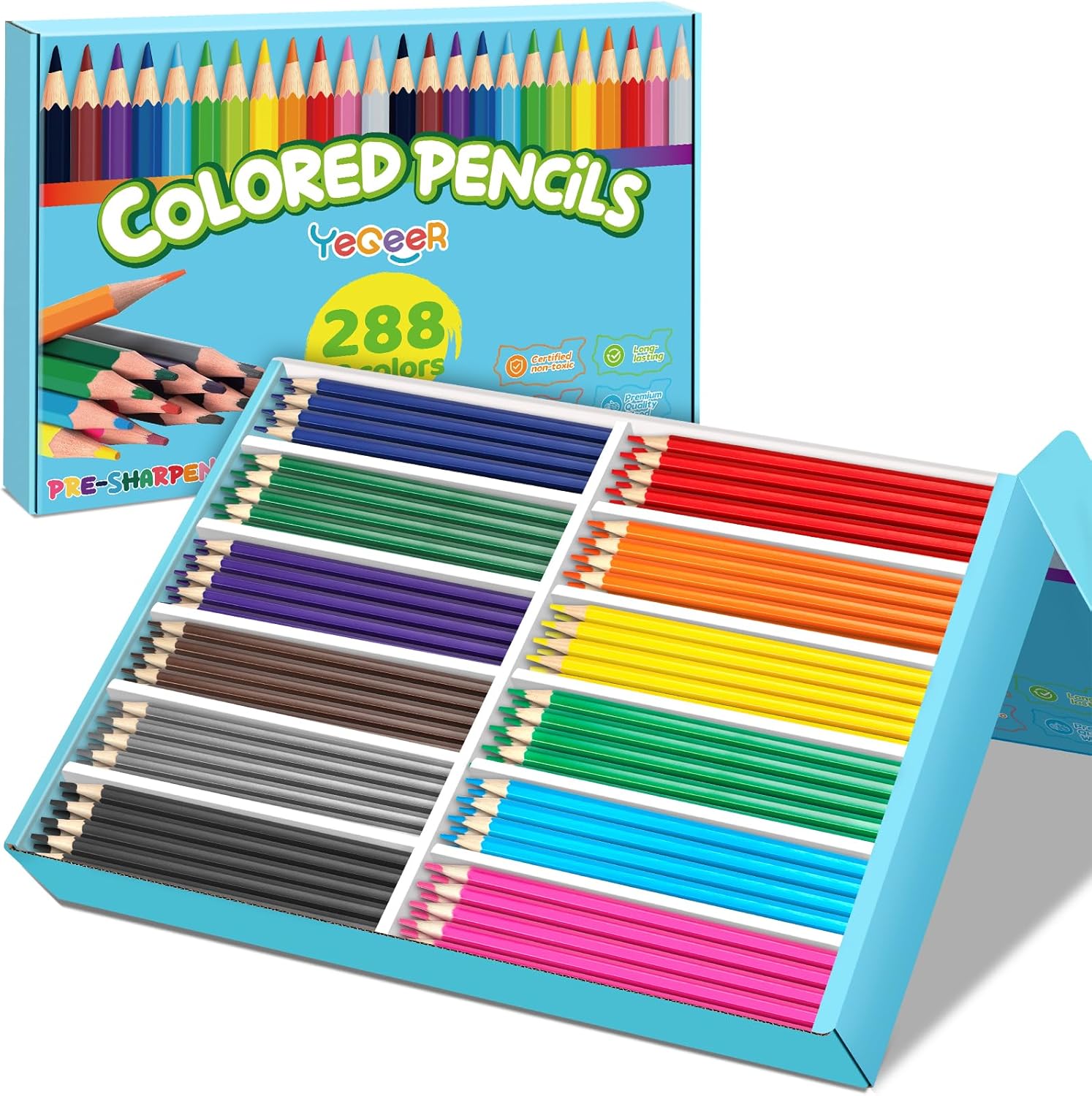
Our verdict: Twenty-four pre-sharpened 12-color sets in one box — this exists for classrooms, parties, and art camps, and it nails the assignment. Every kid gets a full set (no sharing fights), each pencil arrives pre-sharpened (no first-day chaos), and at $24.99 the per-set cost is barely a dollar. For a single child it is overkill; for a teacher or party parent, it is the smartest buy on this list.
- What we like: Every kid gets their own set; lowest per-set cost here; classroom & party ready.
- Keep in mind: Overkill for one child; 12 colors per set only.
Check Price on Amazon — $24.99, 4.6/5 verified buyer rating (checked October 2026).
8. Colorations STUBPEN Chubby Pencils, 48 Count — Best for Toddlers

Our verdict: Regular pencils are genuinely hard for 2- to 4-year-olds: too thin to grip, too fragile, too frustrating. These stubby, chubby pencils are engineered for tiny hands — easy to hold, hard to break, and sized so they cannot roll away. The 4.3-star rating reflects a niche product with fewer reviews, and honest buyers note the price is high per pencil. But for toddlers, the right tool matters more than the count: these turn scribbling from a struggle into play. Pair them with mess-friendly paint days from our best washable paints for kids guide and toddlers get art time without the stress.
- What we like: Perfect for tiny hands; very hard to break; builds early confidence.
- Keep in mind: Pricey per pencil; too chunky for older kids.
Check Price on Amazon — $21.99, 4.3/5 verified buyer rating (checked October 2026).
9. KALOUR 72 Soft-Core Colored Pencils — Best Premium Step-Up

Our verdict: When a kid graduates from flat coloring to blending and shading, soft-core pencils are the upgrade — and KALOUR’s 72-color set is the affordable way in. The creamy cores layer and blend like pencils costing three times more, which is why 13,000+ buyers rate them 4.7 stars. Marketed for adult coloring, so this is for older kids (8+) ready for real technique, not toddlers. At $11.99, it is a low-risk taste of artist-quality color. When they are ready to go further, our best colored pencils for artists guide covers the next level up.
Try this: Shade a circle from dark on one edge to white on the other using only one pencil, pressing hard, then medium, then barely touching. That single exercise teaches pressure control better than any worksheet.
- What we like: Blends like premium pencils; huge range for technique; 13,000+ buyer reviews.
- Keep in mind: Too advanced for little kids; soft cores need careful handling.
Check Price on Amazon — $11.99, 4.7/5 verified buyer rating (checked October 2026).
10. Cra-Z-Art Bulk Colored Pencils, 144 Count — Best Budget Pick

Our verdict: One hundred forty-four pre-sharpened, non-toxic pencils for under eighteen dollars — that is about twelve cents a pencil. This 12-pack-of-12 bulk box is the budget king for classrooms, after-school programs, and big families where pencils vanish like socks. The 4.7-star rating from 640 buyers confirms the quality holds up at bulk pricing. Individually they are basic pencils, but at this price you can afford to be generous.
- What we like: Unbeatable bulk value; great for classrooms & families; no sharpening needed day one.
- Keep in mind: Basic pencil quality; bulk box, not giftable.
Check Price on Amazon — $17.92, 4.7/5 verified buyer rating (checked October 2026).
5. 5 Easy Activities to Try With Any Set
These work with any pencil on this list, cost nothing extra, and teach real skills while kids think they are just coloring.
1
The pressure scale. Draw five boxes in a row. Color the first one pressing as hard as possible, the last one barely touching the paper, and the middle three in between. Kids learn instantly that pressure — not a new pencil — controls darkness.
2
Two-color blending. Color a shape yellow, then layer light blue over half of it. The green in the overlap is a small magic trick, and it works best with soft-core sets like Shuttle Art 80 or KALOUR 72. For water-based color play on other days, see our best watercolor paint sets for kids.
3
Light first, dark second. Color a sunset light yellow first, then add orange, then a little red at the edges. Remind kids: you can always darken a light layer, but you cannot lighten a dark one. This one rule fixes most muddy coloring.
4
Rotate while shading. As one side of the pencil tip wears flat, rotate the pencil slowly while coloring. The color stays even, the tip lasts longer, and big areas stop looking streaky.
5
The travel kit. Rubber-band 12 favorite colors together for car rides and restaurants. A full 80-count tin is miserable in a backpack; a small chosen set gets used far more often.
6. Pro Tips: Stop Breakage and Keep Colors Bright
Store pencils tip-up in a cup. Drops fracture the core inside and cause endless breakage later — even when the pencil looks fine outside. A cup on a desk beats a bag tossed in a backpack.
- A sharp pencil colors better: teach kids to rotate the pencil as they shade for even wear.
- Layer light colors first, then dark — you cannot lighten a dark layer, but you can always darken.
- Keep a dedicated sharpener with a shavings catcher; kid-friendly sharpeners need less force.
- Keep a good eraser handy for pencil work — see our best erasers for drawing so mistakes do not become tears.
Do not press harder to fix pale color. If color looks faint, the pencil is usually too hard or too waxy for the paper — pressing harder snaps the tip. Switch to a softer-core pencil or smoother paper instead, and color in two light layers.
7. Frequently Asked Questions
What age can kids start using colored pencils?
Most kids are ready for regular colored pencils around age 4-5, when their grip is developed enough to hold a thin pencil. For ages 2-4, chubby pencils like the Colorations STUBPEN are much easier to grip and nearly unbreakable. Twistables are a great middle ground for ages 4-7 since there’s no sharpening involved.
Are colored pencils safe for kids?
Yes — look for sets labeled non-toxic, which all ten picks on this list are. Reputable brands also carry AP (Approved Product) certification from the Art & Creative Materials Institute. Non-toxic doesn’t mean edible though, so supervise toddlers who still put things in their mouths.
How many colored pencils does a child need?
Twenty-four to 36 colors is plenty for most kids — it covers the full rainbow plus skin tones and neutrals without overwhelming them. Jump to 50-80 colors around age 7-8, when kids start caring about getting shades ‘right’ and experimenting with blending.
Why do my kid’s colored pencils keep breaking?
Two common causes: pressing too hard (kids do this a lot) and cheap hard leads. Softer-core pencils actually resist kid-pressure breakage better because they lay down color with less force. Also teach the ‘gentle twist’ — dropping pencils tip-first onto hard floors fractures the core inside, causing endless breakage later.
Are Twistables better than regular colored pencils for kids?
For kids under 8, usually yes: no sharpener needed, no shavings, and the tips can’t snap off. The trade-off is that Twistables can’t be sharpened to a fine point, so detailed work is harder. Many families keep both — Twistables for everyday coloring, wood pencils for careful projects.
What’s the difference between cheap and good colored pencils for kids?
It comes down to pigment vs. wax: cheap pencils are mostly wax, so kids press hard and get faint, scratchy color. Better pencils pack more pigment, so color goes on rich with light pressure — which also means fewer broken tips. You don’t need artist grade; even mid-range sets like Crayola or Shuttle Art show the difference clearly.
8. Final Verdict
For most kids, the Crayola 36-count set is the right buy — proven color, tough leads, and a price that makes replacements painless. Hate sharpeners? Grab the Crayola Twistables 50-count. Want maximum color per dollar? The Shuttle Art 80-count is unbeatable under $10.
Keep going: Pair them with paper that does them justice — see our best sketchbooks for beginners guide — or browse the complete art supplies guide. Building a learning setup at home? Read the best art supplies for homeschool guide next.
Last updated: October 2026. Prices and buyer ratings shown were checked in October 2026 and may change; check the Amazon listing for the current price before buying.