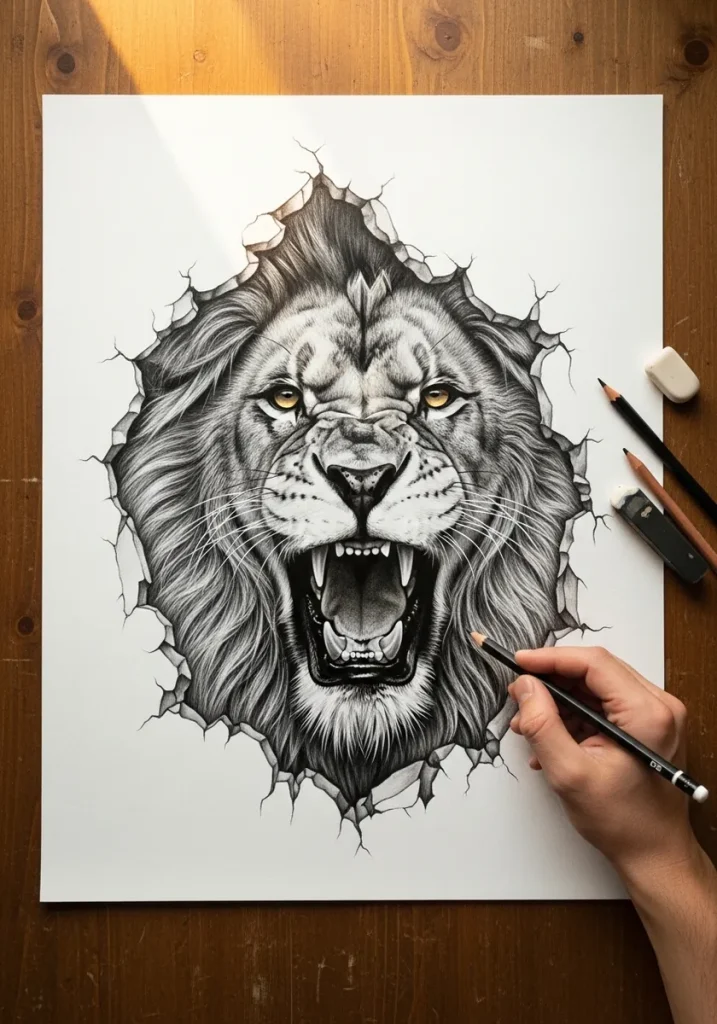
A 3D pencil art tutorial subject is chosen to drill one specific skill: a cast shadow that anchors a floating object, a torn edge that separates two planes, or spacing that tightens to read as distance.
Key takeaways
- Pick tutorial subjects for the one skill they teach, not for how impressive the finished piece looks.
- The torn paper method never changes: render the subject, break the paper, light the top lip, darken the underside.
- One point perspective needs the vanishing point set and every line ruled to it before any detail.
- Faceted subjects teach plane drawing because each facet takes one flat value with no blending.
- On black or toned paper you add light instead of shadow, which reverses your whole shading order.
A tutorial subject is different from a finished piece. You pick it because it teaches you one thing: how a cast shadow anchors a floating object, how a torn edge separates two planes, how tightening spacing reads as distance. Every drawing below was chosen because it drills a specific skill.
The largest group here uses the torn paper illusion — a lion, a wolf, a fox, a shark and a skeletal hand all pushing through a broken sheet. They look dramatic but the method never changes: render the subject normally, then break the paper around it and give the tear a pale top lip and a dark underside.
The rest cover the other core skills. One point perspective in an impossible staircase interior and a cathedral ceiling. Faceted planes in a low poly panther. Smooth graduated shading in a horse, a portrait and a rose. Toned and black paper work where you build up with white instead of down with graphite.
Work through them roughly in order of how much rendering they demand. If you want lighter practice alongside these, mandala drawing builds line control and eye studies build gradients. For depth tricks in another medium, these 3D digital art ideas use the same logic.
1. Roaring Lion Bursting Through Torn Paper
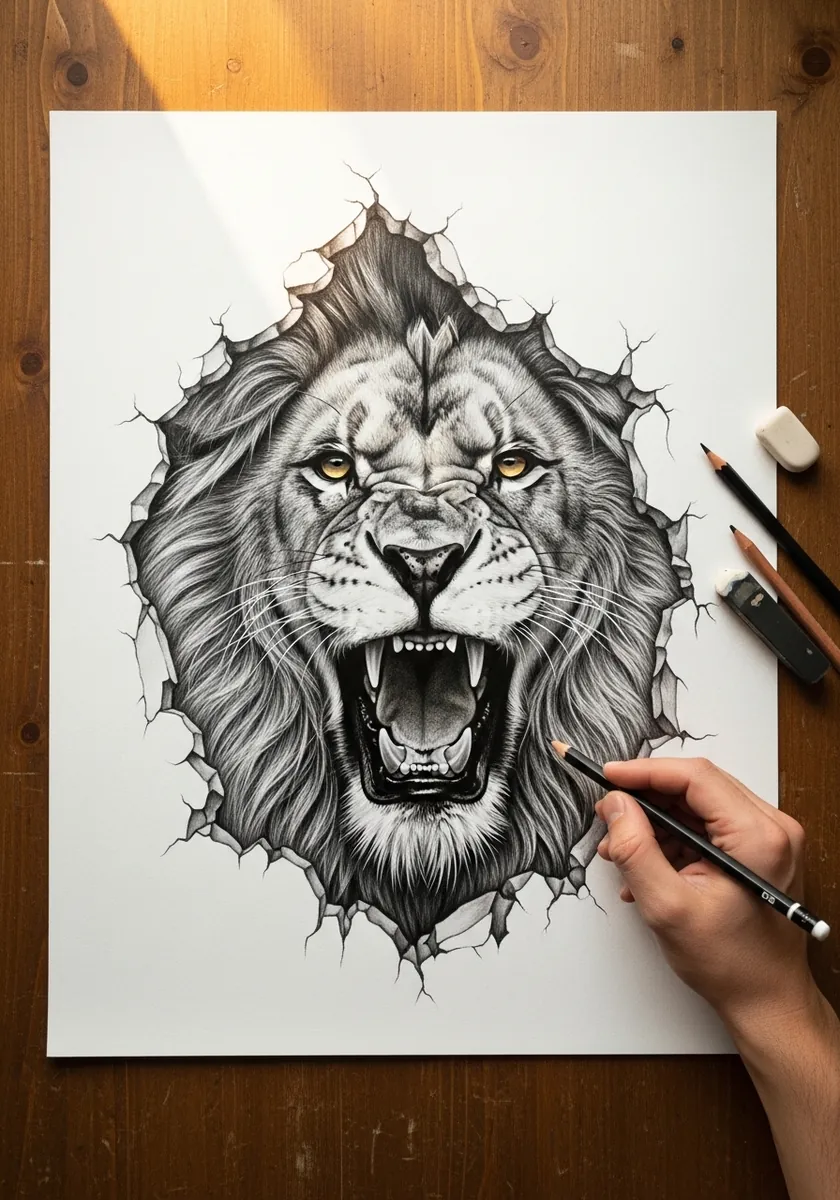
The classic starter for this style. Draw the lion’s head fully first, then break the paper around it with a ragged outline. Give every torn flap a light top surface and a dark underside, and let a few strands of mane cross onto the flat sheet.
2. Open Hand Rising Out of the Sheet
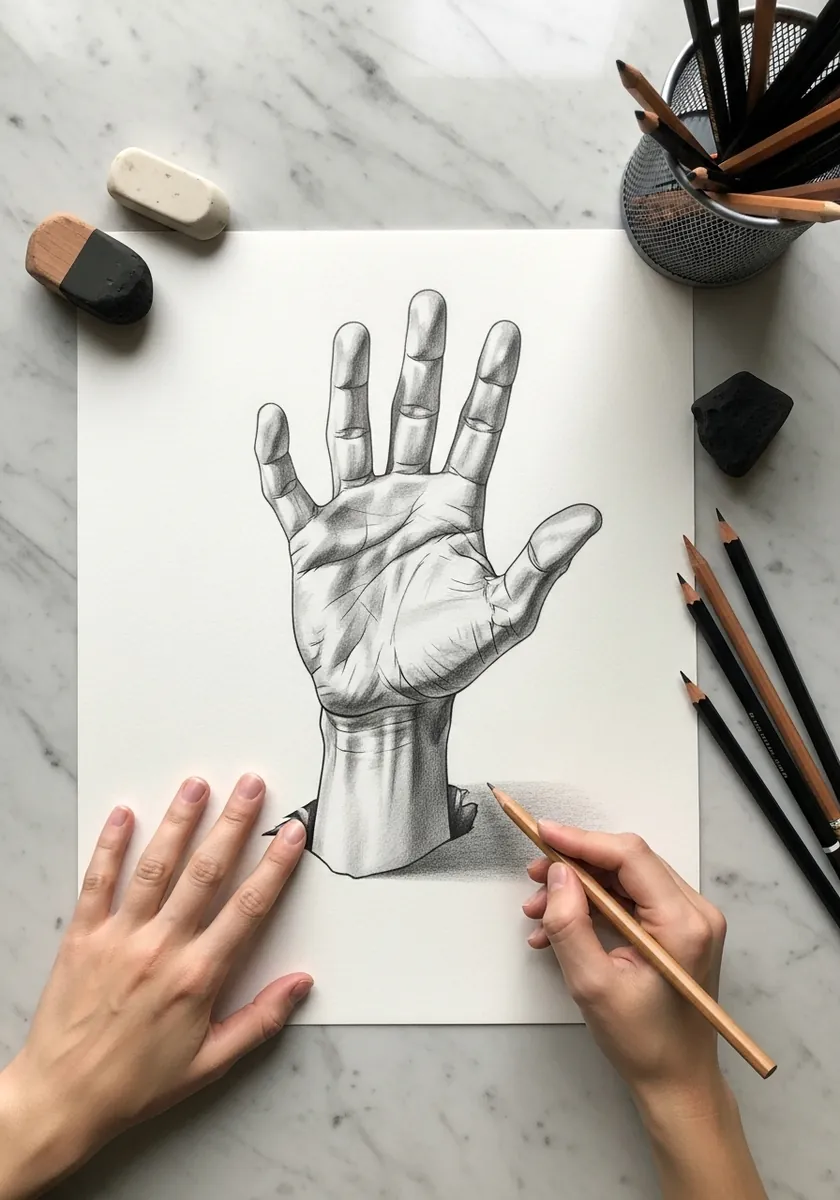
A hand pushes up out of the page with the fingers spread. Get the proportions right before anything else, since a badly drawn hand cannot be rescued by shading. Then add a cast shadow that falls across the intact paper, not inside the drawing.
3. Great Wave Escaping the Frame
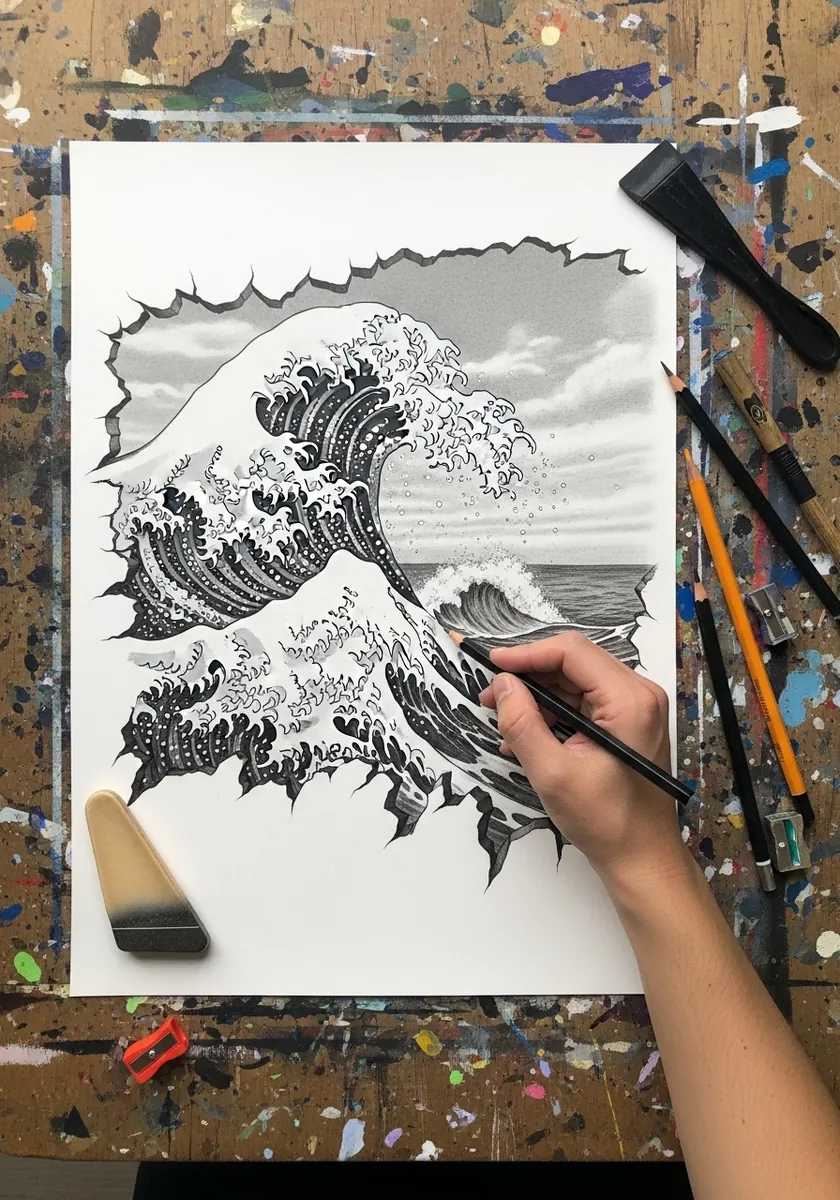
A breaking wave in the Japanese woodblock manner, spilling through a broken edge. Draw the wave crest with fine repeated curls, then let the foam fingers overlap the tear so the water appears to escape the picture entirely.
4. Graphite Rose with a Hard Cast Shadow
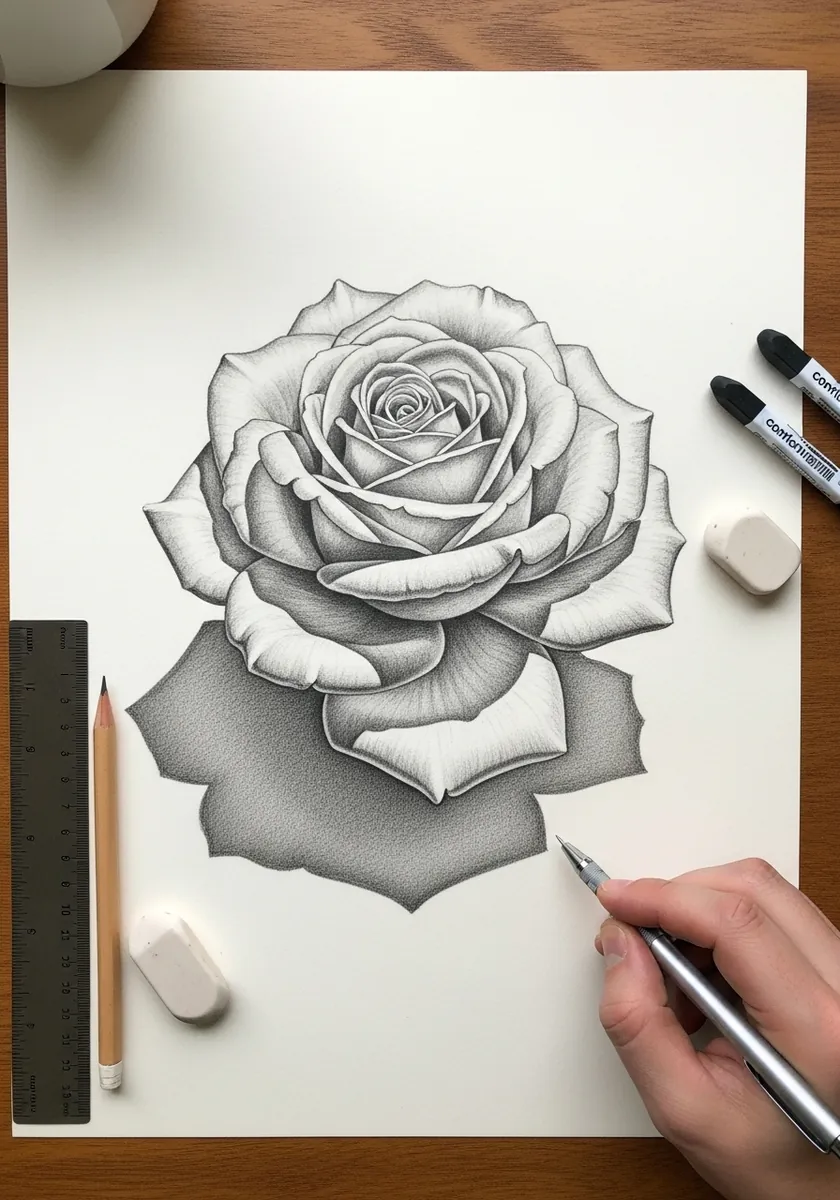
A rose lifted off the page by a solid shadow beneath it. Work from the tight center spiral outward, keeping the innermost petals darkest, then lay the shadow as a flat mid gray silhouette with no detail inside it.
5. Gothic Cathedral Rising from a Crack
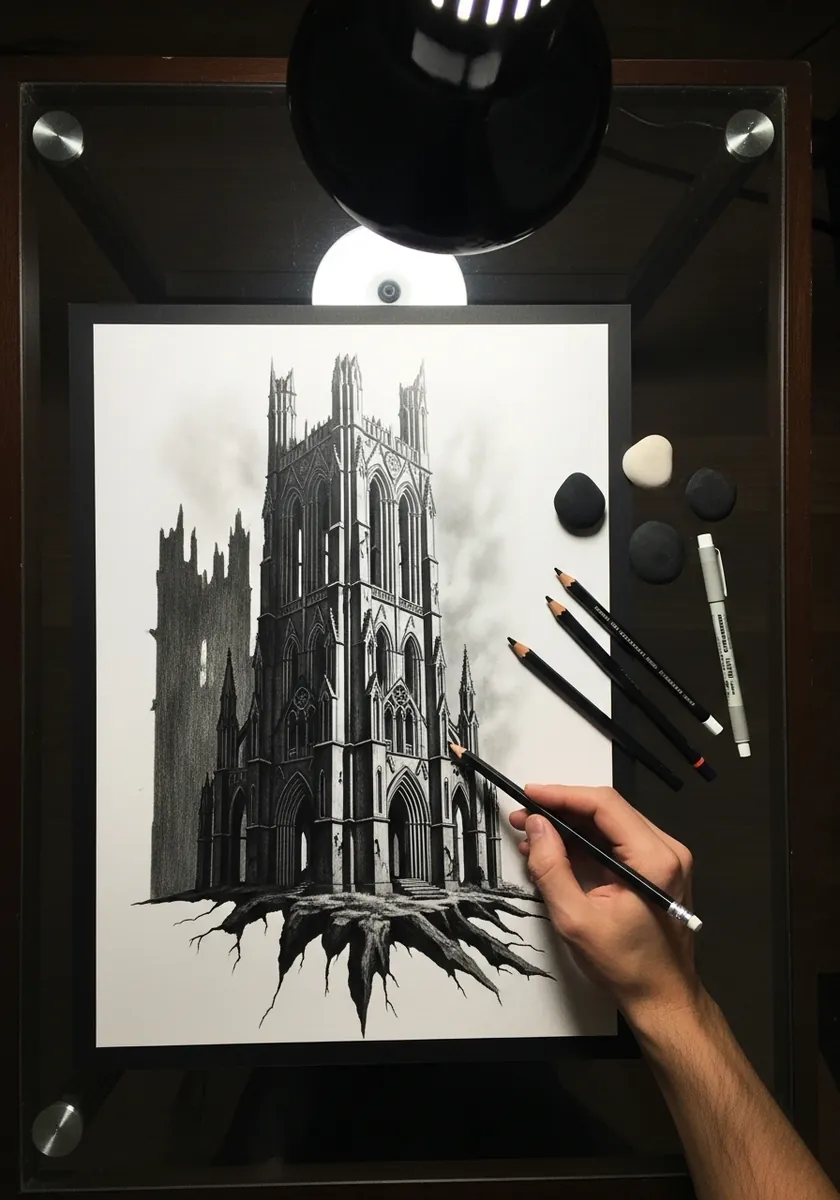
A cathedral tower grows out of a fissure in the sheet under a single lamp. Draw the tower in one point perspective first, then break the ground around its base and darken the crack heavily so the building reads as rooted, not resting.
6. Howling Wolf Through a Broken Sheet
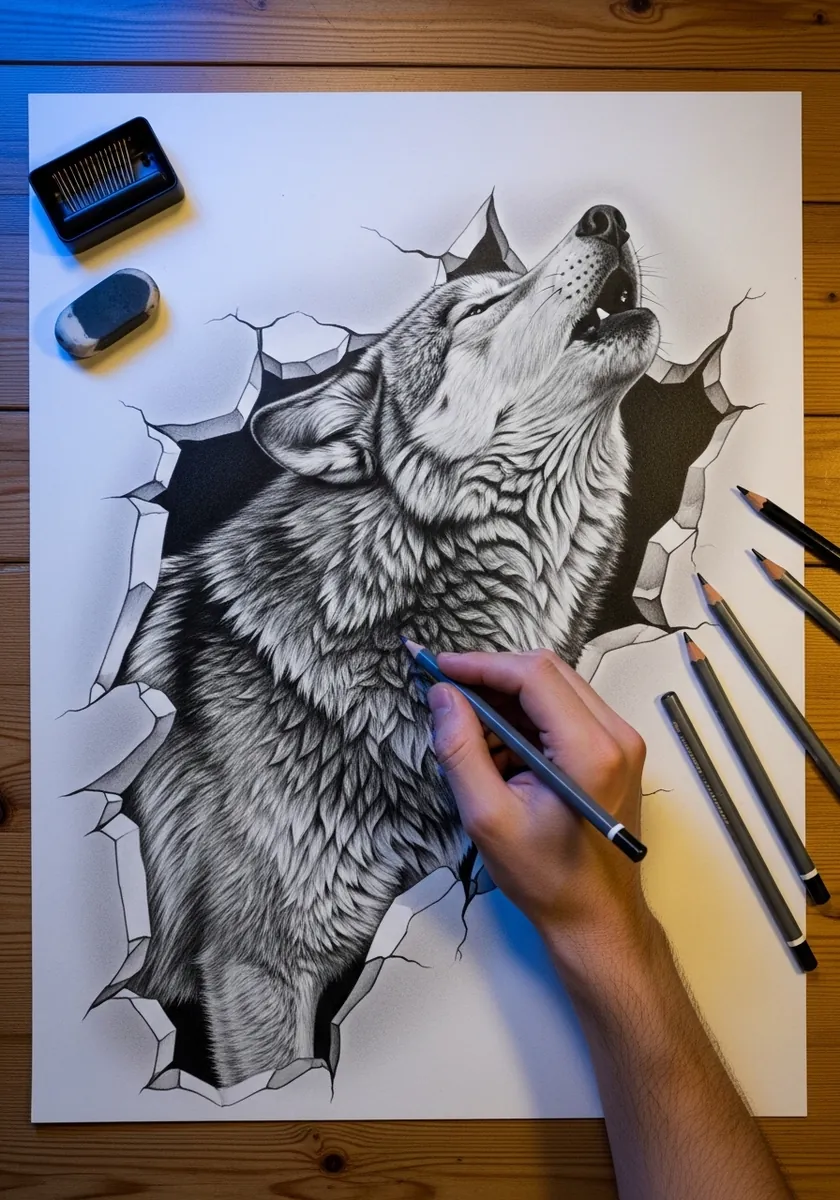
A wolf mid-howl pushes through a torn opening. All the fur strokes should radiate outward from the muzzle in the direction the coat grows. Keep the darkest values right at the rim of the hole so the head appears to sit in front of it.
7. Weathered Old Man Portrait Study
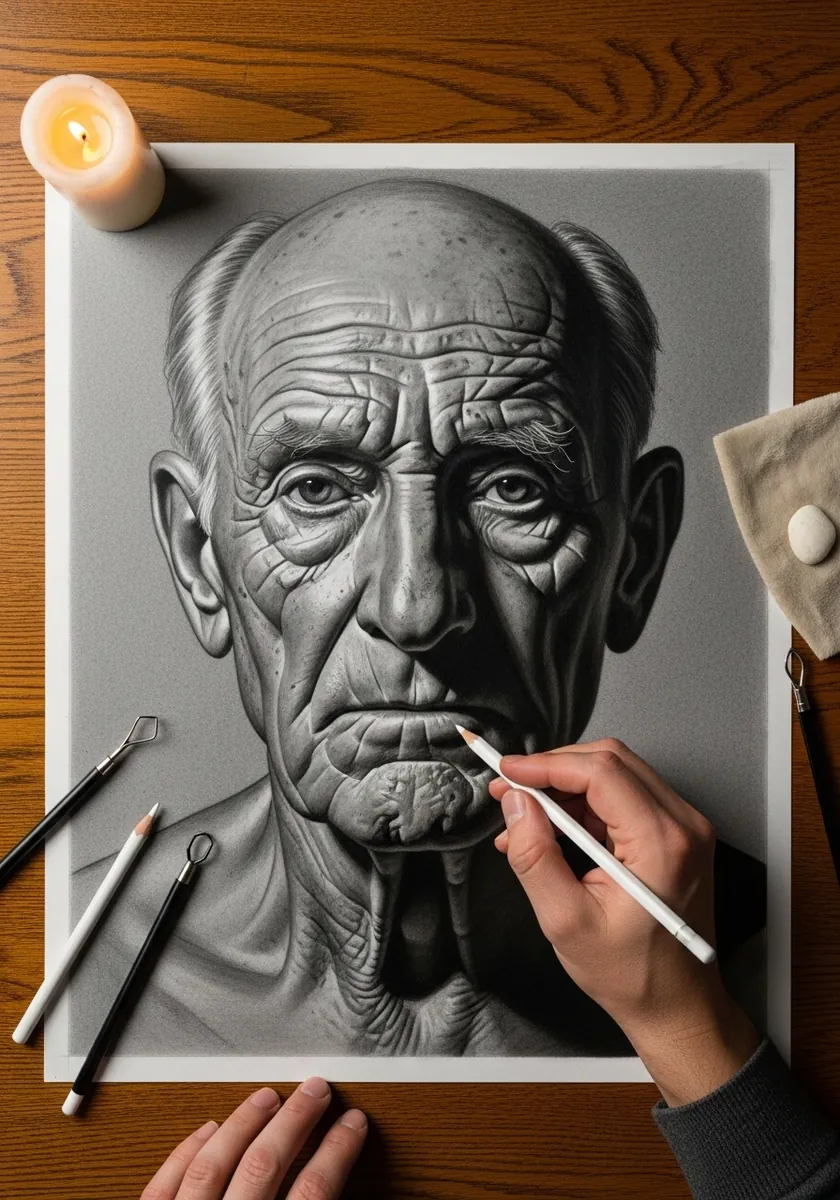
A portrait where every wrinkle is a small change of plane rather than a drawn line. Follow the direction of each fold with your strokes, keep the eyes sharpest, and let the neck and shoulders fall away softly so the face holds attention.
8. Fine Line Fairy with Butterfly Wings
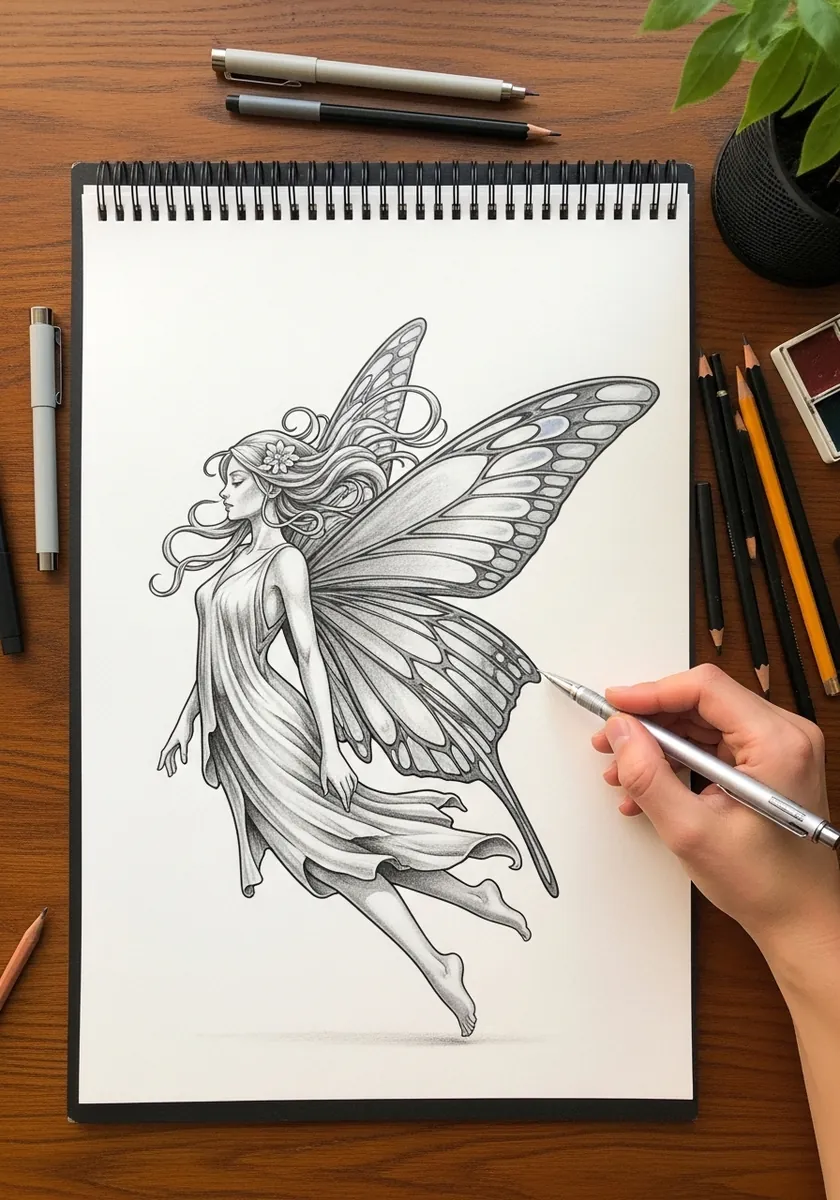
A fairy drawn almost entirely in line with no tonal shading. The wings carry the detail, so build their vein structure from real butterfly reference and keep the figure itself simple, with the dress as a few long confident curves.
9. Clenched Fist Punching Through a Wall
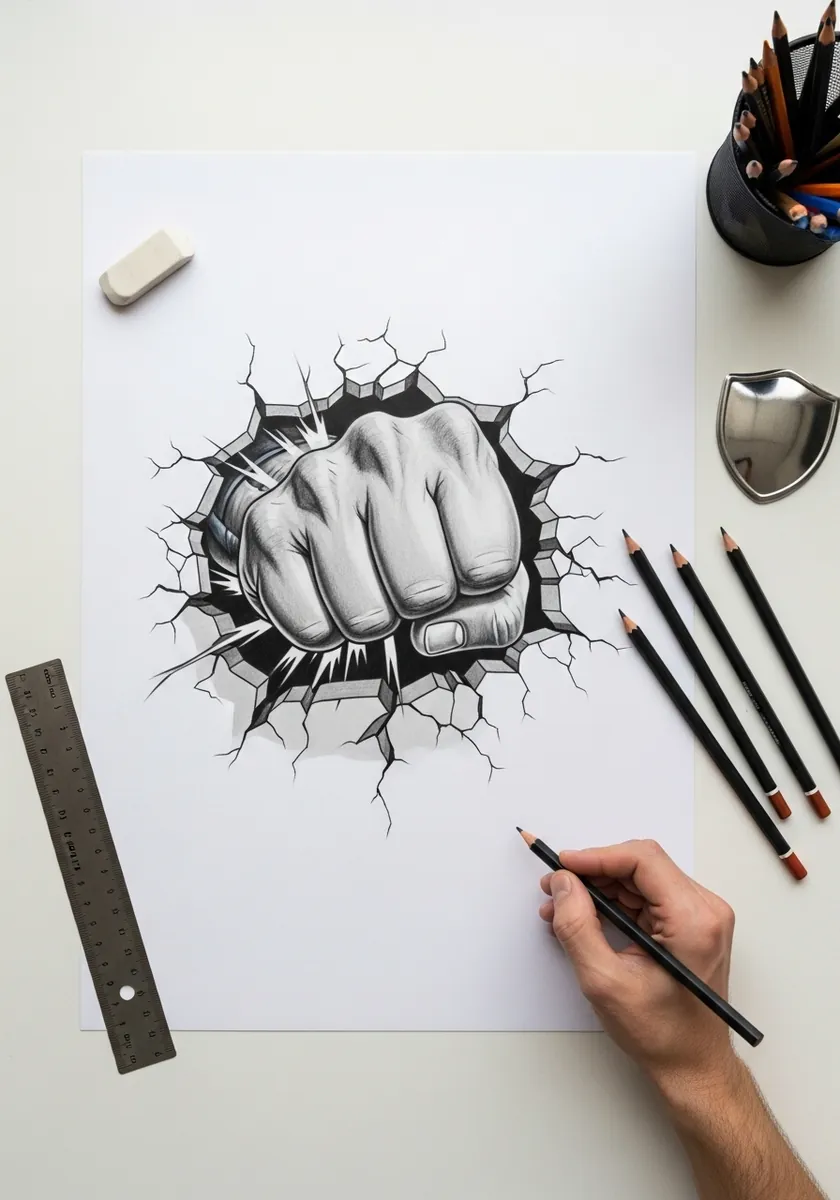
A fist bursts through with cracks radiating outward. Draw the fist as a simple box first and add knuckles afterward. The cracks should thin as they travel and never form a neat circle, or the wall looks drawn rather than broken.
10. Ballerina on Point with a Soft Shadow
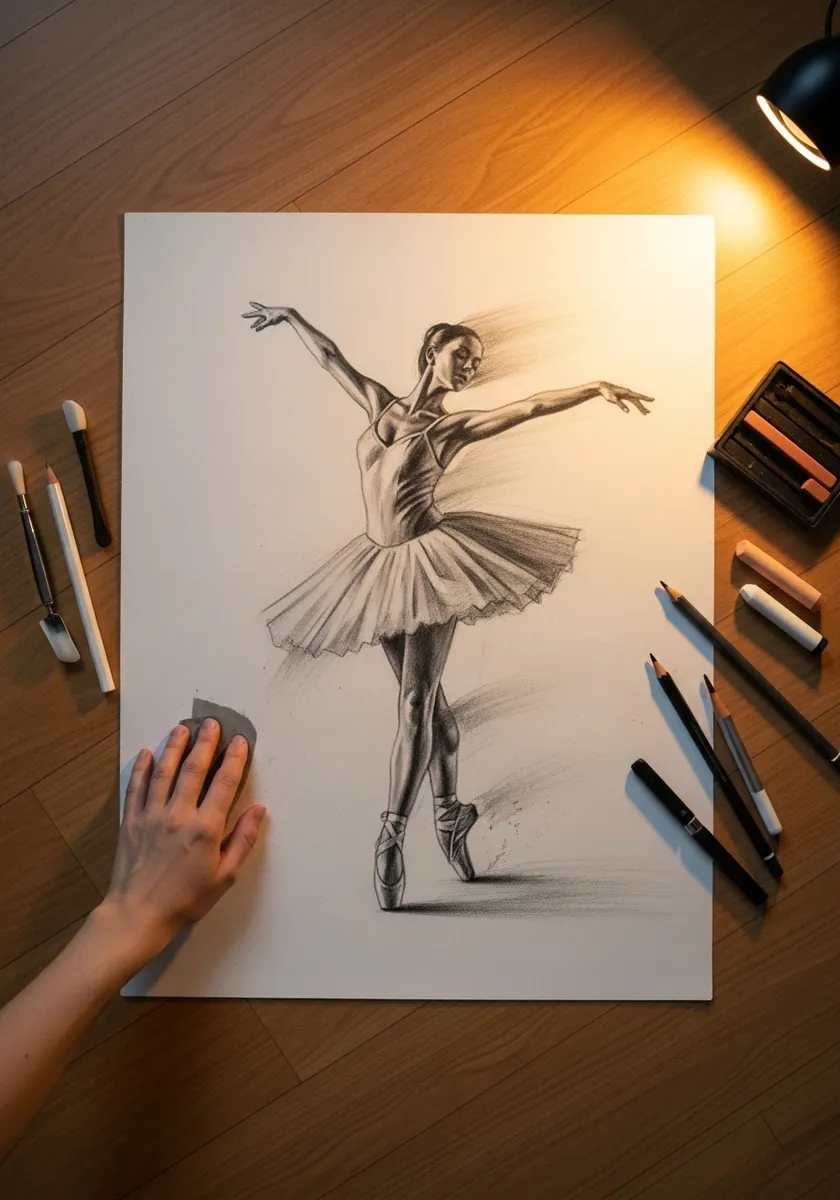
A dancer balanced on point, drawn in soft charcoal. Everything rests on the line of balance, so draw a vertical from the supporting toe upward and hang the whole pose from it before rendering a single fold of the tutu.
11. Mechanical Steampunk Dragon
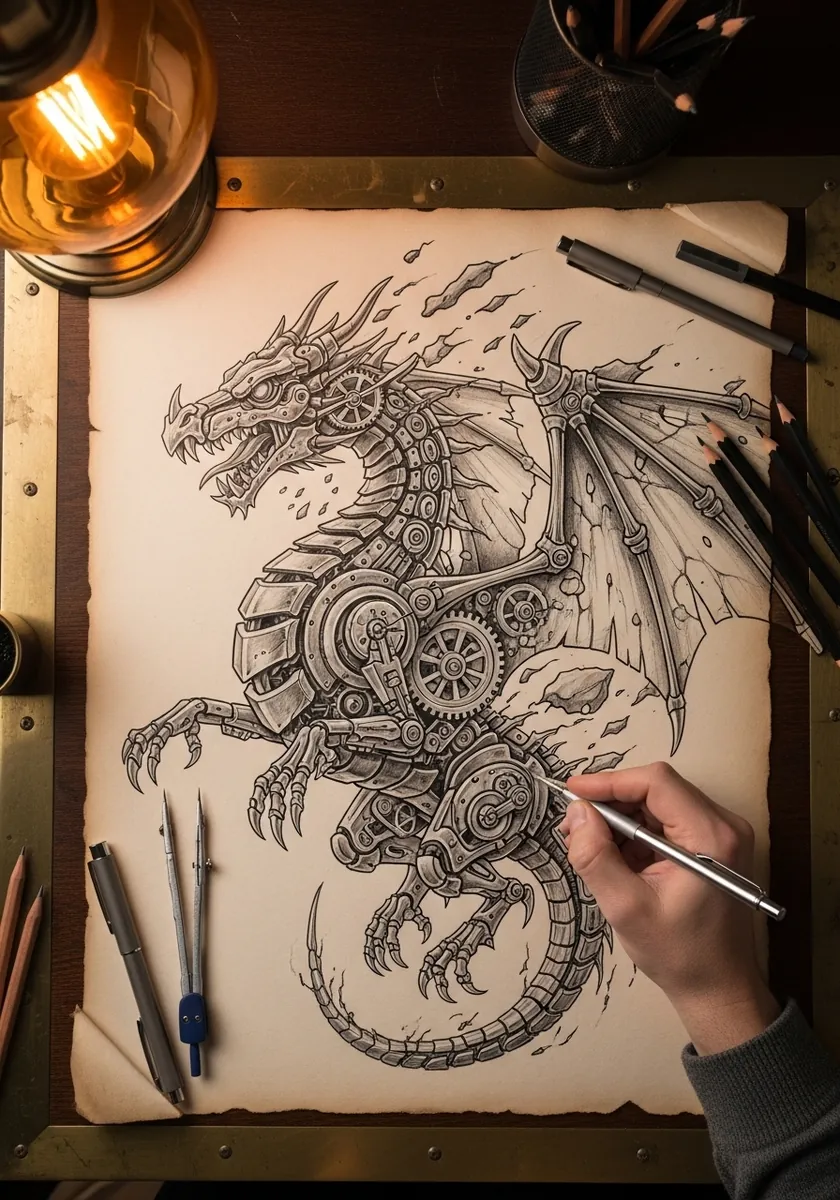
A dragon built from gears, pistons and riveted plates on aged paper. Draw the creature’s anatomy first in light pencil, then replace each body section with machinery, keeping the joints where real joints would be so it still reads as alive.
12. Samurai in Motion with Speed Lines
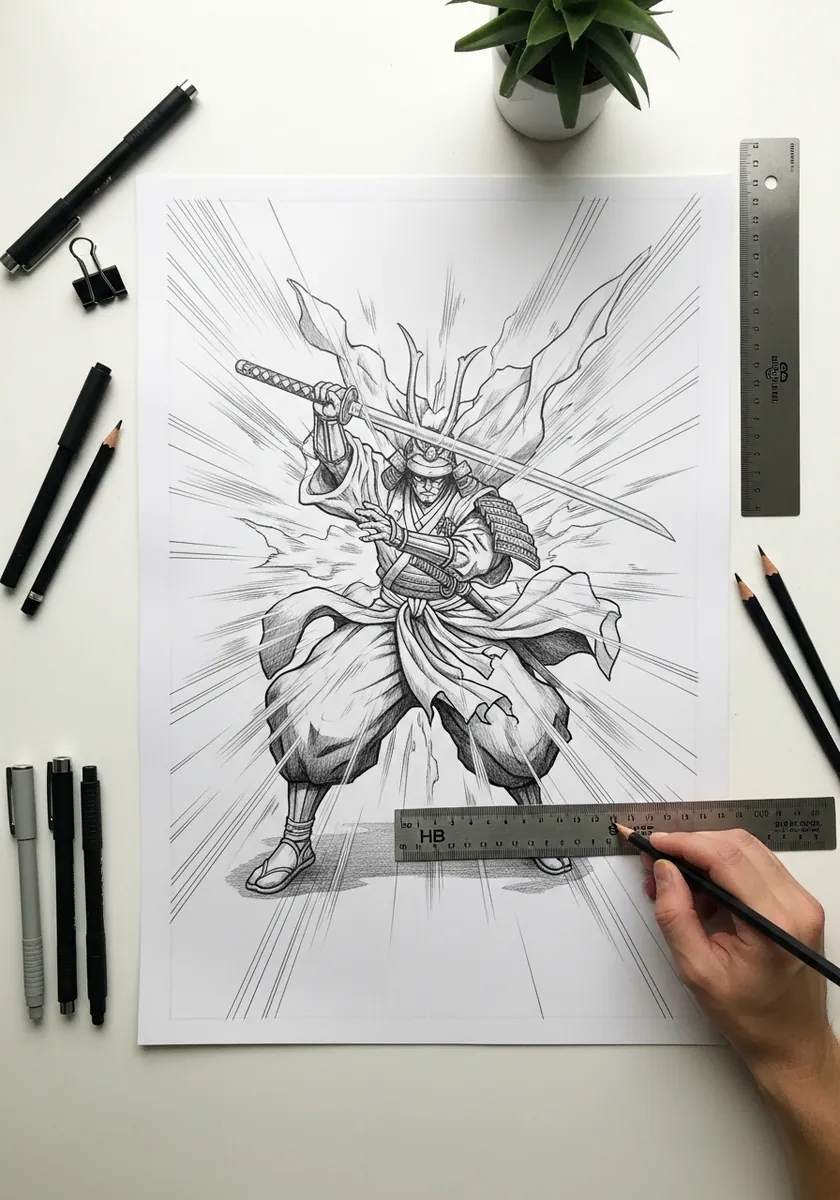
A samurai mid-swing with speed lines radiating behind him. Rule the speed lines from a single point behind the figure with a ruler; freehand lines wander and immediately kill the sense of motion.
13. Raven on a Stone Cross
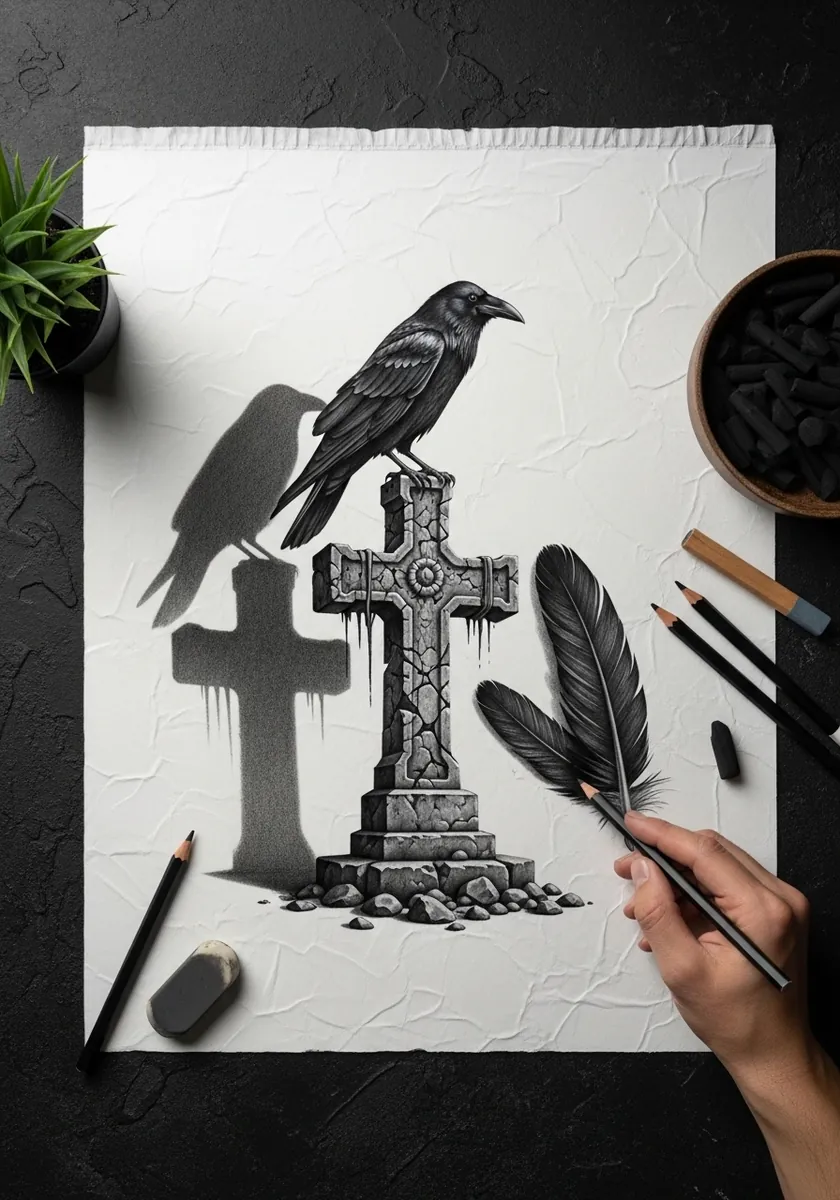
A raven on a carved cross with a long shadow thrown across the paper. Give the stone a rough broken texture and the bird a smooth one, and let the shadow fall at a steep angle so the light source feels low and late.
14. Horse Head Emerging from Mist
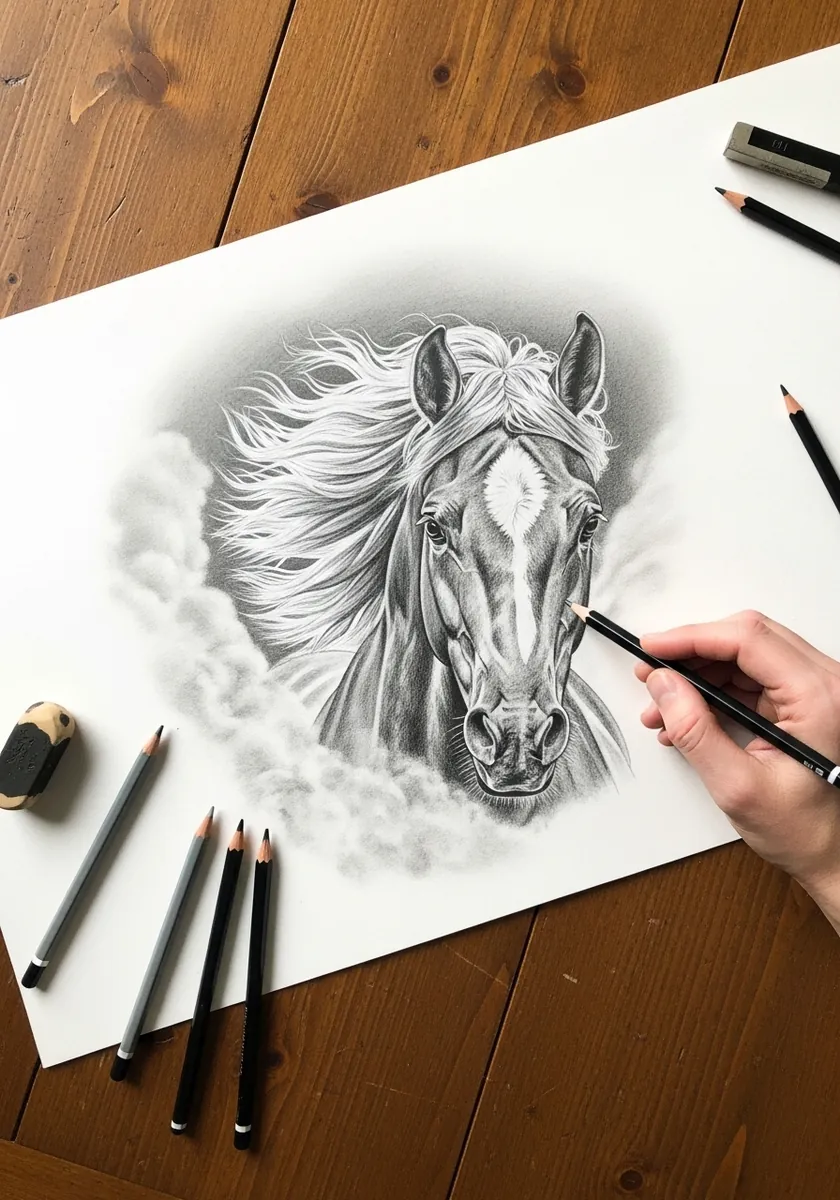
A horse appears out of mist, with the edges of the mane dissolving into nothing. Render the face sharply and then blend the outer mane away with a stump, letting the paper stay white at the boundary rather than drawing a hard edge.
15. Impossible Staircase Interior
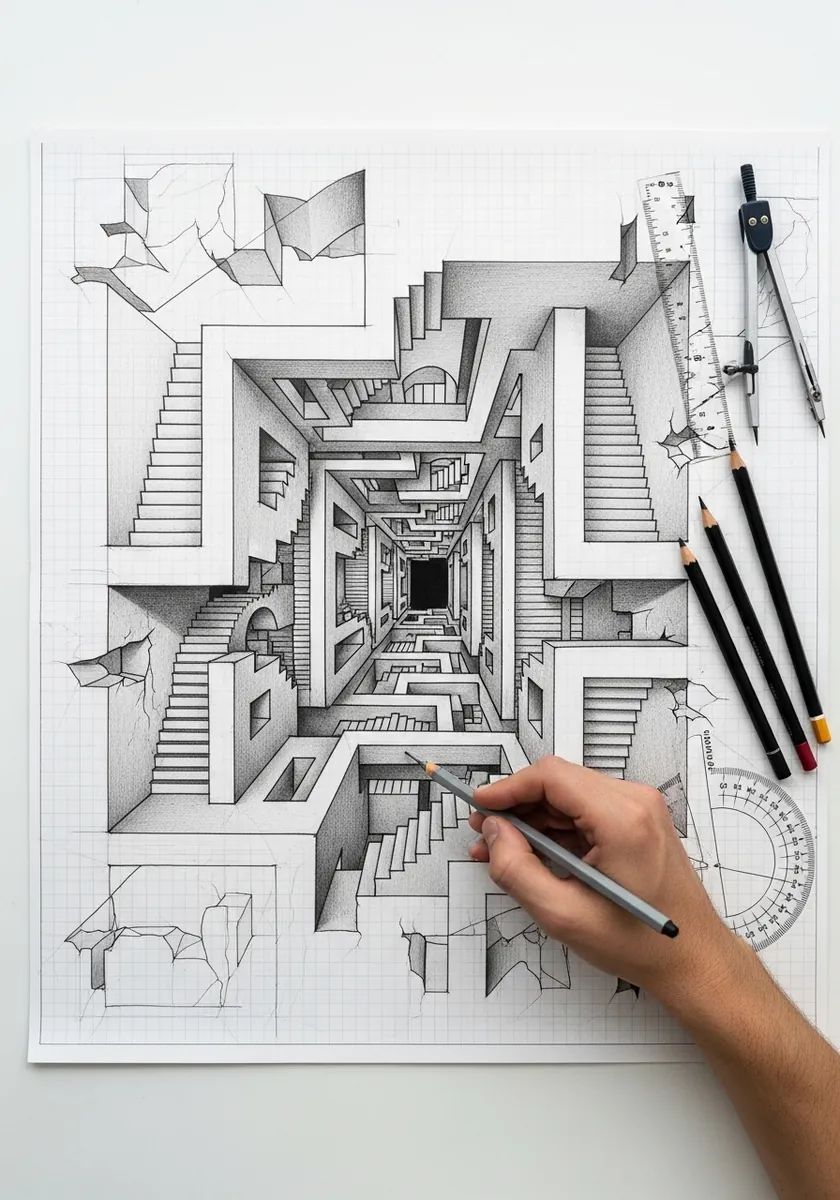
An interior full of staircases receding to a central point. Set one vanishing point and rule every line to it before drawing any step. This is the single best exercise on the page for understanding one point perspective.
16. Cottage in a Forest Portal
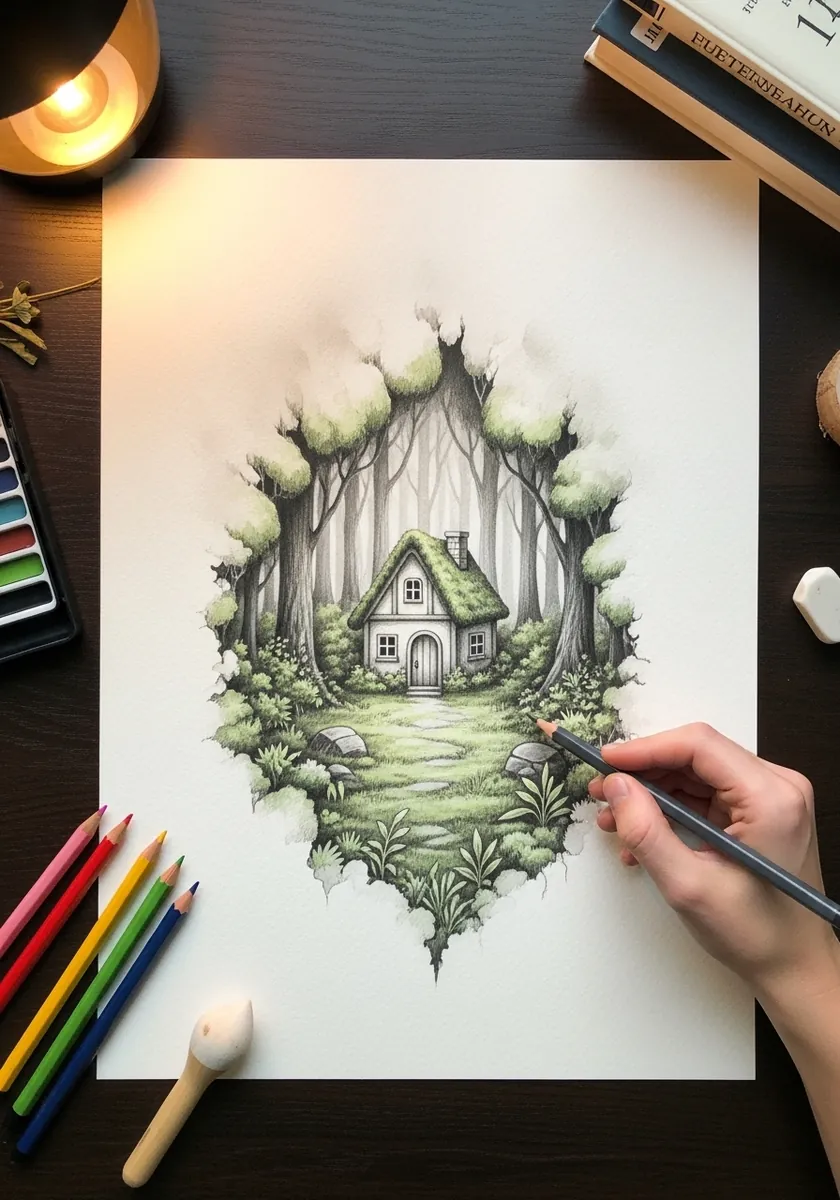
A woodland cottage seen through an oval opening. The opening’s edge needs visible thickness, drawn as a thin band of shadow all the way around, or the scene reads as a printed picture rather than a hole in the page.
17. Skeletal Hand Rising from a Crater
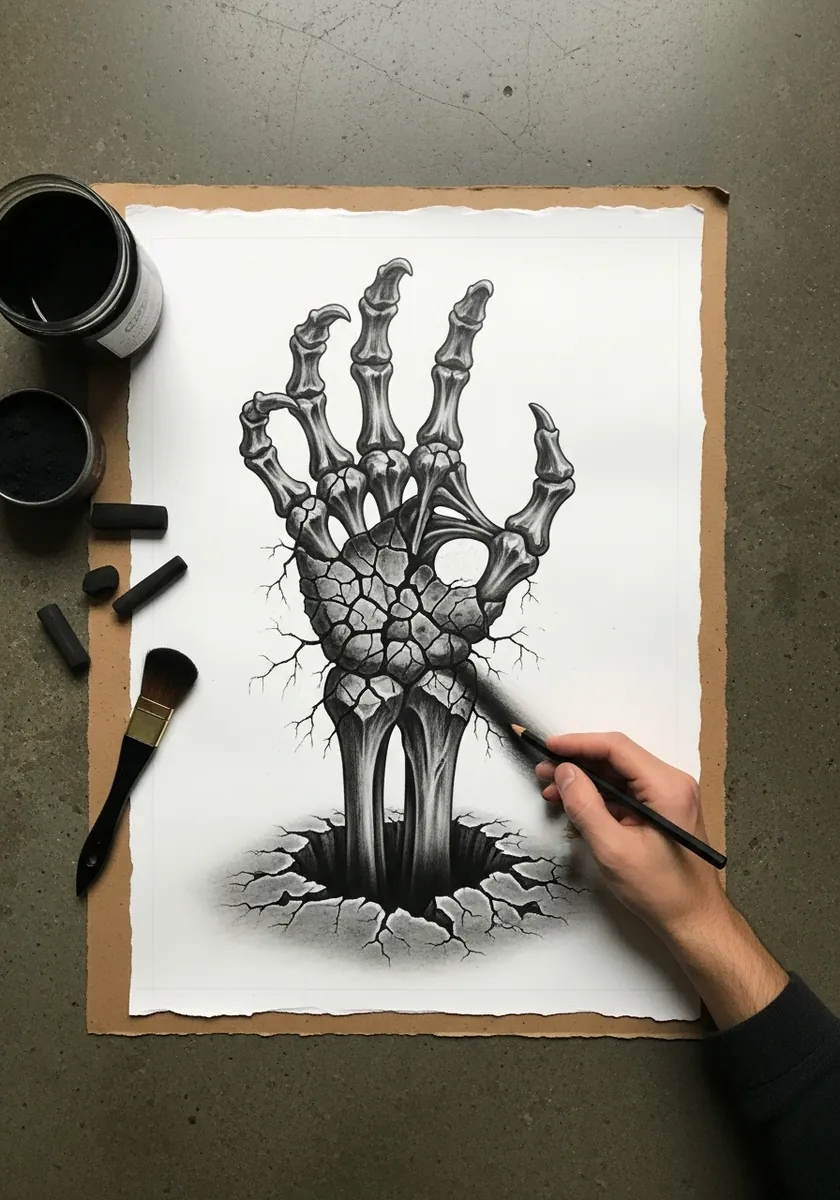
A bone hand climbs out of a cracked hole. Draw the finger bones as tapering cylinders with visible joints, and make the crater darkest right at its center so the hand appears to come from real depth below.
18. Inverted Cherry Blossom Mountain
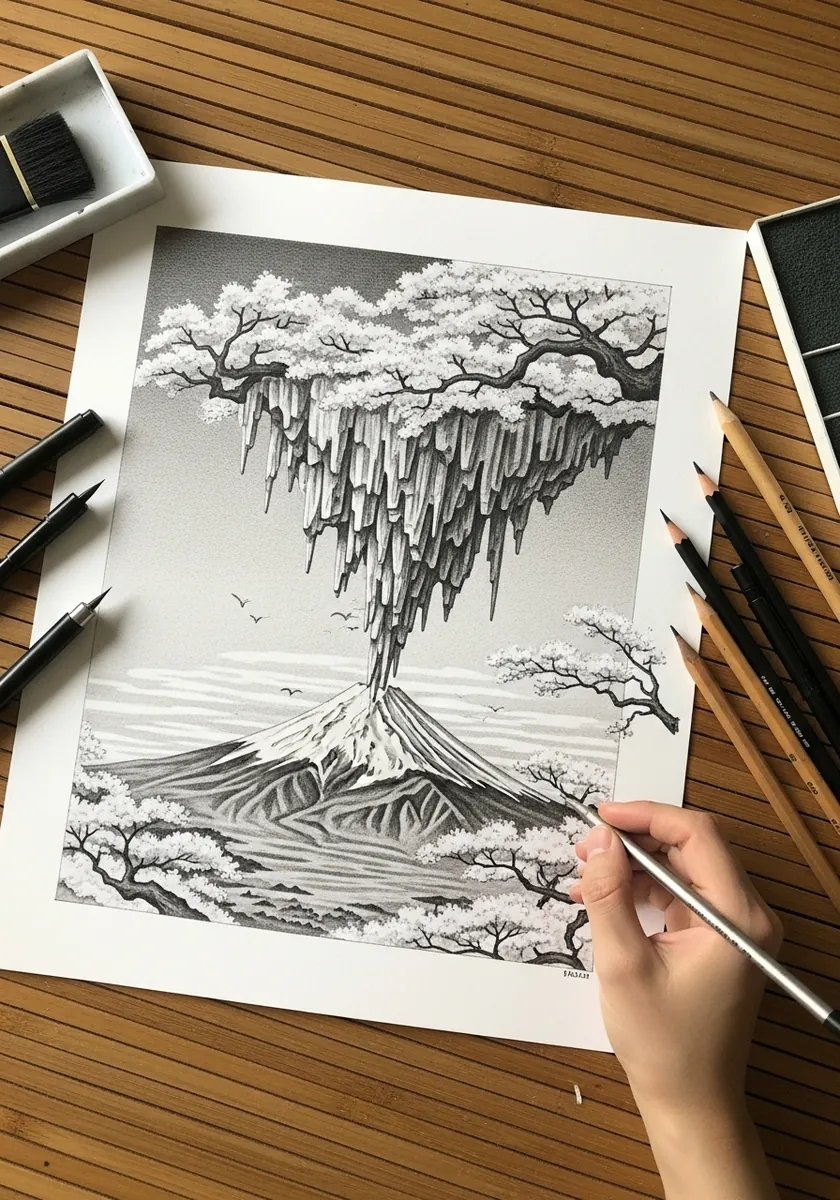
A mountain hanging upside down over its own reflection. Draw the upper form and the lower one as mirror images, then break the symmetry slightly in the water so the reflection reads as a surface rather than a copy.
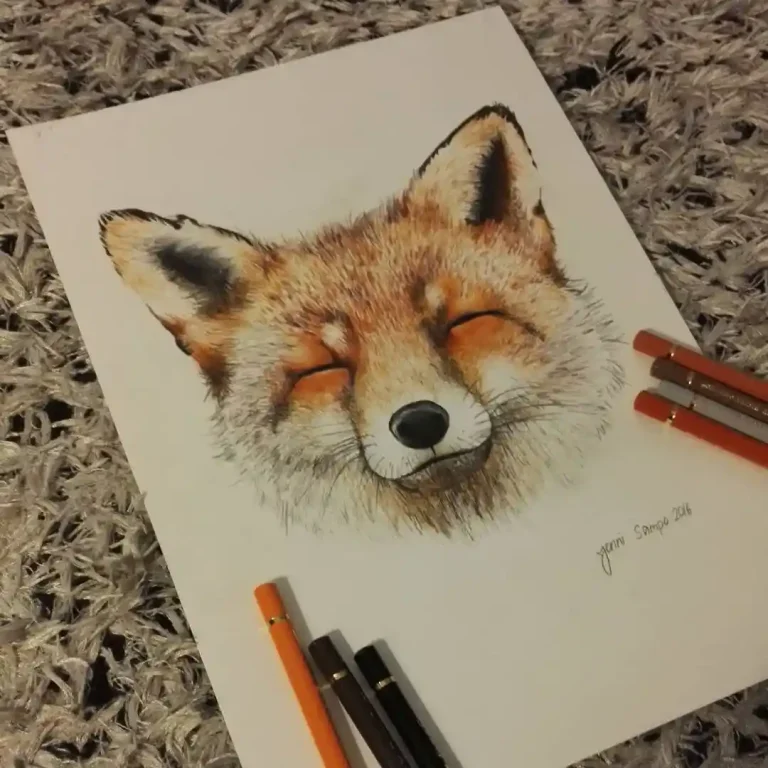
19. Fox Face Through a Cracked Opening
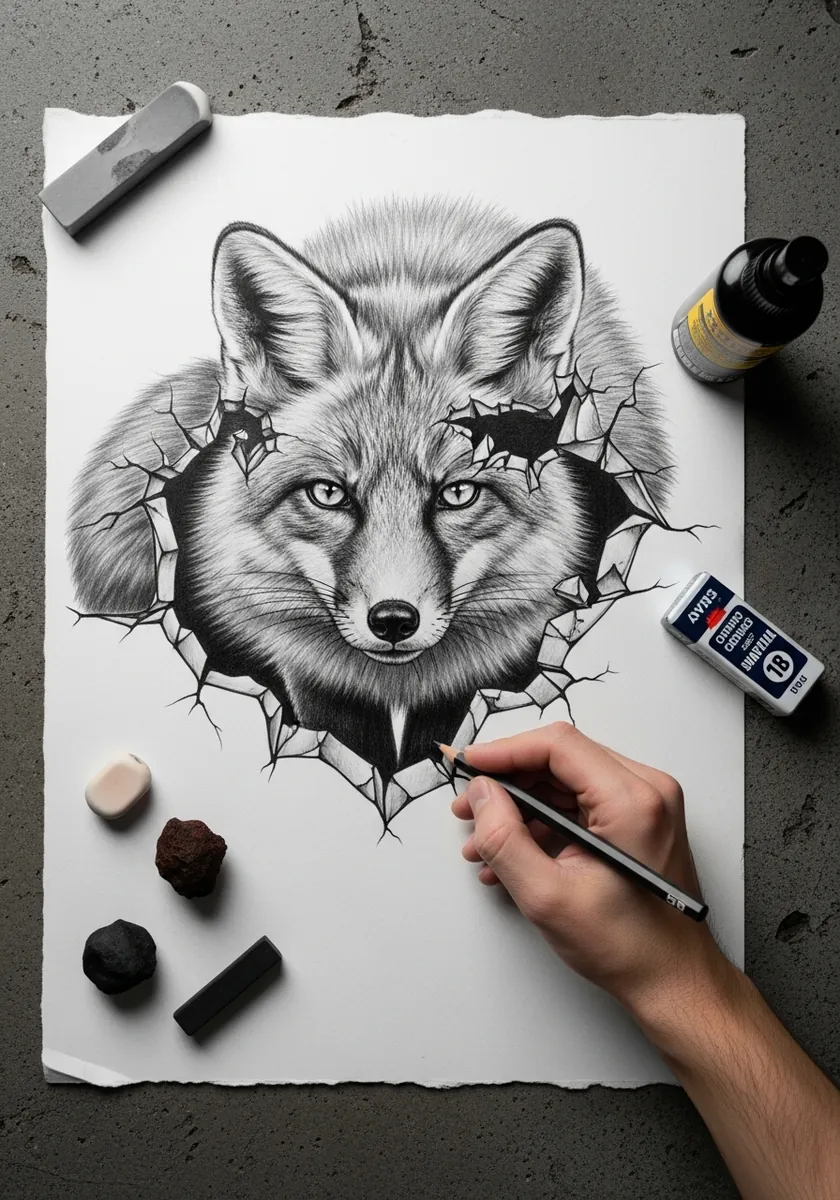
A fox pushes through a cracked hole, its ears breaking the top edge. Fur that crosses the tear line is what sells this, so plan which tufts overlap the paper before you commit to the shape of the opening.
20. Peacock with a Full Fanned Tail
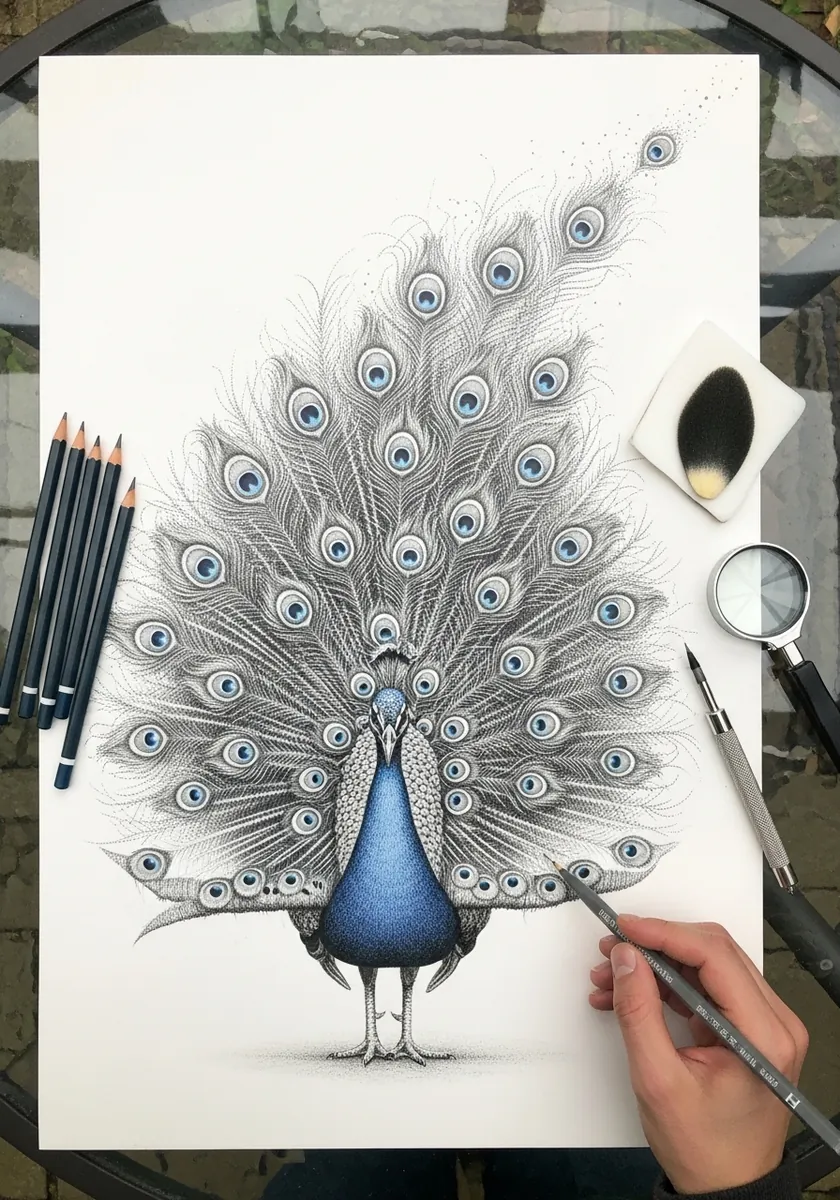
A peacock with its tail fanned into dozens of eye feathers. Draw the fan as a series of arcs radiating from the body first and place one eye per feather along those arcs, letting them compress toward the edges of the fan.
21. Spaceship Over a Moon Surface
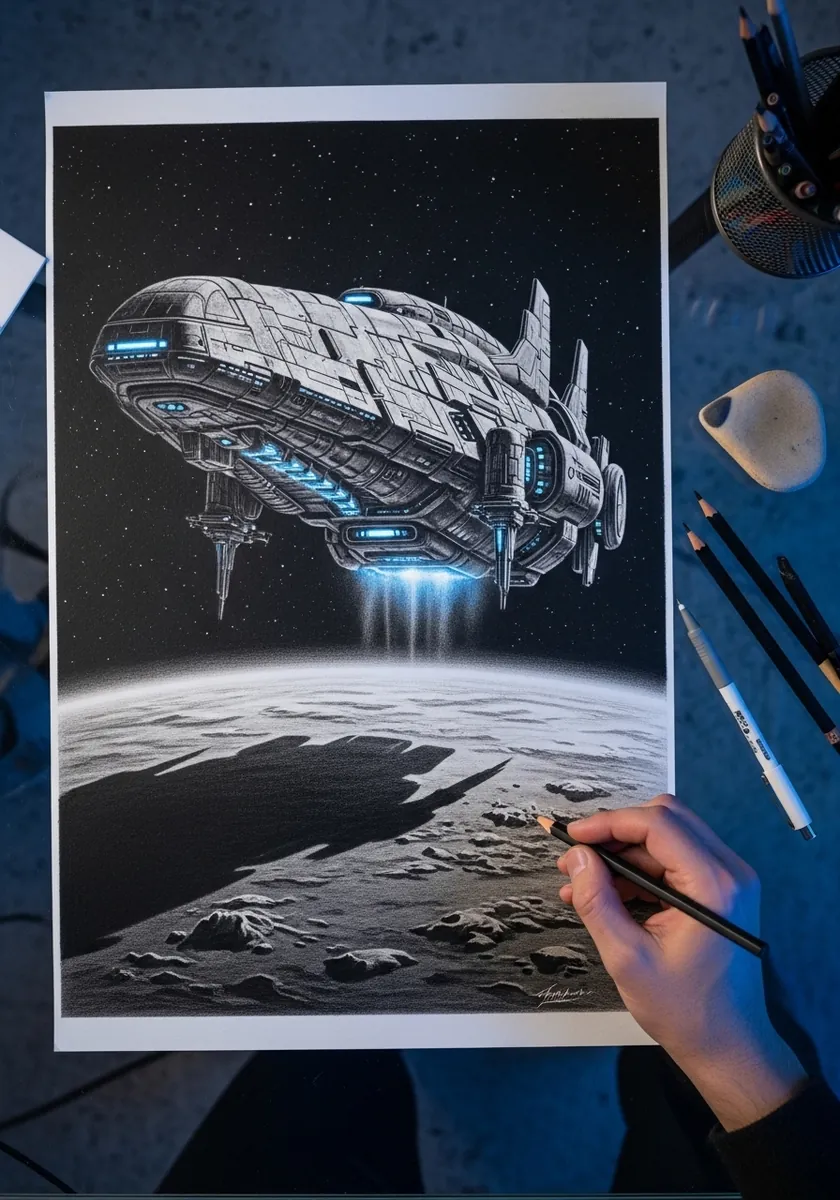
A ship passes over a cratered surface with glowing thrusters. Work on black paper and build everything up with white and light gray, adding the blue glow last as the only color so it reads as the sole light source.
22. Low Poly Panther in Motion
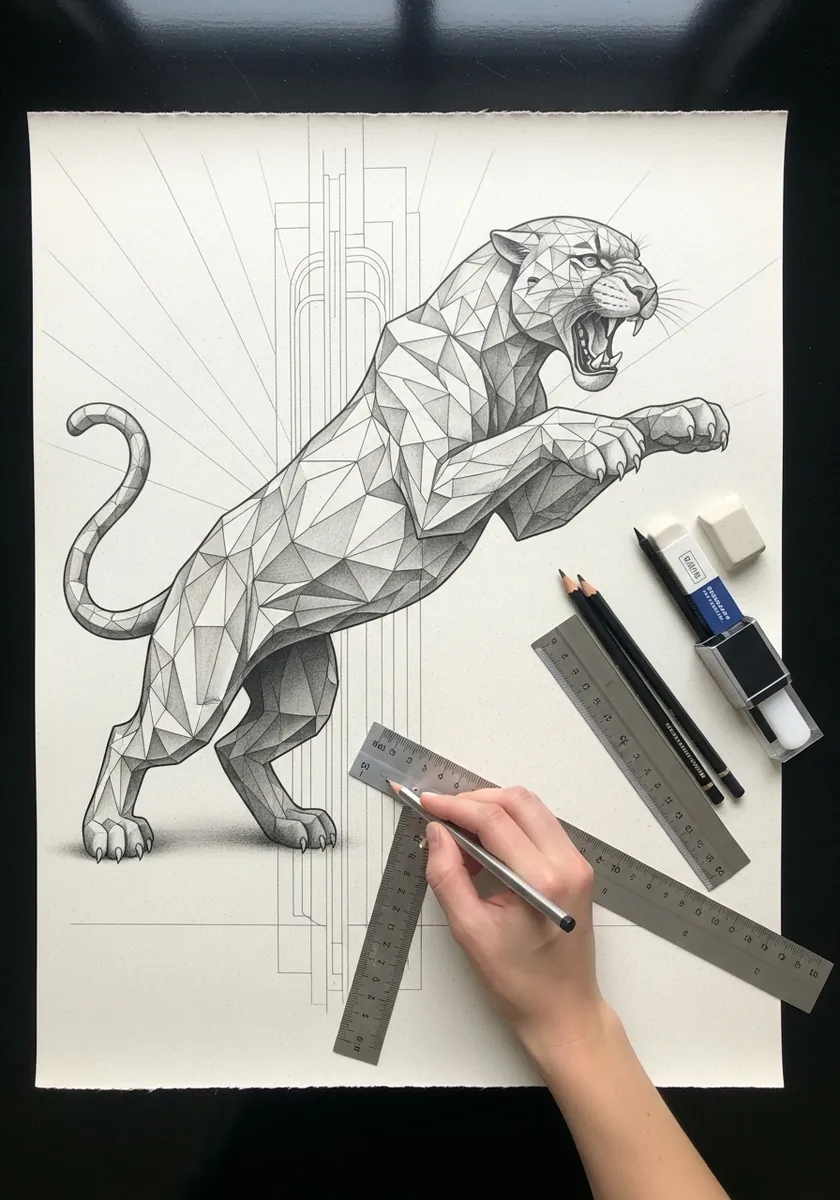
A panther broken into flat triangular facets. Draw the animal normally in light pencil, then lay the facet map over the top, making the triangles smallest where the form turns fastest, like the shoulder and the jaw.
23. Realistic Eye with a Reflected Landscape
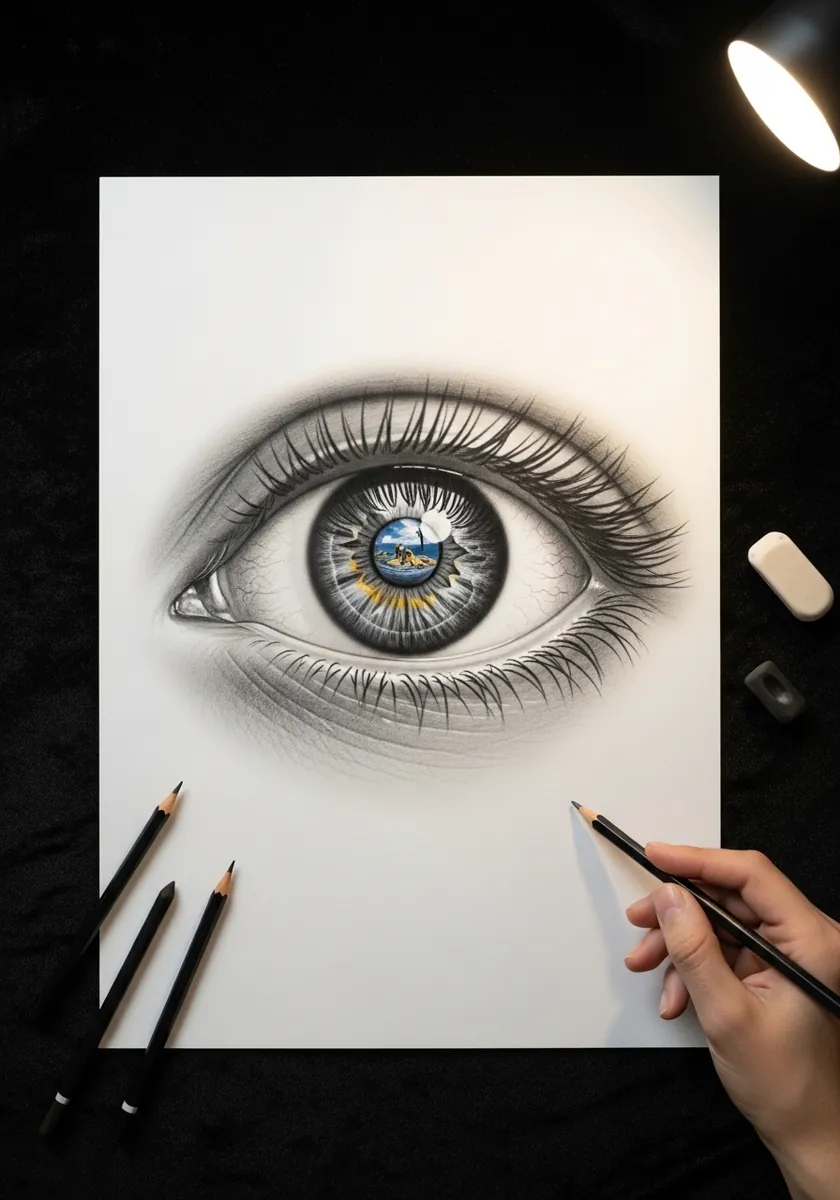
A close-up eye with a tiny scene reflected in the iris. Keep the reflection low in contrast so it does not fight the eye. Build the iris with strokes radiating from the pupil and place one hard white highlight that you never touch again.
24. Cathedral Ceiling Looking Straight Up
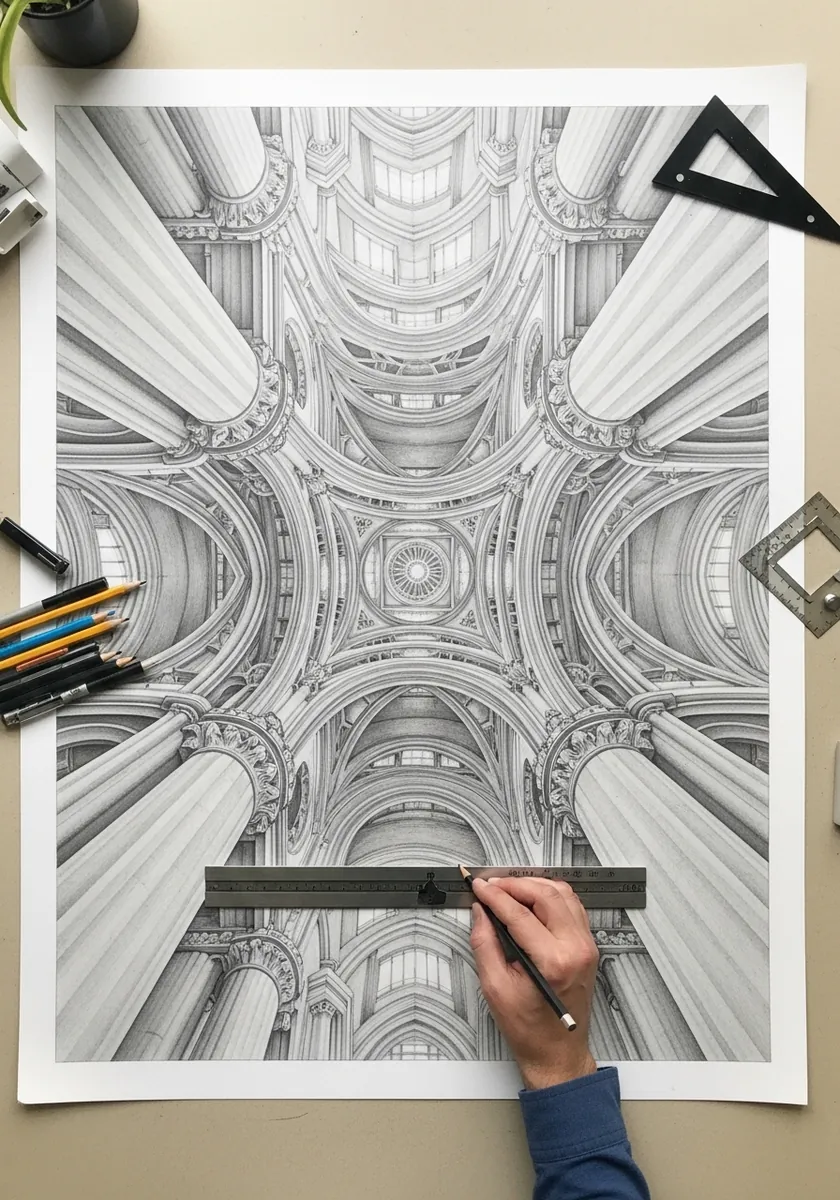
A vaulted ceiling seen from directly beneath, with everything converging overhead. Put the vanishing point in the center of the page and rule every column and rib to it. Symmetry has to be exact here, so measure rather than eyeball.
25. Celtic Knotwork Dragon
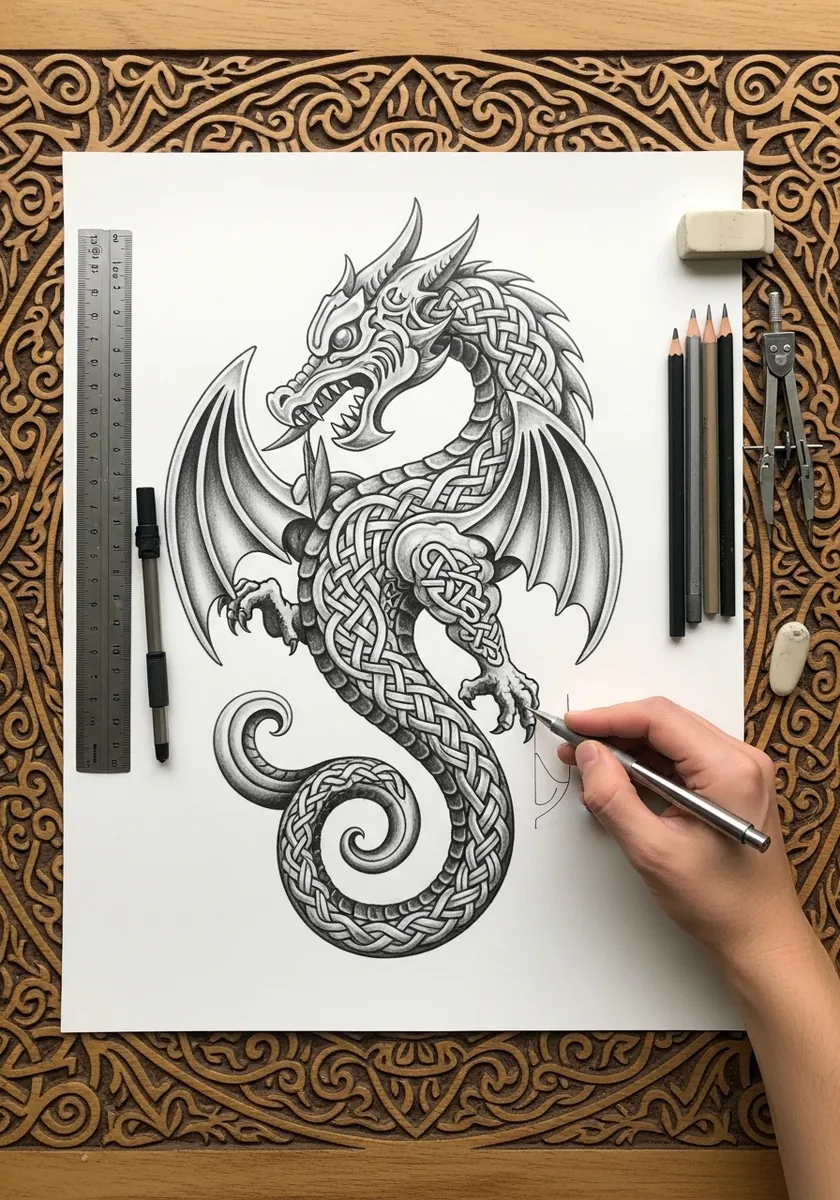
A dragon whose body is a continuous woven knot. Draw the creature’s outline first, then run the knotwork along it, and work out the over-and-under at every crossing before you shade a single strand.
26. Faceted Hand Gripping a Hammer
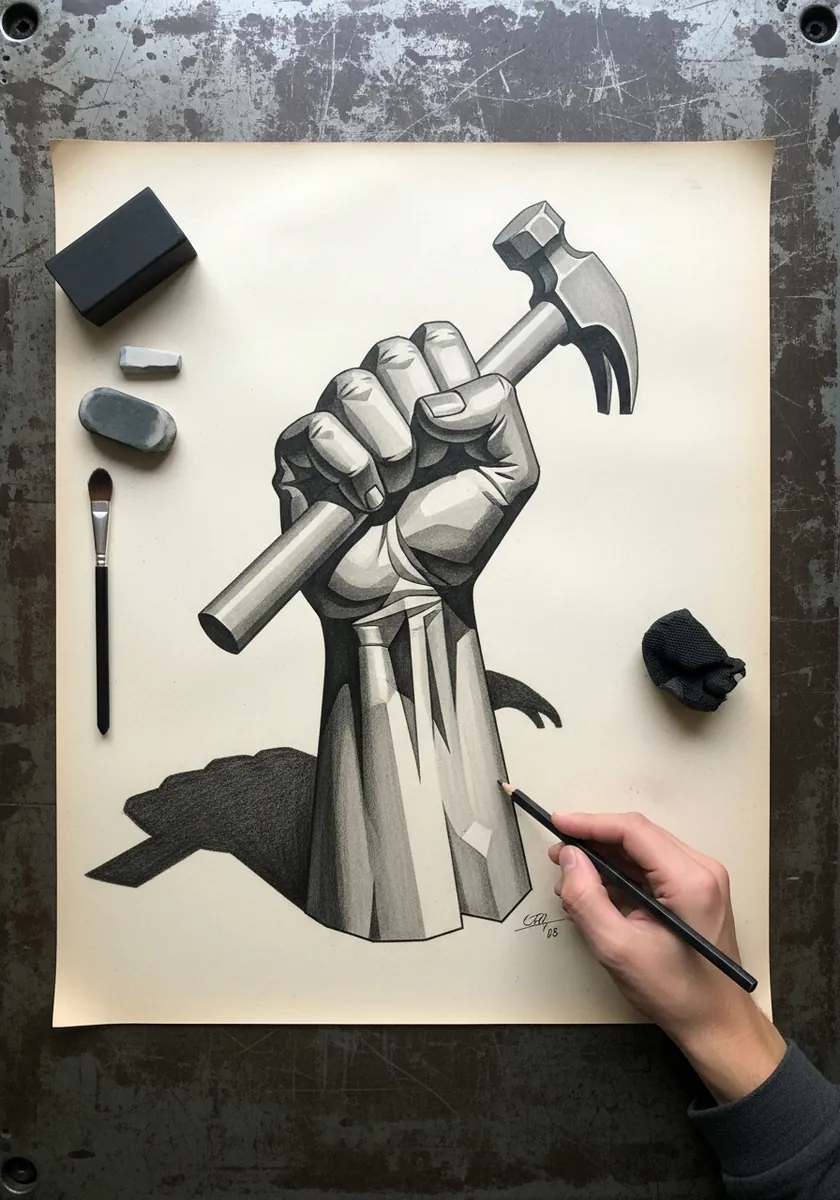
A hand holding a hammer, built entirely from flat angular planes. Assign each facet one value and never blend between them. The hard edges between tones do all the modeling, which makes this an excellent plane-drawing exercise.
27. Baby Elephant Standing on a Cloud
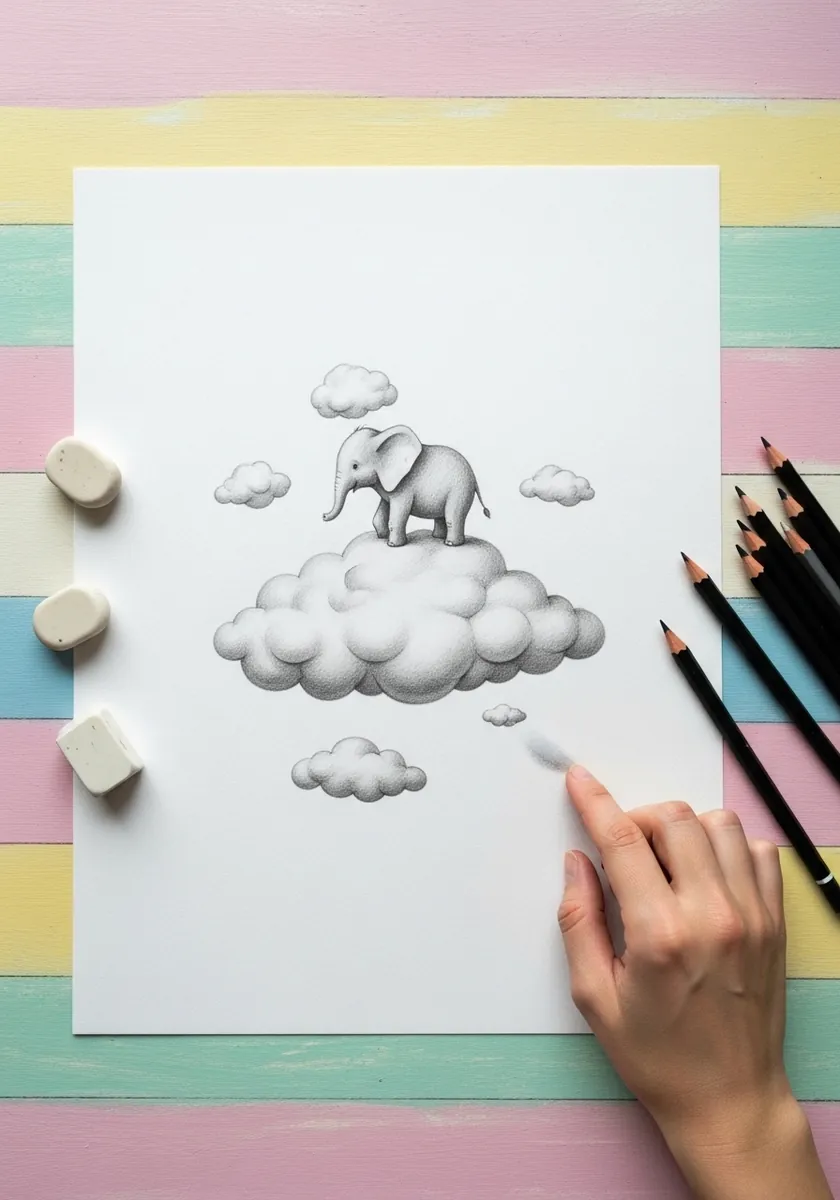
A small elephant on a cloud, drawn very softly. Keep the whole piece in a narrow light value range and use a blending stump throughout, letting the cloud edges stay fuzzy so nothing in the drawing has a hard outline.
28. Shark Bursting Through the Page
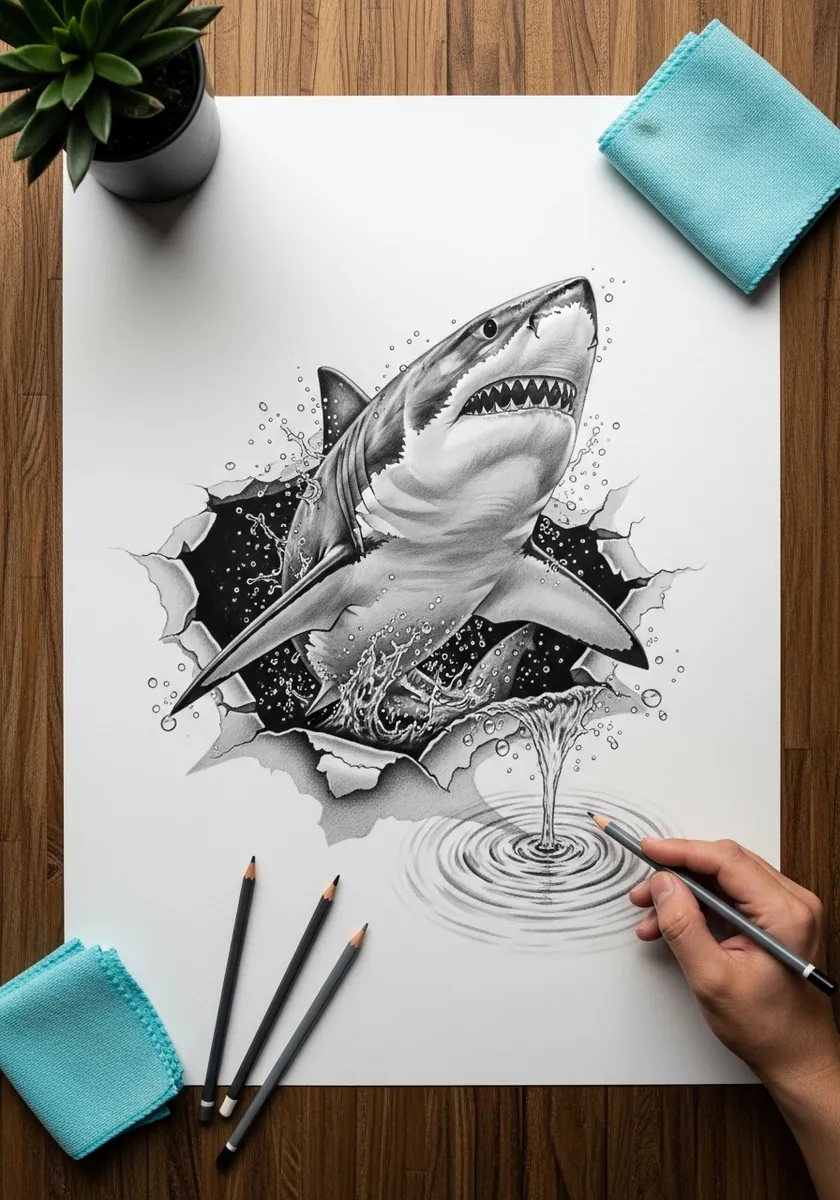
A shark comes through the sheet with water spilling out and ripples spreading on the flat paper below. Those ripples outside the hole are the detail most people skip, and they are what connect the illusion to the real page.
29. Hot Air Balloon Over Rolling Hills
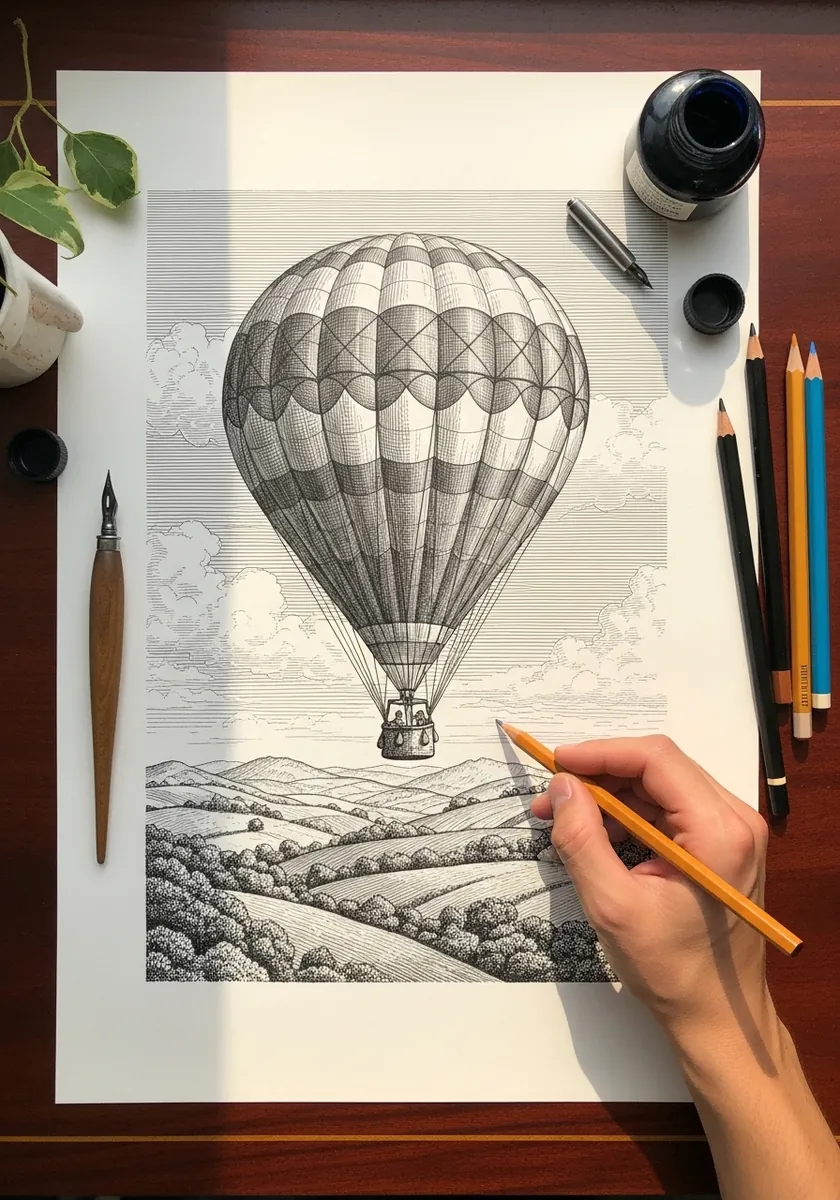
A balloon over a hatched landscape in the manner of an old engraving. Build every value from hatching alone with no blending, and follow the curve of the balloon with your line direction so the envelope reads as round.
30. Rib Cage with Roots on Black Paper
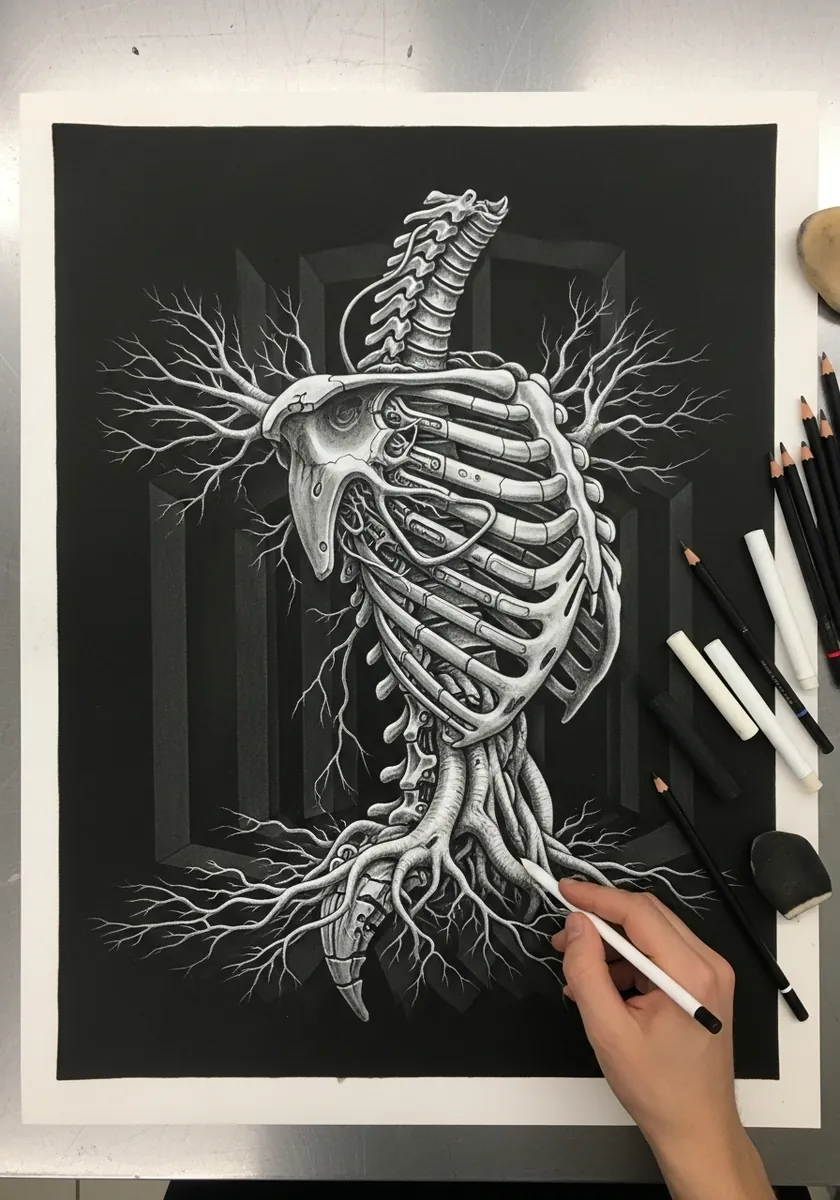
A rib cage with roots growing through it, drawn in white on black. Working in reverse is the lesson here: you are adding light rather than shadow, so put white only where light would actually strike and leave the rest untouched.