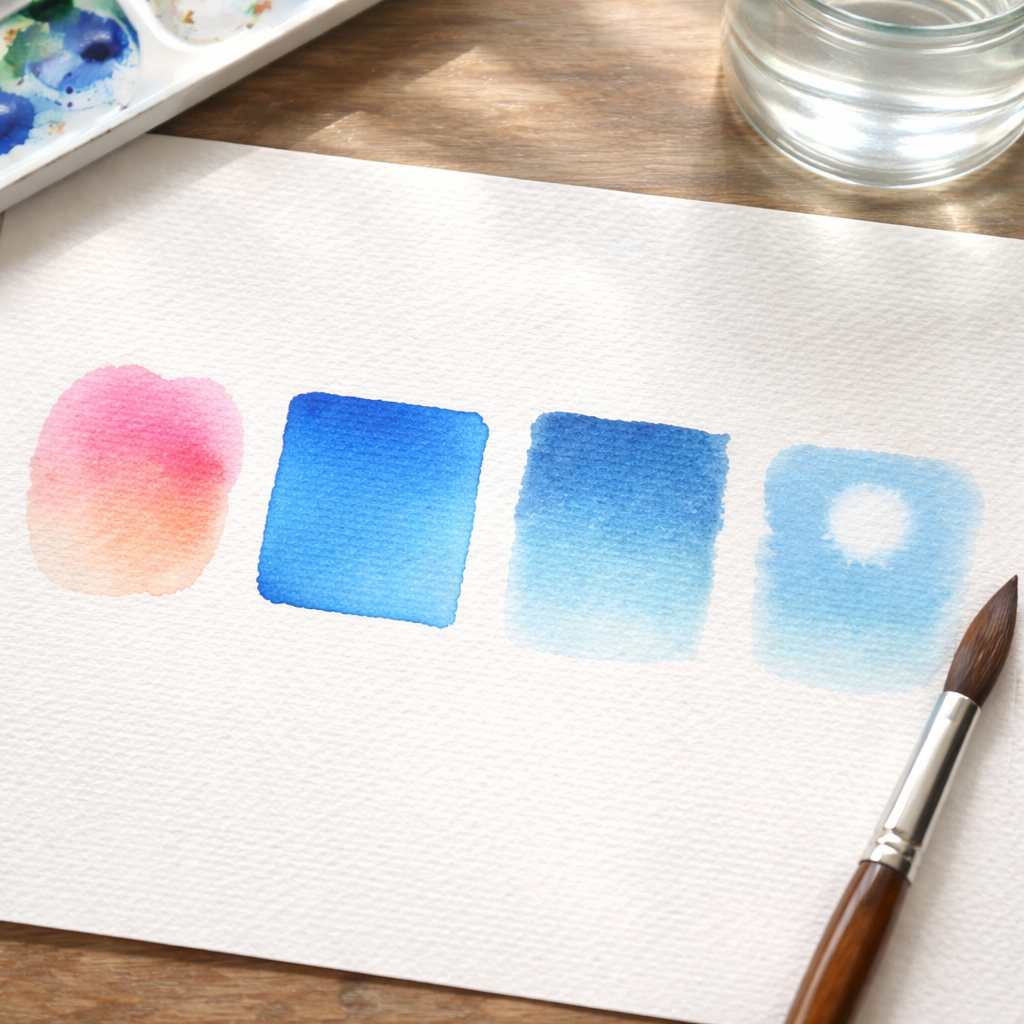
Watercolor is built from four techniques: wet on wet for soft edges, wet on dry for hard edges, the graded wash for smooth transitions, and lifting to remove color. There is no white paint — every highlight is paper you chose not to cover.
Key takeaways
- Highlights in watercolor are reserved paper, not white paint.
- Wet on wet gives soft edges; wet on dry keeps a hard edge exactly where you put it.
- A graded wash needs a bead of paint traveling down a barely tilted board.
- Lifting only works with mineral earth pigments, not modern staining colors.
- Watercolor dries 20 to 30 percent lighter, so mix stronger than looks right.
Watercolor is the only common paint that dries lighter than it looks, cannot be painted over to correct a mistake, and does half its work while you are not touching it. Almost every beginner frustration traces back to one of those three facts.
This guide is the map to everything watercolor on this site: the four techniques that everything else is built from, which subjects to attempt in which order, the problems that stop people, and what to do once your work is worth selling.
Start Here: What Watercolor Actually Does
Watercolor is pigment suspended in gum arabic, thinned with water and made luminous by the white of the paper showing through it. There is no white paint doing the work. Every highlight in a good watercolor is paper you decided not to cover.
That single idea, painting around the light instead of adding it, is the hardest habit to build and the one that separates a watercolor that glows from one that looks muddy. It is also why the paper matters more than the paint, which is covered fully in choosing watercolor paper and choosing a paint set.
The Four Techniques Everything Is Built From
1. Wet on wet
Wet the paper first, then drop color in and let it spread on its own. Edges stay soft and two colors mingle without turning to mud, because they meet on the paper rather than on the palette. This is how skies, mist and fur are made.
Practice it on skies, then on galaxies where the same technique is pushed further.
2. Wet on dry
Paint onto dry paper and the mark keeps a hard edge exactly where you put it. Every layer must dry completely before the next, and each overlap darkens naturally. This is how petals, leaves and architecture are built.
See it working in hydrangeas, lotus flowers and house portraits.
3. The graded wash
One loaded stroke that weakens steadily as you add clean water, pulled across the page in a single pass. Tilt the board slightly so a bead of paint travels down under gravity, and never lift the brush partway through. It is the hardest basic skill and the most used.
Learn it on ocean scenes and layered mountains.
4. Lifting
A damp stiff brush and a piece of kitchen paper will pull color back off the sheet, which is watercolor’s only real undo. It works well with mineral earth pigments that sit in the paper’s texture and barely at all with modern staining colors, so the pigment you chose decides whether the mistake is recoverable.
What to Paint, In Order
Subjects are not equally difficult, and painting them in the wrong order is why people conclude they have no talent. This is a sensible progression.
Week one, no drawing required
- Abstract washes — pure technique practice with nothing to get wrong
- Skies — one big graded wash, and clouds are just reserved paper
Simple shapes with forgiving edges
- Daisies — radiating petals teach you to draw what you see
- Lemons and food — round forms, one light source
- Seashells — fixed shapes that reward careful observation
- Mushrooms — soft edges hide small errors
Layering and control
- Hydrangeas — a mass of blooms rather than a single flower
- Roses — overlapping petals in strict order
- Lotus flowers — long soft gradients within one petal
- Dragonflies — the finest lines you will attempt
Animals and fur
- Cats — the subject people actually commission
- Fish and hummingbirds — iridescence made from reserved white
- Horses and elephants — large forms where proportion shows
Hardest: scenes with perspective
- Houses — straight lines and soft washes fighting each other
- Boats — hull angles that betray any error
- London and Los Angeles — whole streets, where you suggest rather than render
- Portraits — skin tone in transparent layers
Small Things Worth Painting
Not every piece needs to be a full sheet. Small work finishes in one sitting, which is how a habit actually forms, and it is also what sells: bookmarks, thank you cards and postcard studies.
The Problems Everyone Hits
- It dried lighter than it looked. All watercolor does, by roughly twenty to thirty percent. Mix stronger than looks right and test on a scrap of the same paper.
- My colors went muddy. Usually you mixed two convenience colors that each already held three pigments. Single-pigment paints mix clean; the pigment codes are explained in our paint set guide.
- Hard blooms appeared as it dried. The paper is too absorbent, or you touched a wash that had started to set. Both are covered in the paper guide.
- The paper buckled. Under 140 lb, or a loose sheet that was not stretched. A block glued on all four edges removes the problem.
- My colors look wrong the next morning. You mixed under a warm bulb. See studio lighting.
- Washes streak. The board is too steep. A watercolor easel should sit almost flat, as explained in our easel guide.
When Your Work Is Worth Selling
Watercolor sells better as prints than as originals, because one painting becomes many products. The chain is capture, print, present: scanning artwork, then printing at home, then matting and framing. The full buying order across every stage is in our art supplies guide.
Frequently Asked Questions
Why are watercolors so difficult?
Because you cannot correct by painting over. In oil or acrylic a mistake is covered; in watercolor the white of the paper is your only light source, and once it is covered it is gone. The difficulty is planning, not brush control. We break this down further in why watercolors are so difficult, including the four problems that are equipment rather than skill.
How long should I wait between layers?
Until the sheet is dry to the back of your hand, not just to the eye. A wash that looks matte can still be damp underneath, and painting into that stage is what causes hard-edged blooms.
What should a beginner paint first?
Abstract washes and skies, for a week, before any recognizable subject. They train the two things everything else depends on: controlling how wet the paper is, and leaving white paper alone.
Can I use watercolor on ordinary paper?
You can, but it buckles and every wash dries with hard edges, because printer paper has no sizing and no weight. It is the single change that makes the biggest difference to beginner work.
Do I need expensive brushes?
No. One round brush that holds a point and one large wash brush will carry you through the first year. A cheap brush on good paper outperforms a sable on cheap paper, every time.