A reflection is never as strong as the object above it. Water compresses the value range, so the darks come out lighter and the lights come out darker in the reflection, and the whole thing drops directly downward rather than mirroring sideways.
Key takeaways
- ["Reflections lose contrast: darks lighten, lights darken, every time", "A reflection drops straight down from the object, never sideways", "Ripple rings become flattened ellipses as they recede toward the horizon", "Wet ground is darker and shinier than dry ground right beside it", "Break the reflection with horizontal marks wherever the surface moves"]
The reason most painted puddles look like glass rather than water is a value error. A reflection has less contrast than the thing it reflects. Water absorbs some light, so the darks in a reflection are lighter than the real darks, and the lights are noticeably duller. Copy the object exactly and it looks pasted on.
The direction matters just as much. A reflection falls straight down from the object, along a vertical line, no matter where the object sits in the frame. A tree on the left reflects directly below itself, not diagonally across the puddle toward the viewer.
One more piece of geometry finishes it. Ripple rings are circles seen at an angle, so they flatten into ellipses, and the further away they are the flatter they get. Rings drawn as perfect circles make the water look vertical rather than lying on the ground.
The thirty-one ideas below cover cobbled streets, blossom on water, storm skies, stained glass and quiet country lanes across ink, graphite, charcoal, watercolor and acrylic. For more water subjects see watercolor boat drawing ideas, and for the season generally, spring baby animals drawing ideas.
Compiled by the GS Art Zone editorial team. Last updated August 2026. Each idea is paired with the specific step that produces the effect, so you can go from the reference straight to paper.
What You Need Before You Start
- A flat brush for laying the long horizontal marks that read as water
- Masking fluid or a white pen for the bright edges of raindrop rings
- A soft 4B or charcoal, since wet ground needs darks a hard pencil cannot reach
- Heavier paper than usual, because puddles mean large wet washes
- A photograph taken looking down a wet street, which shows the compression clearly
1. Puddle on Cobblestones
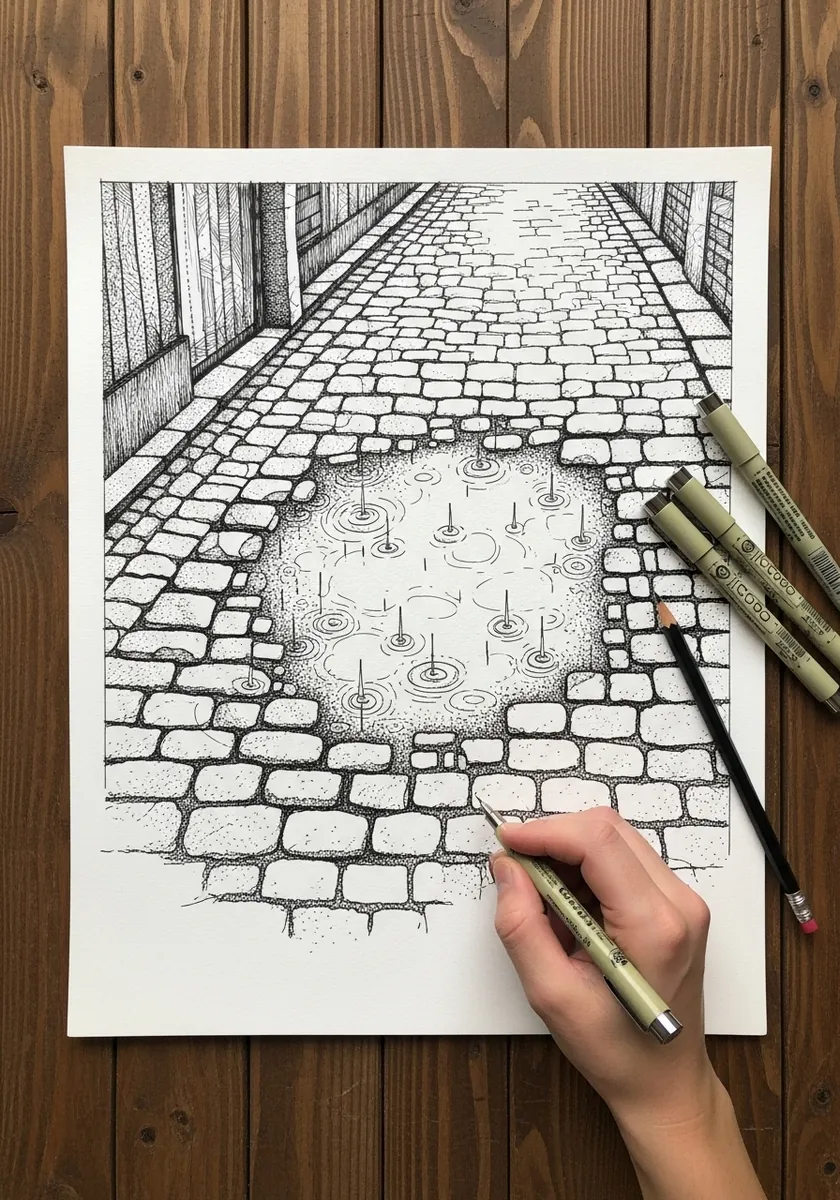
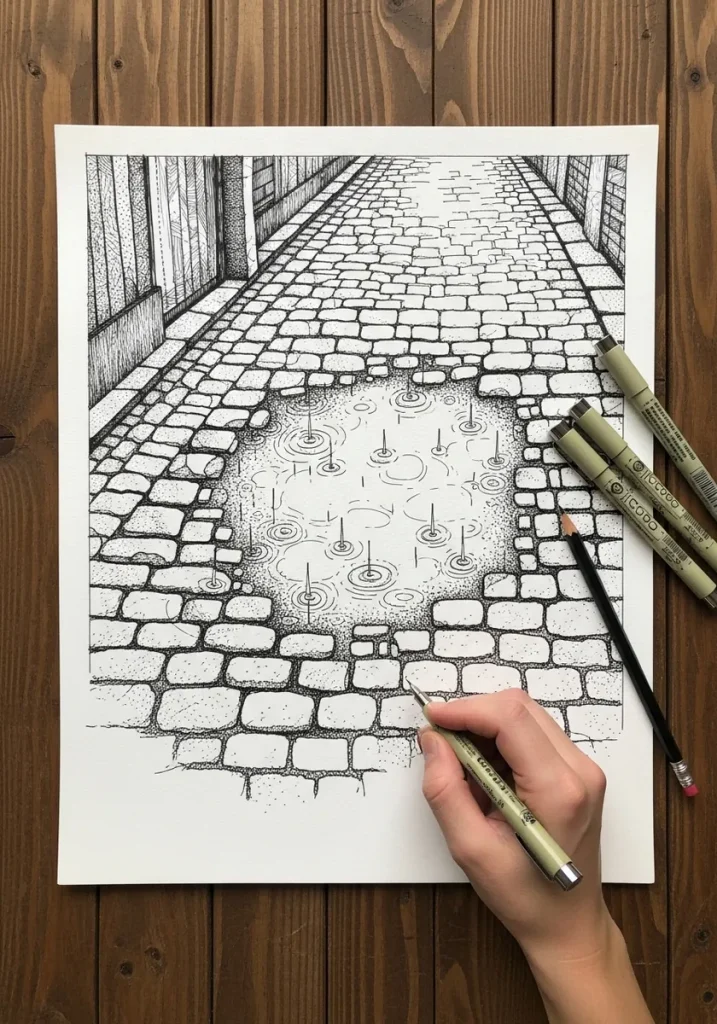
Cobbles are the perfect test of a wet surface. Draw every stone with the same hatching, then let the stones inside the puddle blur and darken while the ones outside stay crisp. The change in edge quality alone reads as water.
2. Park Path in Graphite
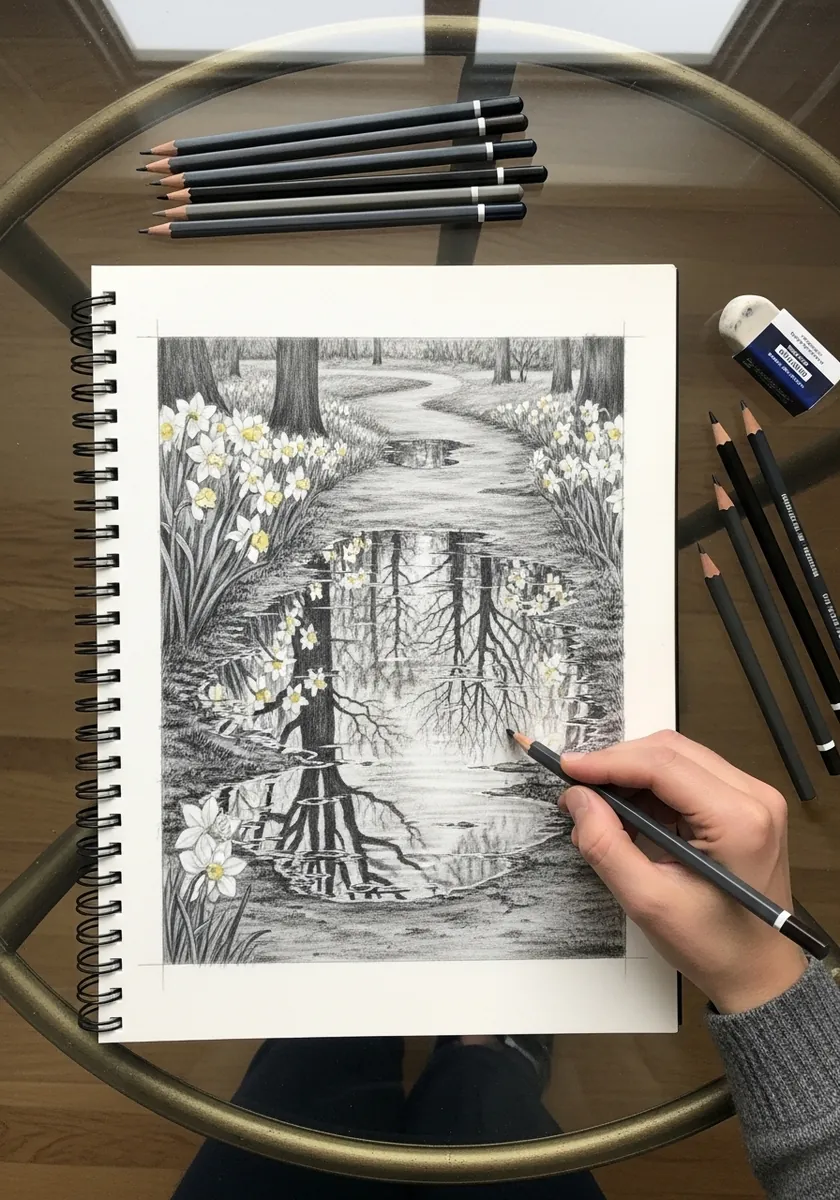
A receding path needs the puddles to flatten with it. Draw the nearest puddle as an open oval and each one further away as a narrower slit, and keep them all on the same line of perspective as the path itself.
3. Wisteria Reflections
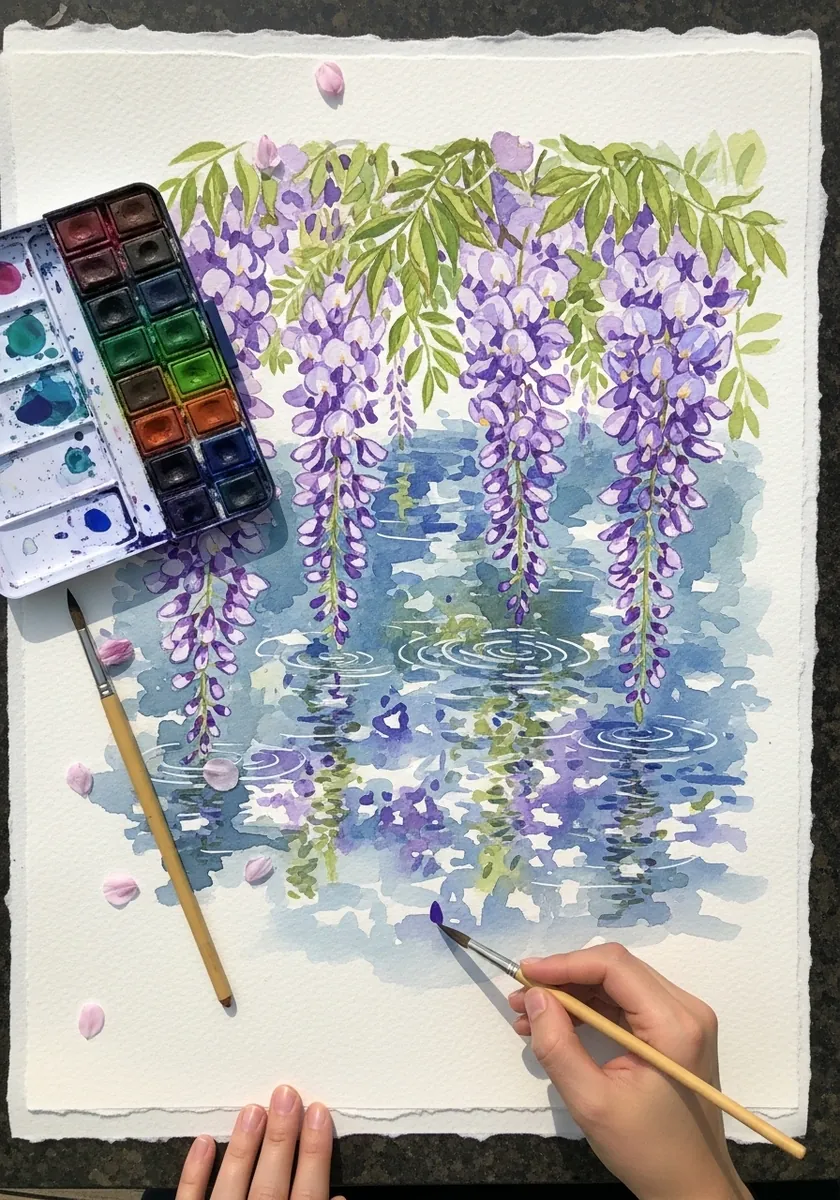
Hanging flowers reflect as vertical streaks. Paint the wisteria above accurately, then drag the same colors straight down into the water with a damp brush and let them soften. Nothing in the reflection needs a hard edge. Add one horizontal ripple across the middle to prove the surface is water.
4. Rainy City at Night
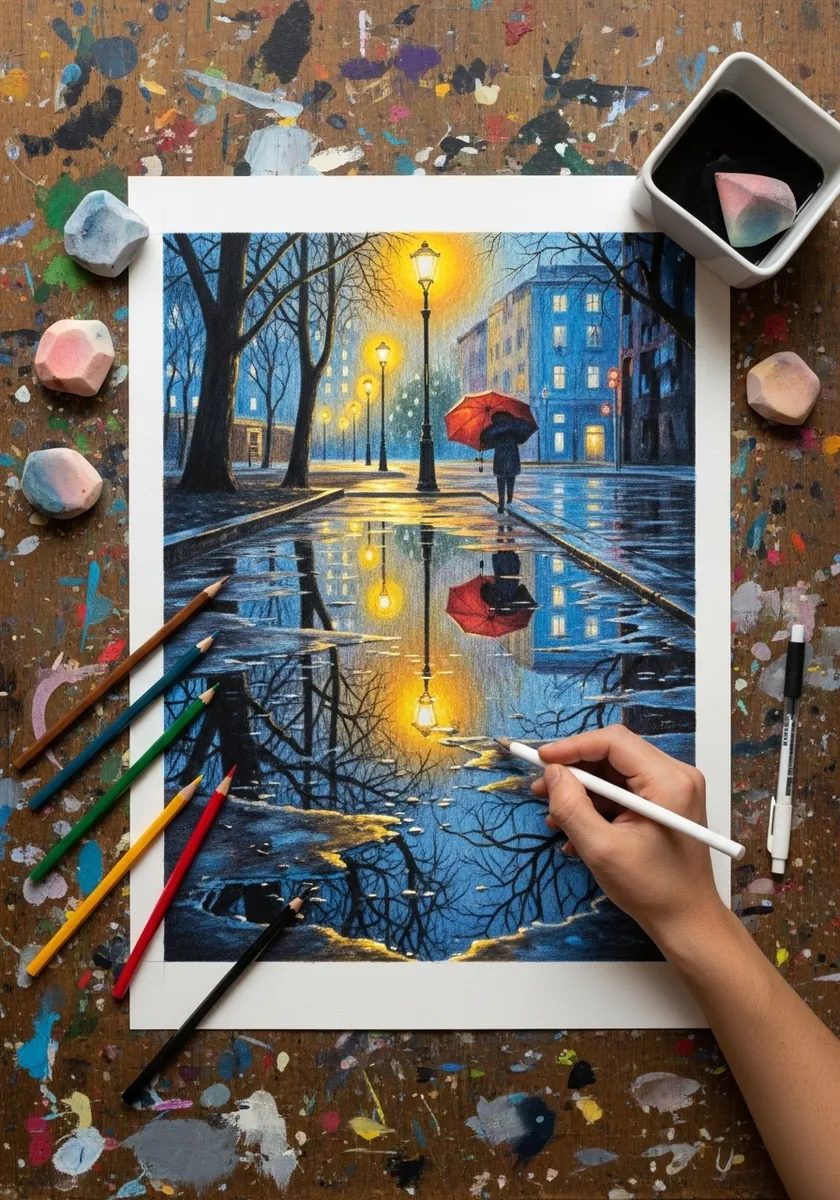
Night rain is about the lights, not the darkness. Pull each lamp’s reflection down as a long vertical smear broken into short horizontal dashes, keep the pavement almost black between them, and let the color be far more saturated in the water than in the air.
5. Charcoal Street and Moon
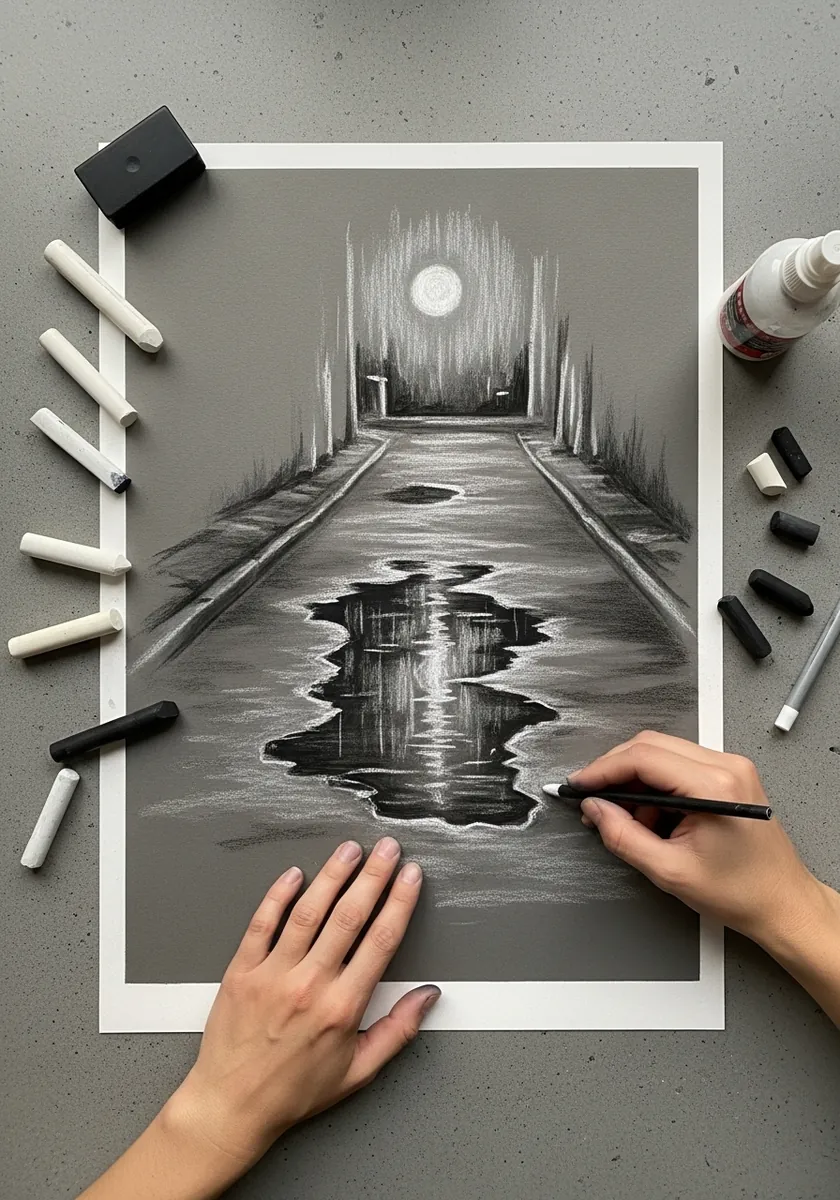
Charcoal suits wet ground because it goes truly dark. Fill the road solidly, then lift the moon’s reflected path with an eraser in a broken vertical band, and leave the sky much lighter than the ground. The contrast is what makes it look wet.
6. Petals Floating on Water
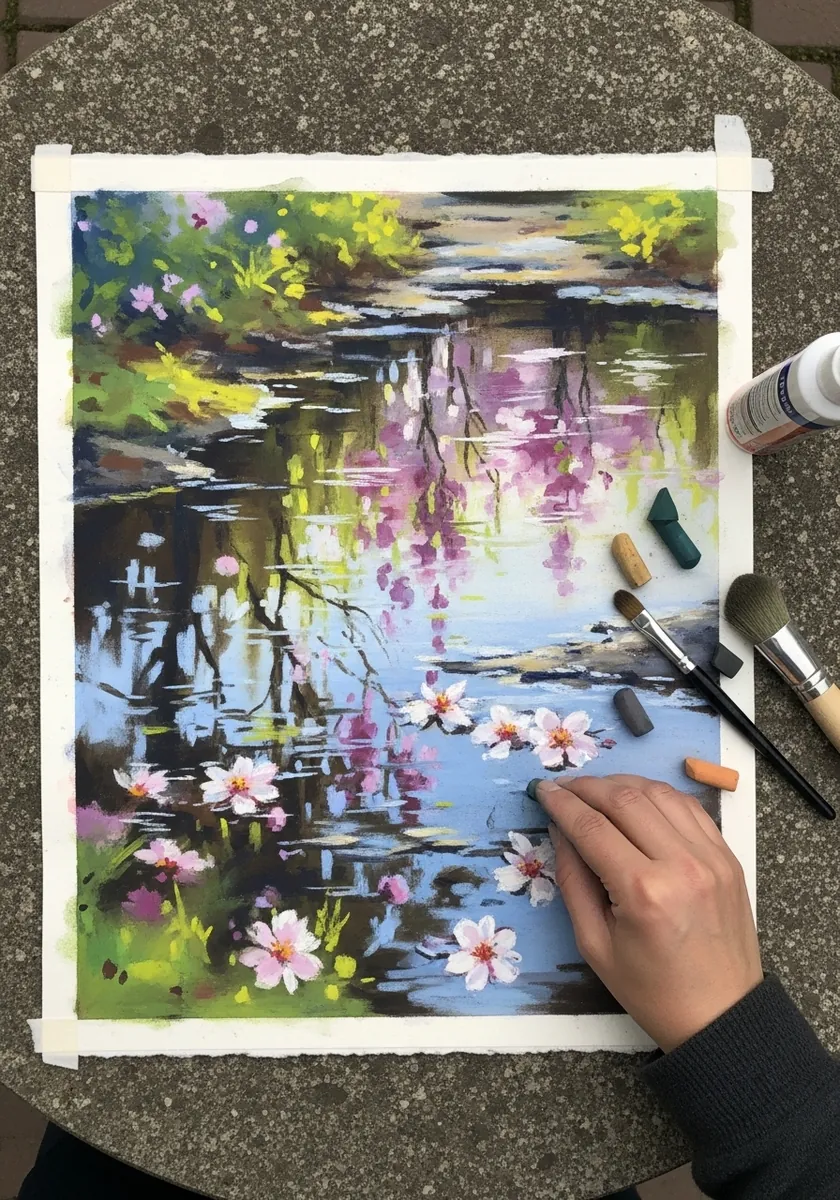
Floating objects need a shadow and a reflection. Give each petal a small dark mark directly beneath it and a paler repeat just below that, keep them all lying flat, and scatter them unevenly. Evenly spaced petals look printed. Keep the water itself almost empty, since the petals are the whole subject.
7. Lantern Alley in the Rain
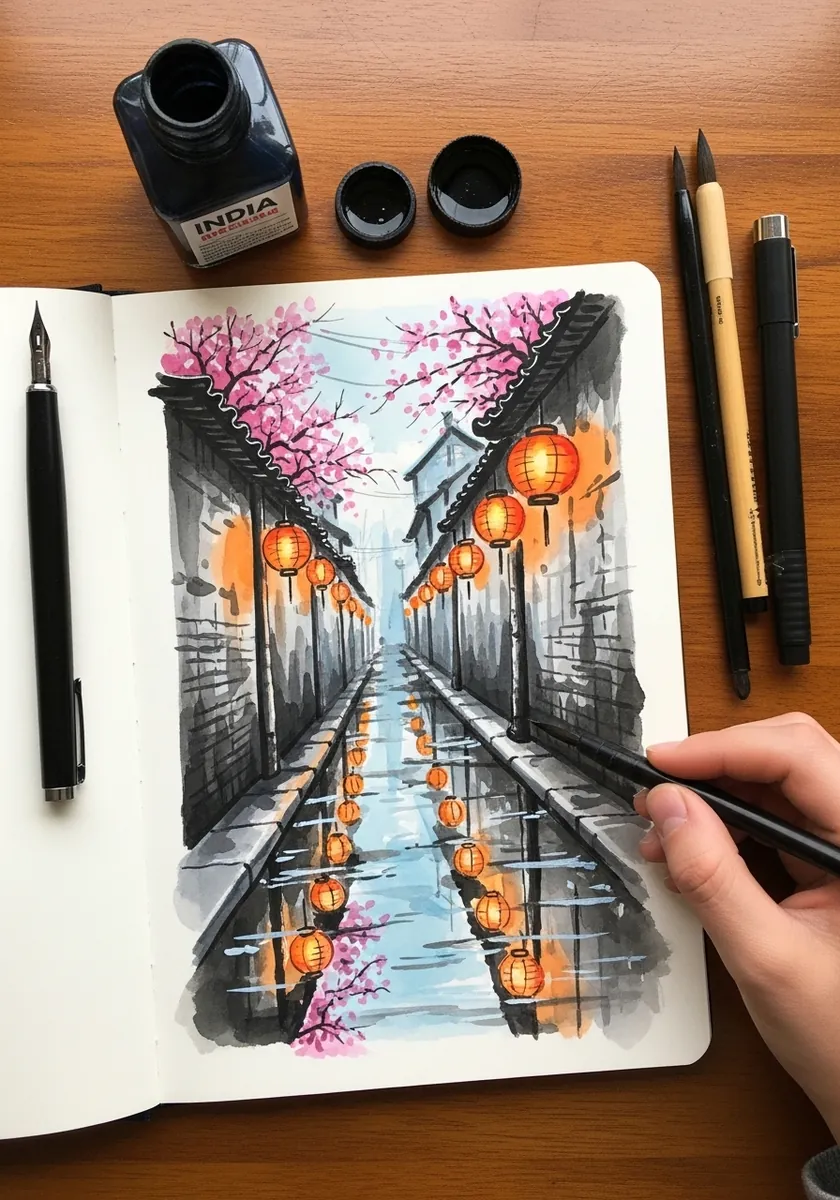
A narrow street pulls the eye to a single point. Run both walls back to one vanishing point, put the brightest lantern near that point, and let the wet ground repeat all the lanterns as vertical streaks down the middle.
8. Impasto Sunflower Path
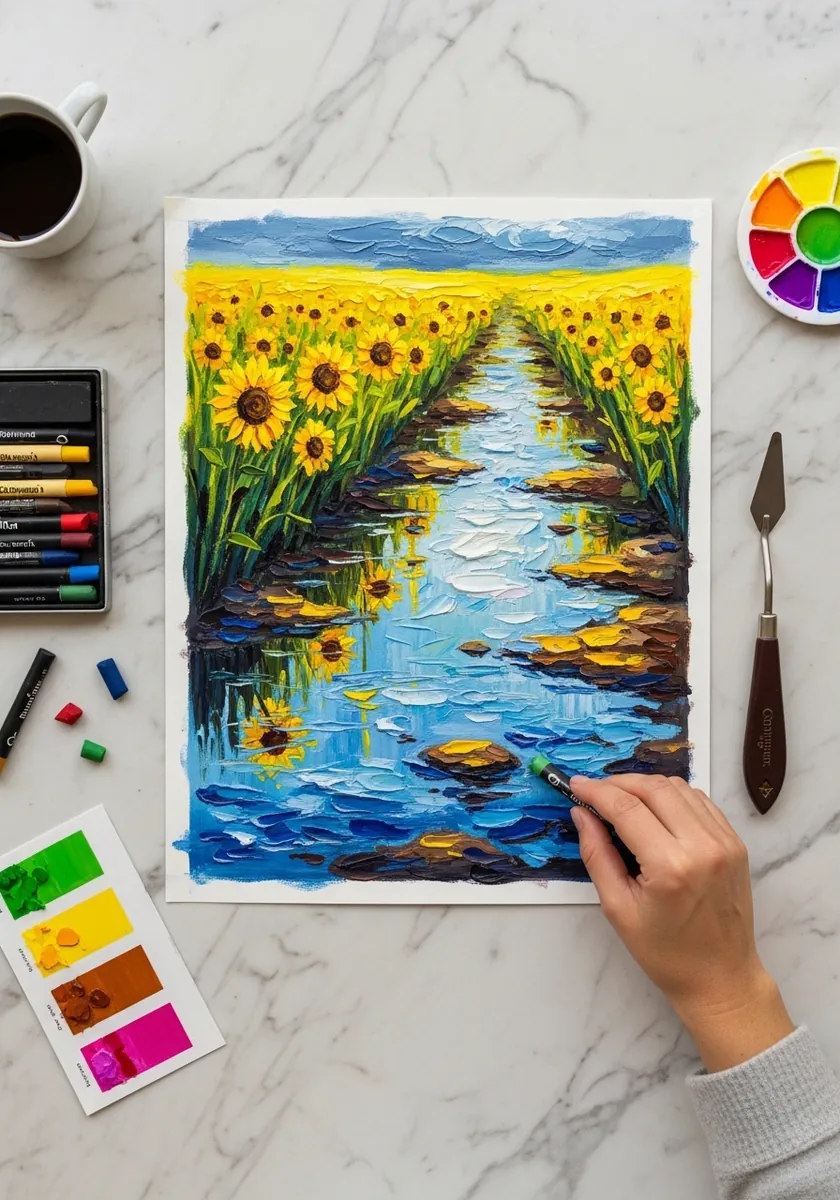
Thick paint cannot hold fine reflections, so simplify. Load the knife and drag horizontal strokes down the water in the same yellows and blues used above, keep every mark broad, and let the impression of a reflection do the work.
9. Ripples on Kraft Paper
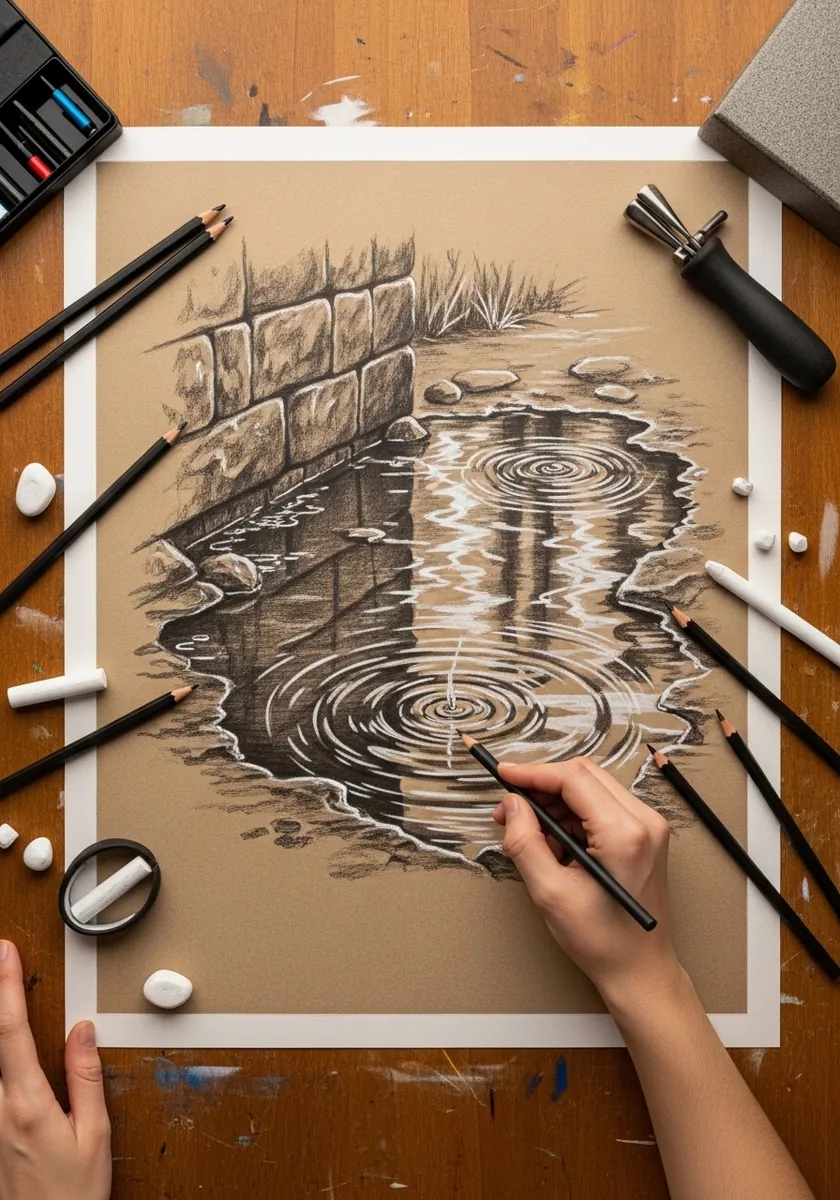
Toned paper is ideal for water, because the mid value is already there. Draw only the dark side of each ripple ring and add white on the lit side, leave the paper as everything in between, and flatten each ring as it recedes.
10. Birch Trees in the Wet
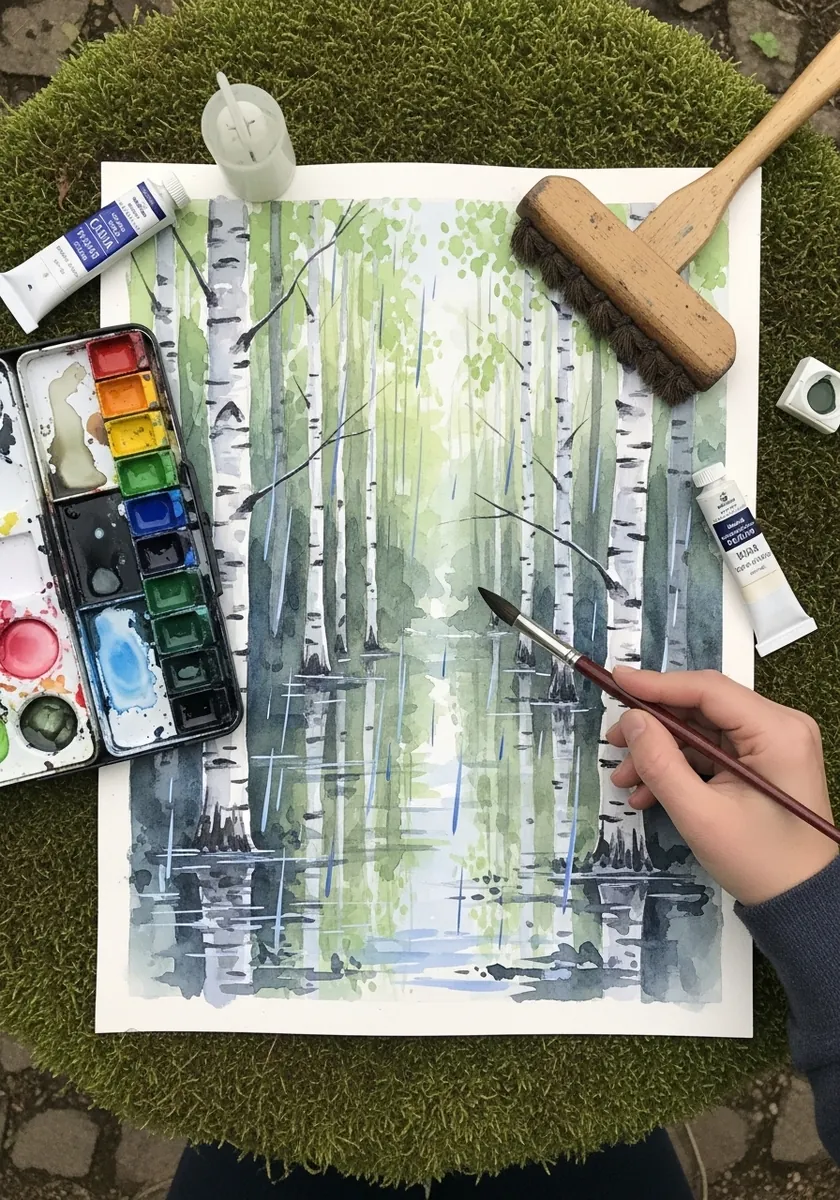
White trunks reflect as pale streaks, not white ones. Reserve the trunks above as clean paper, then in the water make them a soft gray rather than white, and break them with horizontal marks. The compression is obvious with birches.
11. Storm Sky in a Puddle
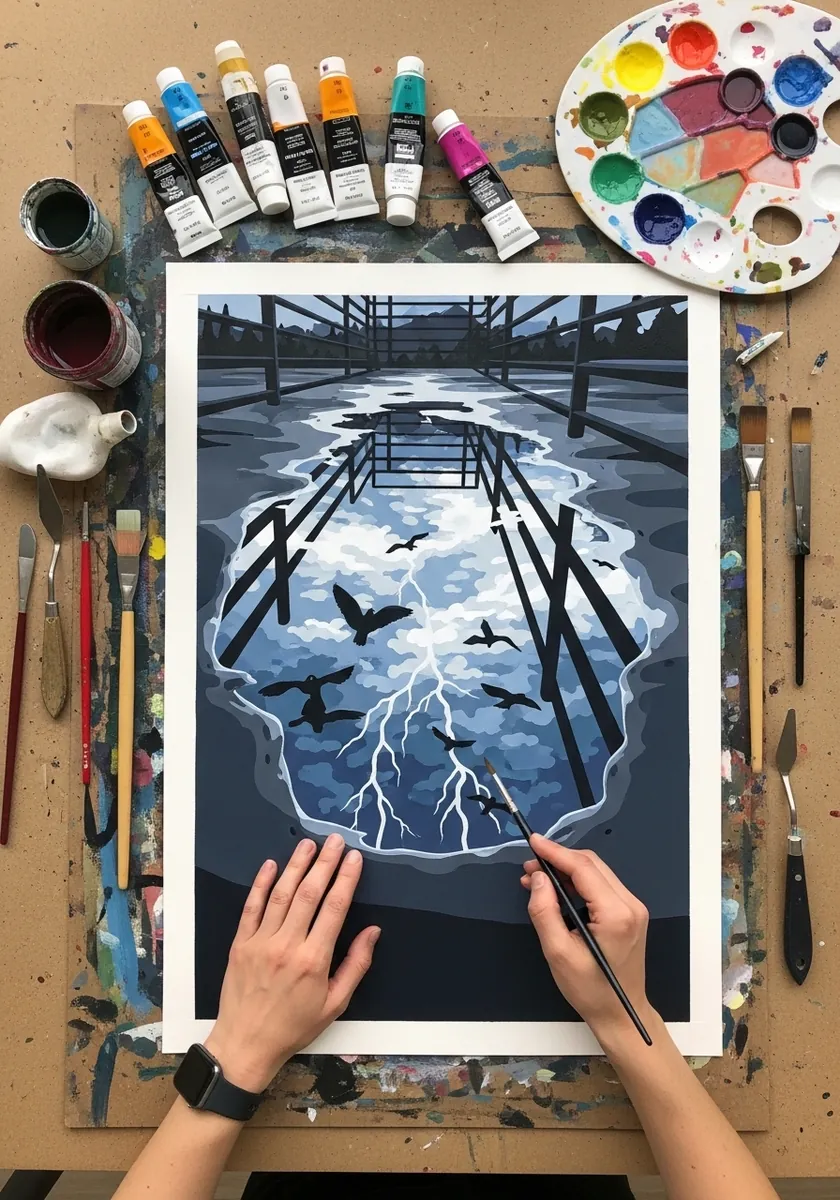
A puddle can hold a whole sky. Paint the ground almost solid dark, then treat the puddle shape as a window onto the clouds above, and keep everything inside it slightly duller than the real sky would be. Give the puddle a hard irregular outline so it reads as a hole in the ground.
12. Blue Monochrome Field
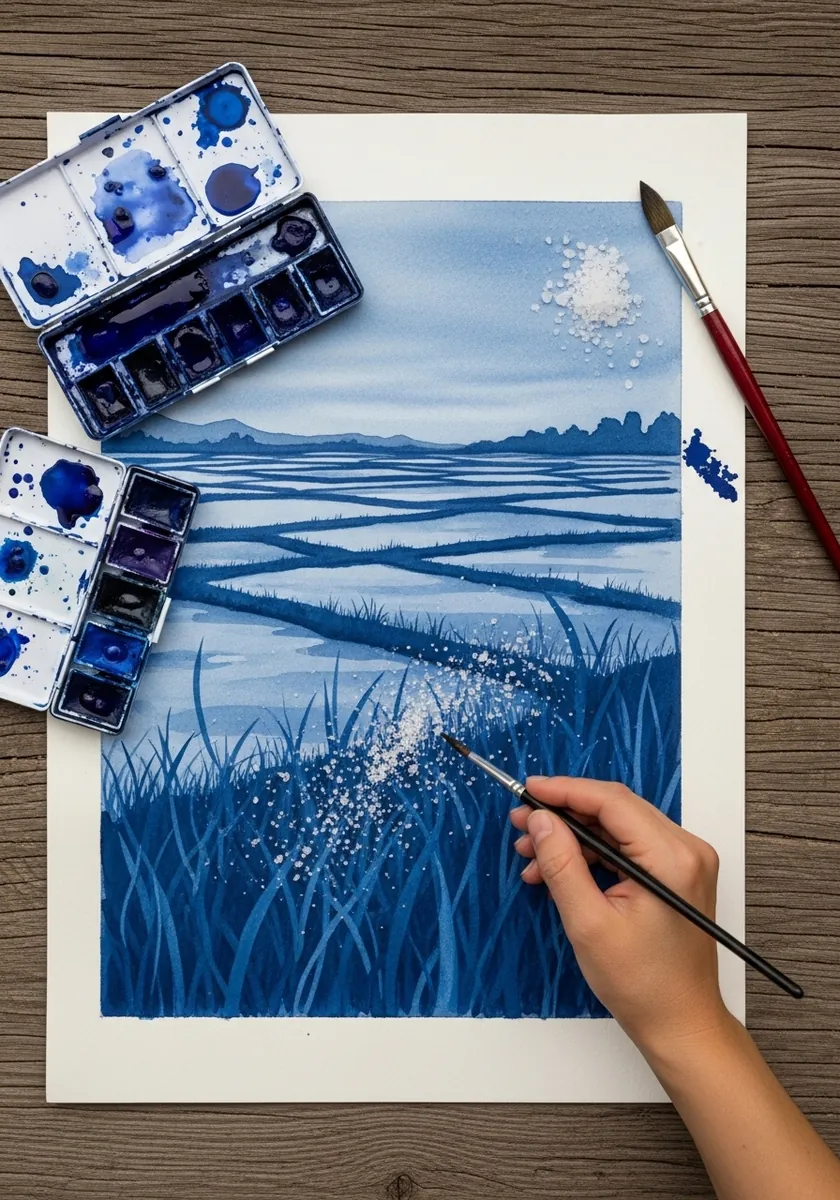
Working in one color forces you to think only in values. Reserve the lightest blue for the water surface, push the land darker than feels right, and let the difference between the two carry the whole picture. Add a single sharp white line along the far edge of the water for contrast.
13. Boots and Their Reflection
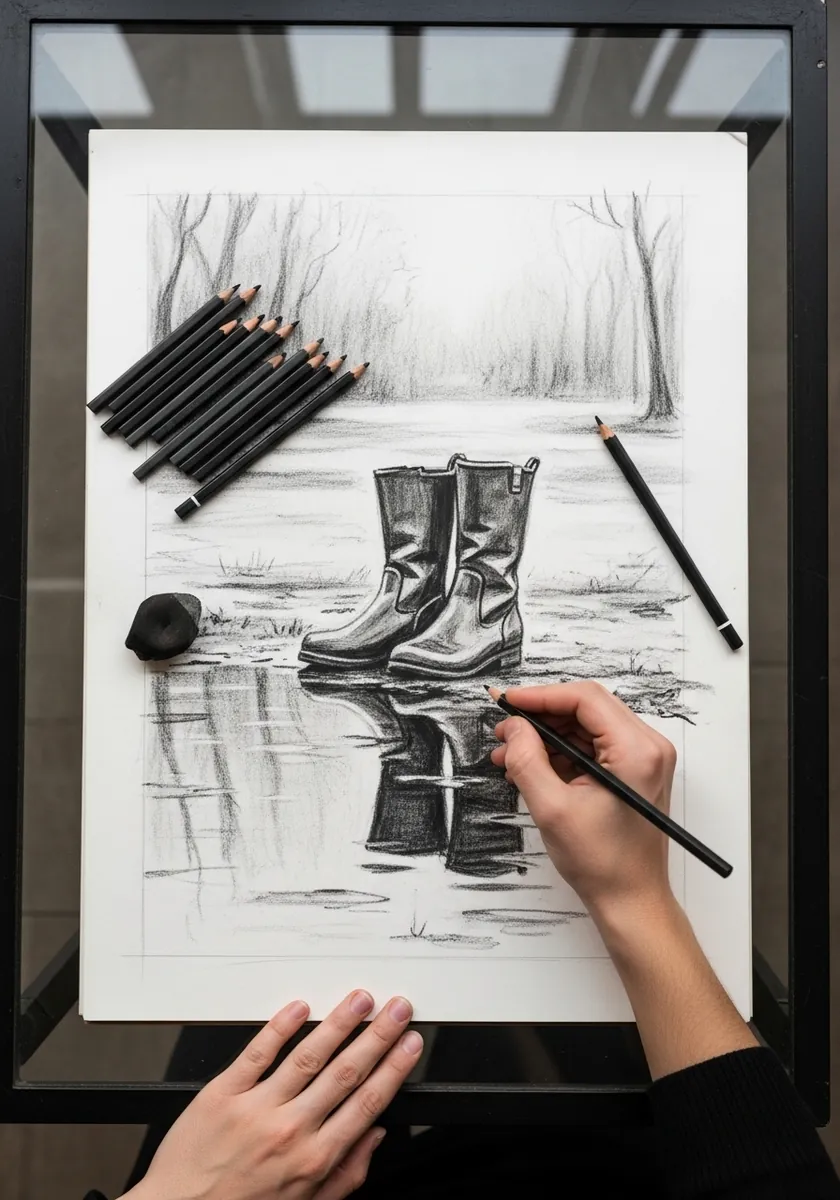
One object and one reflection is the clearest exercise there is. Draw the boots fully, then draw the reflection directly beneath with every dark lightened by a step, and break it with two or three horizontal lines. Keep the ground around the puddle almost white so the shape stands out.
14. Cloister After Rain
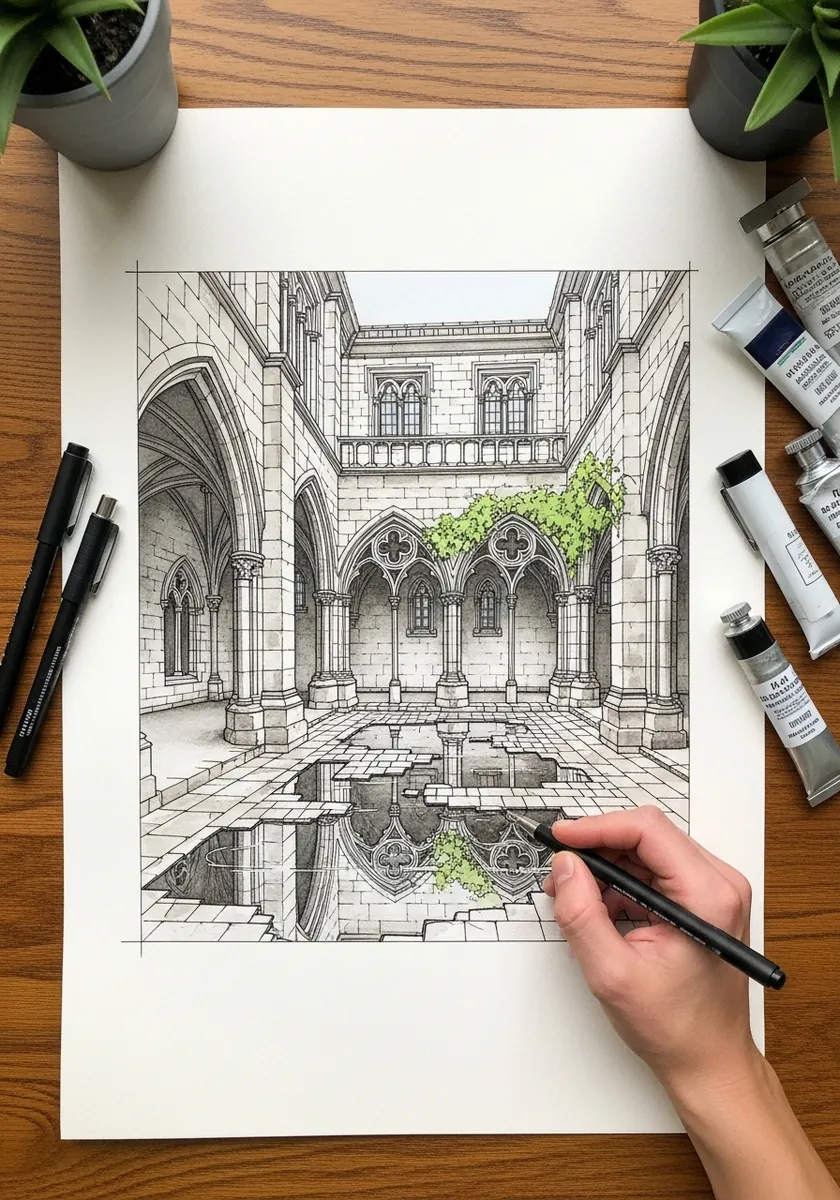
Architecture makes reflections easy to check. Every column reflects on a vertical line beneath itself, and every horizontal in the building stays horizontal in the water; if a reflected arch leans, the drawing has drifted. Keep the reflected stonework simpler than the real thing, with fewer joints.
15. Wet Road in Charcoal
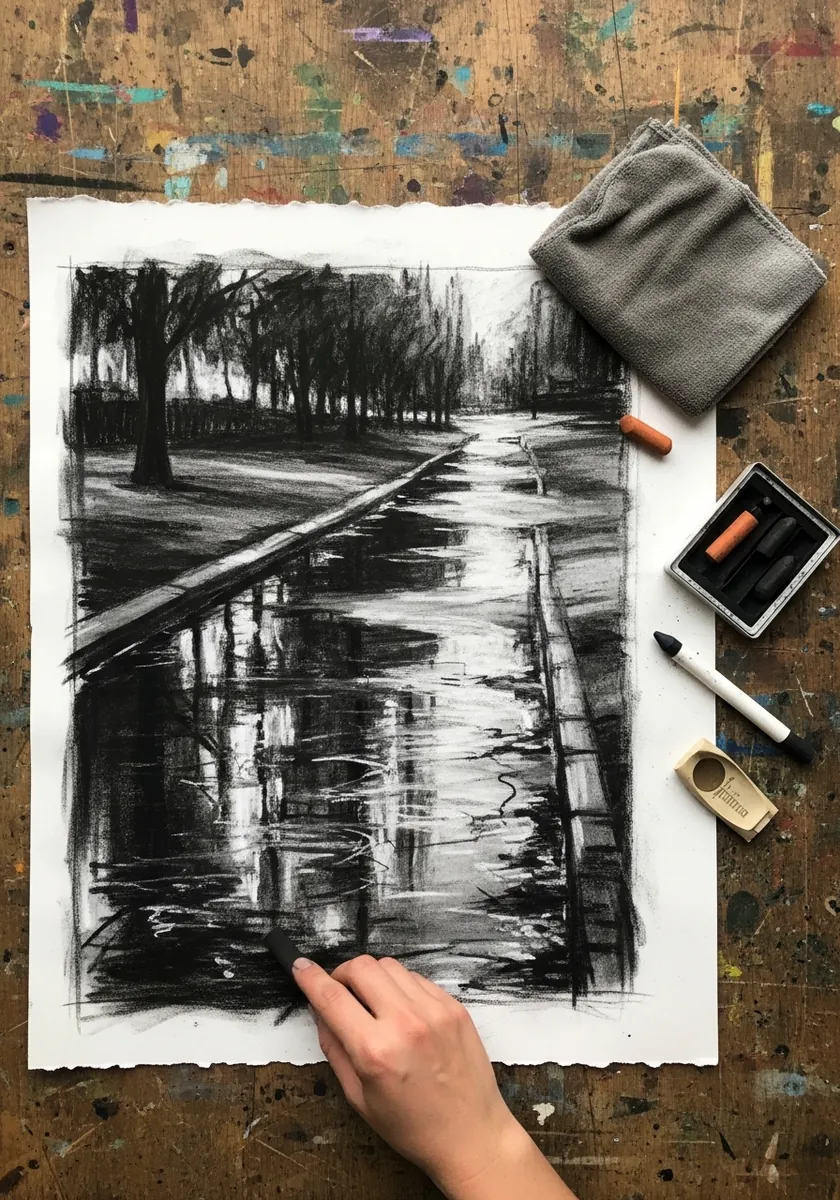
A wet road down the middle of a picture is a light shape, not a dark one. Keep it lighter than the trees on either side, run the trunk reflections straight down into it, and smudge them horizontally with a finger.
16. Tulip Field and Stream
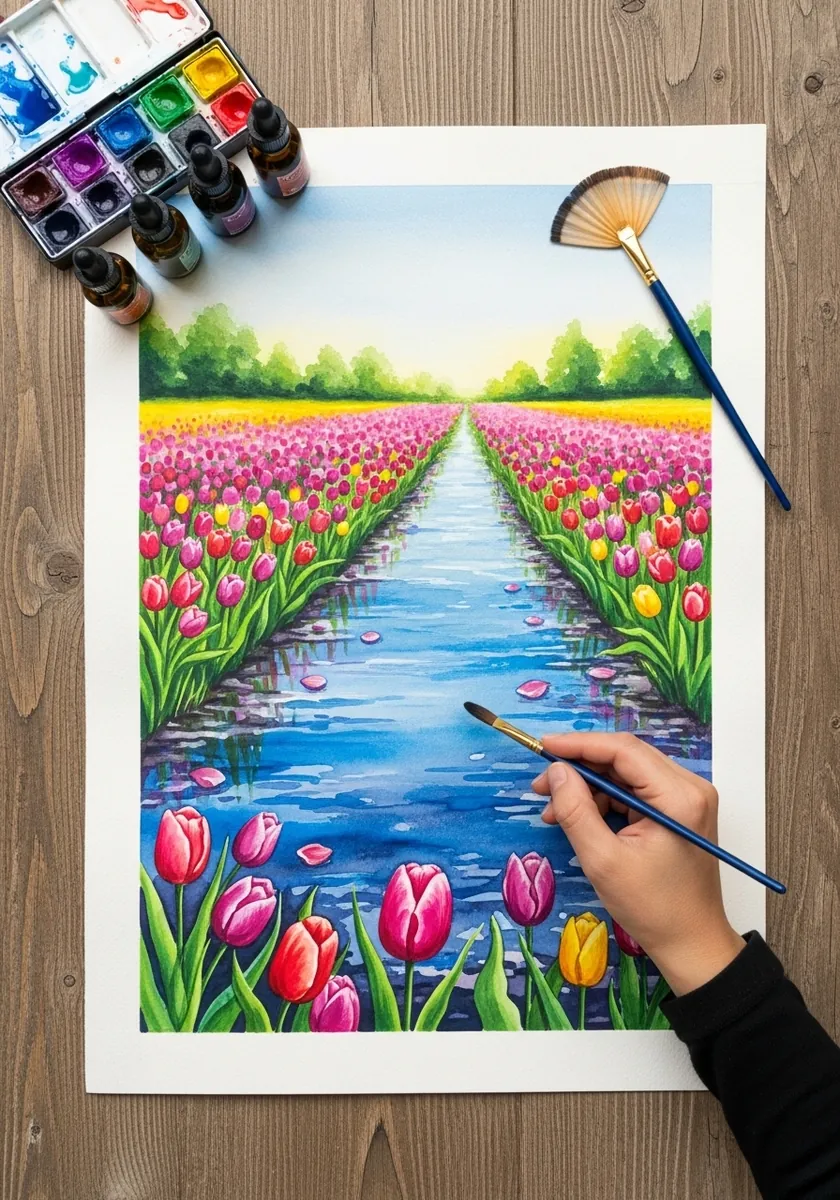
Bright fields need the water to stay quiet. Keep the stream mostly pale blue with only broken hints of the tulip colors, and resist repeating every flower; a reflection carries the impression of color, not the detail. Let the stream narrow steadily as it recedes so the field opens out behind it.
17. Art Nouveau Puddle Panel
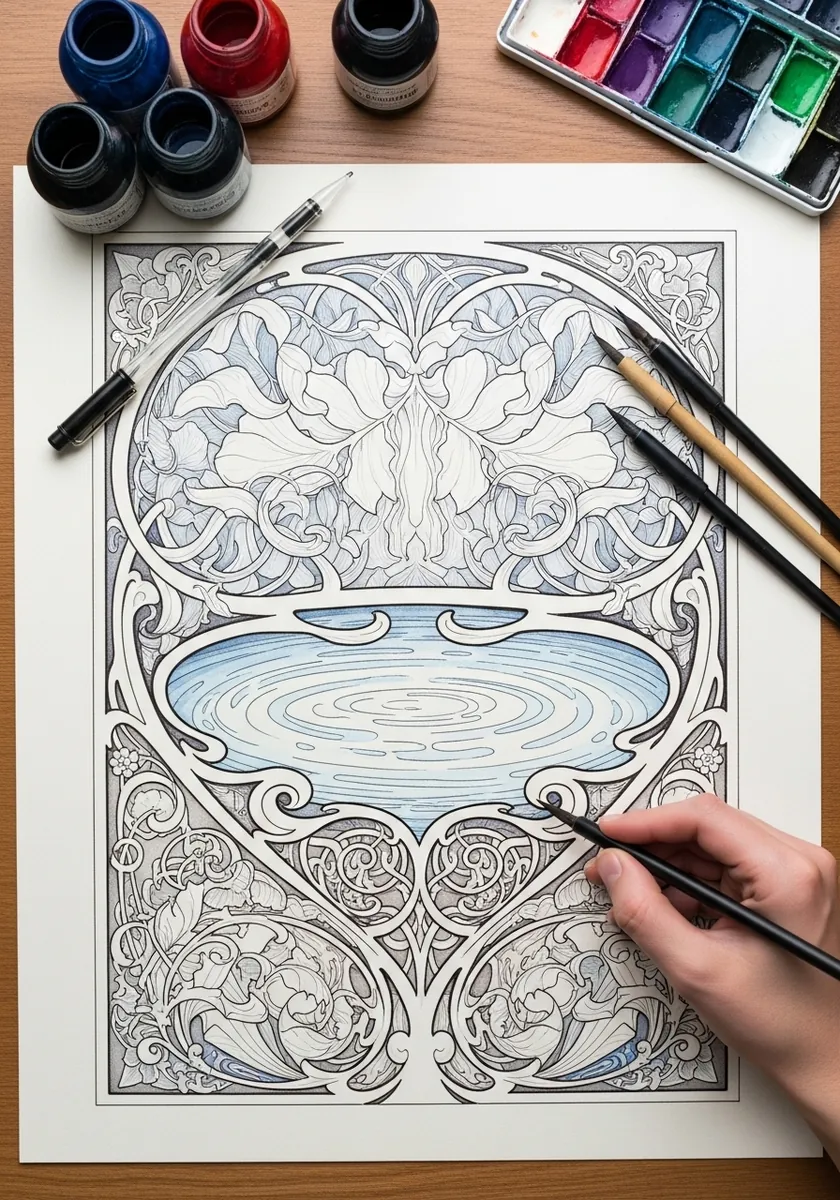
Combining decoration with observation needs a clean division. Keep the ornamental border flat, symmetrical and unshaded, then paint the puddle inside it with real reflections, and let the two never overlap. Choose one flower from the border and repeat it floating in the water below.
18. Flat Graphic Puddle
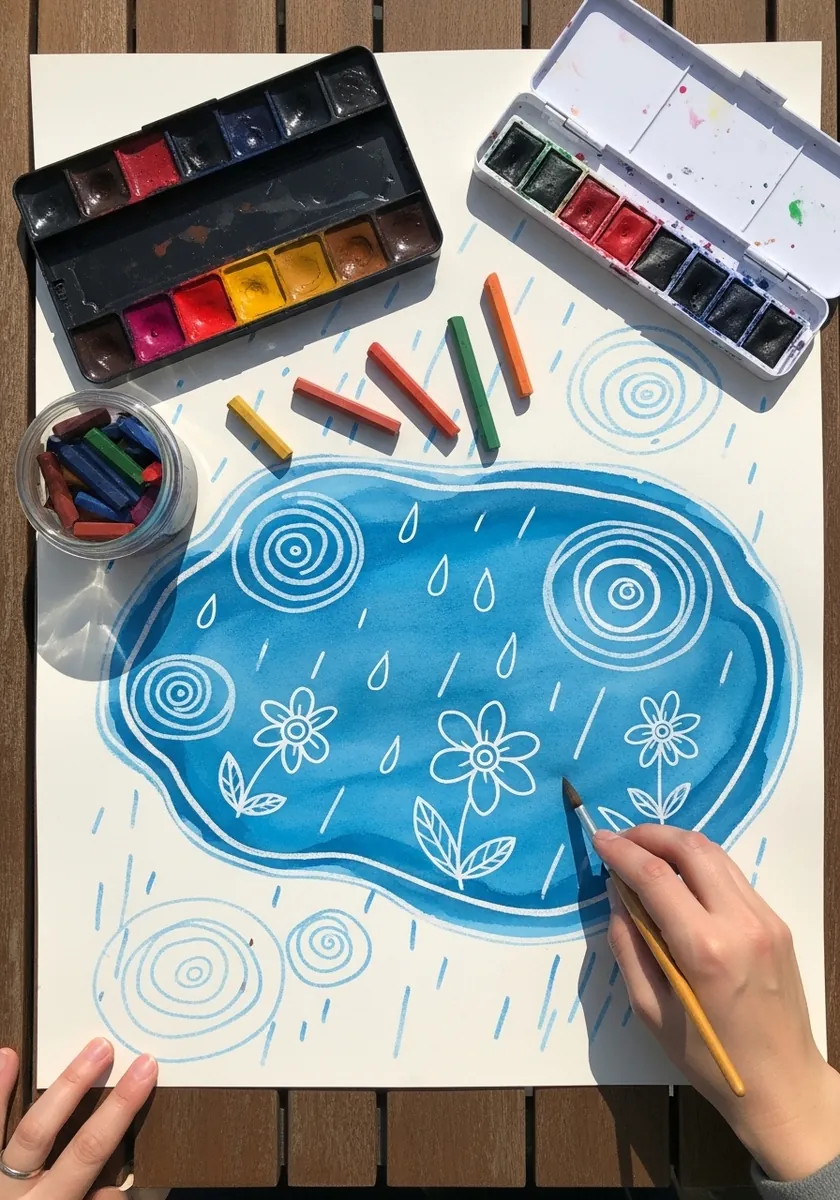
Flat design ignores physics on purpose. Draw the puddle as one solid blue shape with a wobbly outline, add rings and raindrops as simple line symbols, and use no shading at all. Consistency of style matters more than accuracy here.
19. Muddy Country Lane
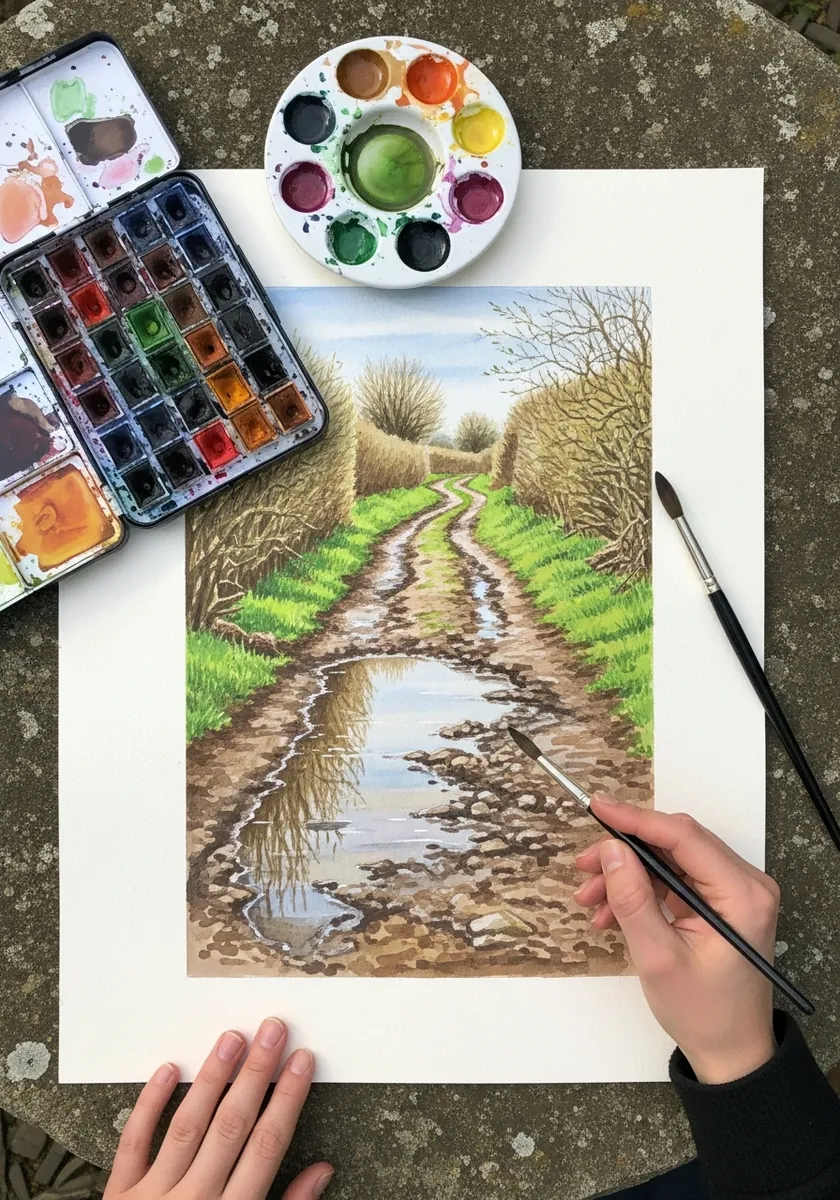
Ruts hold water in long thin strips. Draw two parallel tracks running back into the distance, fill them with pale sky color rather than brown, and keep the mud between them warm and dark. That color difference is the whole effect.
20. Bamboo and Rain in Ink
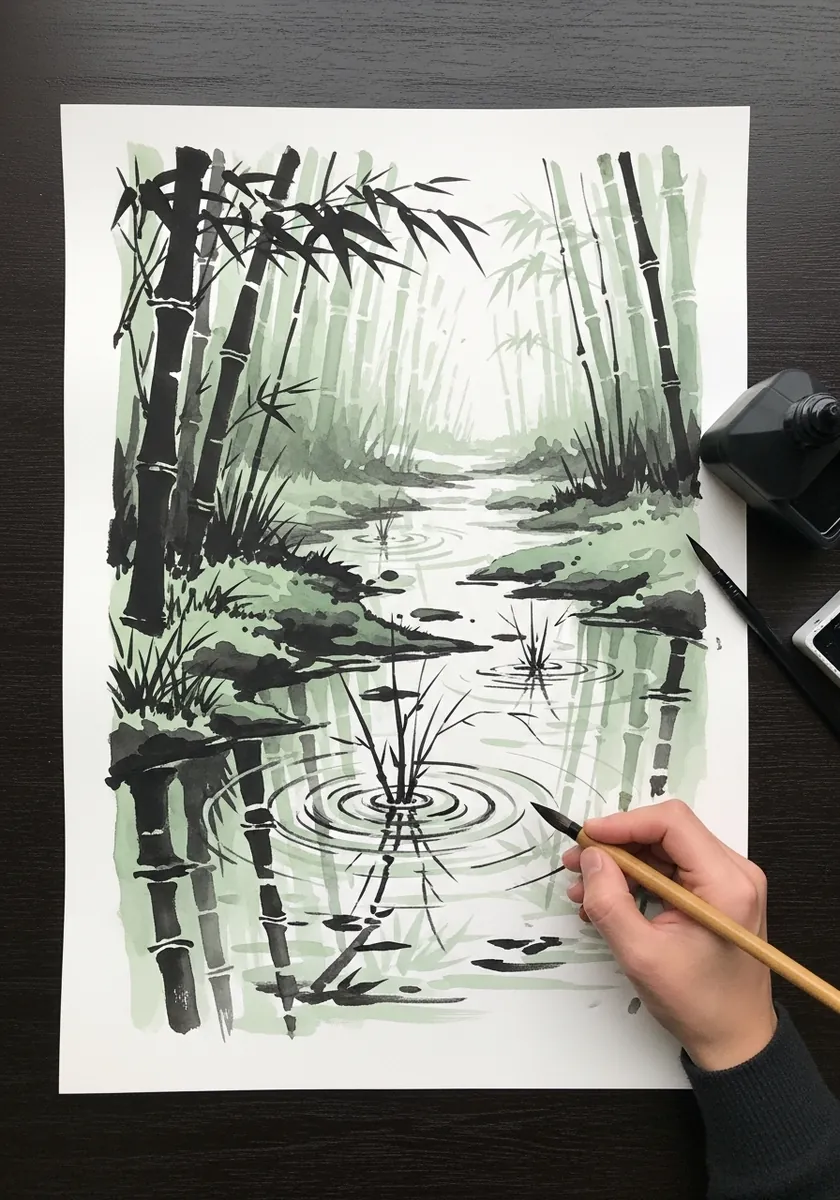
Sumi-e says the most with the fewest marks. Paint the bamboo in single confident strokes, add three or four ripple ellipses below, and leave the rest of the paper empty. Restraint is the technique. Stamp a small red seal near one corner, which is how the tradition finishes a sheet.
21. Pond With Lily Pads
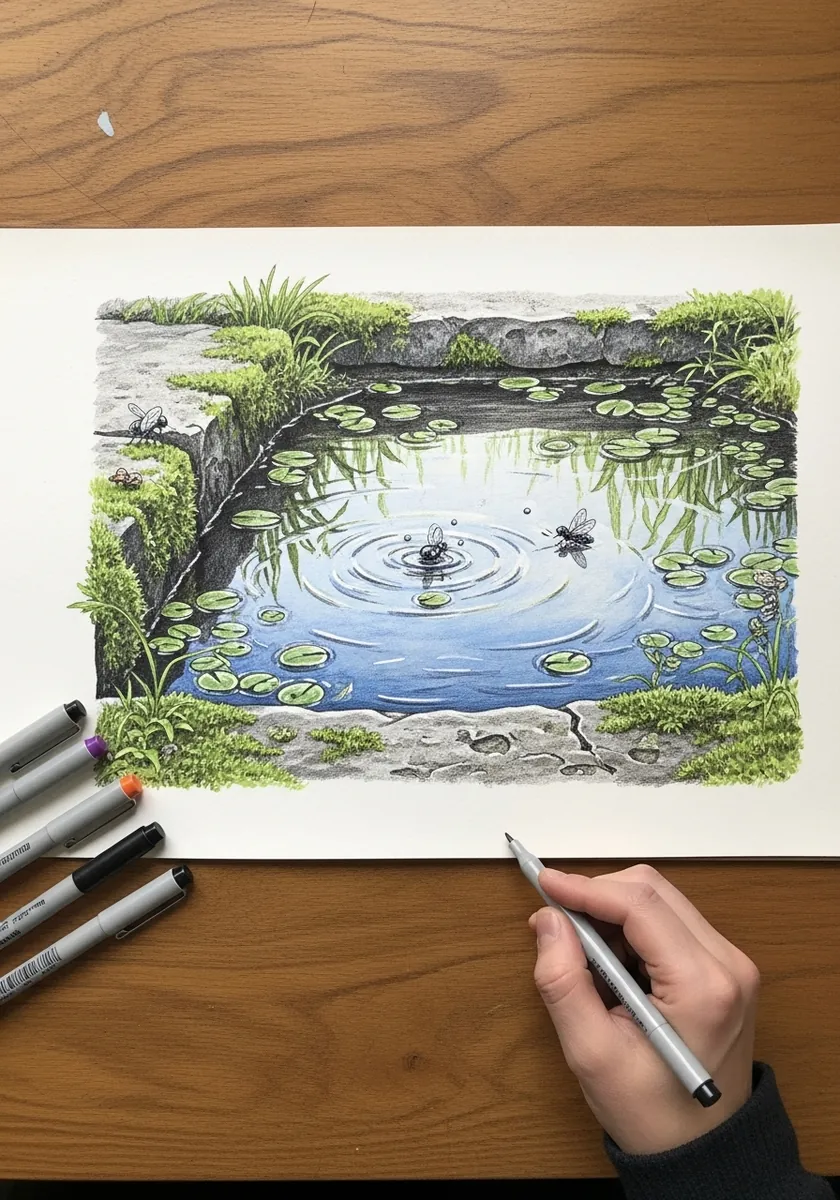
Lily pads sit on the surface, which makes the water level obvious. Draw each pad as a flattened ellipse with a notch cut out, give it a thin dark line where it meets the water, and let the ripples pass around it.
22. Willows and Water Lilies
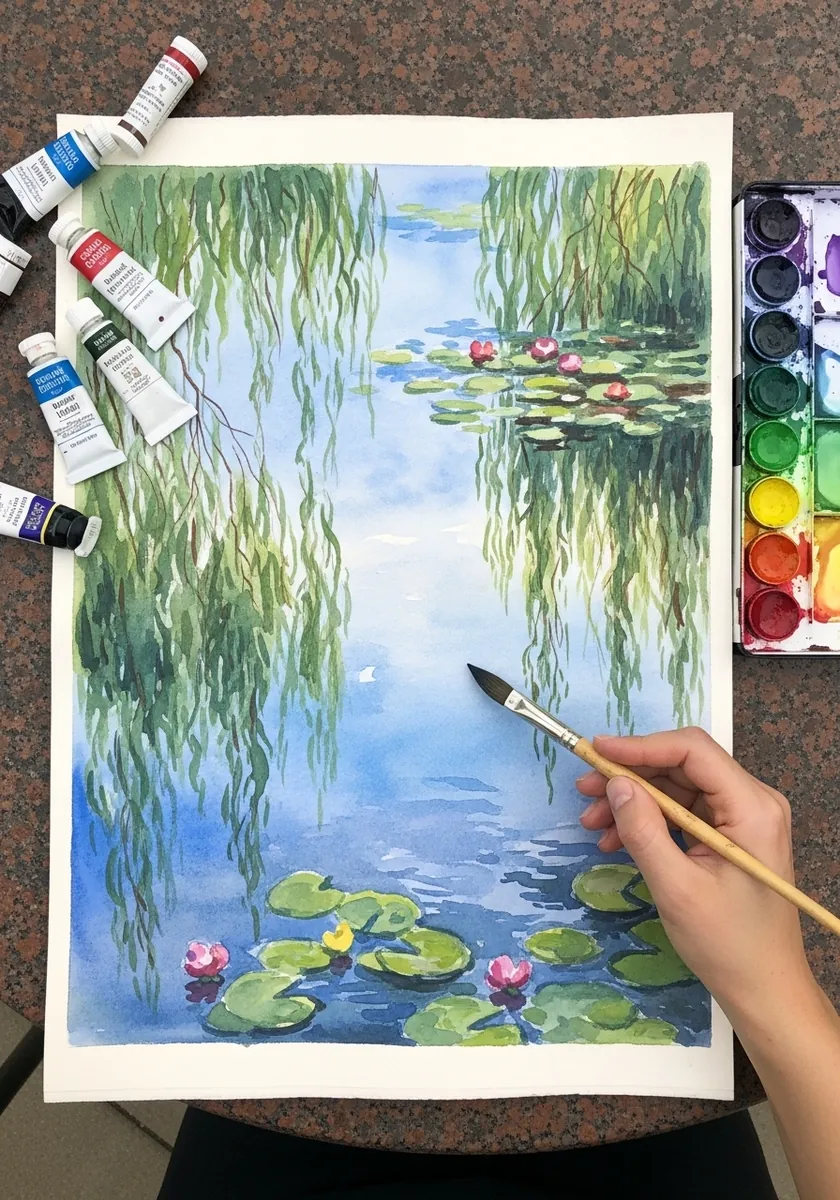
Overhanging branches darken the water beneath them. Deepen the tone directly under the willow, keep the open water beyond it pale, and let the lilies sit brightest where the light reaches. The shadow shape organizes the whole picture. Keep the willow leaves as flicked marks rather than drawn individually.
23. Reflection of a Girl With an Umbrella
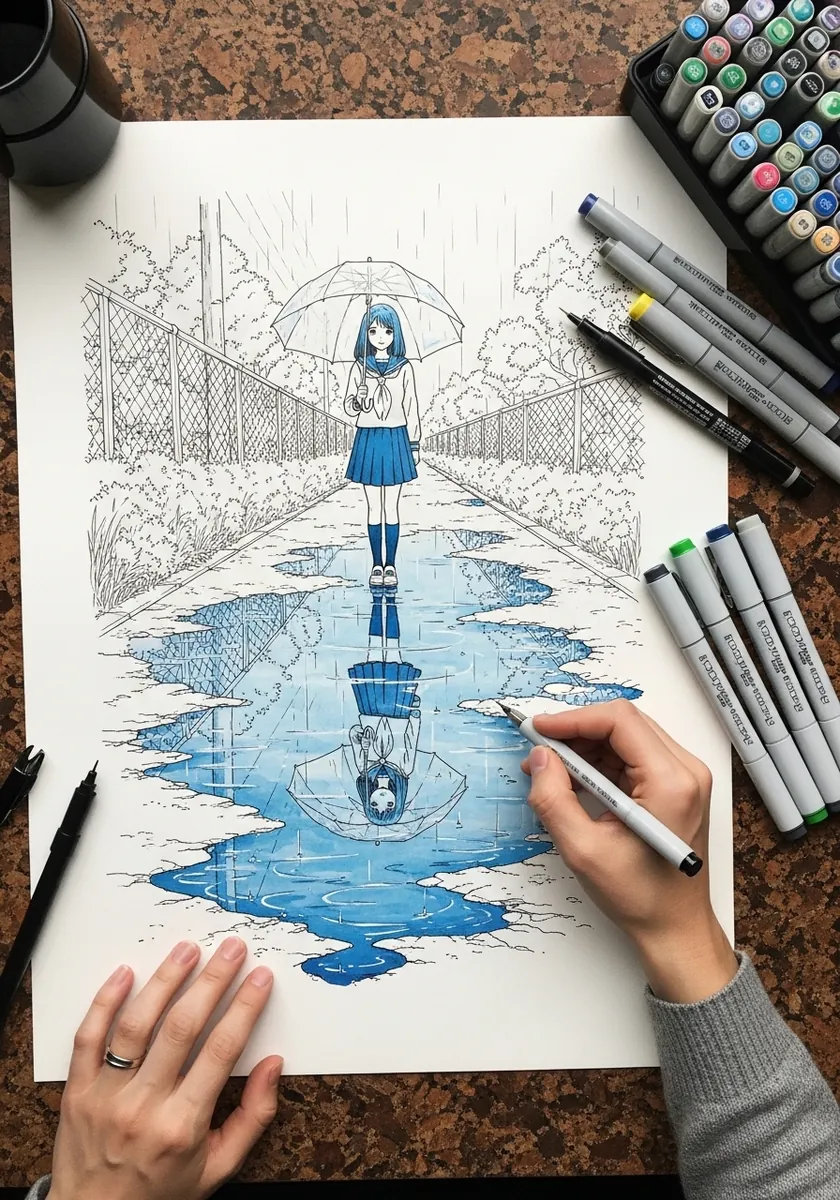
Figures reflect from the feet, not from where they appear to stand. Start the reflection exactly where the shoes meet the water, run it straight down, and remember the umbrella will appear at the very bottom of the reflection. Keep the figure above simple, since the reflection is the interesting half.
24. Child Splashing
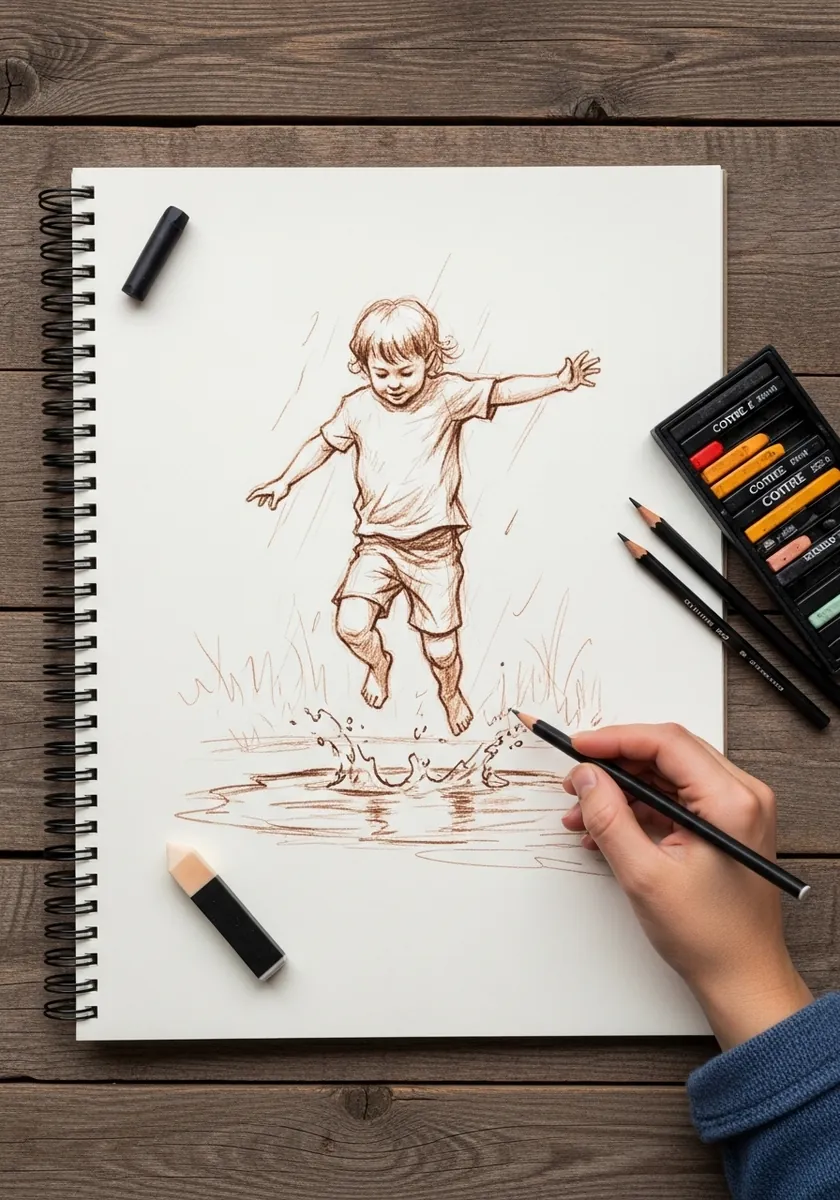
A splash is drawn as shapes, not droplets. Put a ring of pale wedges rising outward from the impact point, keep the largest nearest the foot, and add only a few separated drops above. Too many drops read as snow.
25. Stream Over Stones
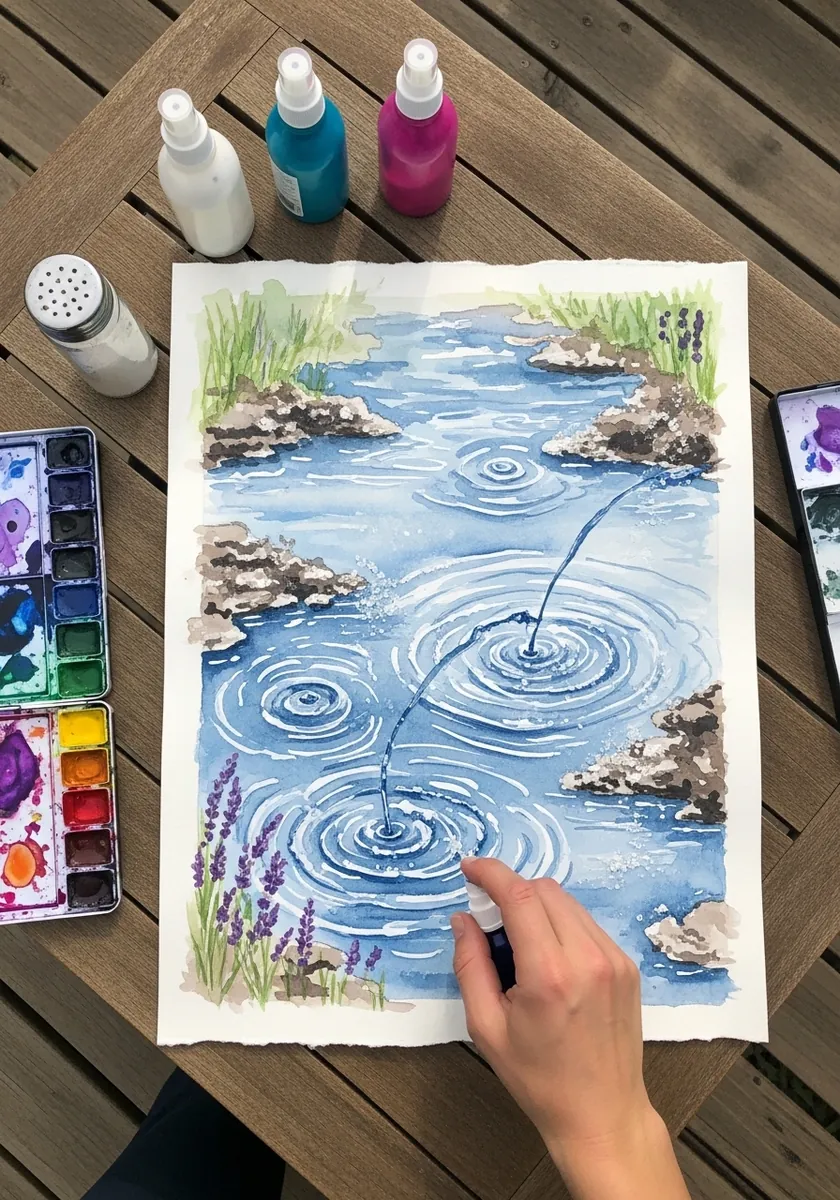
Shallow water shows what is underneath it. Paint the stones first and let them dry, then glaze a pale blue over them, and add a few sharp white marks on the surface. Depth comes from the layering. Vary the stone sizes, because evenly sized pebbles look like a pattern.
26. Mandala Puddle
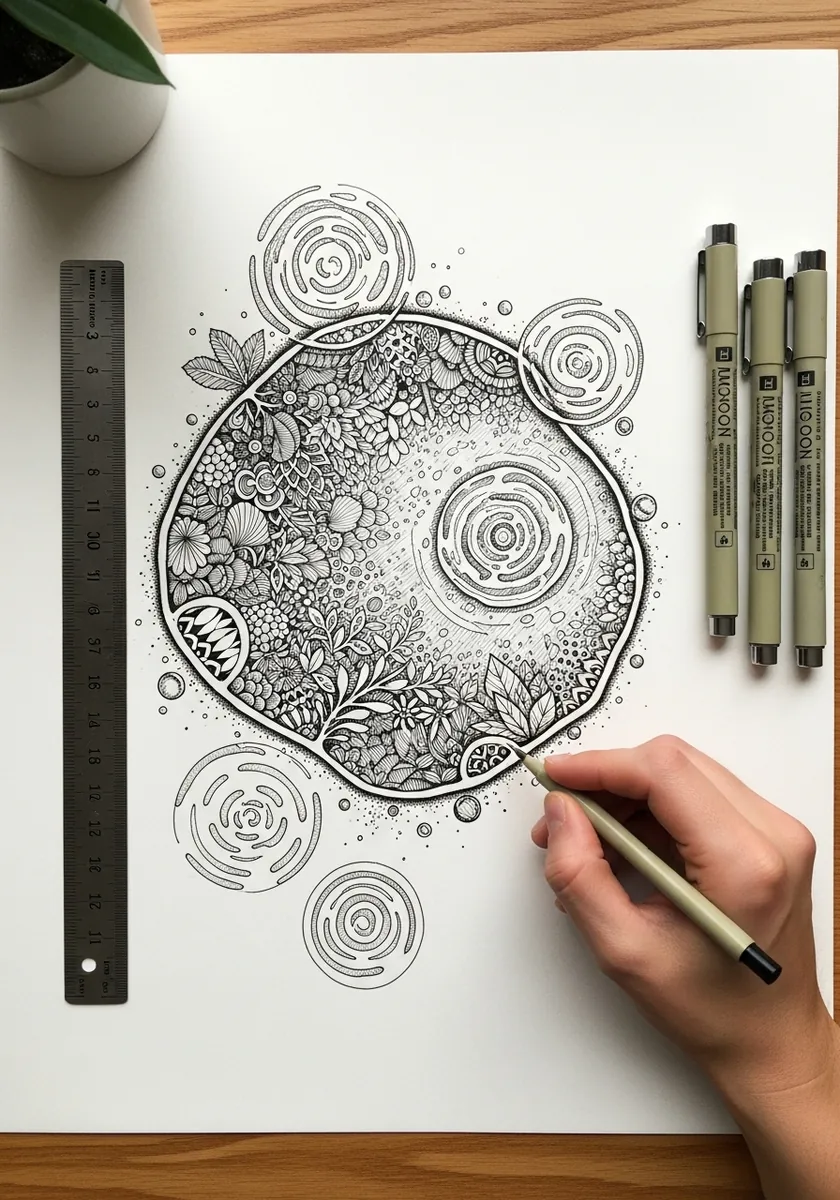
Concentric ripples are already a mandala. Start with a dot at the center and work outward in rings, filling each ring with a different repeating motif, and keep every ring exactly the same width all the way round. Work outward rather than inward, since a spiral drawn inward rarely stays even.
27. Flower-Lined Stream
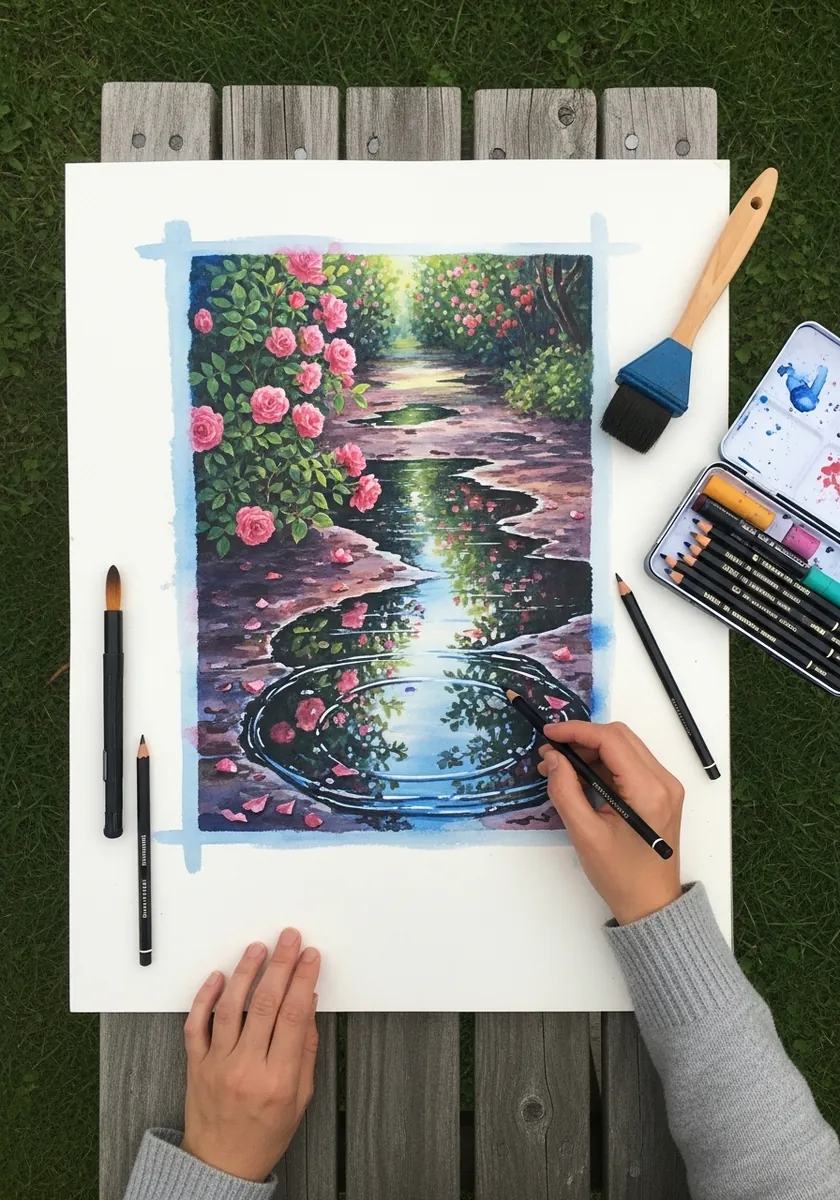
Color reflects far more than shape. Drag the pinks and greens from the banks straight down into the water in soft vertical bands, keep them all duller than the flowers above, and break them with horizontal strokes. Keep the far bank higher than the near one so the water clearly runs toward you.
28. Dramatic Sky on Wet Sand
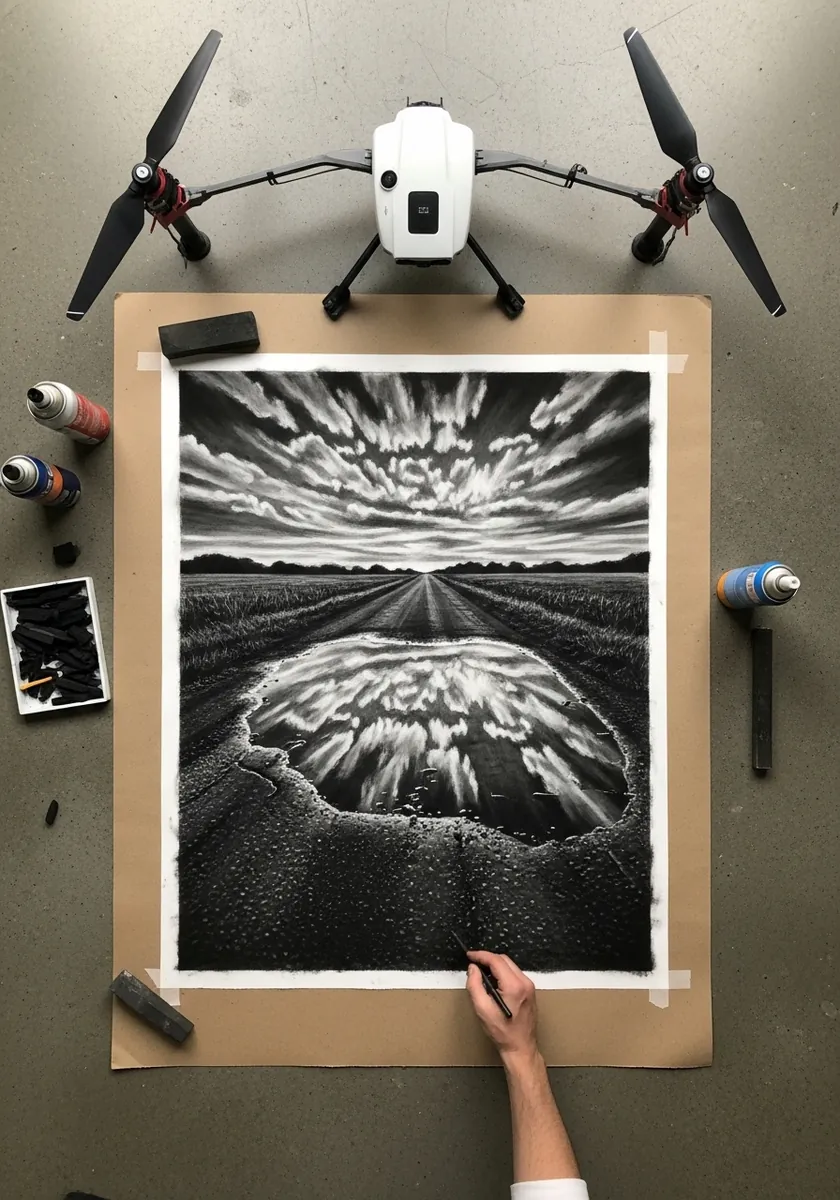
Wet sand reflects a sky in a very compressed way. Keep the reflected clouds much softer and grayer than the real ones, run them in horizontal bands, and let the sand nearest the viewer stay almost dry and pale. Leave one wet strip catching the brightest light, which gives the sand its shine.
29. Town Square in the Rain
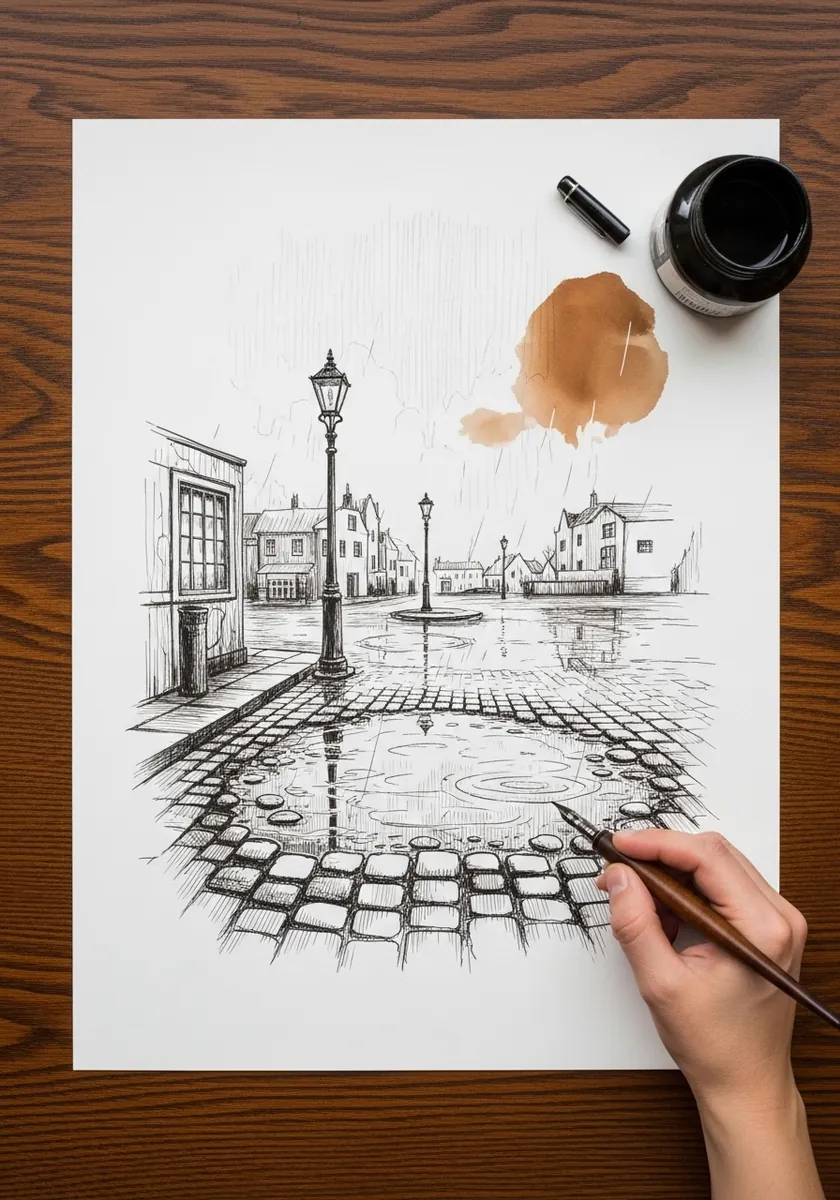
A whole square of reflections needs a hierarchy. Reflect only the two or three tallest or brightest things fully, suggest the rest with short broken marks, and keep the foreground water simplest of all. Keep a few figures small and dark to give the buildings their scale.
30. Stained Glass Puddle
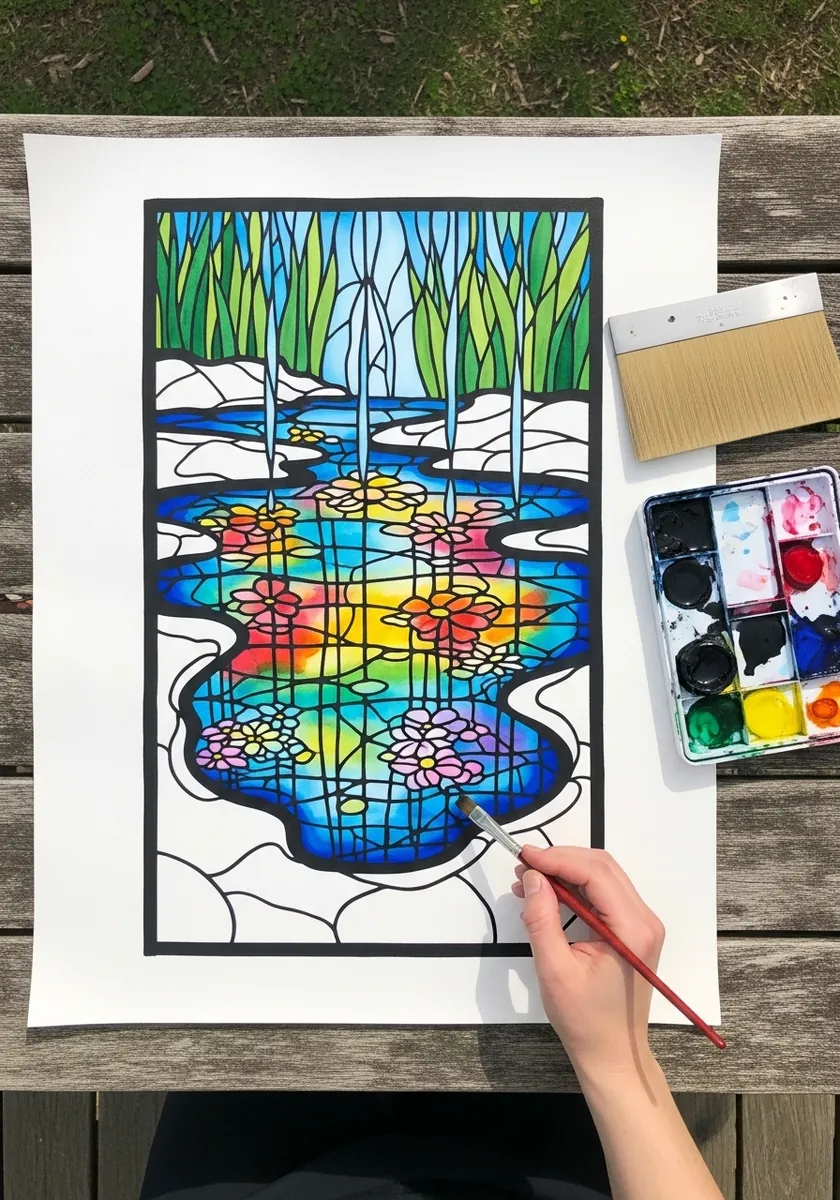
Stained glass turns water into pattern. Divide the puddle into irregular panels with thick black lines, fill each with a single flat color, and keep the colors brightest at the center; nothing here should look wet at all. Leave every black line the same weight, as real leading would be.
31. Rainbow in a Puddle
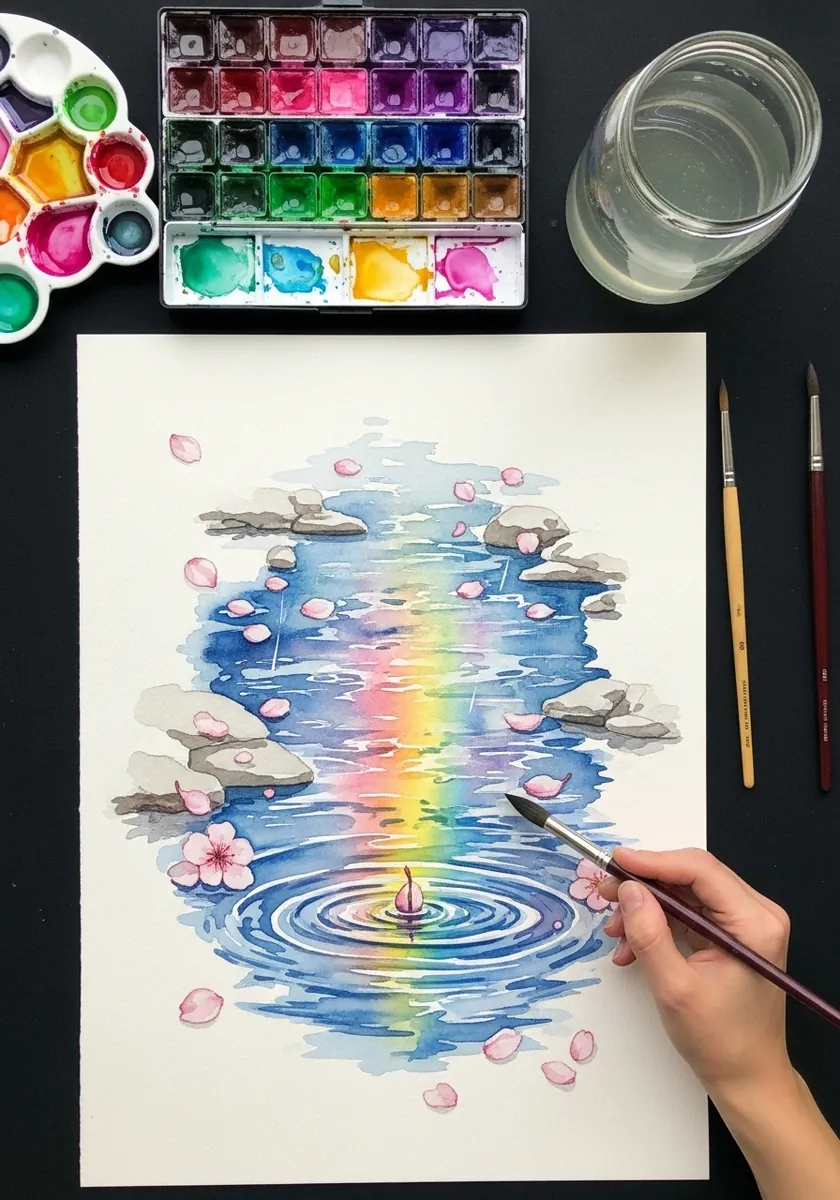
Finish with the hardest reflection to get right. Keep the rainbow in the water much fainter than one in the sky would be, curve it the opposite way, and let the ripple rings cut across it in flattened ellipses. Keep the sky above pale and empty so the water holds all the color.
Frequently Asked Questions
Why do my reflections look wrong?
Usually because they are too strong. A reflection always has a narrower value range than the object above it, so lighten the darks and dull the lights. Copying the object exactly and flipping it is what makes water look like a mirror rather than a puddle.
Which way does a reflection go?
Straight down, on a vertical line from the object. Its position never shifts sideways with the viewer, which is why a lamp post at the edge of a scene still reflects directly beneath itself rather than leaning into the middle of the puddle.
How do I draw ripples correctly?
As ellipses, not circles. You are looking at the water surface at an angle, so the rings flatten, and the further from you they are the flatter they become. Rings near the bottom of the picture stay closer to round.
How do I make ground look wet?
Darken it and give it hard edges. Wet tarmac or stone is noticeably darker than dry, holds a sharp reflection, and shows a bright edge where the water meets the dry surface. That dry-to-wet boundary is what sells it.
What is the easiest rain scene to start with?
A single puddle on a path with one object reflected in it. One reflection lets you concentrate on the value compression and the vertical drop without having to manage a whole street of them at once.
References and Further Reading