
You cannot draw what you see in your head because the mental image is far less detailed than it feels, it shifts every time you look away from the page, and much of what you are recalling is a stored symbol rather than an actual picture. The fix is not more freehand practice from imagination: it is drawing from reference to build a visual library, and learning a construction order for each subject so there is a route from the idea to the marks.
Key takeaways
- Mental imagery reports confidence, not resolution — it has no answer for the details drawing demands.
- Familiar subjects are hardest because you store a label and a rough arrangement, not a picture.
- Working memory refreshes constantly, so an imagined subject drifts while you look down at the page.
- A small minority of people have no visual imagery at all and still draw well by using construction.
- Your taste outruns your hand because it was trained on other people's finished work.
- Reference drawing stocks the library that imagination later runs on — it is not cheating.
You can picture it perfectly. The pose, the lighting, the mood, the whole thing. Then the pencil touches the paper and what comes out is stiff, generic and nothing like it, and the obvious conclusion is that your hand is not good enough yet.
The hand is almost never the problem. The mental image is far less detailed than it feels, it does not stay still, and a lot of what you think you are seeing is a label rather than a picture. Once you know what is actually going on, the gap stops feeling like a talent deficit and starts looking like a set of solvable problems.
1. The Image in Your Head Is Much Blurrier Than It Feels
Mental imagery feels vivid because your brain reports confidence, not resolution. Try it: picture a tiger, then answer how many stripes are on its shoulder, which direction they run, and where the ear notch sits. The picture that felt complete a second ago turns out to have no answer to any of that.
You are not remembering an image so much as remembering the gist of one, and reconstructing the rest on demand. Drawing is the one activity that demands every detail at once, which is why it exposes the shortfall that everyday thinking never does.
2. You Are Recalling a Symbol, Not a Picture
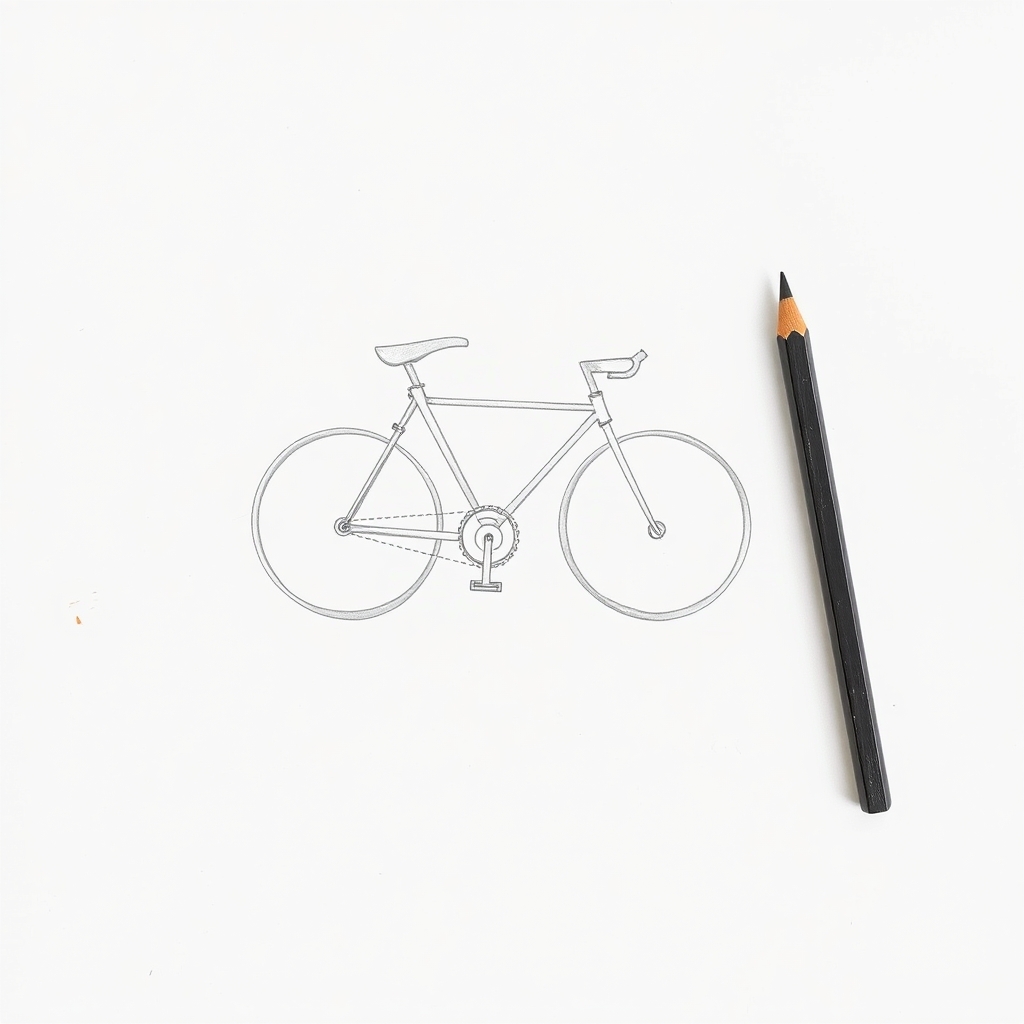
A well-known psychology experiment asked adults to complete a simple side-view drawing of a bicycle. A large share produced frames that could not possibly work: bars running through the wheels, chains connected to nothing, forks missing entirely. These were people who had ridden bicycles their whole lives.
The sketch above has exactly that flavor. It reads as a bicycle at a glance, yet the front wheel is not attached to the handlebars by anything, and the crank floats free of the frame. What you store is a label plus a rough arrangement, which is enough to recognize a bicycle instantly and nowhere near enough to draw one.
This is why familiar subjects are the hardest. Hands, faces and bicycles all fail for the same reason, and it is the same mechanism behind most of the faults in why do my drawings look bad.
3. The Image Will Not Hold Still Long Enough
Even when the mental picture is good, it is running on working memory, which holds very little and refreshes constantly. Look down at the page for four seconds to draw a jawline and the image you look back up at is subtly different: the head has turned, the light has moved, the expression has drifted.
You then end up drawing a composite of six slightly different versions, which is why imagined drawings so often feel oddly incoherent even when every individual part is fine. A reference photo does not make you a worse artist. It removes a variable you cannot control.
4. Some People See Nothing at All, and Still Draw Well
A small minority of people report no voluntary visual imagery whatsoever. They can think about a beach without seeing one. This is called aphantasia, and if it describes you, the instruction to “picture it first” has been useless advice your whole life.
Plenty of working artists fall into that group. They build drawings from knowledge and construction rather than from an inner screen, which turns out to be a perfectly good route to the same place. Vivid imagery is not a prerequisite for drawing, and having it is not the advantage it appears to be.
5. Your Taste Is Ahead of Your Hand, on Purpose
You have looked at far more finished art than you have made. Your judgment was trained on other people’s best work, so it is calibrated years ahead of your output, and the imagined version you compare against is really a memory of somebody else’s finished piece.
This gap is uncomfortable but it is also the thing that makes improvement possible. An artist who cannot see the difference between their work and better work has no direction to move in. Feeling dissatisfied is a working instrument, not a verdict.
6. There Is No Route From the Image to the Page
Suppose the picture in your head really is detailed and stable. You still need a procedure that turns it into marks in a workable order, and that procedure is construction: big shapes first, relationships second, detail last. Without it you start at one edge and draw outward, hoping it fits.
This is the whole reason step-by-step methods exist. Drawing hands begins with a palm box and drawing a nose begins with a ball, not because those look like the finished thing, but because they are the order in which decisions can actually be made.
What Actually Closes the Gap
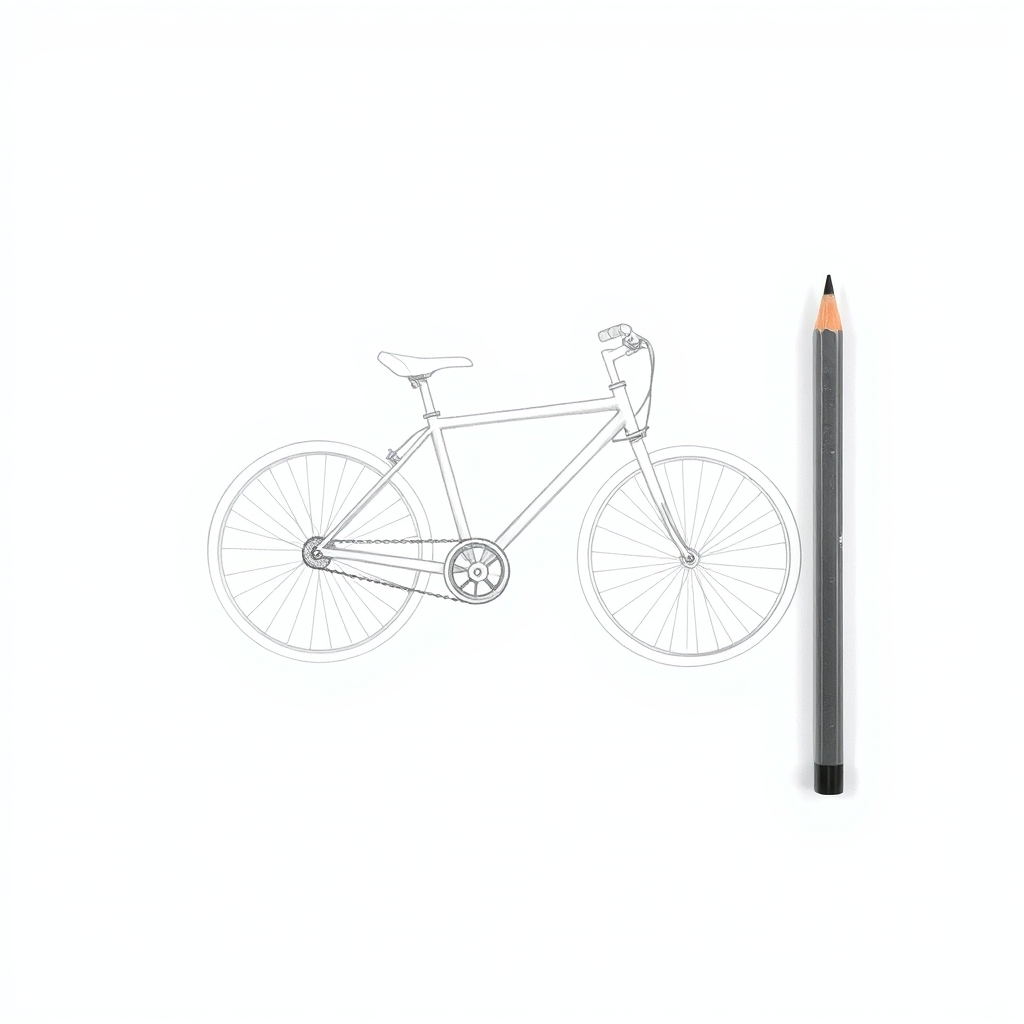
The same subject, drawn while looking at one. The frame closes, the fork reaches the wheel, the chain connects two things that could actually turn. Nothing about the hand changed between these two drawings. The only difference is that the second one was drawn from information rather than from a label.
- Draw from reference far more than you think you should. Every observed drawing deposits real information you can later recall. Imagination runs on that library, so the library has to be stocked first.
- Draw the same subject repeatedly. Five hands in one sitting beats one hand in five sittings, because the corrections are still fresh when you apply them.
- Thumbnail before you commit. Six tiny compositions at postage-stamp size, two minutes each. The mental image gets tested at a scale where being wrong costs nothing.
- Lower the resolution of the goal. Try to capture the pose and the value pattern only. Chasing the fully rendered version in your head guarantees a miss.
- Learn one construction method per subject. A repeatable order of operations is what converts a vague intention into a drawing.
None of this is fast, but all of it is mechanical. The gap between the image and the page is an information problem, and information is the one thing you can deliberately go and get.
Frequently Asked Questions
Why can’t I draw what I see in my head?
Because the mental image is far less detailed than it feels, it shifts every time you look away from the page, and much of what you are recalling is a symbol rather than a picture. Drawing from reference and using a construction method closes the gap faster than practicing freehand from imagination.
Is using reference cheating?
No. Working from reference is how nearly every professional builds the visual library that imagination later draws on. Copying someone else’s finished artwork and presenting it as your own is a different matter, but observing an actual subject is simply how the skill is acquired. The related argument about whether tracing counts as cheating splits the same way.
Does everyone see pictures in their head?
No. Visual imagery varies enormously between people, and a small minority experience none at all, a condition known as aphantasia. Many capable artists have little or no imagery and work from construction and knowledge instead, so it is not a barrier to drawing well.
How do I improve at drawing from imagination?
Build the library first. Draw the subject from life or photos many times, learn its construction, then attempt it from memory and check the result against reference. Imagination is recall plus construction, so both halves have to be fed.
Why does my drawing look worse the longer I work on it?
Usually because detail is being added on top of a structure that was never right. More rendering makes a proportion error more visible, not less. Stopping to check the big shapes against reference is more productive than continuing to refine.
Where to Go Next
If the frustration is more about how finished work turns out than about the imagining, why do my drawings look bad covers the seven faults that show up most often, and why watercolors feel so difficult makes the same argument for paint.
To start stocking the visual library, apple drawing ideas is the smallest useful observation exercise there is, and the drawing guide sets out which subject trains which skill and the order worth taking them in.