
Progress in drawing tracks the hours you spend at the page. The calendar tells you very little. Most people who practise a few hours a week with some feedback method reach a level they are happy showing others in one to two years, and drawing daily shortens that considerably. Simple objects stop looking like symbols at roughly 20 to 30 hours, proportion becomes reliable near 100 hours, and value control usually arrives around 300 hours.
Key takeaways
- Hours at the page decide progress, so two people with the same number of months can be far apart.
- Practice without a feedback method mostly repeats the same mistakes.
- Simple objects stop reading as symbols at around 20 to 30 hours of practice.
- Proportion becomes reliable near 100 hours, and value control around 300 hours.
- The 10,000 hour figure came from Gladwell's Outliers, and Ericsson said it misrepresented his research.
- Faces and hands stay hard longest because you carry a stored mental shortcut for both.
Every version of this question assumes the answer is a number of months, and it never is. Two people can both say they have been drawing for a year. One of them has done four hundred drawings and the other has done eleven. They are not at the same place and no calendar will tell you that.
So the useful unit is hours at the page, with one condition attached: something has to be telling you when you are wrong. Hours without feedback mostly repeat the same mistakes and feel like practice while doing very little.
What follows is the pattern we see most often. Treat the hour figures as rough. People vary enormously, and the order things improve in matters more than the exact totals.
What Usually Changes, and Roughly When
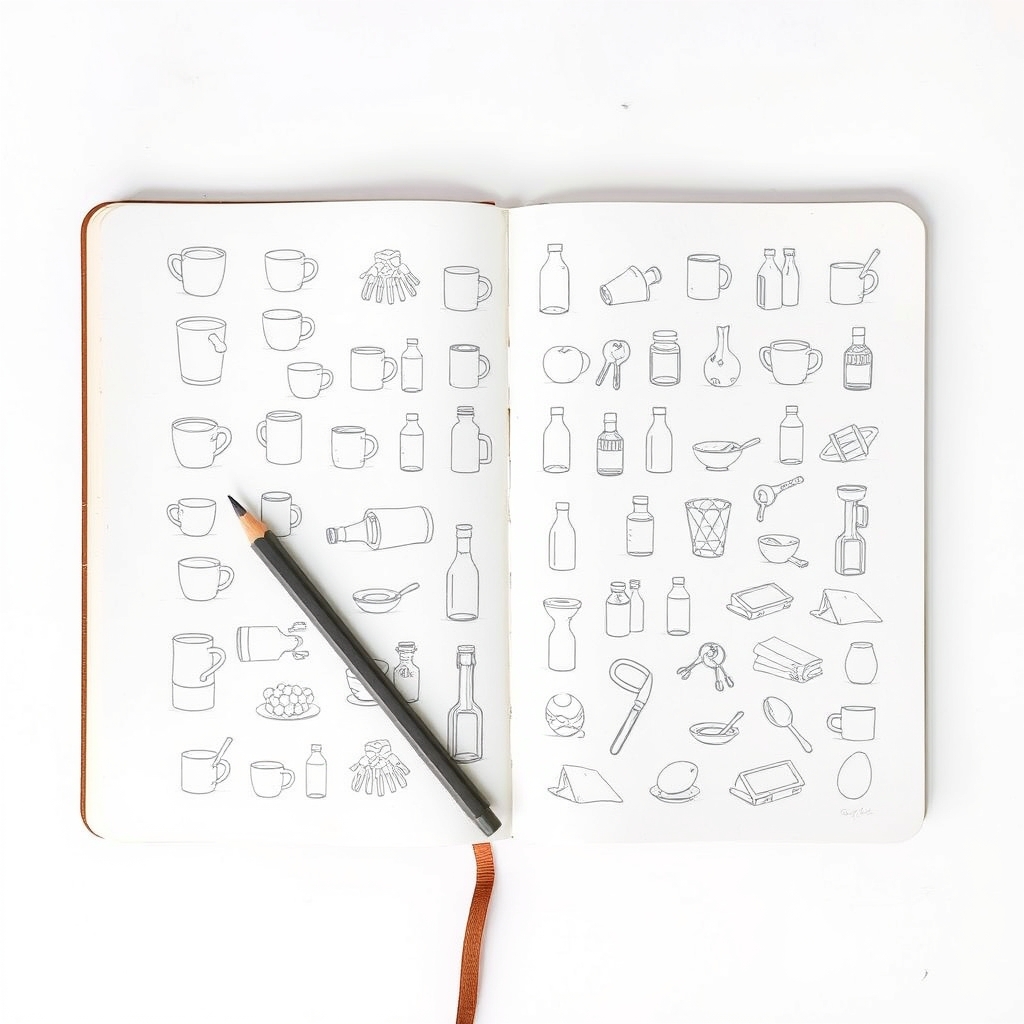
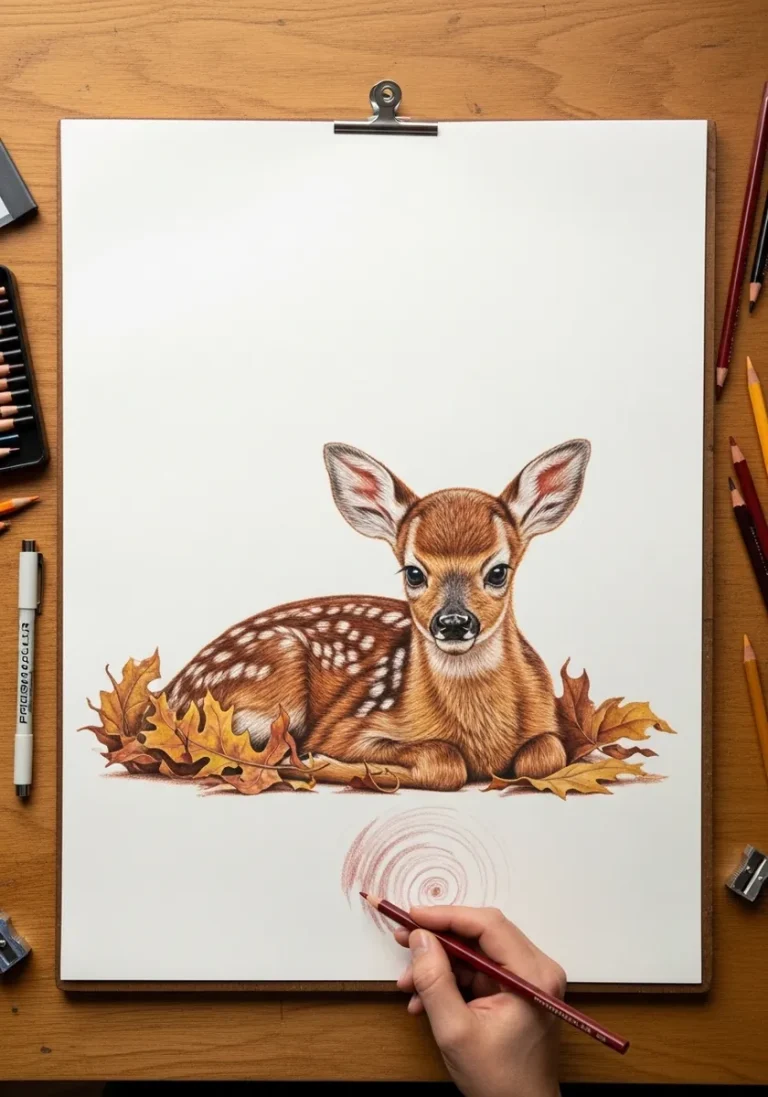
A page like the one above is worth more than a single careful drawing that took the same amount of time. Volume is what moves the early stages along, because most of what you are fixing is how you look at things rather than how you move the pencil.
- Around 20 to 30 hours, simple objects stop coming out as symbols. An apple starts behaving like a round thing with light on it instead of a circle with a stick.
- Around 100 hours, proportion on familiar subjects stops being guesswork. You can look at a cup and get its width against its height close enough that nothing looks off.
- Around 300 hours, value control arrives. Your drawings start looking solid because you finally commit to a real black and leave a real white.
- Somewhere past 500 hours, unfamiliar subjects become approachable. You can attempt something you have never drawn and get a usable result, because you are working from structure now.
Three or four hours a week puts the first milestone about two months out and the second somewhere in the second year. An hour a day compresses that considerably. Neither schedule is wrong, and the daily one wins mostly because corrections stay fresh between sessions.
Why Two People With the Same Hours End Up Miles Apart
This is the part that decides everything, and it has almost nothing to do with talent. Four habits account for most of the gap.
- Drawing only what you are already good at. It feels productive and teaches you nothing. The person who spends an evening failing at hands learns more than the person who draws their twentieth confident eye.
- Working with no feedback method. Flipping a drawing horizontally, squinting to check values, holding it up next to the reference: all of these take seconds and all of them tell you something your eyes will not.
- Drawing from imagination too early, before there is anything stored to draw from. That gap has its own article: why you cannot draw what you see in your head.
- Only doing long drawings. Two-minute studies train your eye. Two-hour studies train your rendering. Doing one of them exclusively is the standard way to plateau.
About the 10,000 Hour Figure
You will run into this number in every discussion of learning a skill. It comes from Malcolm Gladwell’s 2008 book Outliers, which drew on research into deliberate practice by the psychologist K. Anders Ericsson. Ericsson said afterwards that the round figure misrepresented his findings.
His actual point was about the quality of the hours. Practice that targets something you currently cannot do, with feedback on the result, produces improvement. Repetition of what you have already mastered produces very little, however many hours go into it. For drawing that distinction matters more than any total, and it is good news, because it means the number is smaller than 10,000 for most of what you want to do.
What Actually Speeds It Up
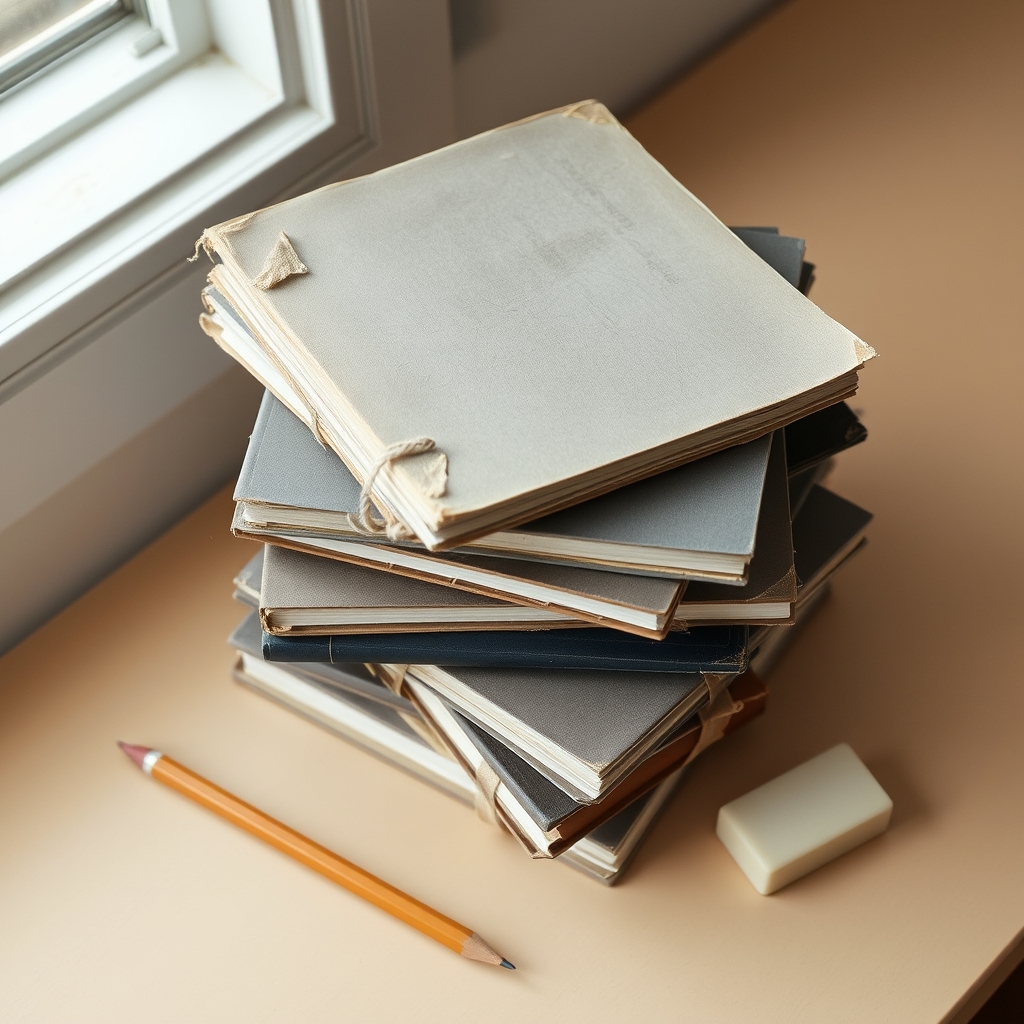
Nobody gets a stack like that in six months, and nobody gets good without one. Filled sketchbooks are the only honest record of how much work has gone in, which is also why keeping the bad ones is worth doing.
- Draw the same subject several times in one sitting. Five hands in an evening beats one hand a week for five weeks, since you can apply the correction while you still remember making the error.
- Work from reference far more than feels acceptable. Every observed drawing puts something in the library that imagination later runs on, which is also the reason tracing builds that library so slowly.
- Date every drawing and keep all of them. Comparing your work to your own from three months ago is the only comparison that tells the truth, and that same pile is where your art style becomes visible once there is enough of it.
- Learn one construction method per subject. A repeatable order of operations turns a vague intention into an actual drawing, which is what our step-by-step tutorials are built around.
- Vary session length deliberately. Short studies and long studies train different things.
Some Subjects Take Much Longer
General progress does not arrive evenly across every subject. A few of them lag badly behind the rest, and it is worth knowing which so you do not read it as a plateau.
- Faces and hands stay difficult longest, because you have seen so many that your brain has a stored shortcut fighting you the whole time. Our hands tutorial exists for exactly that reason.
- Anything with hard perspective, such as buildings and cars, improves in sudden jumps once the underlying rule clicks. Progress there is lumpy, so a flat month means very little.
- Landscapes and still life improve steadily and early, which makes them good for morale when the figure work is going badly.
- Anatomy from memory is the slowest of the lot. Assume years, and assume it runs alongside everything else rather than being something you finish.
Frequently Asked Questions
How long does it take to learn to draw well?
Most people who practise a few hours a week with some feedback method reach a level they are happy showing others somewhere between one and two years. Drawing daily rather than weekly shortens that considerably. The count that matters is hours and completed drawings, since a year of occasional sketching and a year of daily work are not comparable.
Can an adult still learn to draw from scratch?
Yes, and adults often move faster at the start than children do. Drawing rests on observation and patience, both of which adults have more of. The disadvantage is impatience with bad early results, which is what makes most adult beginners stop in the first month.
How long does it take to learn to draw realistically?
Realism depends mainly on value control and patience, so it arrives later than people expect and then improves quickly. Expect a few hundred hours before a realistic study of a simple object looks convincing. Realistic portraits take considerably longer, because small proportion errors are far more visible on faces.
How many hours a day should I practise?
Thirty focused minutes daily beats a single four-hour session at the weekend for most people. Consistency keeps corrections fresh and stops each session starting with a warm-up you have to repeat. Longer sessions become more useful later, once you are working on finished pieces.
Why does my progress feel like it has stopped?
Usually because your judgment improved before your hand did, so you are now able to see faults that were invisible to you six months ago. That feels like getting worse and is a sign of the opposite. It also helps to check that you have not drifted into drawing only what you are already comfortable with.
Where to Go Next
If your finished work is disappointing you rather than your rate of progress, why do my drawings look bad lists the seven faults behind most of it, along with the test that exposes each one. If you have stopped drawing altogether, what causes art block is the more useful read.
To put the hours in productively, the drawing guide sorts every subject by the skill it trains and the order worth taking them in, and apple drawing ideas is the smallest useful observation exercise to start counting from.