Short answer: Start with a simple tilted oval for the heart muscle, then add the aorta arching out of the top, the pulmonary artery crossing in front of it, and the four chambers in proportion before you shade anything. Get those big shapes right and the drawing reads as a real human heart, not a cartoon symbol, even if your shading is still simple.
This guide walks you through that 5-step method, helps you pick the right style for your goal, and then shows 18 finished heart studies to copy, adapt, or mix together.
In this guide
Drawing is a powerful act of creation, a way to translate the complex world within us onto a canvas. Whether you are a seasoned artist or just beginning to sketch, the act of putting pencil to paper is a journey of discovery and self-expression.
Our “Human Heart Drawings Ideas” collection is a starting point, a wellspring of inspiration to help you explore the intricate, symbolic, and deeply personal nature of this iconic organ.
Here, you’ll find a community dedicated to celebrating creativity in all its forms. We offer a diverse range of styles and techniques to help you develop your skills and find your unique artistic voice. Let the beating heart of your imagination guide you as you embark on your next creative adventure.
1. How to Draw an Anatomical Heart in 5 Steps
You do not need to memorise a textbook diagram. Work big to small: overall shape first, vessels second, chambers third, texture last. Use a light 2H or HB pencil for steps 1 to 3 so you can erase cleanly, then commit with a darker pencil only once the proportions look right.
1
Block in the tilted shape. Sketch a rounded form that leans slightly to the left, wider at the top and pointed at the bottom left. This point is the apex. If the apex points straight down, the heart will look stiff and symmetrical, which real hearts never are.
2
Add the aorta first. Draw the thick aorta arching up from the top centre and curving back down. It is the largest vessel and the anchor for everything else. Place it before the smaller vessels, or the top of the heart quickly turns into a tangle.
3
Add the pulmonary artery and veins. Draw the pulmonary artery crossing in front of the aorta, then the thinner pulmonary veins entering from the sides. Keep these vessels thinner than the aorta so the size difference reads clearly.
4
Mark the chambers and grooves. Lightly divide the lower two-thirds into the left and right ventricles, with the left side slightly larger and thicker-walled. Add the shallow groove running down the front surface. This one line does more for realism than any amount of early shading.
5
Shade last, from one light source. Pick a light direction and stick to it. Shade the grooves, the undersides of vessels, and the far side of the heart darkest, and leave a clean highlight along the front curve. Erase a small highlight back in if you over-shade; a kneaded eraser lifts graphite without tearing the paper.
Beginner tip: Draw the same heart three times at small size (about 10 minutes each) instead of once at large size. The second attempt is almost always visibly better, because your hand has learned where the aorta curves and where the apex sits.
2. Pick the Right Heart Style for Your Goal
Not every heart drawing needs to be realistic. Pick your goal first, then jump straight to the matching studies in the gallery below.
| Your goal | Start with these studies | Why they work |
|---|---|---|
| Learn real anatomy | 1, 3, 10, 13, 14 | Clear chamber shapes and vessel placement you can label and copy |
| Express an emotion | 2, 17 | Healing and pierced hearts carry a story without any words |
| Mix flowers and nature | 4, 6, 12 | Floral and natural elements soften the anatomical shape |
| Practise shading | 5, 7, 11, 15, 18 | Strong light, shadow and texture to build tonal control |
| Use bright colour | 16, 8 | Coloured pencil and sunset colour for a bold, energetic finish |
| Try something abstract | 9 | Freedom to break the anatomy rules on purpose, once you know them |
If you are new to pencil shading, practise on a simpler subject first: our easy pencil drawing ideas for beginners explain the three-pressure rule (light, medium, firm) that makes heart shading look smooth instead of scratchy.
The two guides below are the original creative and symbolism tips from this collection, kept exactly as written. Use them after the 5-step method, when you want your anatomical drawing to feel like art rather than a diagram.
How can I make my anatomical heart drawing more creative and less like a biology textbook diagram?
- Integrate Floral Elements: Combine the delicate beauty of flowers with the detailed structure of the heart. Try drawing vines wrapping around the arteries or have a bouquet of wildflowers spilling out from the aorta. This blends scientific accuracy with nature’s elegance.
- Explore Surrealism: Place the heart in an unexpected context. Imagine a heart floating in a cosmic landscape, or one encased in a glass jar, perhaps with a miniature city growing inside. This approach allows you to tell a story and evoke emotion beyond its biological function.
- Experiment with Textures and Materials: Use cross-hatching, stippling, or a mix of mediums like ink and watercolor to create unique textures. The veins could be made of tangled wires, and the muscles of stone or wood, transforming the heart into a piece of mixed-media art.
What are some meaningful ways to incorporate symbolism into my heart drawings?
- Connect to Nature: The heart can be a powerful symbol of life and growth. Draw a tree with roots forming the heart’s ventricles or birds flying from its chambers. This symbolizes the heart as the source of all life and a connection to the natural world.
- Utilize Line and Color Theory: Use a fragmented or broken heart to represent loss, and connect the pieces with glowing threads or light to signify healing and resilience. Color can also convey emotion—blue for tranquility, black for grief, or a gradient from a somber tone to a vibrant one to show emotional transformation.
- Combine with Other Objects: Pair the heart with a key and lock to represent opening oneself up to love, or with a compass to symbolize finding direction in life. These symbolic pairings can add depth and a narrative element to your artwork, making it more personal and thought-provoking.
Dive into our gallery and discover the boundless possibilities of human heart drawings. Start your masterpiece today and let your creativity flow!
3. The Heart Drawing Gallery
Browse all 18 finished studies below. Each one is shown with the original artist note from this collection, kept exactly as written, so you can see both the technique and the thinking behind it.
1. Realistic Heart Study on Sketchbook Paper

This drawing is an incredible study in realism, capturing the intricate textures of the human heart. The artist uses a precise hand to render the veins and arteries, creating a sense of three-dimensional depth. It’s a true celebration of anatomy, showcasing the beauty and complexity found within the body, almost like a piece of scientific art.
2. Healing Heart on Sketchbook Paper
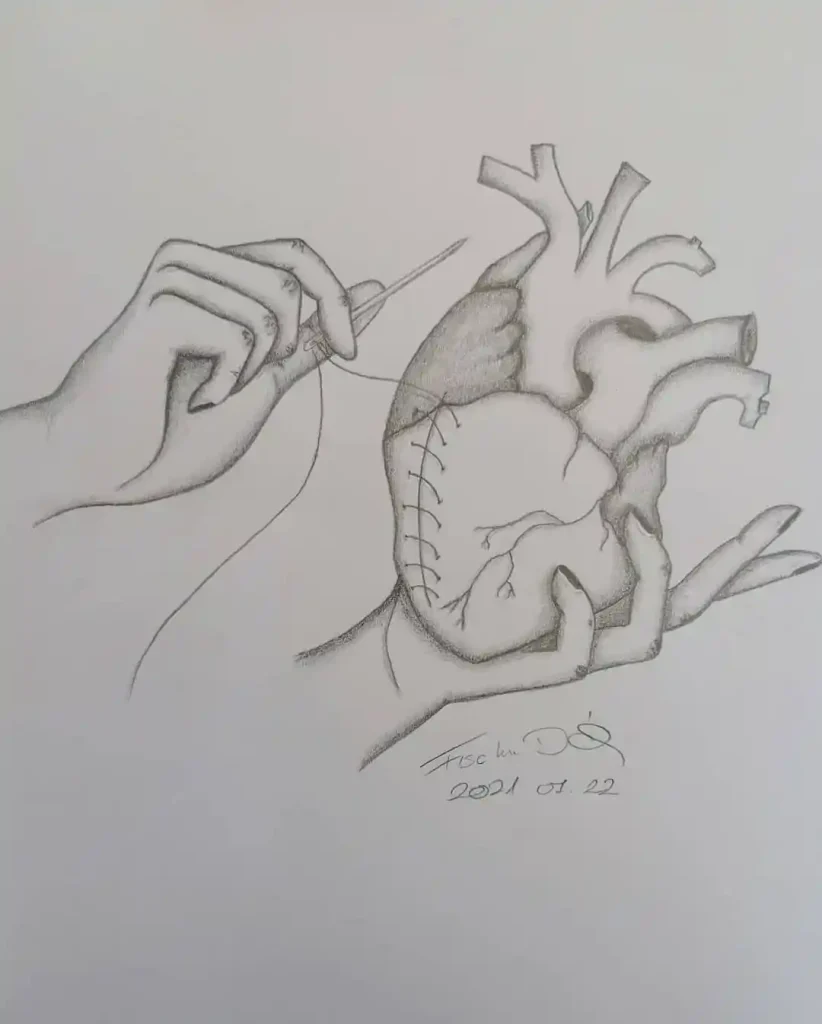
A poignant drawing, this piece beautifully illustrates the process of healing and restoration. The artist’s hands are carefully mending a broken heart with a needle and thread, a powerful metaphor for overcoming emotional pain and putting oneself back together. It’s a hopeful and deeply personal piece that speaks to resilience and inner strength.
3. Anatomical Heart Study on Sketchbook Paper
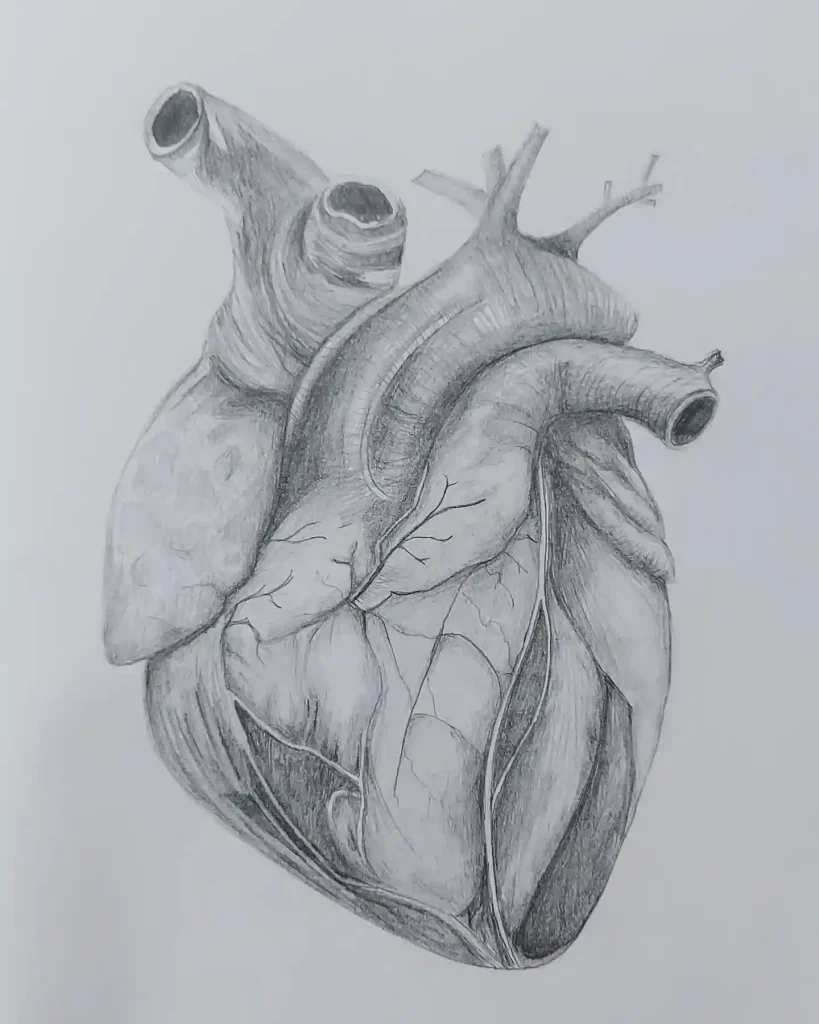
This drawing stands out for its meticulous detail and expert shading. The artist’s focus on the delicate surface veins and sinews gives the heart a lifelike quality. It feels both scientific and artistic, a testament to the fact that the human body itself can be a masterpiece, inspiring awe and a closer look.
4. Floral Heart Fusion on Sketchbook Paper
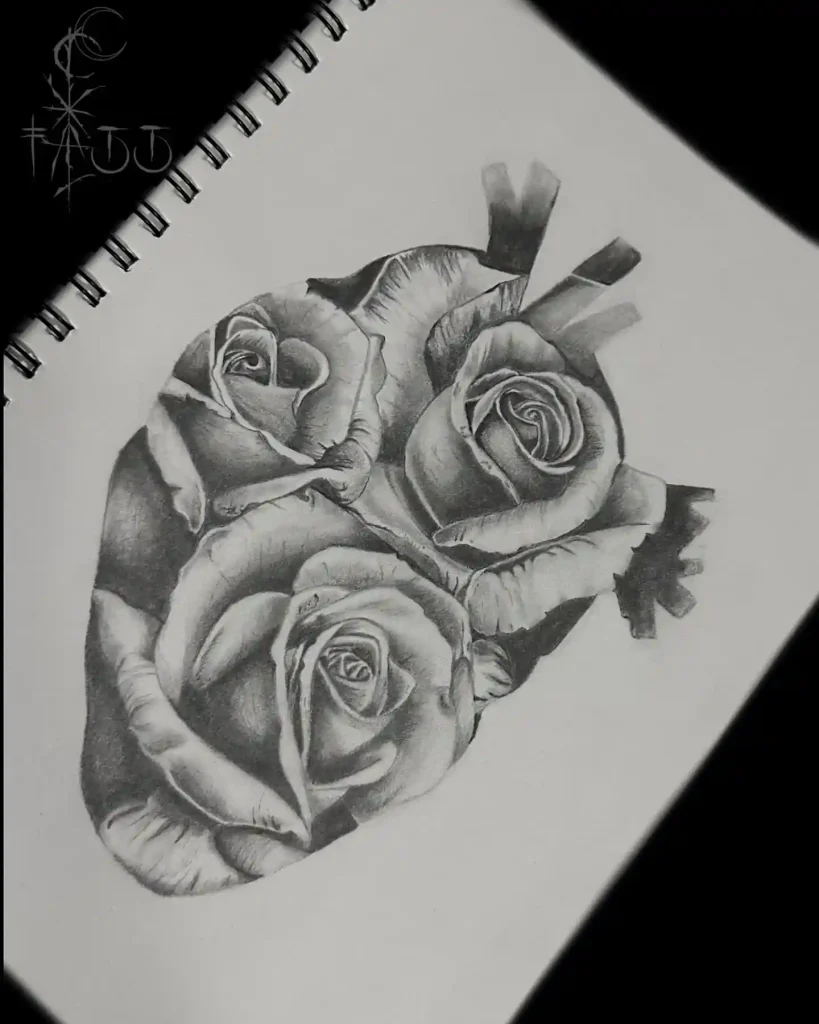
What a stunning blend of nature and anatomy! This drawing creatively replaces the muscle of the heart with three beautifully rendered roses. The delicate petals and leaves intertwined with the heart’s outline symbolize love, passion, and the organic connection between our emotions and our physical form. It’s a romantic and intricate piece.
5. Shaded Heart Drawing on Sketchbook Paper

This bold, high-contrast drawing showcases an impressive mastery of shading. The deep shadows and bright highlights give the heart a dramatic, almost sculptural presence. A mechanical pencil and eraser rest nearby, a little nod to the tools and process behind the creation of this powerful, lifelike anatomical study.
6. Heart in Nature on Sketchbook Paper
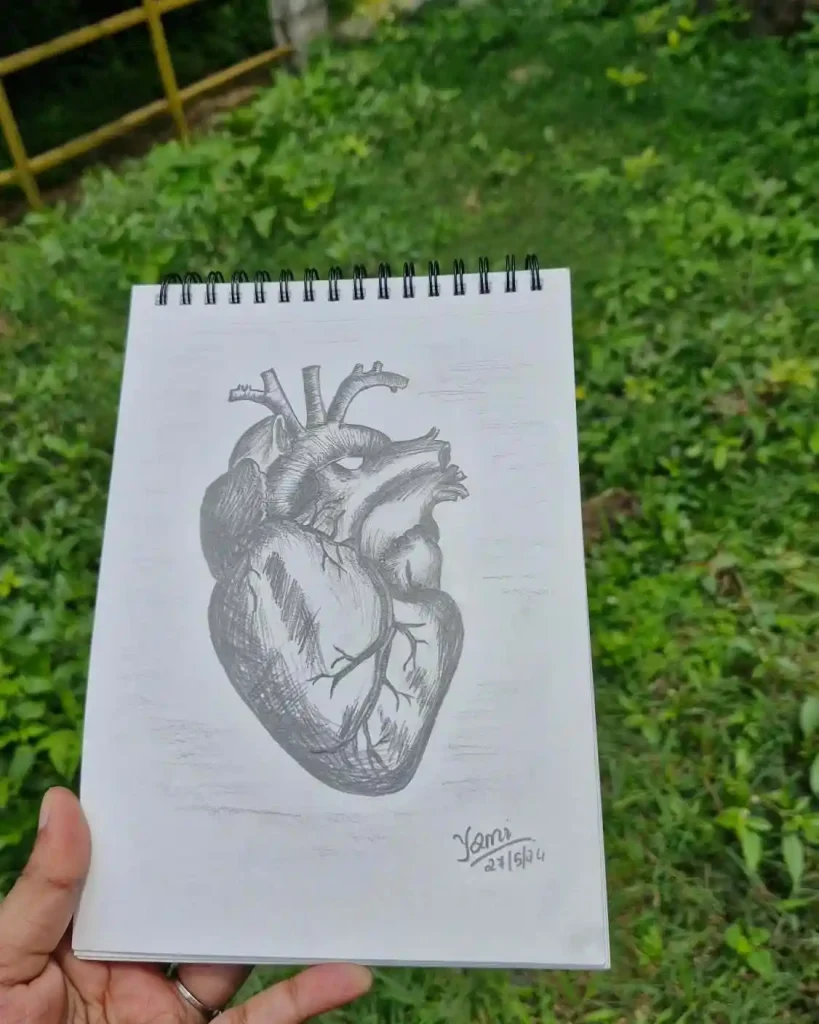
Captured against a lush, green background, this drawing feels like an ode to the heart’s connection to life and nature. The artist’s shading is soft yet defined, giving the heart a gentle, organic feel. Holding the drawing outdoors creates a beautiful contrast between the art and the living world that inspired it.
7. Dramatic Shaded Heart on Sketchbook Paper
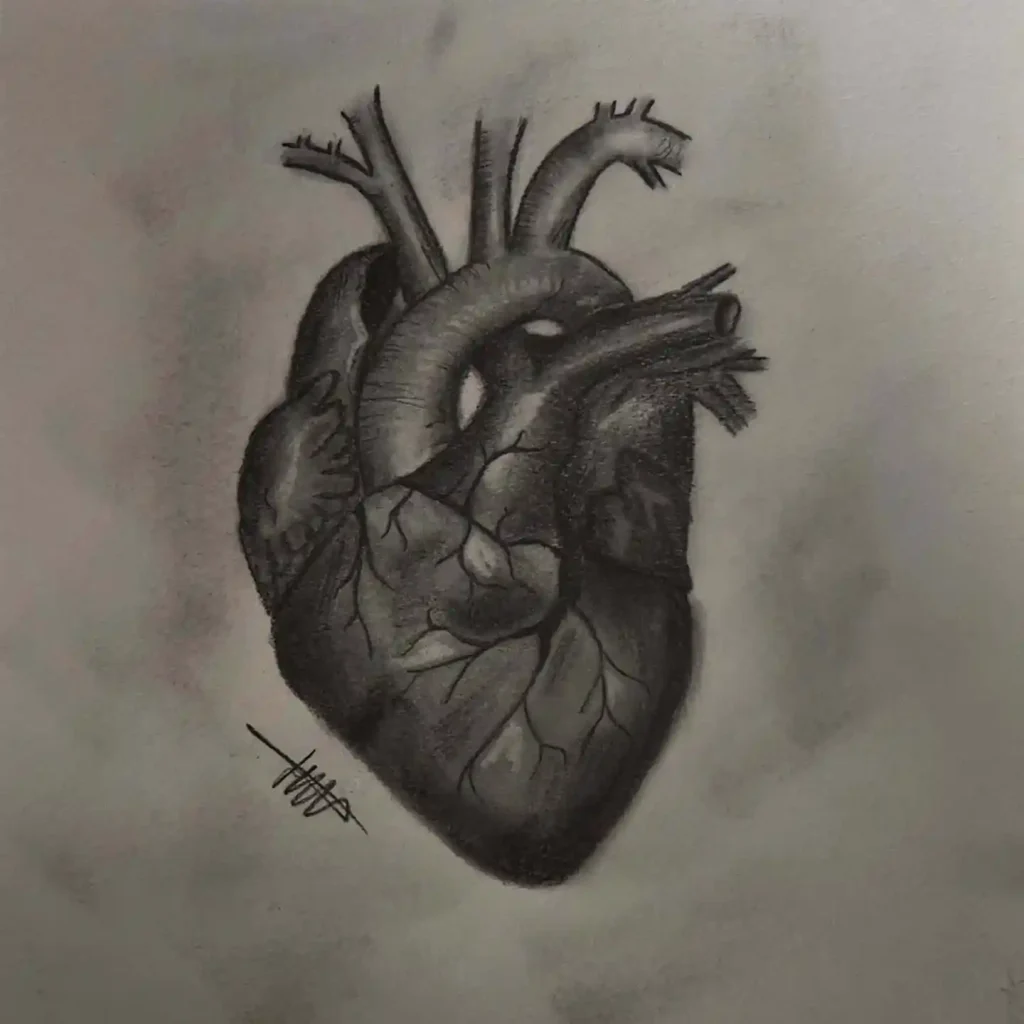
This piece is all about mood and atmosphere. The soft, smoky background enhances the dramatic, heavily-shaded heart, giving it an ethereal quality. The artist uses a charcoal-like effect to create deep shadows and subtle highlights, making the heart feel almost like a timeless relic or a symbol of deep, ancient emotions.
8. Heart at Sunset on Sketchbook Paper
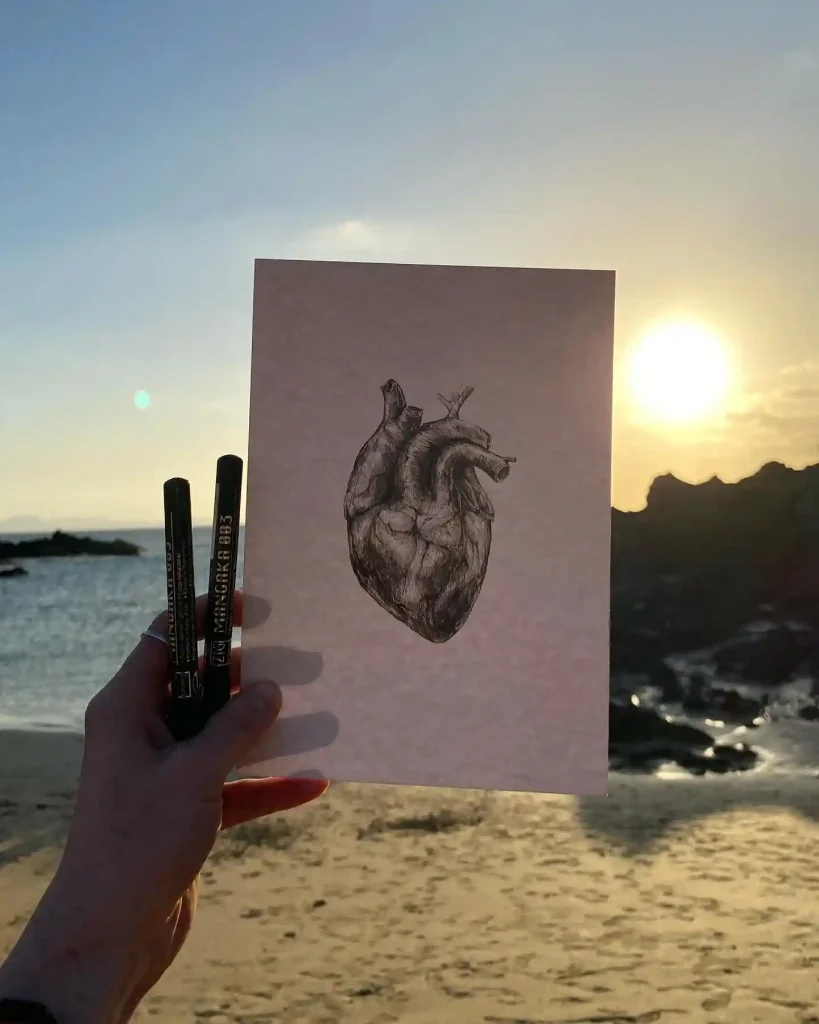
The beautiful photograph of this drawing at sunset on a beach makes it feel like a cherished memory or a travel keepsake. The heart drawing itself is finely detailed, with cross-hatching and shading that give it a vintage, etched feel. It symbolizes a heart open to new experiences, bathed in the glow of a new day or a memory.
9. Abstract Heart Drawing on Sketchbook Paper
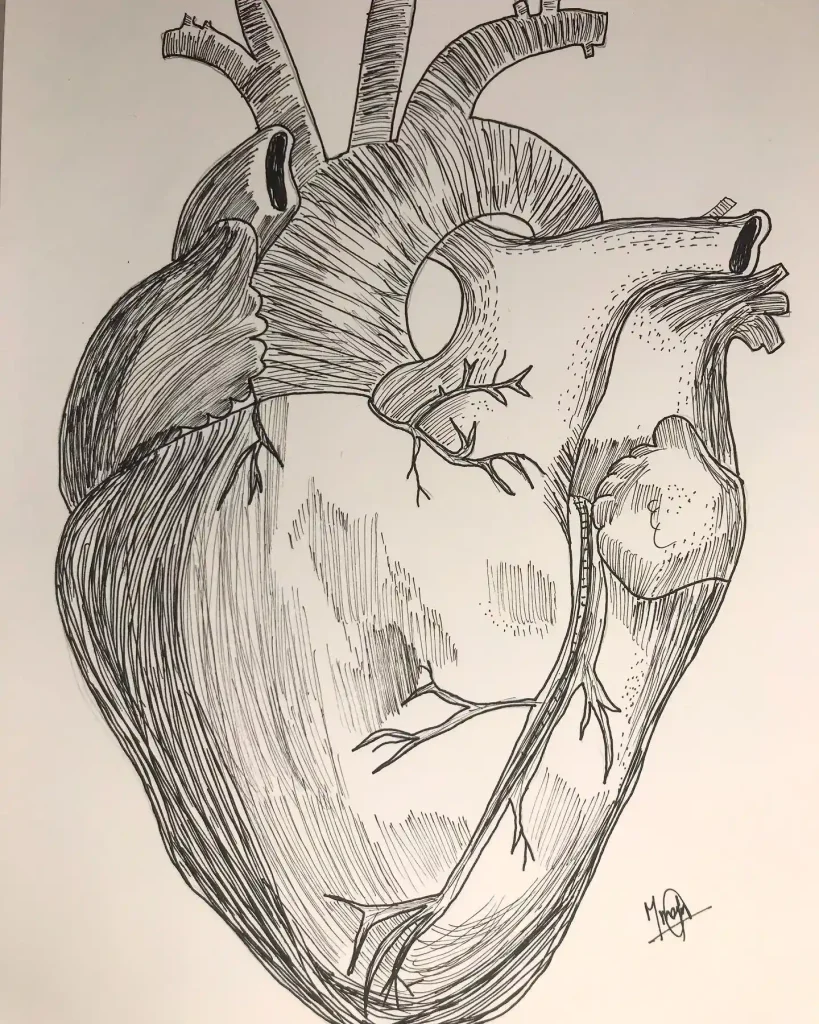
This is a dynamic and energetic take on the anatomical heart. The artist uses a mix of bold linework and textured cross-hatching to create a vibrant, pulsating image. The varied patterns and textures within the drawing give the impression of movement and life, making the heart feel alive and full of energy.
10. Realistic Heart on Sketchbook Paper
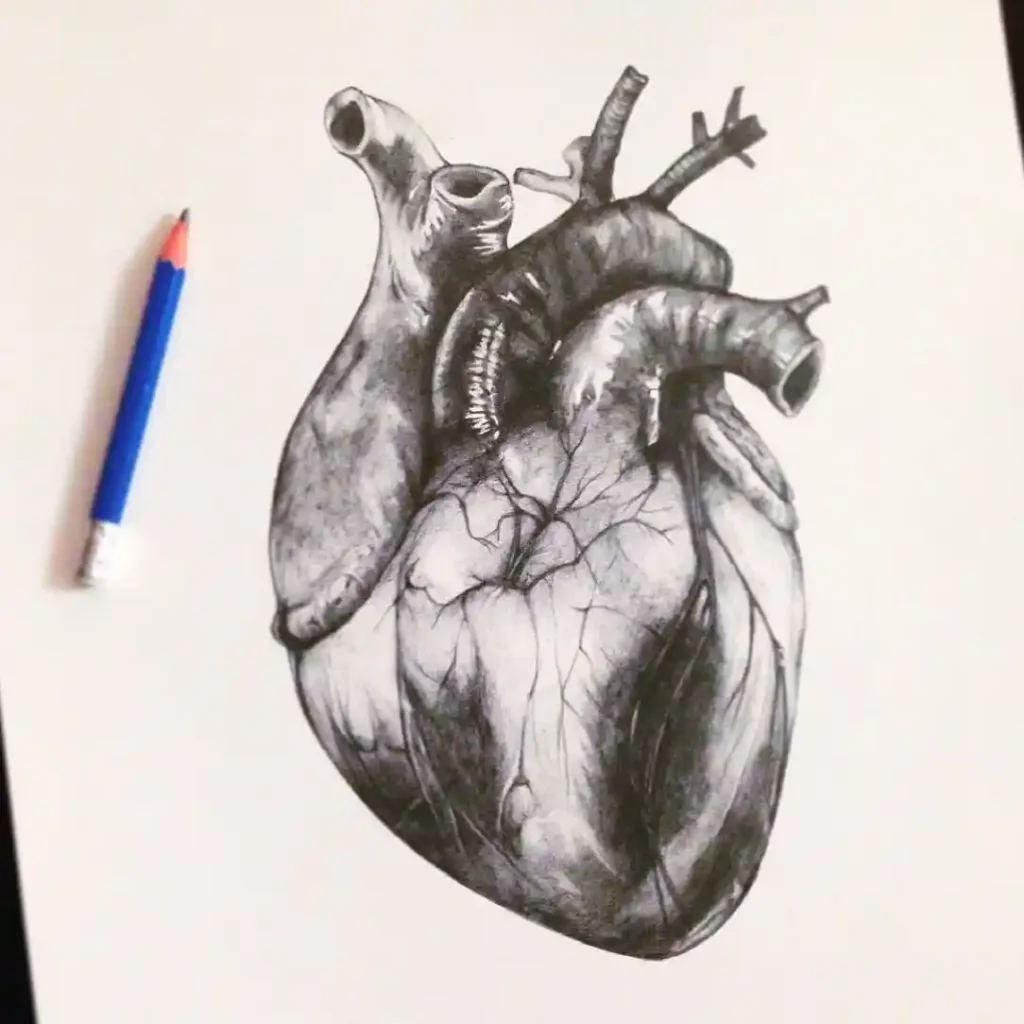
This drawing is a masterclass in realistic shading, capturing the complex folds and textures of the human heart. The artist’s use of light and shadow makes the piece pop off the page, creating a three-dimensional effect that is both striking and educational. It’s an incredible study of form, showing the beauty in anatomical detail.
11. Tonal Heart Study on Sketchbook Paper
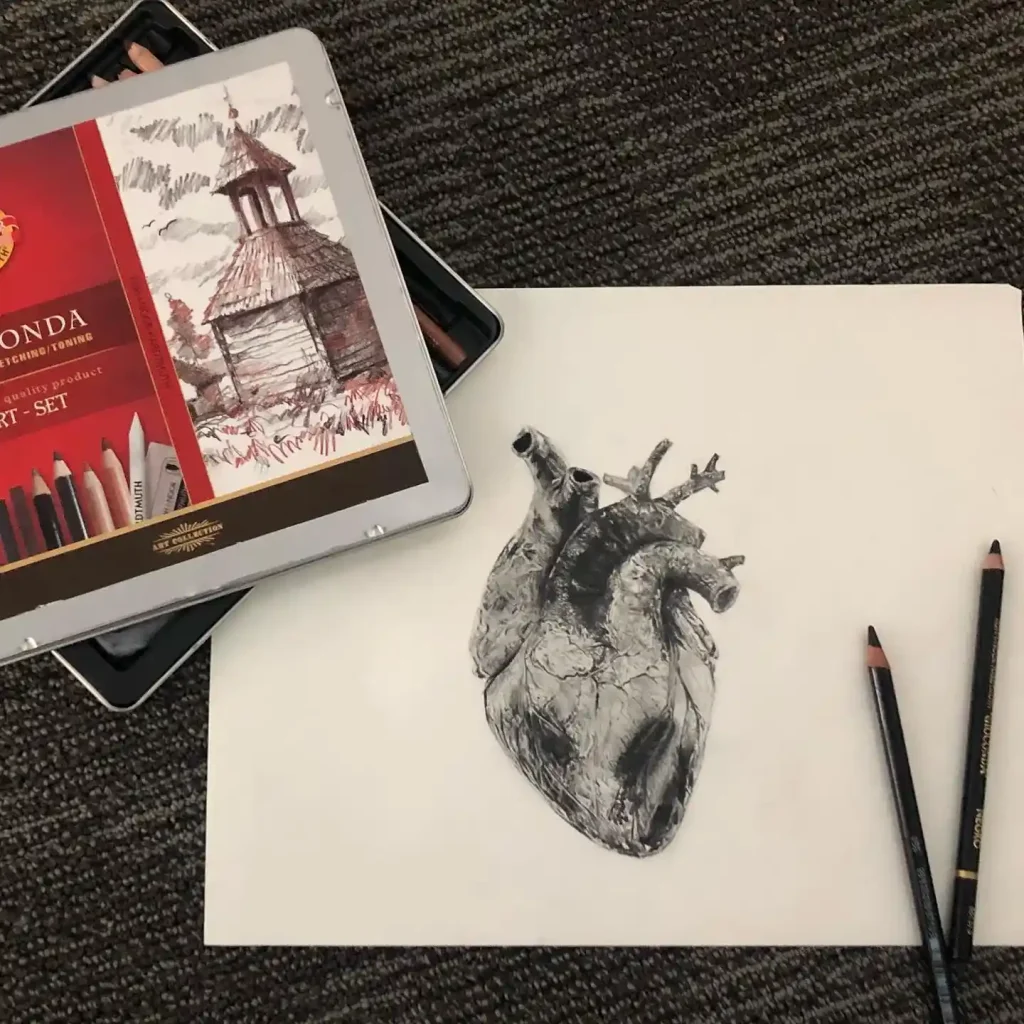
A wonderful example of how to use tone and contrast to bring a drawing to life. The artist has expertly used a range of darks and lights to create a realistic, sculptural feel. The inclusion of the pencils and a drawing set in the shot offers a glimpse into the creative process, inspiring others to pick up their own tools.
12. Floral Heart on Sketchbook Paper
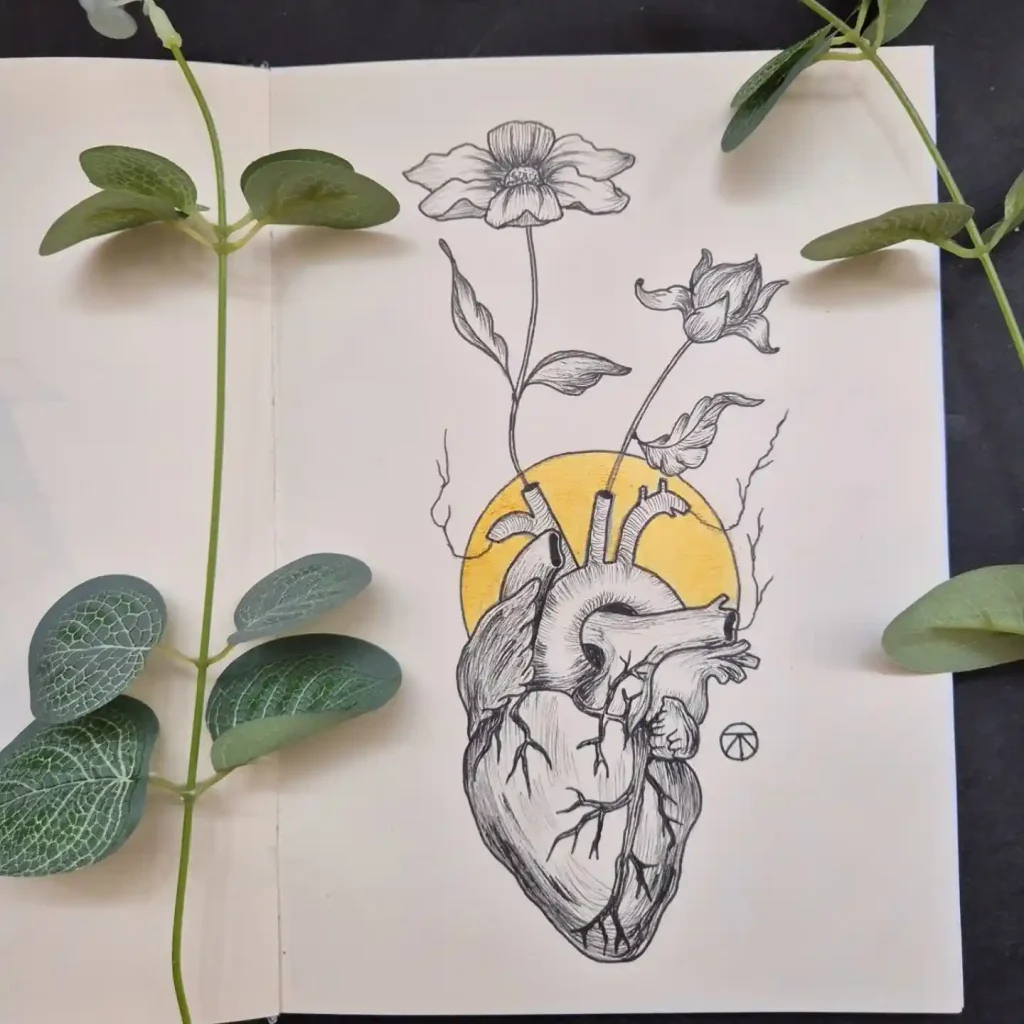
What an imaginative and symbolic piece! Here, the artist draws flowers blooming from the top of the heart, with a vibrant yellow circle behind it. This drawing beautifully represents the concept of a growing heart—of new life, hope, and emotional vitality springing from within. The bold, clean lines give it a modern, almost graphic feel.
13. Intricate Heart Study on Sketchbook Paper
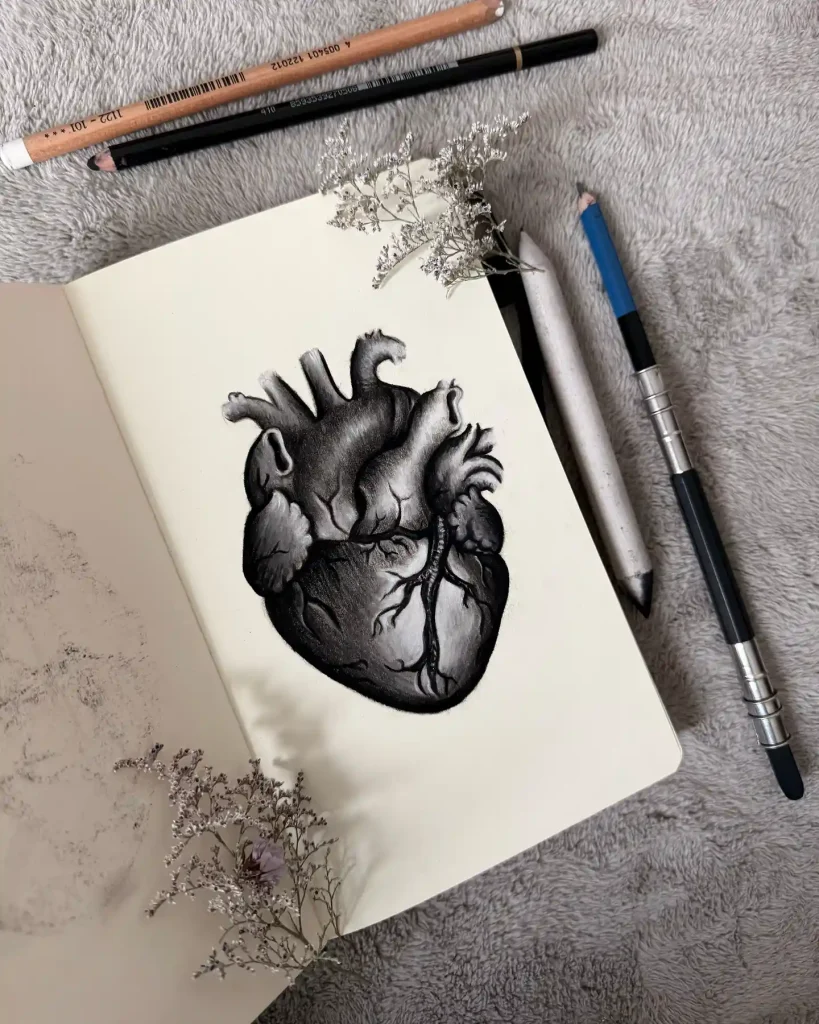
The charcoal-like rendering in this drawing is absolutely stunning. The artist has created a piece with incredible texture and depth, making the heart feel almost palpable. The soft lighting and surrounding art supplies, including dried flowers, give this image a romantic, almost whimsical vibe, showcasing the artist’s personal touch.
14. Detailed Shaded Heart on Sketchbook Paper

This drawing is a showcase of incredible detail and patience. The artist’s use of fine lines and cross-hatching creates an almost gritty texture, giving the heart a very visceral and organic look. It’s a powerful piece that emphasizes the raw, life-giving essence of the organ, stripped down to its beautiful, intricate form.
15. Sculptural Heart on Sketchbook Paper

What a cool way to present an anatomical heart! By placing the heart on a simple plinth, the artist gives it the status of a statue or a museum piece. The soft shading and clean lines make it feel elegant and timeless, celebrating the human heart not just as an organ, but as a masterpiece of design.
16. Vibrant Colored Heart on Sketchbook Paper
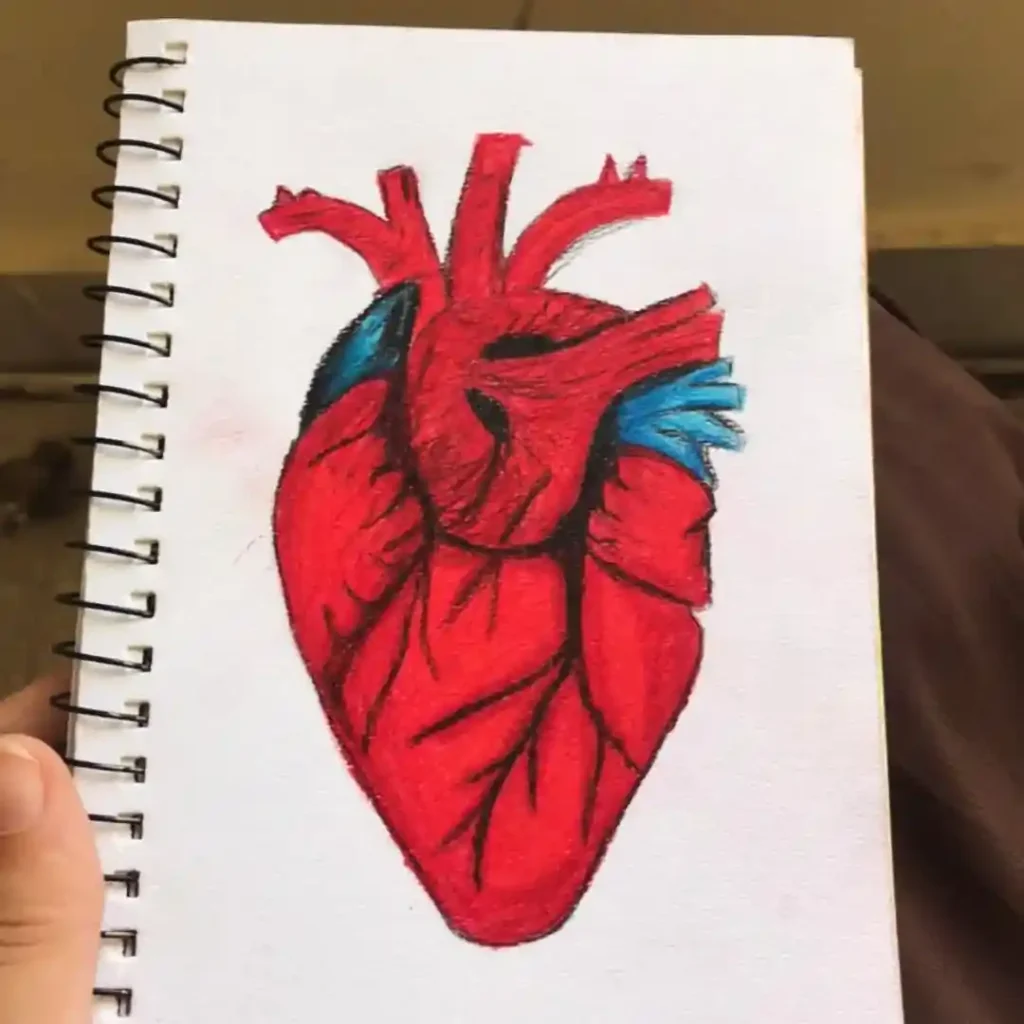
This drawing is a playful and vibrant take on the human heart. The use of bright red and blue colored pencils gives it a bold, almost cartoon-like energy, while still maintaining the anatomical shape. It’s a fresh, energetic piece that celebrates life and color, perfect for anyone looking for a more dynamic style.
17. Pierced Heart on Sketchbook Paper

A dramatic and powerful drawing, this piece uses a sword piercing the heart to symbolize emotional pain or betrayal. The stark, bold lines and deep red color of the bleeding heart create a visceral, emotional response. It’s a compelling drawing that tells a story of heartbreak and resilience through strong, symbolic imagery.
18. Textured Heart on Sketchbook Paper
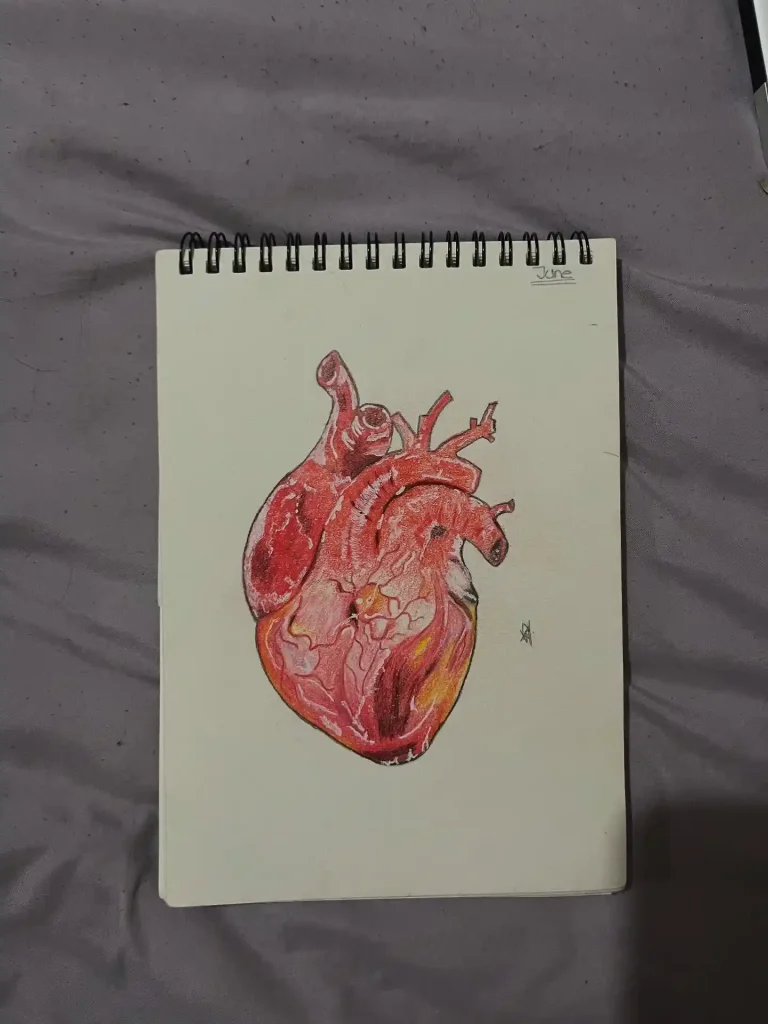
This drawing is a fantastic example of using color to create texture and depth. The artist blends shades of red and yellow, with hints of orange and white, to make the heart appear textured and three-dimensional. It feels like a glowing, energetic core, full of life and warmth. It’s a truly expressive piece.
4. Shading, Colour and Anatomy Tips
A heart drawing looks convincing when three things agree: the anatomy is in the right place, the light comes from one direction, and the texture matches the material. The table below gives you a quick anatomy reference to check your drawing against before you shade.
| Part to draw | Where it sits | Drawing cue |
|---|---|---|
| Aorta | Top centre, arching up and back | Thickest vessel; draw it first |
| Pulmonary artery | Crossing in front of the aorta | Slightly thinner; overlaps the aorta |
| Left ventricle | Lower left, forming the apex | Thickest wall; darkest shading on its far side |
| Right ventricle | Lower right, front-facing | Thinner wall; sits slightly forward |
| Atria | Upper left and right, behind the vessels | Softer, rounder shapes; keep them in the background |
For a reliable anatomy reference while you draw, see Visible Body’s guide to heart anatomy: vessels, valves, and chambers, which labels each chamber and vessel clearly. Check your sketch against it once, before shading, and you will catch most proportion mistakes while they are still easy to fix.
Colour choices that actually help
Real hearts are not one flat red. Try a deep crimson for shadowed muscle, a brighter red for lit areas, and a touch of blue or purple for veins. In the vibrant coloured study (idea 16), red and blue pencils do exactly this job: the colour contrast separates arteries from veins at a glance. If you work in watercolour, lay the lightest wash first and build darker layers only after each layer dries, or the colours will turn muddy.
Common mistake: shading every vessel the same darkness. Vessels in shadow get dark shading; vessels catching the light stay pale with just an edge line. Equal darkness flattens the whole top of the heart into one grey blob.
A practical 30-minute practice plan: spend 10 minutes on a light contour sketch using the 5 steps above, 10 minutes adding the main shadows from one light direction, and 10 minutes on texture, such as cross-hatching on the muscle or stippling on the vessel walls. Finish by comparing your sketch with the anatomy table above and fixing one proportion error. One focused correction per session improves your next drawing more than a full redraw.
For more depth practice, the 3D pencil drawing ideas show how the same shading rules create depth on any subject, and the skull drawing ideas are a natural next anatomical subject once hearts feel comfortable.
5. Frequently Asked Questions
How do you draw a realistic human heart step by step?
Block in a tilted rounded shape with the point at the bottom left, add the aorta arching from the top, then the pulmonary artery crossing in front of it. Mark the left and right ventricles and the groove down the front, then shade from one light direction, darkest in the grooves and on the far side.
What are the main parts of the heart to include in a drawing?
Include the four chambers (left and right atria, left and right ventricles), the aorta, the pulmonary artery, the pulmonary veins, and the vena cava. Getting the aorta largest and the left ventricle thickest matters more for realism than adding every small vein.
How can I make my anatomical heart drawing less like a biology diagram?
Add one creative element and keep the anatomy accurate: vines wrapping the arteries, a heart in an unexpected setting such as a glass jar, or mixed textures like ink and watercolour. One strong idea reads as art; five competing ideas read as clutter.
What pencils are best for shading a heart drawing?
Start with a 2H or HB pencil for light construction lines, then a 2B or 4B pencil for shadows and dark grooves. Use a kneaded eraser to lift clean highlights back out of shaded muscle, which keeps the heart looking rounded rather than flat.
How long does a good heart drawing take?
A solid small study takes about 30 minutes: 10 minutes on contour, 10 on main shadows, and 10 on texture and corrections. A large finished piece with full shading and colour can take two hours or more, so build up through small studies first.
Can beginners draw an anatomical heart, or should they start with a cartoon heart?
Beginners can draw an anatomical heart if they follow the big-to-small method in this guide: overall shape, then aorta, then other vessels, then chambers, then shading. Start small, repeat the sketch three times, and compare each attempt against an anatomy reference.
Keep drawing: related guides
If you enjoyed the floral hearts here, try how to draw a rose step by step and wildflower bouquet drawing ideas for the flower skills behind ideas 4 and 12. For colour versions, see watercolour rose drawing ideas, and for what to practise next, browse the full drawing ideas guide.