Use lights rated CRI 95 or higher, at 5000K for judging prints and paint and 6500K for judging screens. Ordinary household LEDs sit near CRI 80, which renders reds and deep violets inaccurately.
Key takeaways
- Buy CRI 95 or higher for anything where you mix or judge color|Use 5000K (D50) to judge prints and paint, and 6500K (D65) to judge monitors|R9, deep red, is excluded from the headline CRI average, so a good CRI can still render reds badly|Photograph artwork with two matched lights at 45 degrees either side to kill glare and gradients|Never work under one bright lamp in a dark room, and never mix warm and cool bulbs
Disclosure: GS Art Zone is a participant in the Amazon Services LLC Associates Program. If you buy through a link on this page we may earn a small commission at no extra cost to you. It does not change which lights we recommend. Prices were correct at the time of writing.
If you have ever mixed a color that looked perfect at your desk and wrong the next morning by the window, the paint was not the problem. The light was lying to you.
The number that governs this is CRI, the Color Rendering Index. It runs from 0 to 100 and describes how faithfully a light source renders colors compared with a reference light of the same temperature. Ordinary household LEDs often sit around CRI 80. At that level some pigments — reds and deep violets worst of all — simply do not show you what they are.
For any work where color matters, look for CRI 95 or higher. And here is the part that almost nobody mentions:
The general CRI figure is an average of eight pastel test colors, R1 to R8. Deep saturated red, R9, is not included in that average. A lamp can advertise CRI 90 and still render your cadmium red and alizarin crimson badly. If a manufacturer publishes an R9 figure, that tells you they have something to be proud of.
The Second Number: 5000K or 6500K?
Color temperature, measured in kelvin, decides whether your light is warm or cool. Two values matter and they are not interchangeable:
- 5000K (D50) is the standard illuminant used for viewing printed material in the graphic arts. Judge prints, paint and paper under this.
- 6500K (D65) is the white point that sRGB and most calibrated monitors are built around. Judge screens under this.
This is why a print can look correct on your monitor and too warm in your hand. You are comparing two things lit to two different standards. If you do both jobs at the same desk, buy a bi-color light and switch it, rather than compromising at 5700K and being slightly wrong at everything.
Compiled by the GS Art Zone editorial team. Last updated August 2026. Specifications come from manufacturer documentation.
Quick Comparison
| Light | CRI | Color temp | Price | Best for |
|---|---|---|---|---|
| NiceVeedi 2-pack 36W | 95+ | 2700–6500K | $90 | Photographing artwork |
| RALENO 13 in panel | >95 | 2500–6500K | $60 | Desk light and video |
| NiceVeedi 36W single | 95+ | 2700–6500K | $55 | One-light starter |
| OttLite Creative Curves | Not published | Daylight LED | $50 | Everyday desk task light |
| OttLite LED Task Lamp | Not published | Daylight LED | $45 | Portable, battery powered |
| OttLite Slimline CFL | Not published | Daylight CFL | $45 | Folding arm, small desks |
1. NiceVeedi 36W Bi-Color 2-Pack — Best for Photographing Artwork

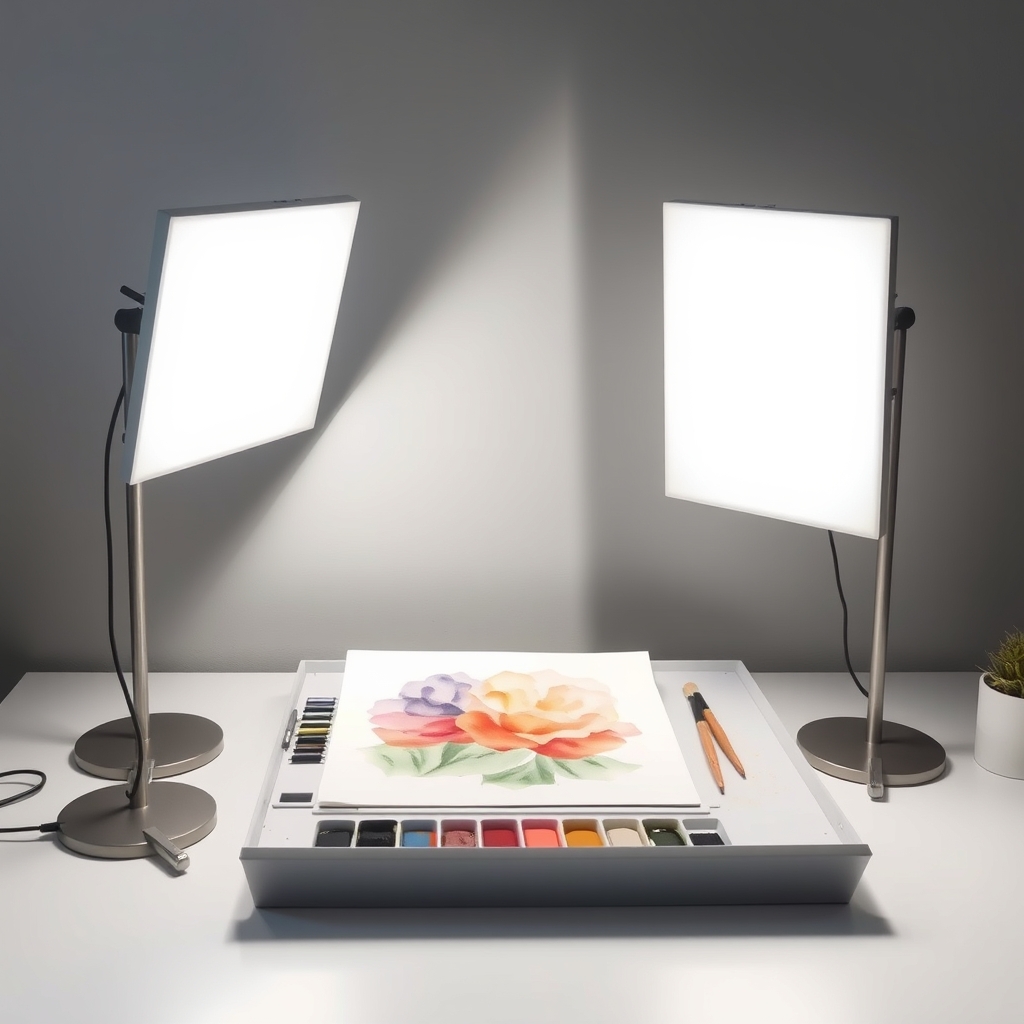
Two lights, CRI 95+, adjustable from 2700K to 6500K, on stands that extend to 72 in — for about $90. This is the kit that solves the single hardest problem in reproducing artwork: even illumination with no glare.
The setup is fixed and worth memorising. Place one light either side of the artwork, each at roughly 45 degrees to the surface, at equal distance and equal power. At that angle the reflection bounces away from the lens instead of into it, so glare disappears, and because the two lights are symmetrical the illumination is even corner to corner. One light alone always leaves a gradient across the piece.
The built-in barndoors matter more than they sound. Closing the flaps stops stray light spilling onto the wall behind and bouncing back as a colored cast.
- Two 36W panels, CRI 95+, 2700–6500K
- Built-in four-leaf barndoors, 90 to 150 degrees
- Stands adjust from 41 in to 72 in, 180 degree tilt
- Infrared remote, 1% brightness steps
- Around $90 for the pair
2. RALENO 13-Inch Panel — Best Desk Light for Color Work

A 13 in soft panel with 192 LEDs, CRI over 95, adjustable 2500K to 6500K, on a small desk stand. At around $60 this is the most sensible single purchase for someone who paints at a desk and cares about mixing color accurately.
Two things make it better than a conventional lamp for this job. It is a broad panel rather than a point source, so the light is soft and does not throw a hard shadow of your own hand across the work. And the LCD shows the actual color temperature, so you can set it to 5000K to check a print and 6500K to check the screen, deliberately rather than by guesswork.
The 8000 mAh battery gives about 90 minutes at full power, which also makes it usable for photographing work away from a socket.
- CRI over 95, 2500–6500K adjustable
- 192 LEDs across a 13 in soft panel, 1 in thick
- Built-in 8000 mAh battery, about 90 minutes at full power
- LCD shows live brightness and color temperature
- Desk stand plus standard 1/4 in thread for tripods
3. NiceVeedi 36W Single — One-Light Starter

The same panel as the two-pack, sold singly at around $55. Common sense applies here: if you intend to photograph finished work, buy the pair, because the second light is what removes the gradient. If you want one adjustable, high-CRI light to work under and will photograph by a window, this is enough.
- 36W, 360 LEDs, 3000 lumens at full power
- CRI 95+, 2700–6500K, 0–100% dimming
- Built-in four-leaf barndoor
- Aluminium stand from 41 in to 72 in
4. OttLite Creative Curves — Best Everyday Task Lamp

OttLite has been making daylight-balanced task lighting since 1989 and the brand is a fixture in craft rooms for good reason: the light is bright, low-glare and comfortable to sit under for hours. The Creative Curves has a 20 in flexible neck and four brightness levels on touch control.
One honest caveat. OttLite markets on “natural daylight” rather than publishing a CRI figure, so you cannot compare it numerically against a CRI 95 panel. Treat it as an excellent lamp to work under, and use a light with a published CRI when you are judging color for print.
5. OttLite LED Task Lamp — Best Portable

Battery powered, 10 in tall, with a carrying handle and 30 daylight LEDs rated for 40,000 hours. This is for sketching in the evening, working somewhere without a socket, or taking to a life drawing class or craft fair. It is not a color-critical light and is not sold as one.
6. OttLite Slimline CFL — Best for Very Small Desks

The appeal here is entirely mechanical. The articulating arm adjusts between 14.75 in and 19.75 in and folds flat against itself when you are not using it, which on a small or shared desk is worth more than any specification. The rotating shade keeps glare off the page.
It uses a replaceable 13W CFL tube rather than LEDs. Bulbs are still easy to find, but factor in that you will replace them eventually where an LED lamp you would not.
Four Mistakes That Ruin Studio Lighting
- One bright lamp in a dark room. The contrast between a brilliant pool of light and a dim room is exhausting to work under. Light the room to a reasonable level as well as the desk.
- Mixing color temperatures. A warm ceiling bulb plus a cool desk lamp means every surface is lit by two different whites and nothing looks like itself. Match them.
- Ignoring flicker. Inexpensive LED drivers pulse rapidly. You do not consciously see it, but it contributes to eye strain and it will show as banding if you film your process.
- Letting colored walls bounce. A strong wall color reflects onto your work and tints everything. Neutral grey or white walls near the easel are worth the repaint.
What Goes With It
Accurate light only pays off if the rest of the chain is honest too. Judging a print means having a printer worth judging, covered in the best printers for selling art prints. Reproducing originals is in scanners for artwork, screen color is in the drawing tablet comparison, and where all of it sits is setting up a small home art studio.
Frequently Asked Questions
What CRI do I need for an art studio?
CRI 95 or above wherever you mix or judge color. Ordinary household LEDs are often around CRI 80, which is enough to see by and not enough to trust. If a light does not publish a CRI figure at all, assume it was not designed for color-critical work.
Should studio lighting be 5000K or 6500K?
5000K, known as D50, is the standard for viewing printed material and is what to judge paint and prints under. 6500K, D65, matches the white point most calibrated monitors use, so judge screens under that. A bi-color light lets you switch between the two rather than compromising.
What is R9 and why does it matter?
R9 is the test score for deep saturated red, and it is deliberately excluded from the headline CRI average, which covers only the eight pastel samples R1 to R8. A light can therefore claim a good CRI while rendering strong reds poorly, which matters a great deal if you paint with them.
How do I light artwork for photographing it?
Two matched lights, one either side, each at about 45 degrees to the surface, equal distance and equal power. That angle sends reflections away from the lens rather than into it, and the symmetry keeps brightness even across the whole piece. A single light always leaves one side darker.
Is north-facing window light really best?
In the northern hemisphere, yes, and the reason is consistency rather than quality — a north window never receives direct sun, so its light stays relatively stable in color and intensity through the day. In the southern hemisphere the same logic applies to a south-facing window.
Do I need daylight bulbs if I already work near a window?
Yes, for the hours when the window is not helping. Daylight shifts dramatically from morning to evening and disappears entirely in winter afternoons. A consistent high-CRI light means the color decisions you make at 9pm match the ones you made at noon.
Good Light Only Helps If the Paint Is Honest
High-CRI light shows you the color that is really on the paper, which is exactly why it exposes weak paint. A convenience color built from three or four pigments looks acceptable under a warm bulb and reads as grey sludge under daylight-balanced light, because now you can finally see what you mixed. Reading pigment codes on a paint set explains how to avoid that combination in the first place. Our art supplies guide shows where lighting falls in the buying order.
References and Further Reading
- Color rendering index, Wikipedia
- Standard illuminant (D50 and D65), Wikipedia
- Color temperature, Wikipedia
- Flicker (light), Wikipedia