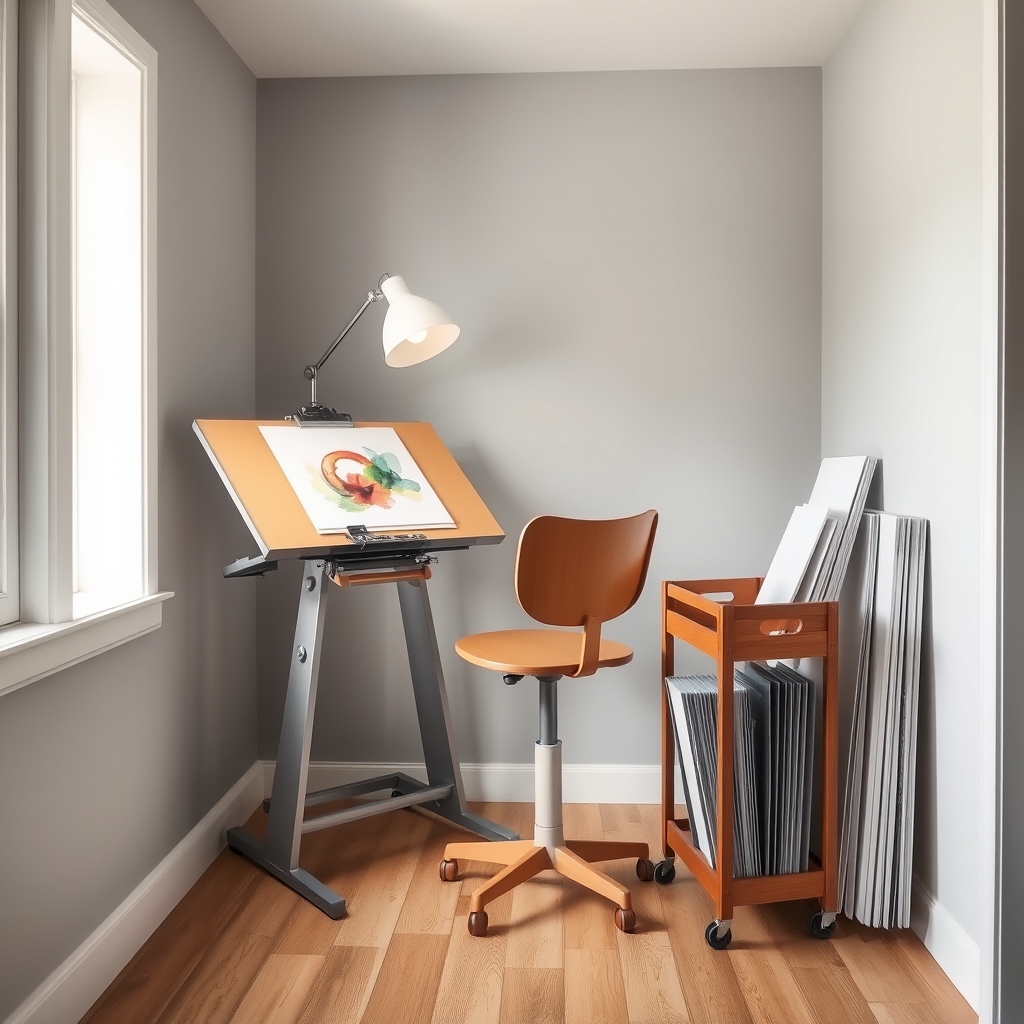
Tilt your desk 15 to 25 degrees for drawing and 35 to 50 for painting, because a flat surface foreshortens what you draw. Then set the chair so your elbows meet the surface, and add an adjustable footrest.
Key takeaways
- Tilt the desk 15 to 25 degrees for drawing, 35 to 50 for painting, flat for wet washes|Set chair height by your elbows, then add a footrest because your feet will not reach the floor|A corner about 5 ft by 5 ft is enough; put everything possible on lockable castors|Store paper flat, never rolled, since paper keeps a memory of its stored shape|A genuinely usable starter studio costs about $225 including desk, cart, lamp and flat storage
Disclosure: GS Art Zone is a participant in the Amazon Services LLC Associates Program. If you buy through a link on this page we may earn a small commission at no extra cost to you. It does not change what we recommend. Prices were correct at the time of writing.
Most people do not have a spare room. What they have is a corner, and that is genuinely enough — but only if you get two measurements right, and almost nobody does.
Rule One: Your Desk Should Tilt
Draw on a flat horizontal table and you are looking at the far end of the paper at a much shallower angle than the near end. Your eye is closer to the bottom of the sheet than the top. That is foreshortening, and it happens to your drawing whether you notice it or not: circles come out as ovals, and anything you draw near the top of the page ends up compressed.
Tilting the surface toward you brings the whole sheet closer to perpendicular to your line of sight, and the distortion largely disappears. This is the entire reason drafting tables exist, and it is why every drawing course tells you to hold your sketchbook up rather than flat on your knees.
Roughly 15 to 25 degrees for drawing and drafting — enough to fix the distortion, flat enough that pencils do not roll away.
Roughly 35 to 50 degrees for painting, where you also want gravity working for you.
Flat for wet watercolor washes, where any tilt sends the pigment downhill.
For watercolor specifically, the tilt is a tool rather than an ergonomic setting. Flat gives you pooling and blooms. A slight tilt gives you a controlled gradient as pigment migrates gently downward. A steep tilt gives you runs. Being able to change the angle mid-painting is worth more than any other feature on a drawing desk.
Rule Two: Set the Chair to Your Elbows, Then Add a Footrest
The correct working height is the one where your elbows sit at roughly the height of the work surface with your shoulders relaxed and down. Set the chair to that, not to whatever feels normal.
Here is the consequence nobody warns you about: once the seat is high enough for a drafting table, your feet no longer reach the floor. Dangling feet put your whole body weight onto the underside of your thighs, which cuts circulation and is why your legs go numb after an hour.
That is precisely why drafting chairs have a foot ring and ordinary office chairs do not. If you buy a tall desk, you must buy a chair with an adjustable footrest. It is not an upgrade, it is the other half of the same purchase.
Compiled by the GS Art Zone editorial team. Last updated August 2026. Specifications come from manufacturer documentation.
Three Budgets, Fully Costed
| Tier | What you get | Approx. total |
|---|---|---|
| Corner starter | Tilting table with stool, 4-drawer rolling cart, task lamp, portfolio bags | ~$225 |
| Working studio | Three-zone tilting desk, drafting chair with footrest, beech supply cart, CRI 95 panel light, portfolio bags | ~$590 |
| Full studio | All of the above plus a large art cart, two-light kit and a flat file cabinet | ~$2,300 |
The Desk
QZJIKE Drafting Table — Best Tilt Range

This one is worth the extra money for a specific reason: the manufacturer designed the tilt around three named working zones — 0 to 15 degrees for writing and laptop work, 15 to 35 for sketching and drafting, and 35 to 50 for painting and watercolor. That maps almost exactly onto the rule above, which means you can change discipline without changing furniture.
- 0 to 50 degree tilt across three defined working zones
- Metal frame with 12 mm MDF panels and levelling rubber feet
- Four fabric drawers plus a suspended tool organiser
- Open shelf area that stays flat for a laptop or sketchbooks
- Around $130
Yaheetech Adjustable Drafting Table with Stool — Best Value Complete Set

Table and stool together for around $103, with a 0 to 60 degree tilt range and a height that adjusts between 27.4 in and 36.4 in. For a first studio this is the most sensible single purchase on the page, because it solves the desk and the seat in one order.
The adjustable metal pencil ledge matters more than it sounds. The moment you tilt a surface past about 20 degrees, everything round on it starts rolling, and a ledge is the difference between working and chasing pencils across the floor.
- 47.4 × 23.6 in surface, height adjusts 27.4 to 36.4 in
- 0 to 60 degree tilt
- Adjustable metal pencil ledge
- Side tray, retractable board, two fabric drawers and a lower metal shelf
- Padded stool included
Yaheetech Tilting Drafting Table — Largest Surface

50.5 in wide with a separate flat side counter, which is the layout that actually works day to day: tilted surface for the work, flat surface beside it for the palette, water jar, laptop or lamp. Tilt runs 0 to 40 degrees and locks at ten heights, and it takes about 159 lb on the top.
The pencil ledge slides off entirely, so it converts to a plain desk when you need the room for something else. In a shared space that flexibility is the whole argument.
The Chair
FREEKYROCK Drafting Chair — Best Adjustment Range

Seat height from 24 in to 31.9 in and — the important part — a footrest that itself adjusts from 9.45 in to 16.9 in. Most cheap drafting chairs have a fixed ring, which only suits one leg length. An adjustable ring means you can actually apply the elbow rule instead of approximating it.
- Seat 24 to 31.9 in, footrest 9.45 to 16.9 in, both adjustable
- BIFMA and SGS certified gas lift, rated to 330 lb
- 3.15 in high-density foam, wipe-clean PU leather
- Wide anti-tip base
- Around $86
Synorla Ergonomic Drafting Chair — Best for Long Sessions

Breathable mesh back with adjustable lumbar support and flip-up arms. The flip-up arms are the feature to care about: when you are painting you need to move freely and arms get in the way, and when you are drawing detail you want them there to rest on. Around $110.
Primy Drafting Chair — Best Lumbar Support

Curved back with adjustable lumbar support, a waterfall cushion edge to reduce pressure behind the knees, and a foot ring. If you already know your lower back is the thing that ends your sessions, start here. Around $109.
Storage That Rolls
In a small space, put everything you can on castors. A studio you can push against the wall in ninety seconds is a studio you are allowed to keep in a shared room, and that matters more than any specification.
Solid Beech 5-Tier Art Cart — Best All-Round

Solid beech, five tiers, three drawers, lockable castors, and — the detail that makes it an artist’s cart rather than a kitchen trolley — a built-in brush holder, a brush washing groove and a detachable acrylic tray that lifts off and becomes a portable palette. About 27 × 17.5 × 30 in, around $270.
At 30 in tall it sits at roughly working height beside a drafting table, which is exactly where you want it.
4-Drawer Rolling Cart — Best Budget

Around $51 for a metal-framed cart rated to 150 lb with four mesh drawers and a wooden top. Mesh drawers sound like a small thing and are not — you can see what is in them without opening each one, which is the difference between using your supplies and forgetting you own them.
MEEDEN Extra Large Art Cart — For a Dedicated Studio

Around $650 for a considerably larger beech cart with two open shelves, three sliding drawers and a removable side tray that works as a separate mixing station. This is a real piece of studio furniture rather than storage, and it only makes sense if you have the floor space and you paint most days.
Store Paper Flat, Never Rolled
This is the mistake that quietly destroys finished work. Paper takes a memory of whatever shape you leave it in. Roll a watercolor and put it in a tube for six months and it will never lie truly flat again — and on anything with body, gouache or heavy acrylic, the curl can crack the paint film.
It also matters commercially. A buyer who unrolls a print that immediately curls back up assumes it is cheap, whatever it cost you to make.
EOOUT 24 × 36 in Portfolio Bags — Cheapest Flat Storage

Four zippered vinyl mesh portfolios at 24 × 36 in for around $20. Slide them flat under a bed or behind a wardrobe and you have solved flat storage for the price of a set of brushes. They are also waterproof, which matters more than people expect in a room where water jars get knocked over.
Diversified Spaces Flat File Cabinet — The Permanent Answer

Five dovetailed drawers, each 37 × 24.8 in inside and only 1.5 in deep — that shallowness is the point, because it stops you stacking a hundred sheets and crushing the ones at the bottom. Chemical-resistant UV finish, made in the USA, around $1,288 in light hardwood or $1,539 in oak.
It is a serious amount of money and an entirely reasonable purchase if you are selling work. Prints stored flat, clean and dust-free are prints you can ship the same day.
Arrange It as a Triangle
Kitchen designers have a rule called the work triangle: sink, hob and fridge should form a compact triangle so you are not walking across the room mid-task. A studio has exactly the same three points.
- The work surface — the tilting desk or easel.
- The wet zone — water, palette, solvents, paper towel. Keep this on the side of your non-drawing hand so you never reach across wet work.
- Storage — the rolling cart, within arm’s reach without standing up.
Two more placement rules that are worth following exactly. Put your light source on the opposite side to your drawing hand, so your own hand does not cast a shadow over what you are working on — left side for right-handed people, right side for left-handed. And leave a drying zone where wet work can sit undisturbed for hours, because the alternative is stacking a wet painting and losing both.
Ventilation Is Not Optional
Fixative sprays, solvents, oil mediums and alcohol markers all put vapour into the air of a room you are sitting in for hours. Spray fixative outdoors or at an open window, never in a closed room, and keep a window cracked whenever you are using solvents. A small desk fan pointed away from you and toward a window is a cheap and genuinely effective extractor.
If oil painting is your main medium, look into odorless mineral spirits and keep rags in a sealed metal container — oil-soaked rags can self-heat and are a documented fire risk when left in a heap.
Two Things Worth Buying Before Anything Else
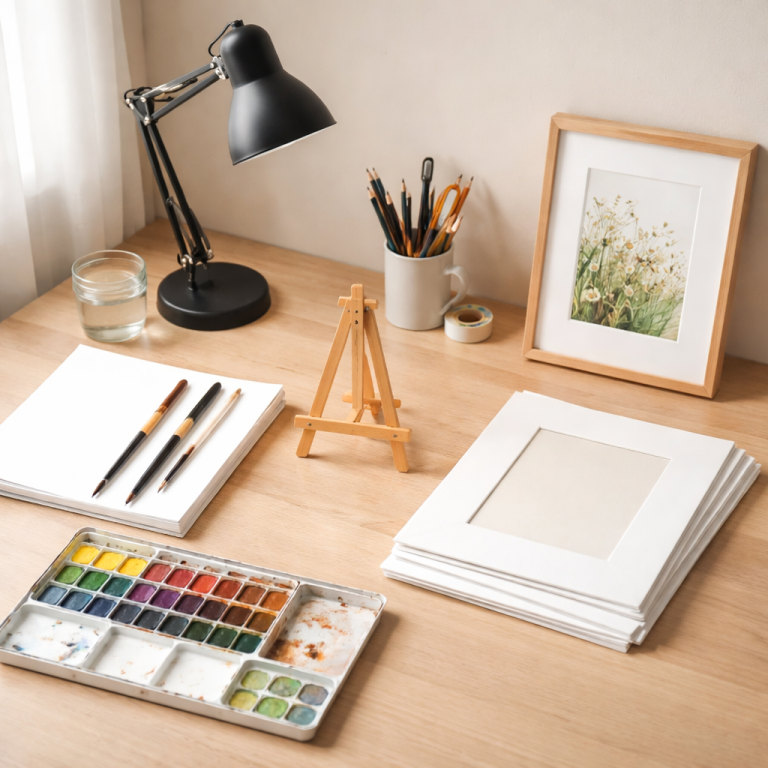
Once the corner exists, the two purchases that change daily practice most are a tilted working surface and a way to finish work properly. A tabletop easel fixes the distortion you get drawing flat, covered in our guide to easels and drawing angles, and a small stack of acid-free mats turns finished sheets into something you can sell or hang, which matting and framing your own art walks through. Neither costs much, and both get used every session. The full order, from first sheet of paper to selling prints, is laid out in our art supplies guide.
What Goes In It
The furniture is the shell. What turns it into a business is what sits on top: high-CRI studio lighting so your colors are true, a scanner for reproducing originals, a pigment printer for selling prints, and if you work digitally, a drawing tablet. For what to actually make in it, start with our watercolor ideas library.
Frequently Asked Questions
What angle should a drawing table be?
About 15 to 25 degrees for drawing and drafting, which removes most of the foreshortening distortion you get on a flat surface. Around 35 to 50 degrees for painting. Keep it flat for wet watercolor washes, since any tilt sends the pigment downhill.
How much space do I need for a home art studio?
A corner roughly 5 ft by 5 ft is genuinely enough for a tilting desk, a chair and a rolling cart. The constraint that actually bites is not floor area but storage for flat paper and somewhere for wet work to dry undisturbed.
Why do drafting chairs have foot rings?
Because once the seat is raised high enough for a drafting table, your feet cannot reach the floor, and dangling legs press your body weight into the underside of your thighs. The ring restores the support the floor would normally give and prevents numbness and circulation problems.
Should I store artwork flat or rolled?
Flat, always, if you have any choice. Paper takes a memory of the shape it is stored in, and a rolled sheet may never lie properly flat again. On work with body, such as gouache or heavy acrylic, the curl can also crack the paint surface.
Which side should my light be on?
The opposite side to your drawing hand, so your hand does not throw a shadow across the work. Right-handed artists light from the left, left-handed artists from the right. Ideally add a second, softer light on the other side to lift the shadow it does cast.
Can I use a normal desk instead of a drafting table?
Yes, with one addition. Put a portable drawing board on it propped at an angle, or a simple tabletop easel. You lose the adjustability but you get most of the ergonomic and optical benefit for very little money, which is a reasonable place to start.
What is the cheapest usable home studio?
Around $225 covers a tilting table with a stool, a four-drawer rolling cart, a daylight task lamp and a set of flat portfolio bags. That is a genuinely functional setup, and everything in it stays useful when you upgrade later rather than being replaced.
References and Further Reading
- Drawing board, Wikipedia
- Human factors and ergonomics, Wikipedia
- Perspective and foreshortening, Wikipedia
- Spontaneous combustion and oily rags, Wikipedia