A Father's Day drawing works when the two figures physically connect. Give them a shared task or a point of contact such as held hands or a shoulder, get the adult to child height ratio right, and draw that interaction before either face.
Key takeaways
- Two figure scenes need a physical contact point; without one the pair reads as two separate drawings.
- A young child is roughly half an adult's height, and their head is proportionally much larger.
- Draw the gesture and interaction first, because faces added to a stiff pose never rescue it.
- Overlap one figure in front of the other, since overlap is what creates the sense of relationship.
- Father's Day falls on the third Sunday of June in the US, UK and India, which is worth noting for cards.
Almost every stiff Father’s Day drawing has the same problem: the two figures never touch. Held hands, a hand on a shoulder, a child on a knee, any physical contact point turns two separate drawings into one relationship. Decide where they connect before you draw either face.
The second thing to fix is scale. A young child stands roughly half an adult’s height, and their head is proportionally much larger than a grown-up’s. Sketch both figures as simple stick shapes at the correct relative sizes first, because a scale error is impossible to correct once you have started rendering.
The forty ideas below run from graphite portraits and charcoal silhouettes through watercolor beach scenes, oil pastel campfires and a caricature apron card. For the faces, portrait drawing ideas and face drawing practice are the obvious companions.
If you are making something to give rather than to keep, watercolor card ideas covers the format, and craft ideas for kids is useful if a child is making it. Father’s Day falls on the third Sunday of June in the US, UK and India.
Compiled by the GS Art Zone editorial team. Last updated August 2026. Each idea is paired with the specific step that produces the effect, so you can go from the reference straight to paper.
What You Need Before You Start
- A 2B and 4B for the graphite portraits, plus a kneaded eraser for lifting soft highlights
- Colored pencils in a warm skin range, since most of these scenes need believable skin tones
- Watercolor in a small set for the loose outdoor scenes, where hard edges would feel wrong
- Charcoal and white chalk on toned paper for the silhouette and sunset pieces later in the list
- Card stock at around 300 gsm if you intend any of these to actually be given as a card
1. Pencil Portrait on a Garden Bench
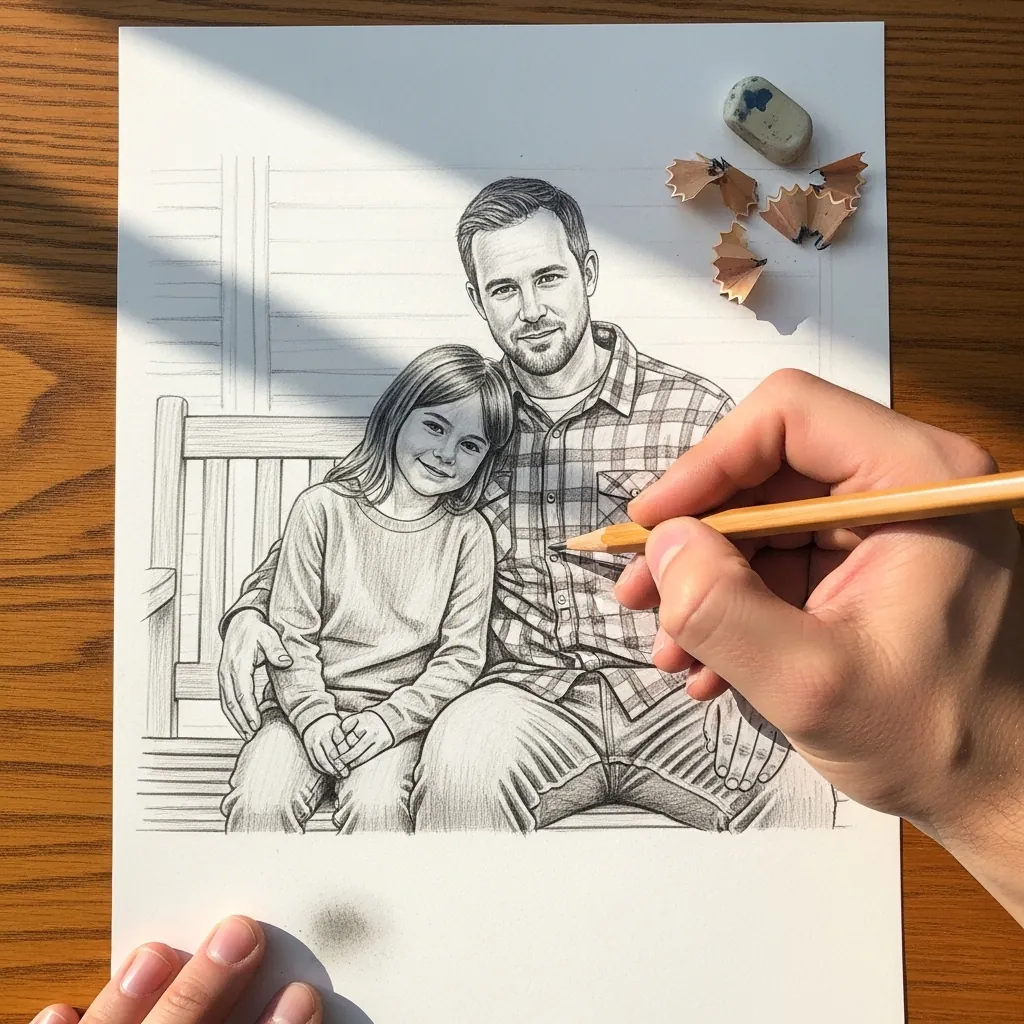
Start with a seated pose because sitting solves the hardest problem in two figure work. The bench fixes both figures at a known height, their shoulders naturally overlap, and you get a contact point for free where the child leans against the parent.
2. Watercolor Lift with Falling Petals
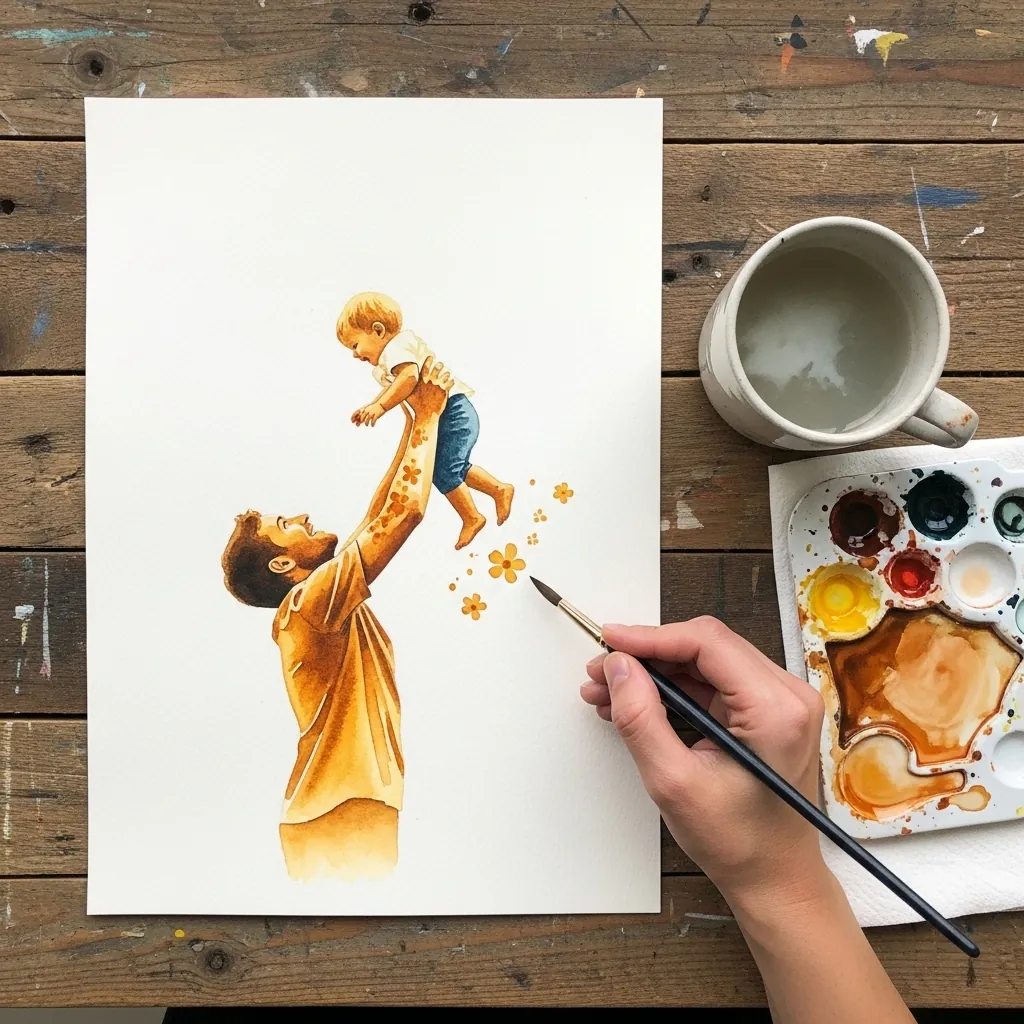
Lifting a child is all about the line of action. Draw one long curve running from the adult’s back foot, up through the arms and into the raised child, then hang everything on that curve. The petals simply confirm the upward direction.
3. Charcoal Bike Lesson with Long Shadows
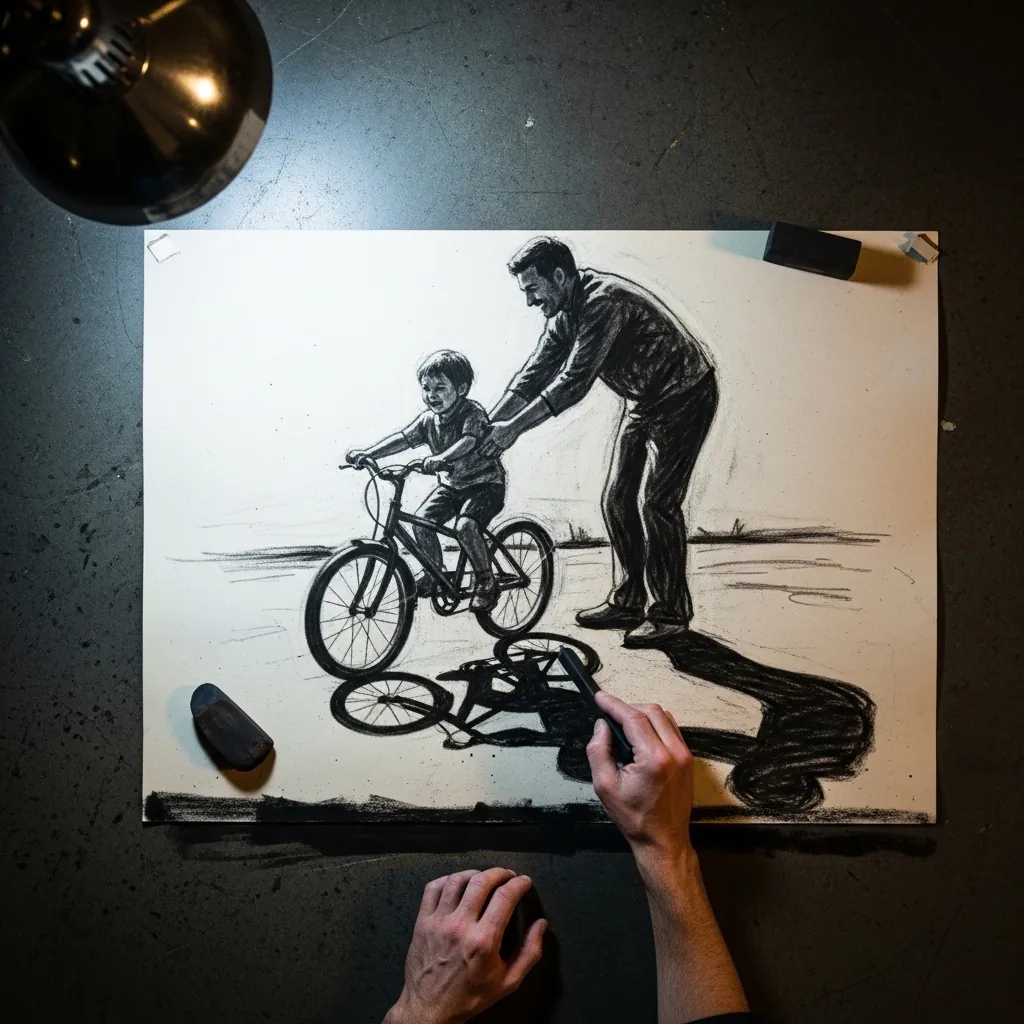
This is a story told entirely through one hand. The adult’s grip on the saddle is the whole subject, so place it clearly and let the long cast shadows on the ground tie both figures to the same surface and the same low light.
4. Colored Pencil Reading Together
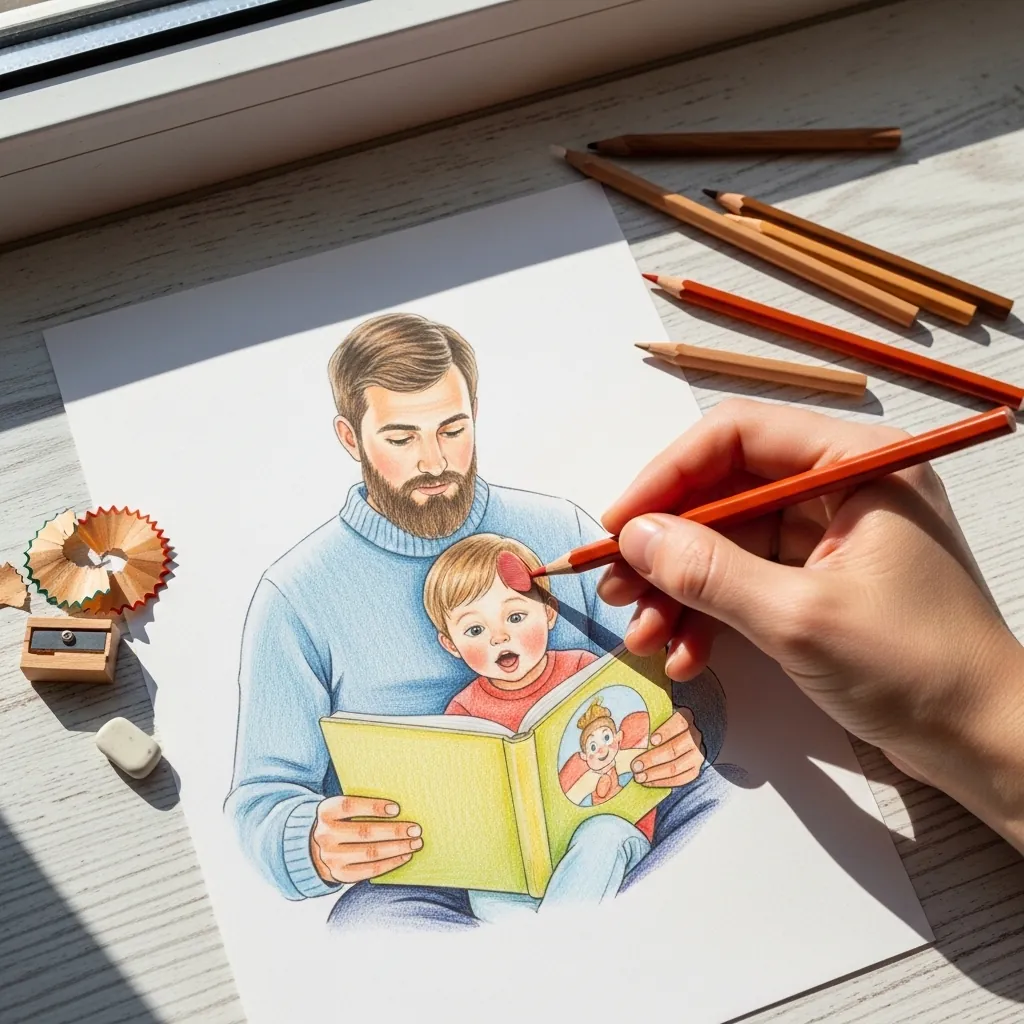
A child on a lap creates maximum overlap, which is exactly what you want. Draw the adult’s seated shape completely first, then place the child inside that silhouette. Both faces should tilt toward the book rather than toward the viewer.
5. Fine Line Newborn in Arms
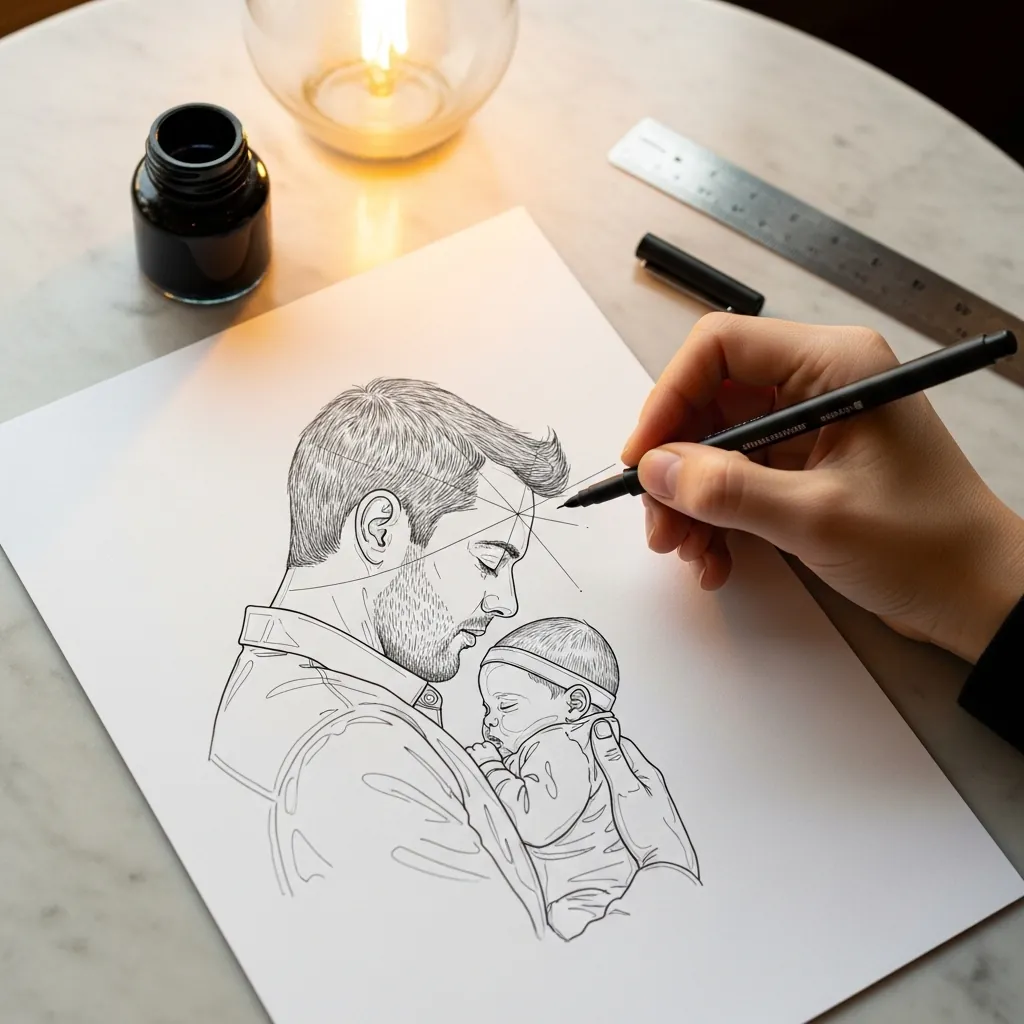
Newborn proportions catch people out badly. The head is enormous relative to the body, roughly a quarter of the total length, and the limbs stay tucked. Draw the adult’s forearm as the shelf the whole baby rests along. Keep the adult’s hands larger than instinct suggests, since underscaled hands are the giveaway here.
6. Pastel Fishing Trip on a Dock
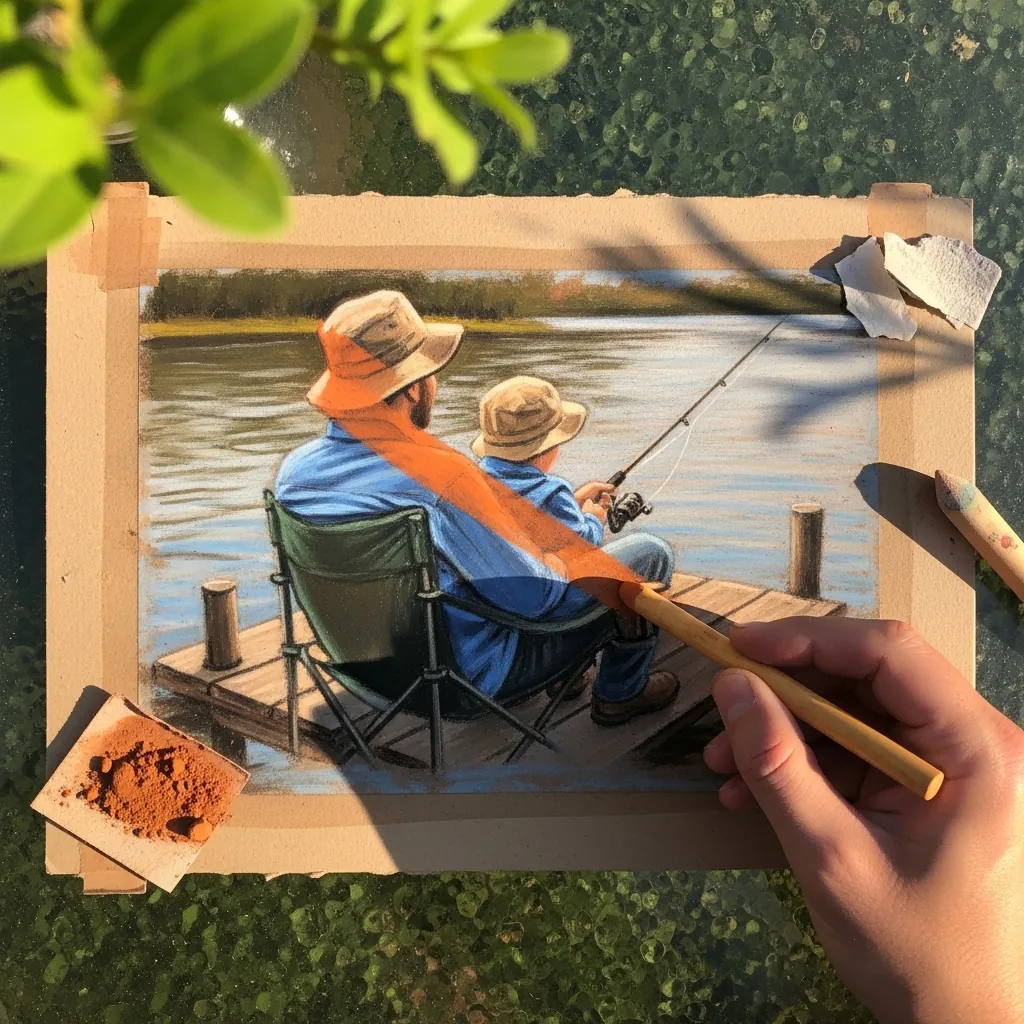
Two figures seen from behind is an underused option. It removes every facial expression problem and lets the matching hats, the parallel rods and the shared direction of attention carry all the warmth the picture needs. Two rods entering the water at slightly different angles stops the pair looking like a mirror image.
7. Graphite Hands Holding a Baby Foot
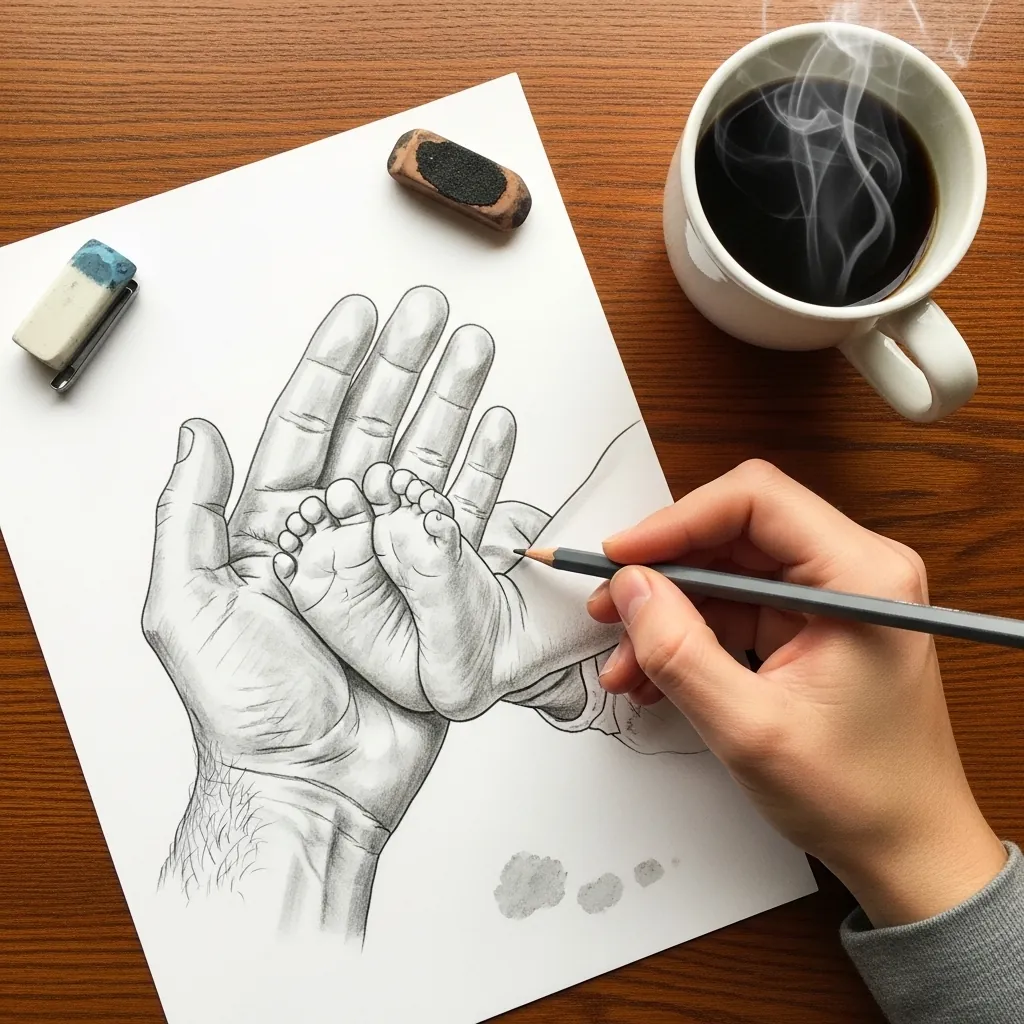
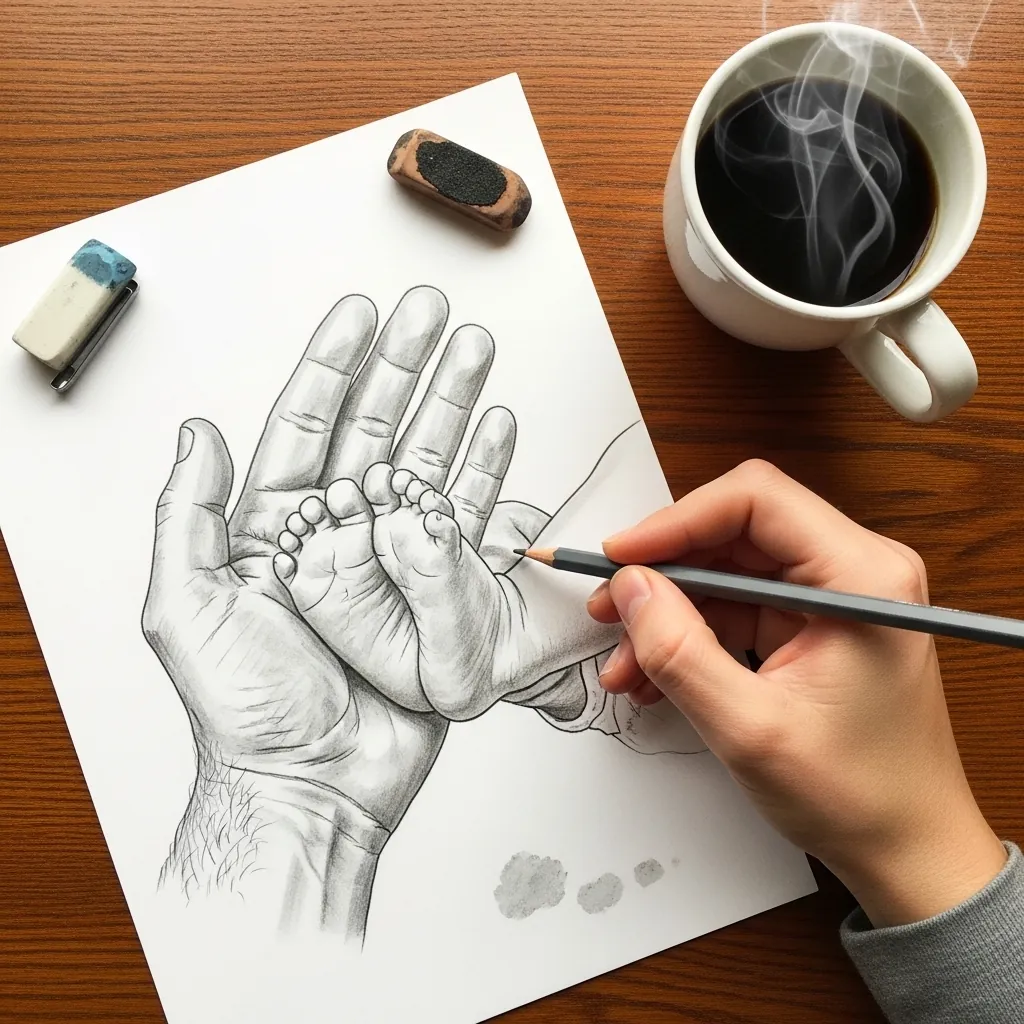
The purest version of this whole subject. No faces at all, just a size relationship, and it works because the contrast between weathered adult skin and a smooth infant foot says everything without a single other element. Light both hands from one side only, and let the small foot cast a soft shadow into the adult’s palm.
8. Watercolor Baseball in the Park
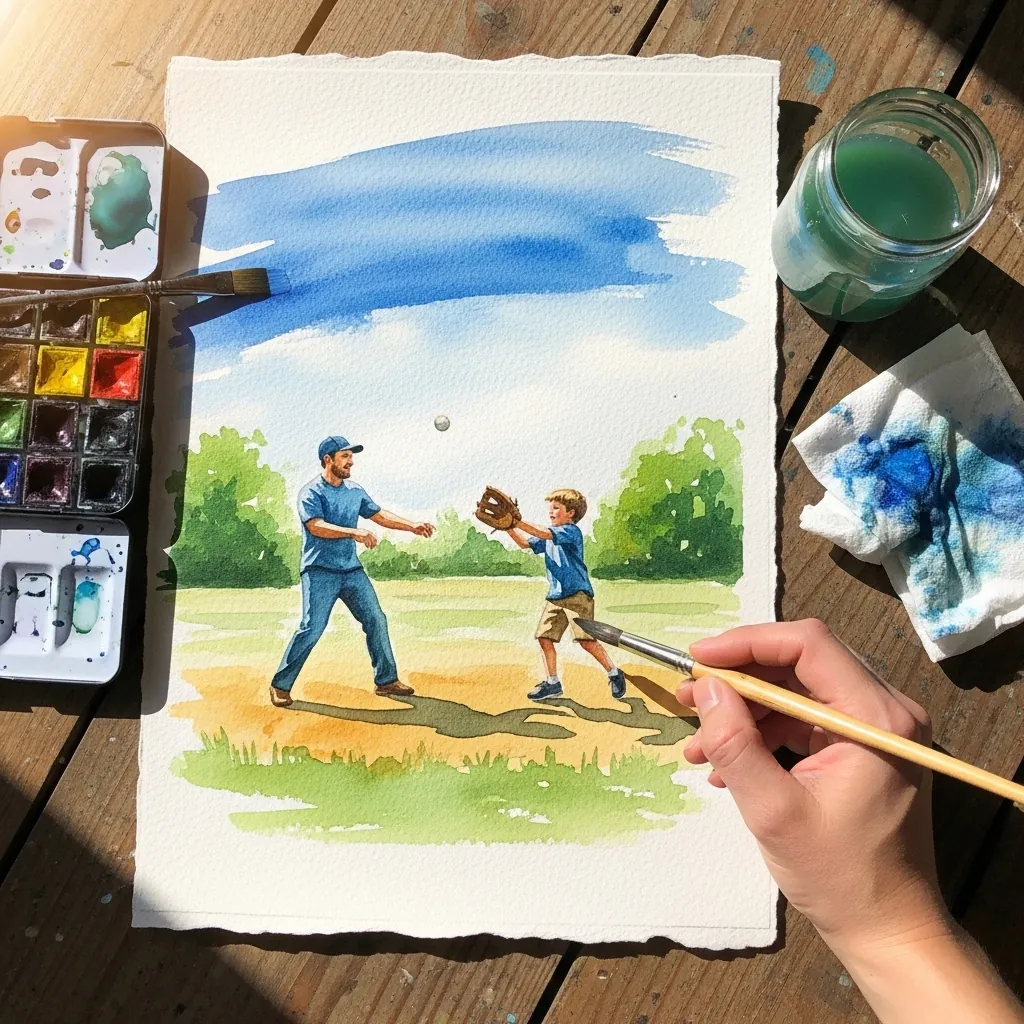
Loose watercolor suits action because it refuses to be precise. Paint both figures as simple shapes with correct posture, keep the ball as a tiny reserved white dot mid-air, and let the background stay entirely unresolved. Leave the sky as a single flat wash, because any cloud detail would pull attention off the figures.
9. Sepia Portrait of an Older Father
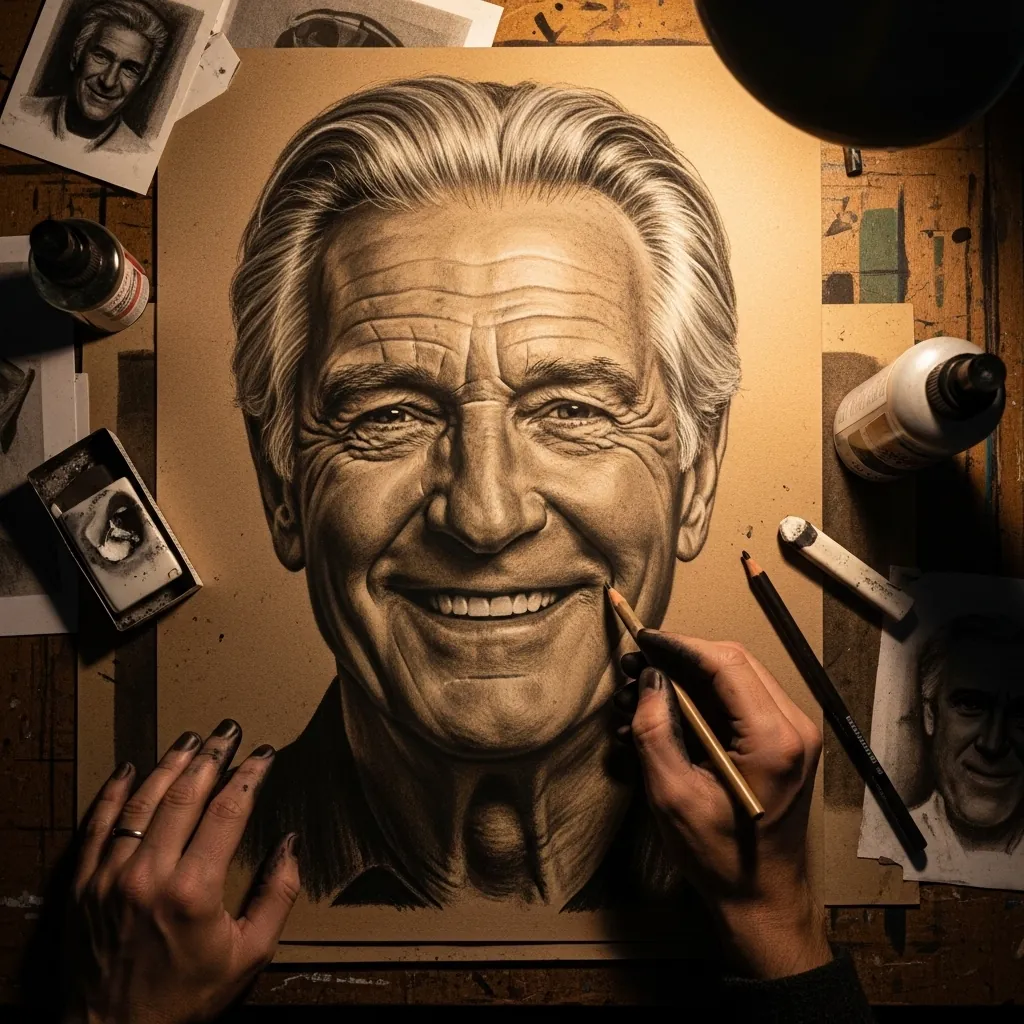
Age lives in the transitions rather than the lines. Render the changes of plane around the eyes and mouth as soft gradients first, then place only the deepest few creases as actual drawn lines. Drawing every wrinkle ages a face into a caricature.
10. Colored Pencil Baking Together
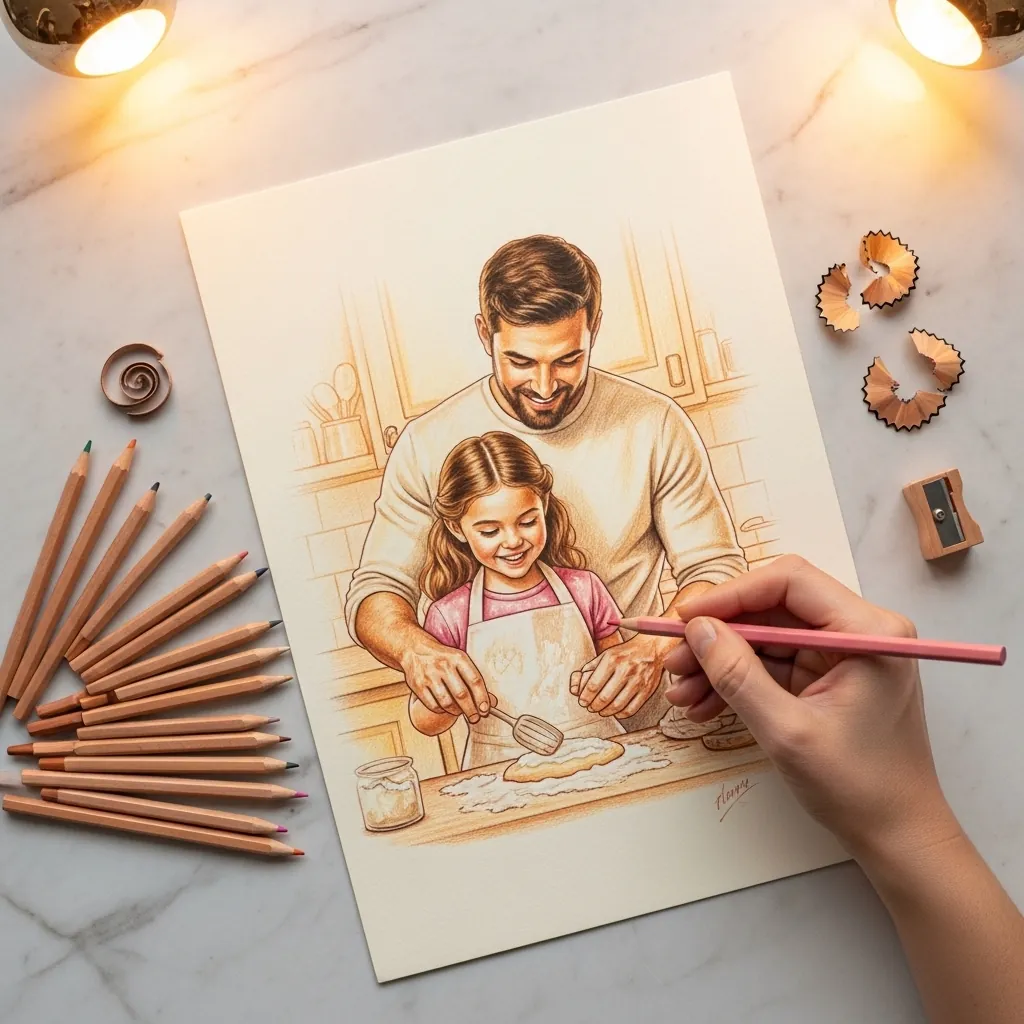
A shared task gives both figures a reason to lean the same way. Place the mixing bowl between them at the exact center, angle both bodies toward it, and the composition organizes itself around that single point. Flour dust on the counter is worth adding, as small mess details make a domestic scene feel lived in.
11. Ink Line Drive in the Car
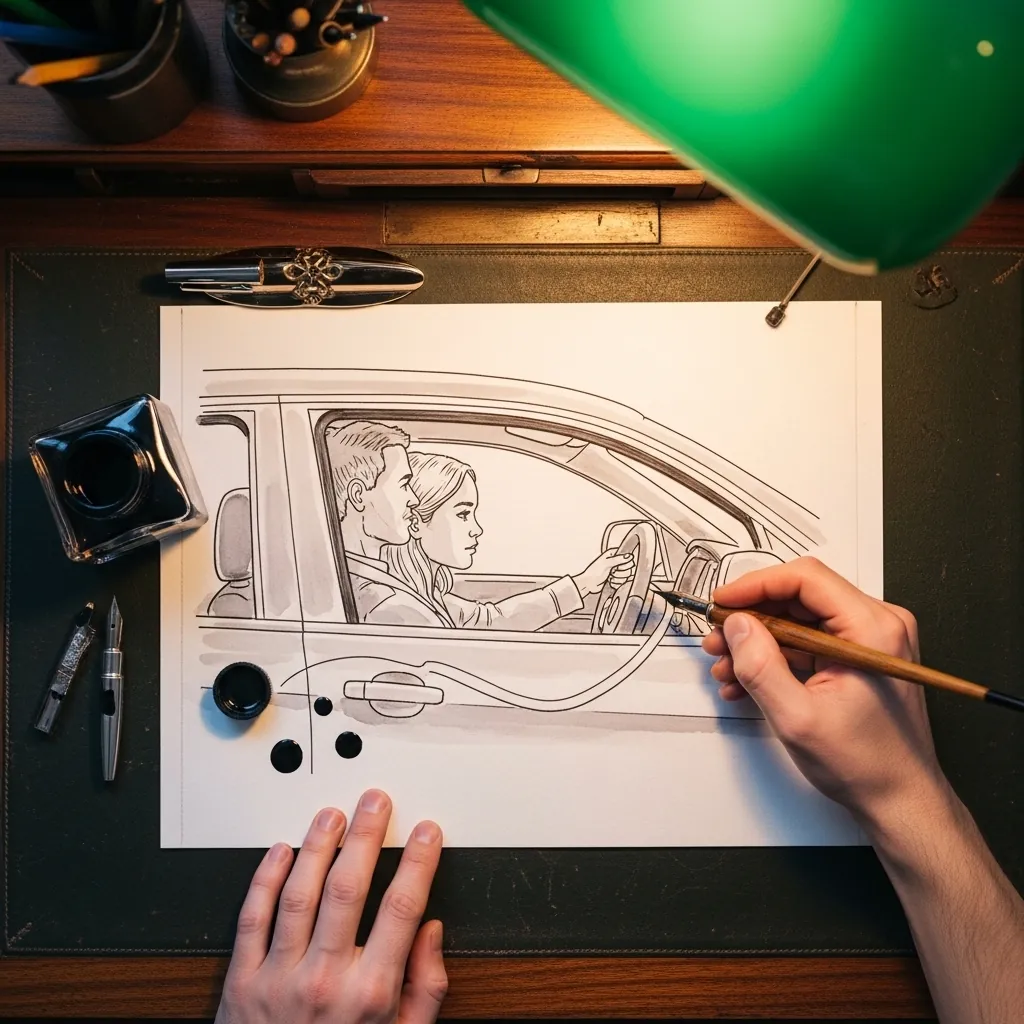
The window frame is doing the composition work here. It crops both figures deliberately and creates a natural border, which is why this reads as a considered image rather than a sketch that ran out of paper. Reflections in the glass are optional, but a couple of angled streaks instantly suggest a windscreen.
12. Autumn Walk in Oil Pastel
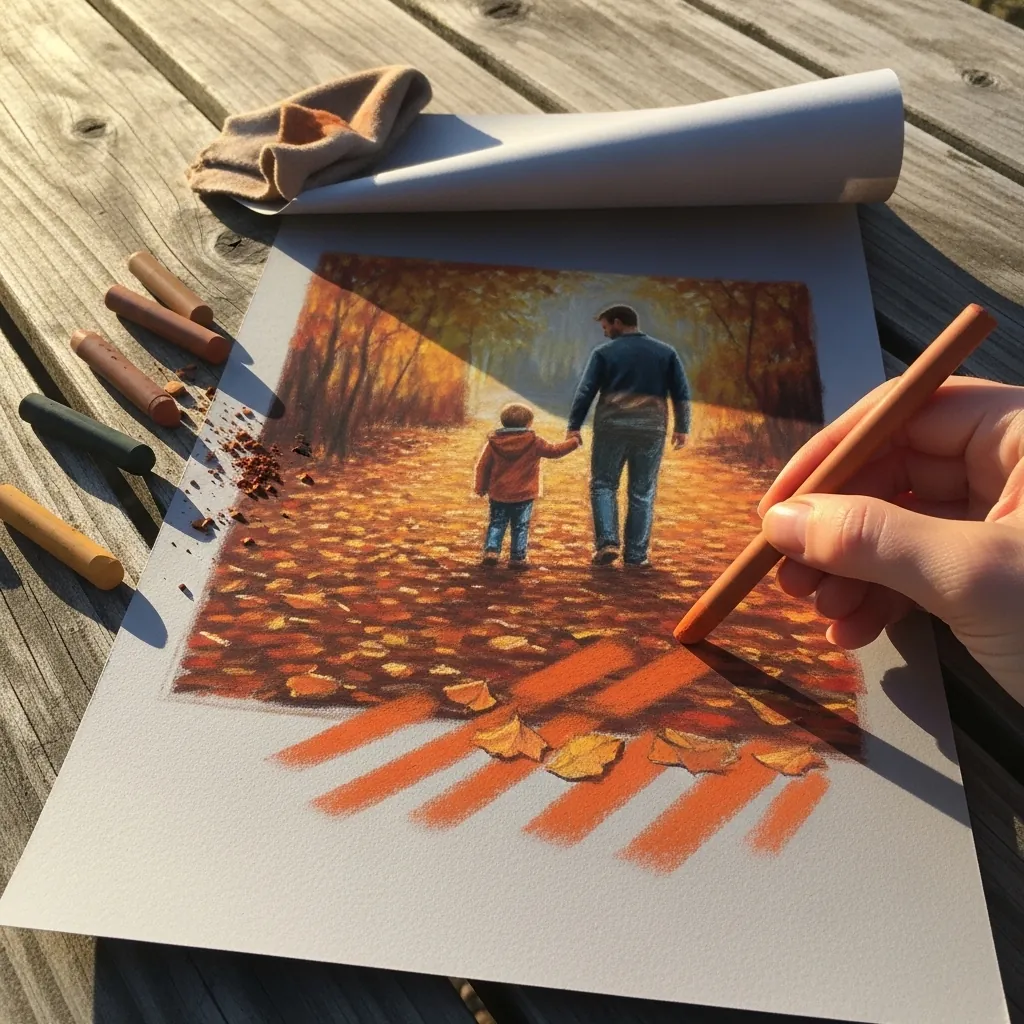
Held hands are the strongest contact point available. Place that join near the center of the composition, let the two arms form a single connecting line between the figures, and keep the leaf carpet loose so the hands stay the focus.
13. Sleeping in an Armchair
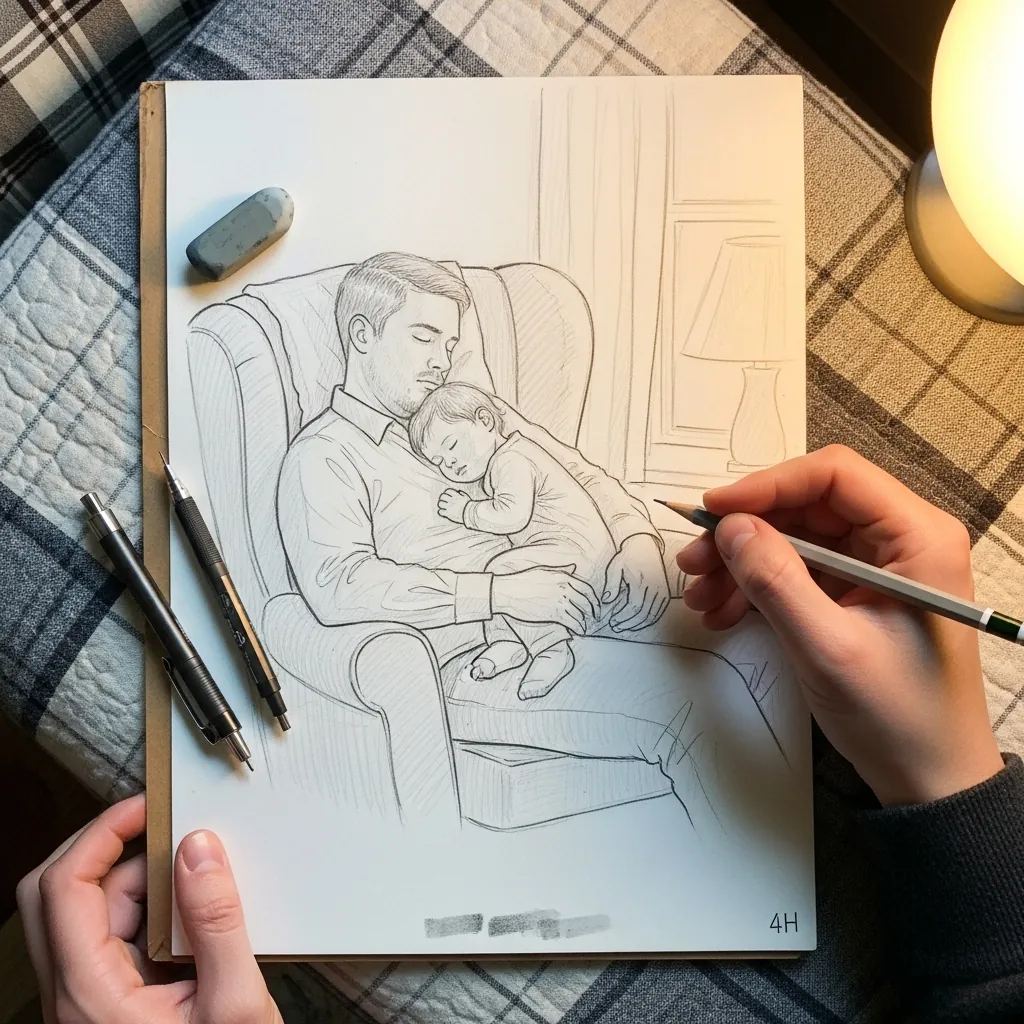
Stillness needs very few marks. Keep this in the lightest possible line with almost no shading, since a heavily rendered version of a quiet subject fights against its own mood. The chair contains both figures as one soft mass. One warm lamp in the corner gives you a reason for the whole scene to sit in a narrow value range.
14. Watercolor Sandcastle at the Beach
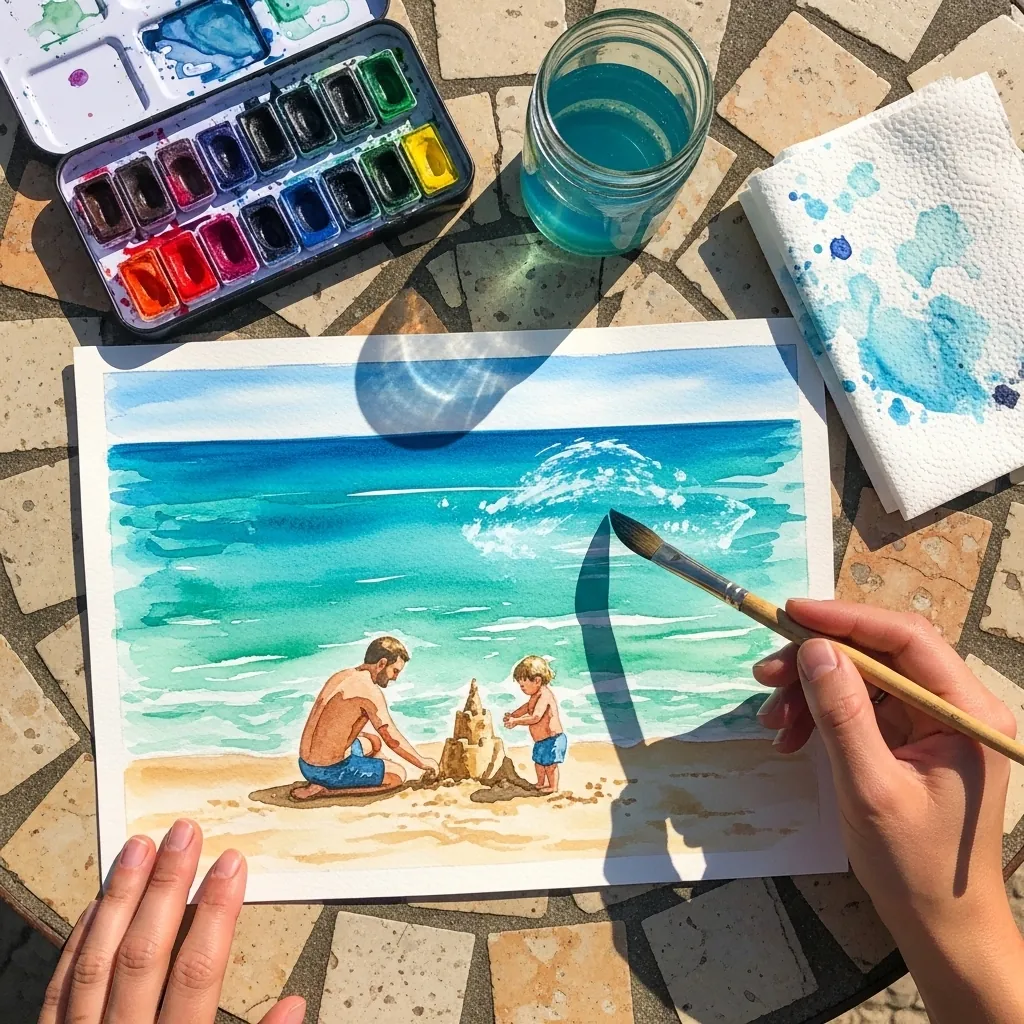
Crouching brings an adult down to a child’s height, which is a useful compositional trick. Both heads now sit at nearly the same level, so the pair reads as equals working together rather than as one figure supervising another. Wet the sky and sea areas first and paint them in one pass, so the sand keeps its crisp dry edge.
15. Stippled Night Sky Together
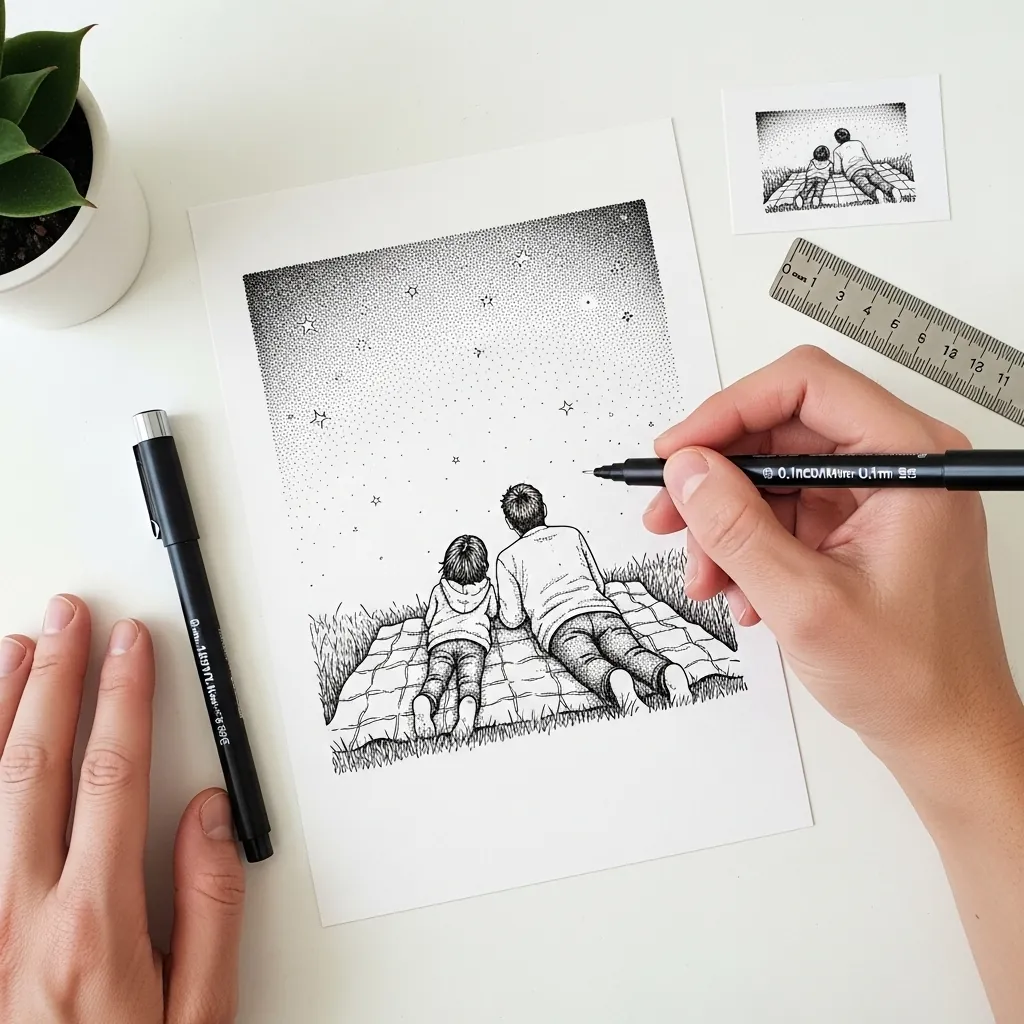
Stippling suits a night sky perfectly. Build the darkness with dense dots, leave the stars as untouched paper, and keep the two figures as simple silhouettes seen from behind so the enormous sky stays the actual subject. Vary the star sizes deliberately, because evenly sized dots read as a texture rather than as a sky.
16. Tying a Shoelace in Colored Pencil
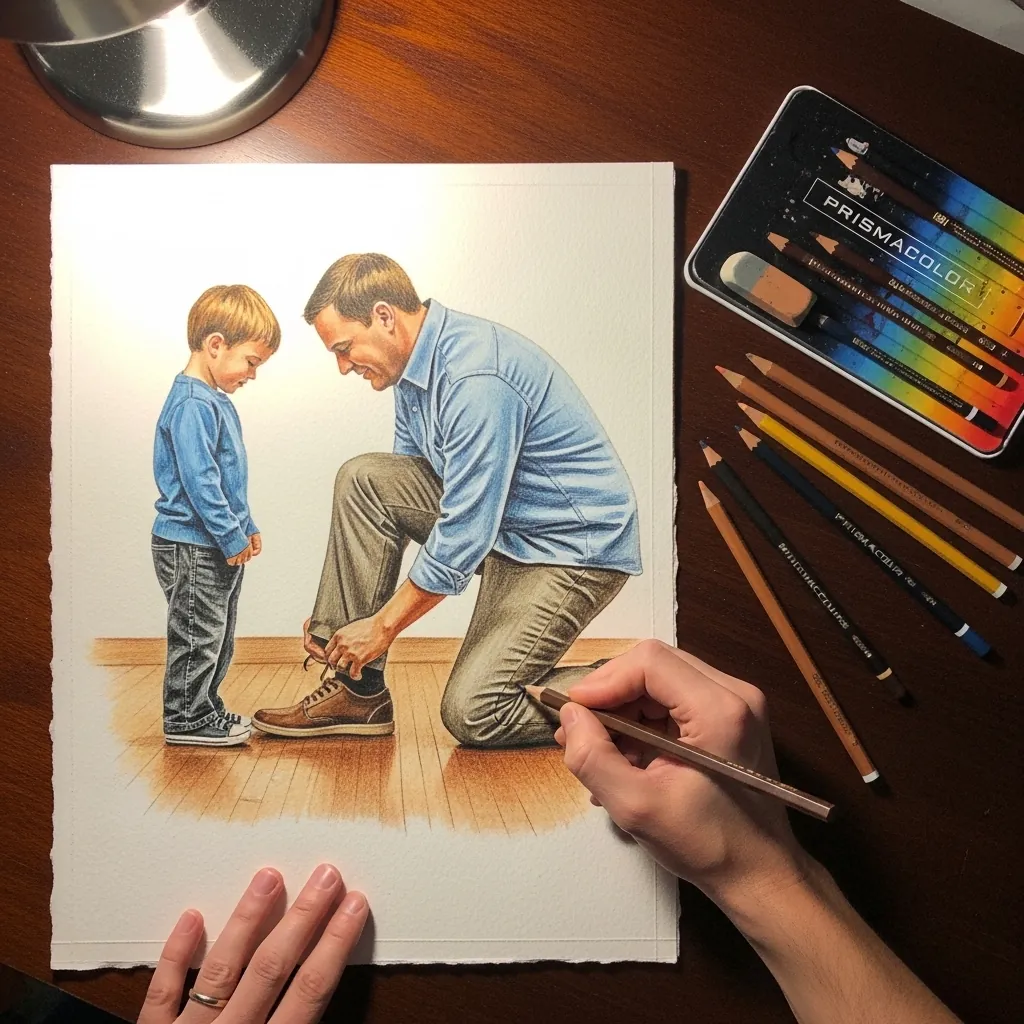
Kneeling creates a strong triangular composition. The adult’s bent form makes a stable base, the child stands as the vertical, and the two heads tilting toward each other close the shape at the top. Give the boy a slight lean forward as children rarely stand still while someone works on their feet. That small tilt keeps the pose from freezing.
17. Charcoal Mountain Silhouette
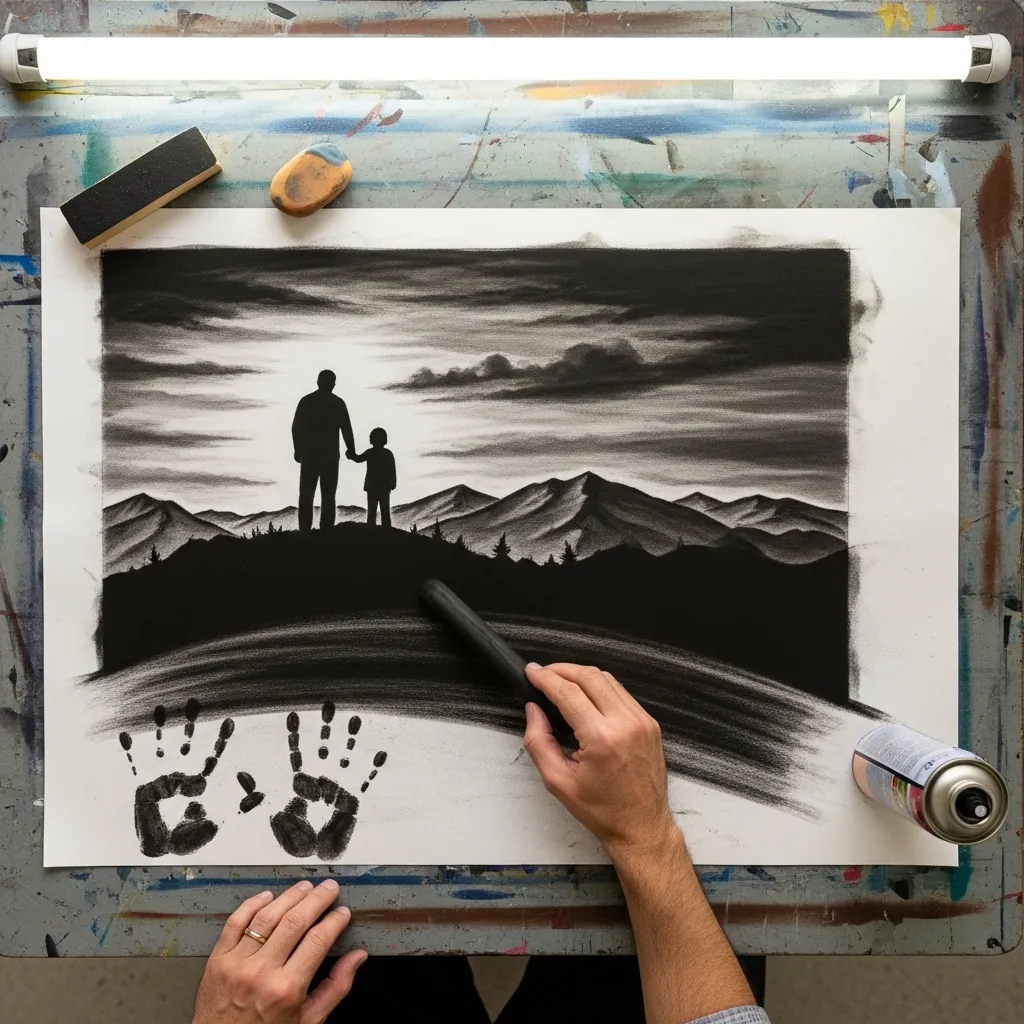
Silhouettes live entirely on gesture. With no interior detail available, the outline has to say everything, so exaggerate the height difference and leave a clear gap of sky between the two figures so both shapes stay readable. Push the sky value darker at the top of the page and lighter at the horizon behind both heads.
18. Campfire Scene in Oil Pastel
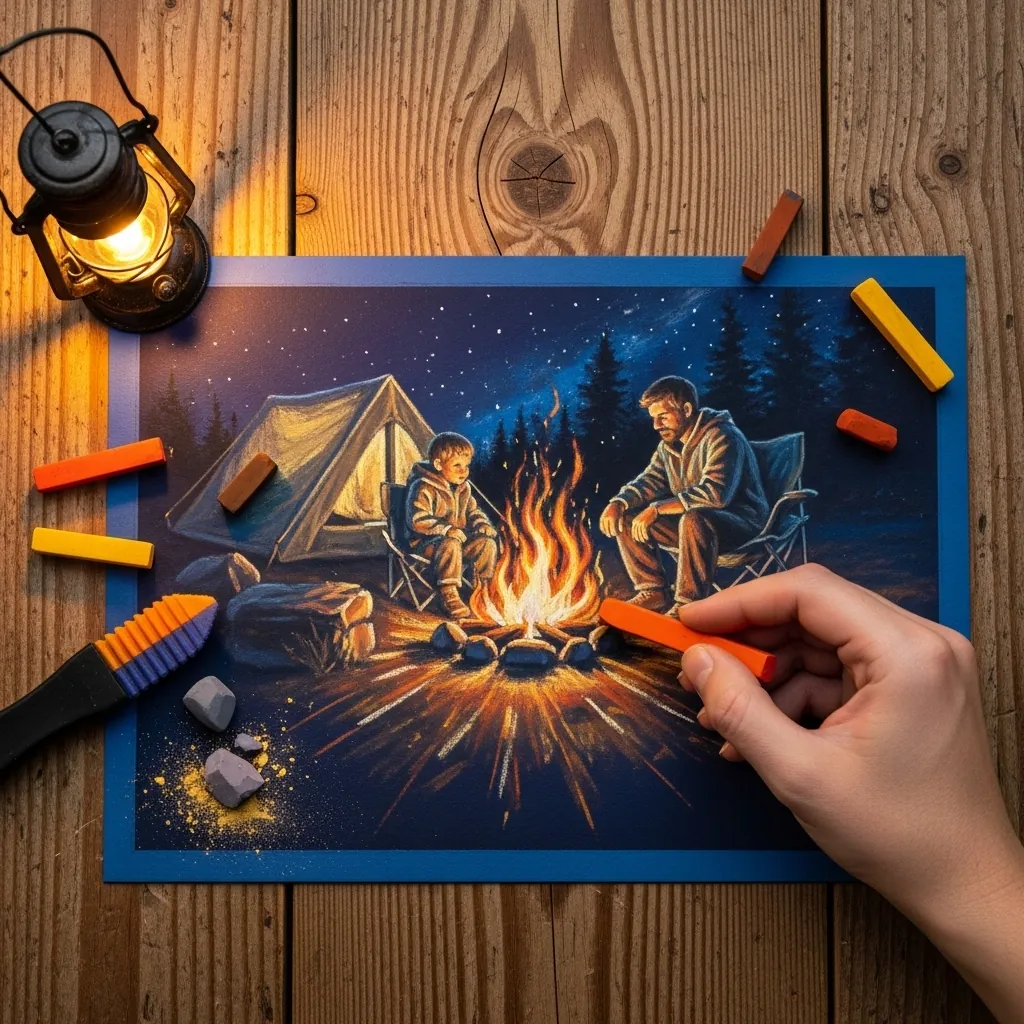
Firelight comes from below, which reverses all your normal shading. Light the undersides of both faces, the chins and the brow ridges, and let the tops of their heads fall into darkness against the night sky. Keep the flame the only saturated color, and let every other hue in the scene sit close to gray.
19. Laughing Portrait in Graphite
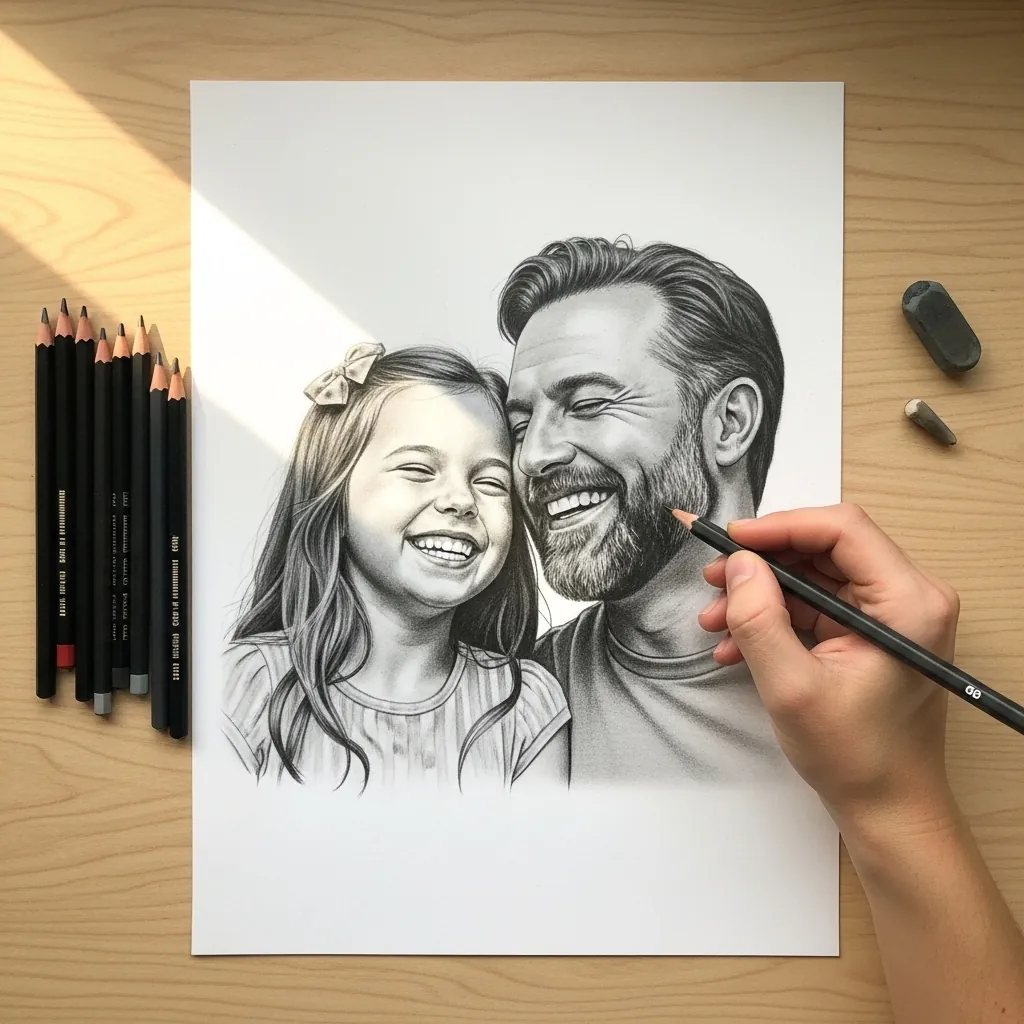
Genuine laughter shows in the eyes as much as the mouth. Narrow both sets of eyes and lift the cheeks, because a wide open mouth with unchanged eyes reads as a grimace rather than as joy in any portrait. Draw the two heads tilting toward each other rather than upright, since laughter is rarely symmetrical.
20. Watercolor Football in the Garden
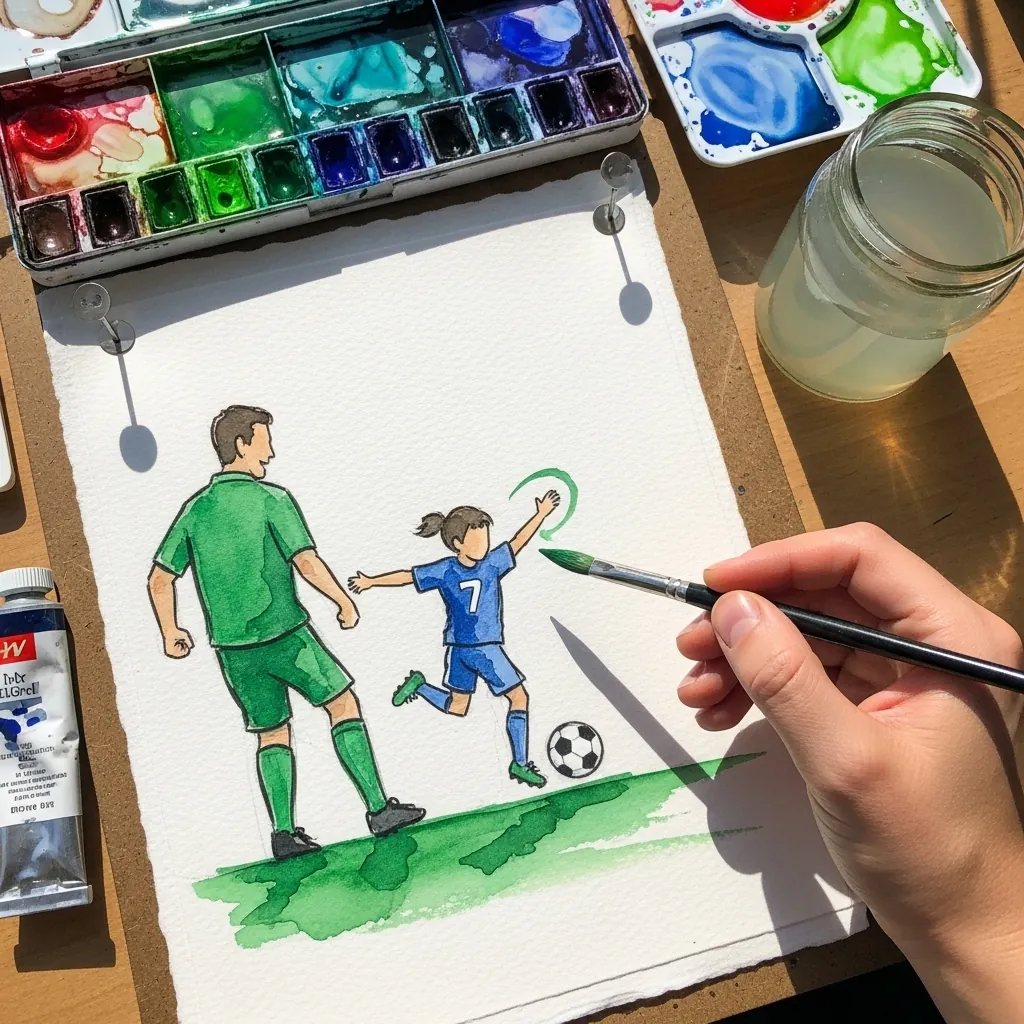
Motion needs one figure clearly off balance. Tilt the child’s body past their supporting foot so they are mid stride, and keep the adult more upright by contrast. That difference alone suggests movement. The ball should sit off center and clearly airborne, never resting on the ground between the figures. Its position tells you the moment.
21. Building Blocks on the Floor
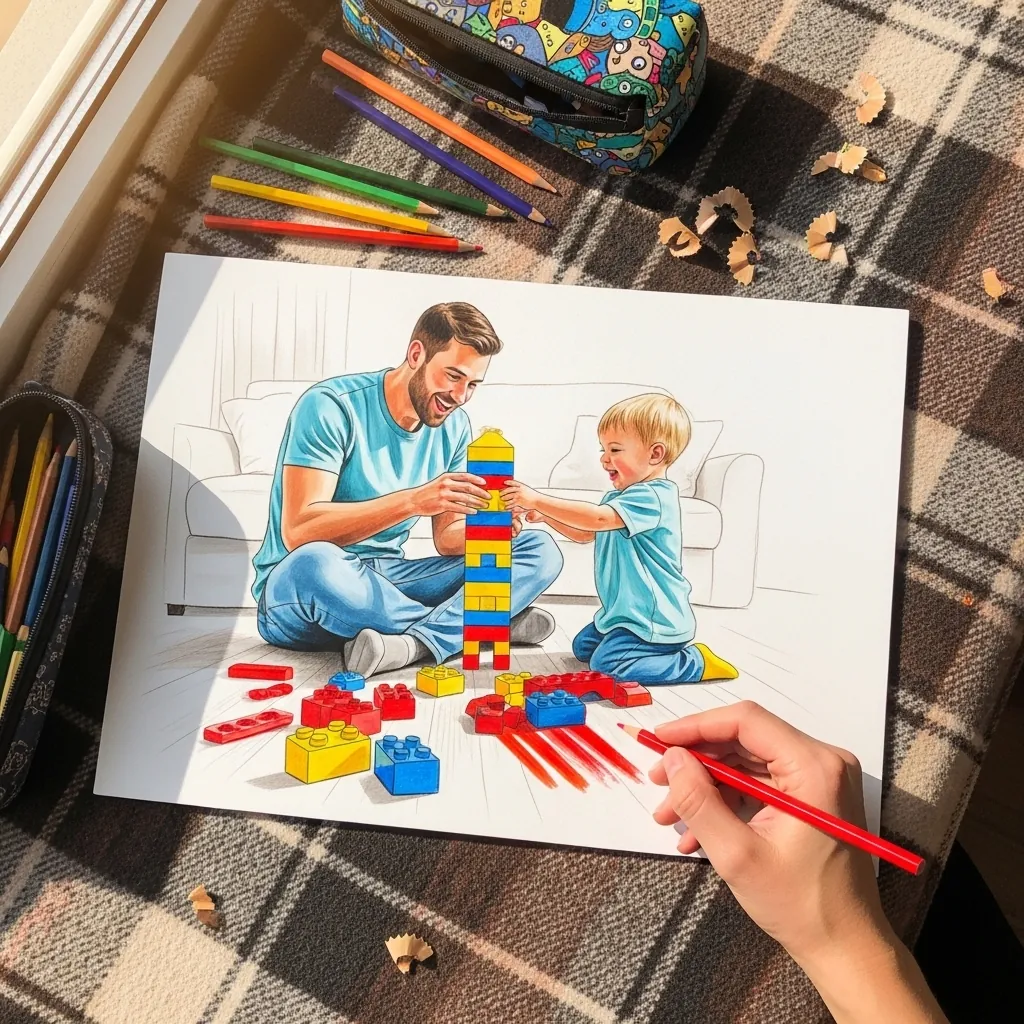
Both figures sitting on the floor puts every head at the same low level. Use the growing tower as the vertical element that breaks up all that horizontal, and let both pairs of hands converge on it near the center.
22. Ink Drawing Under the Car Bonnet
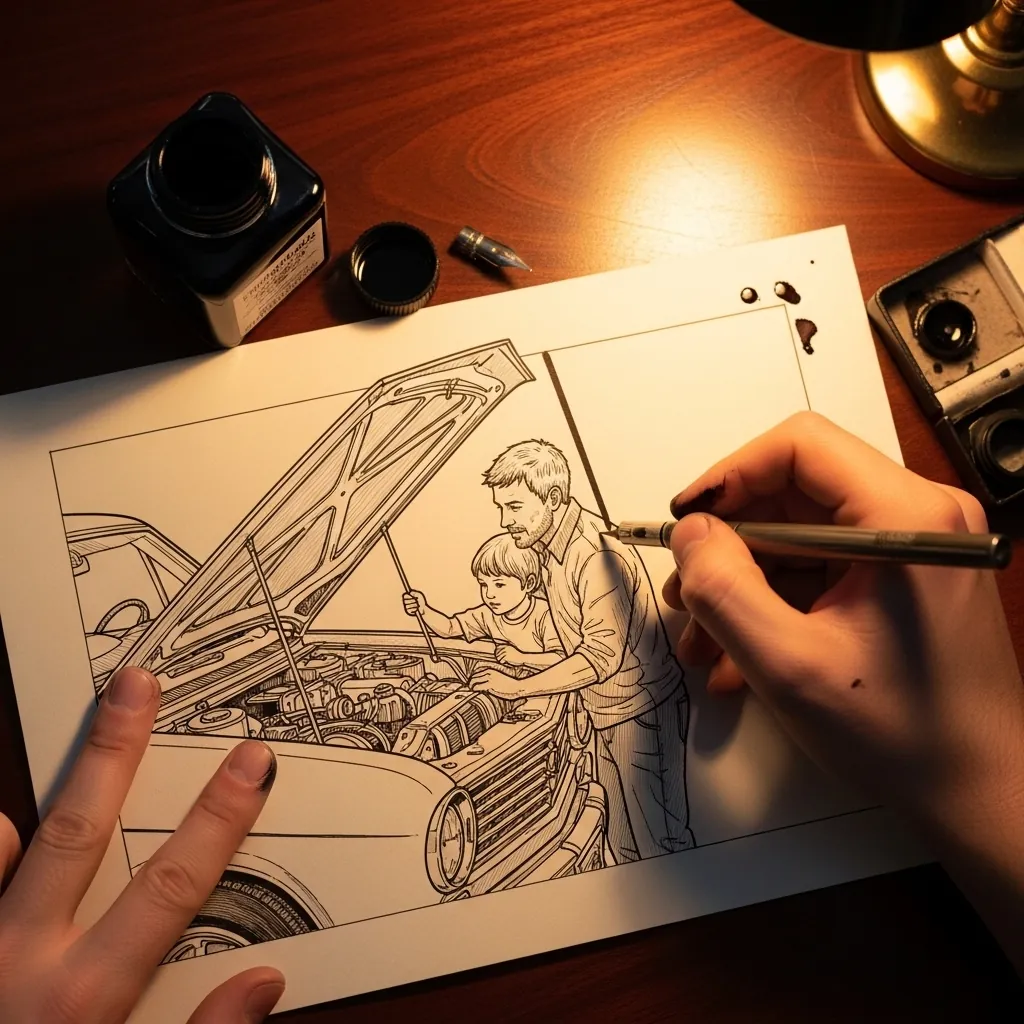
The raised bonnet acts as a frame within the frame. Draw the machinery in fine consistent line, keep the two figures slightly heavier in weight, and they will read clearly against all that mechanical detail behind them. Angle the bonnet slightly open rather than fully vertical, which gives you a more interesting shape.
23. Two Hands Clasped in Charcoal
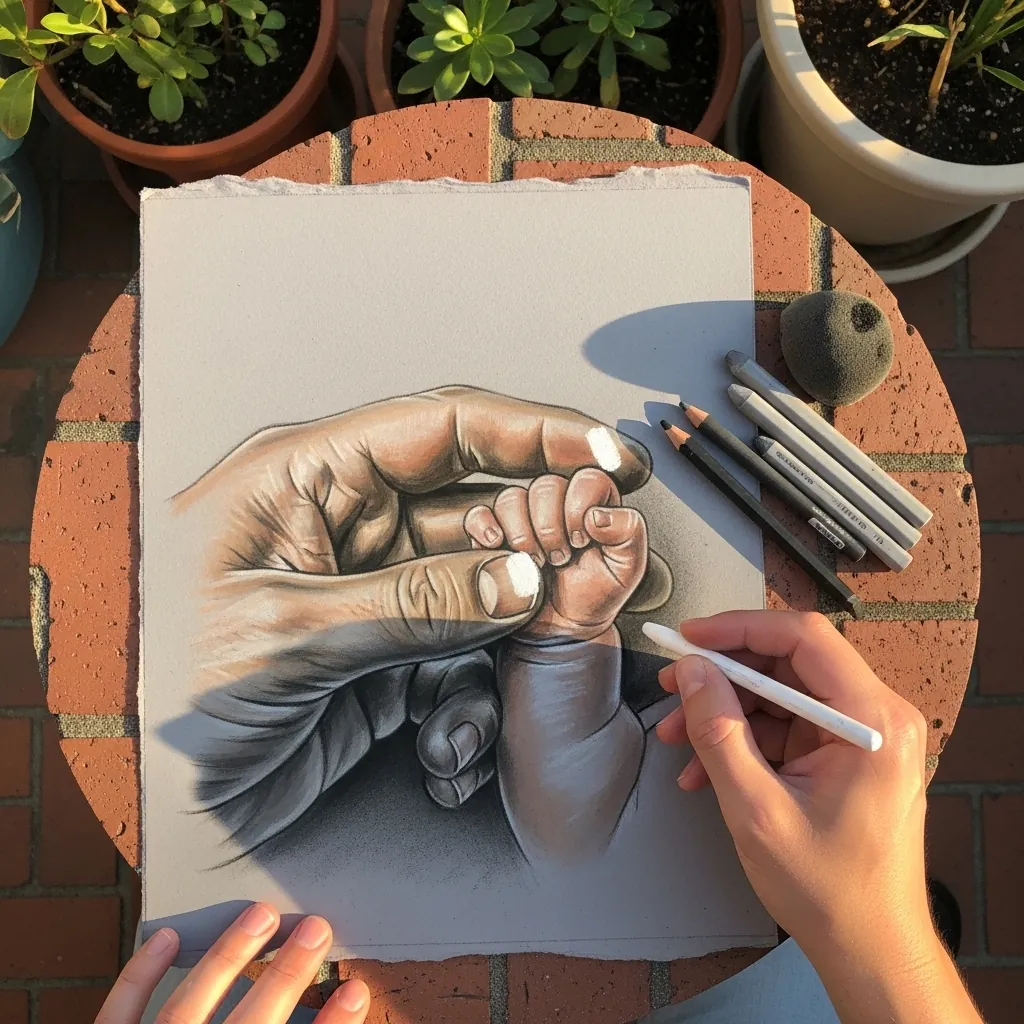
Hands carry more character than most faces. Render the adult knuckles and tendons in full detail, keep the child hand almost featureless and smooth by comparison, and that texture contrast tells the entire story. Position the clasp slightly off center, since a dead central grip makes the composition feel like a diagram rather than a moment.
24. Caricature Dad at the Barbecue
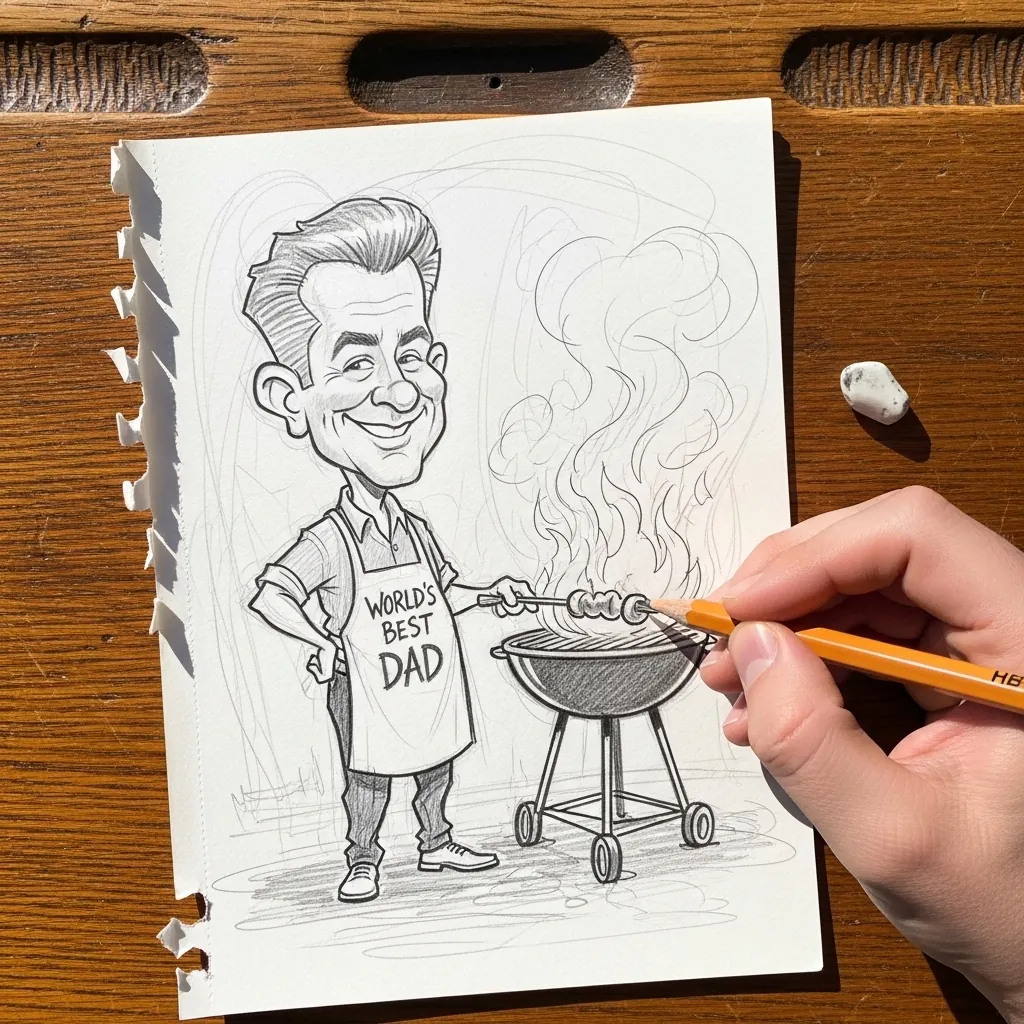
Caricature works by choosing one feature to exaggerate and leaving the rest alone. Push the smile and the hair, keep the body proportions loosely correct, and the drawing stays affectionate rather than tipping into mockery. Keep the apron lettering hand drawn rather than ruled, as neat type would fight the loose caricature line.
25. Watercolor Dancing on Her Feet
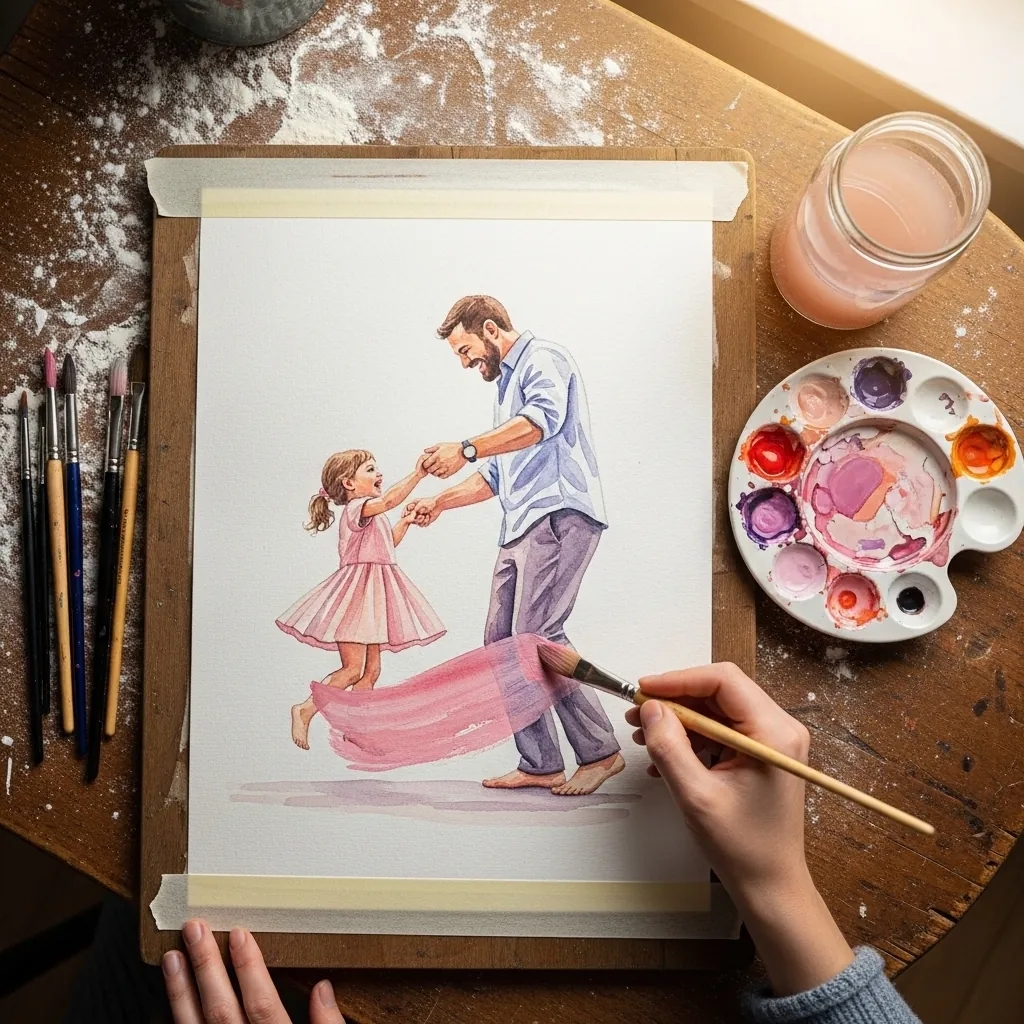
A child standing on an adult’s feet is a lovely visual problem. Both figures share one base of support, so draw the adult’s feet carefully and let the child’s weight visibly transfer down through them. Draw the adult’s knees slightly bent, because a fully upright stance makes the pose look posed. A small bend suggests real weight.
26. Homework at the Table
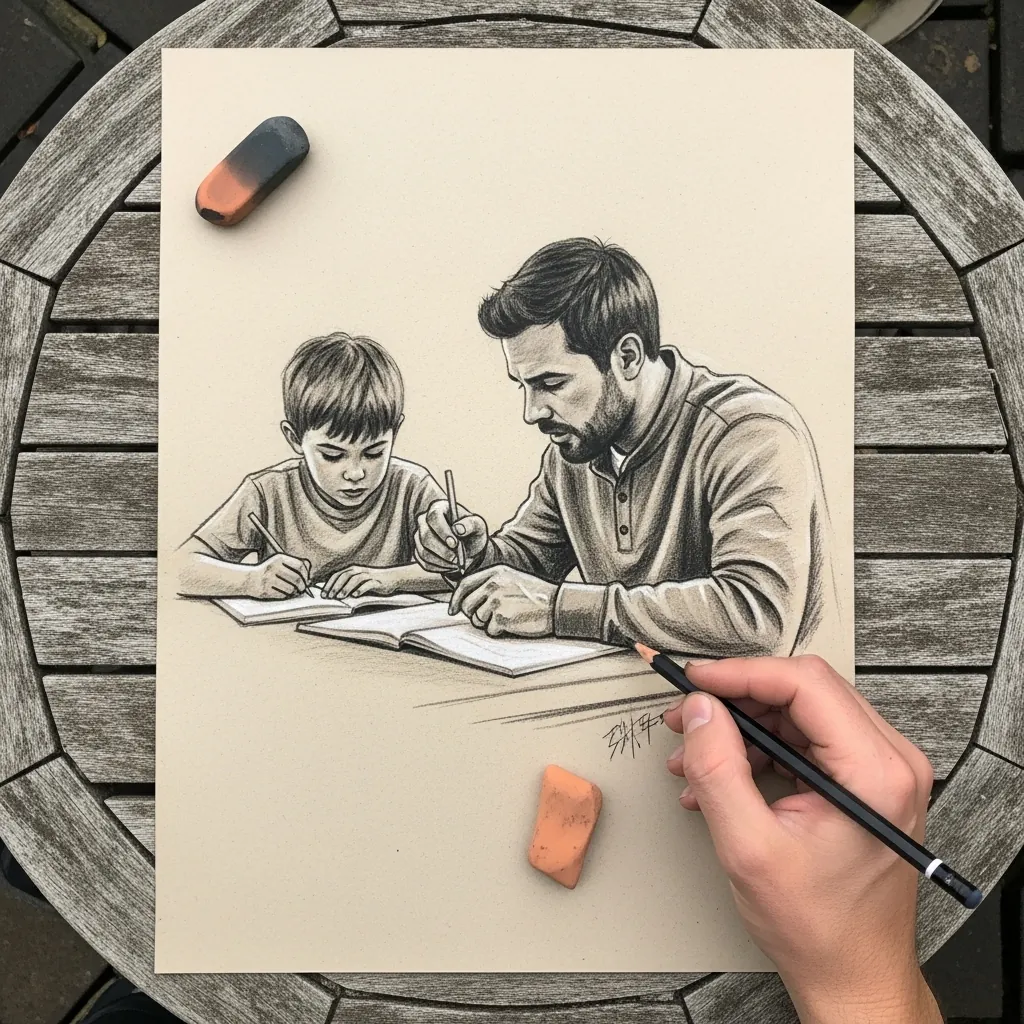
Two heads bent over the same book creates a natural triangle. Let the table edge run across the bottom of the composition as a horizontal anchor, and keep both figures leaning inward so the shape closes. Let the lamp light fall across the open book so the brightest area sits exactly between both faces.
27. Autumn Tree Lift in Colored Pencil
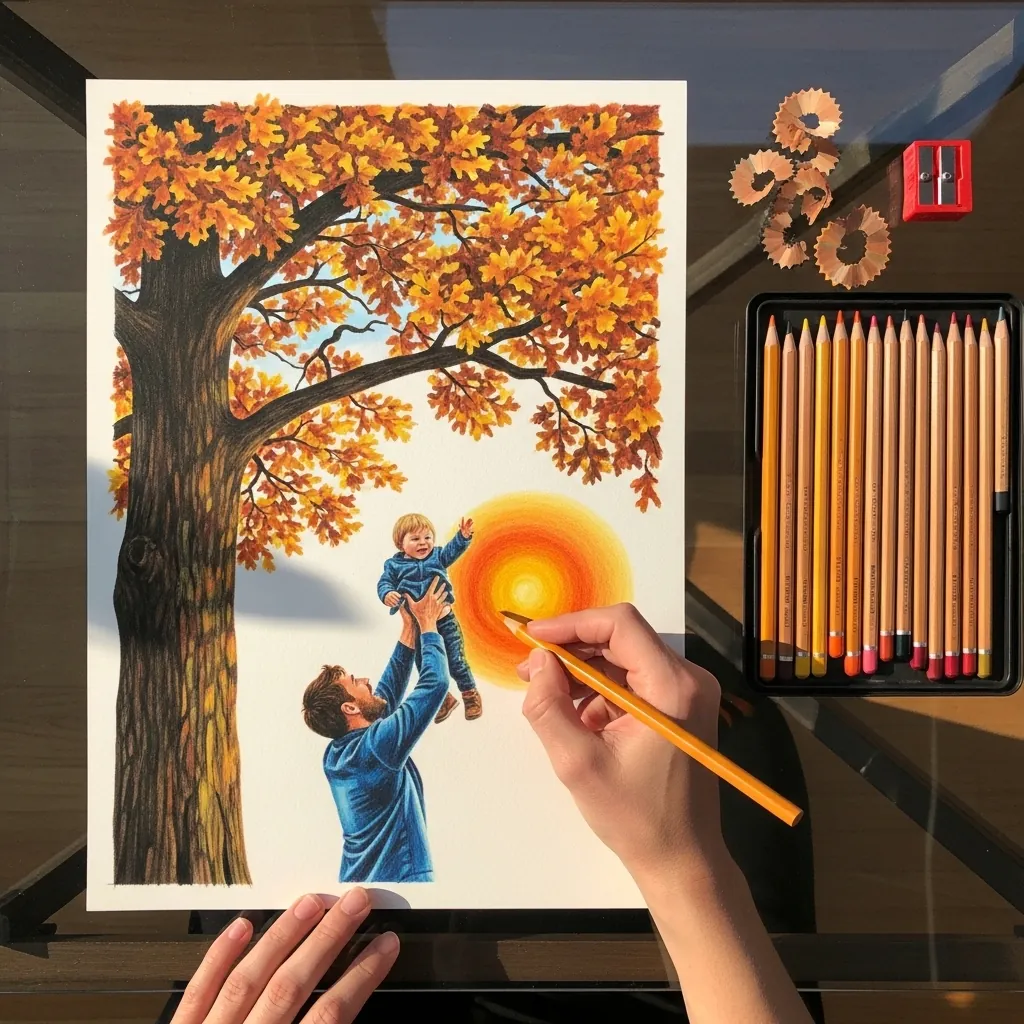
The tree does the framing here. Its trunk provides a strong vertical on one side, the canopy arcs overhead, and the two figures sit in the gap between them, which is a classic and reliable landscape arrangement. Break the canopy edge irregularly, since a smooth outline turns a tree into a lollipop shape instantly.
28. Reading the Newspaper Together
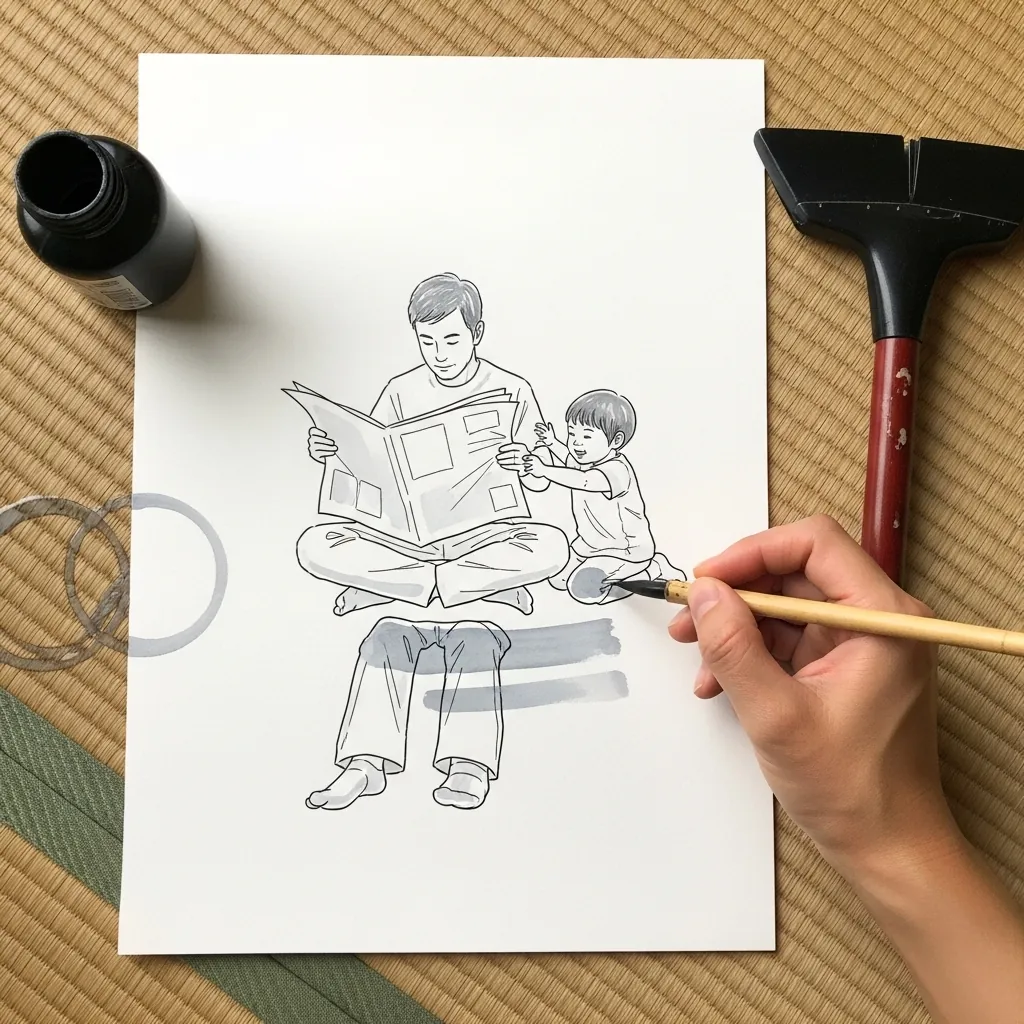
Everyday moments need very little rendering. Keep the whole thing in even weight line with one flat gray shadow beneath, and let the child’s curious lean over the newspaper edge supply all the character. The newspaper should overlap the adult’s torso, which immediately places it in front rather than beside. Overlap is doing the work.
29. Rooftop Chess Game in Charcoal
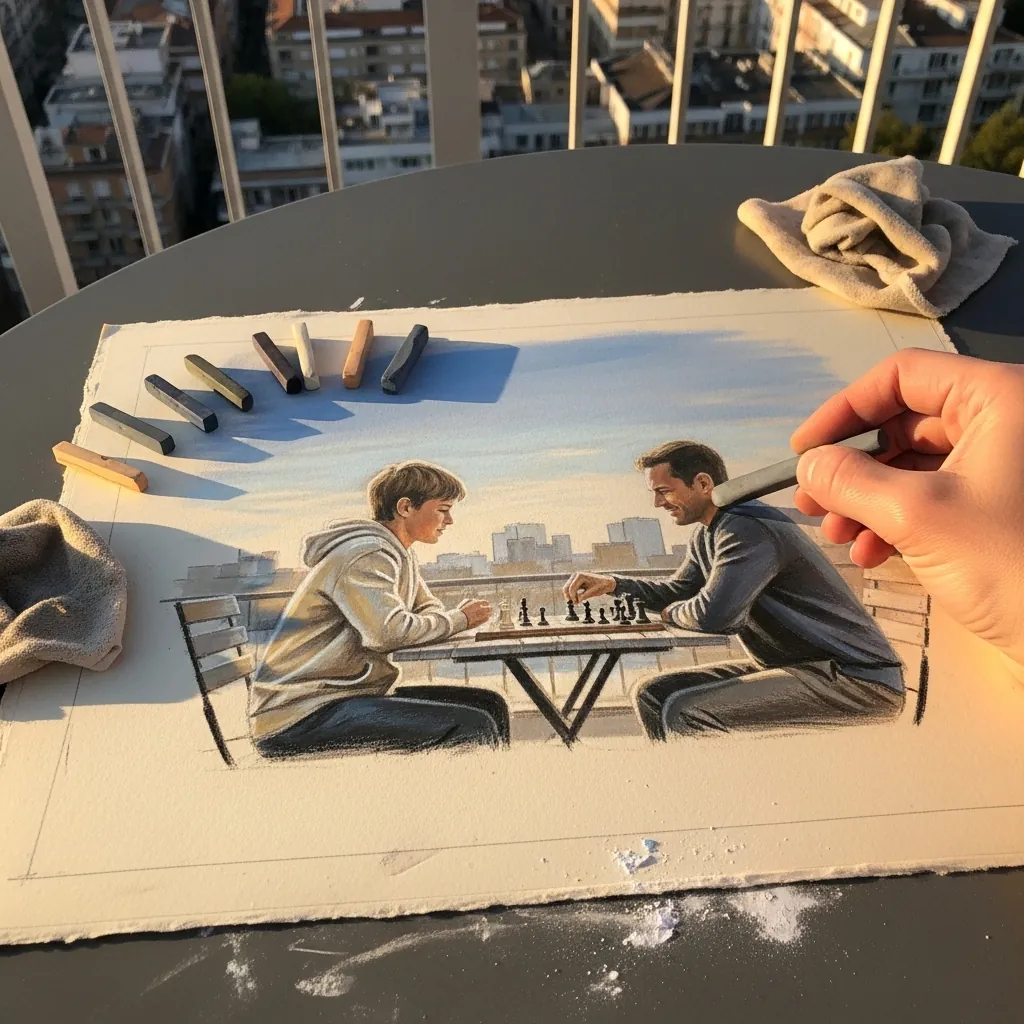
An older child changes the scale problem entirely. A teenager is nearly adult height, so the relationship now has to come from posture and the shared board rather than from any size difference between them. Keep the board square to the viewer and both figures at slight angles, which stops the scene going flat.
30. Drawing Together by Lamplight
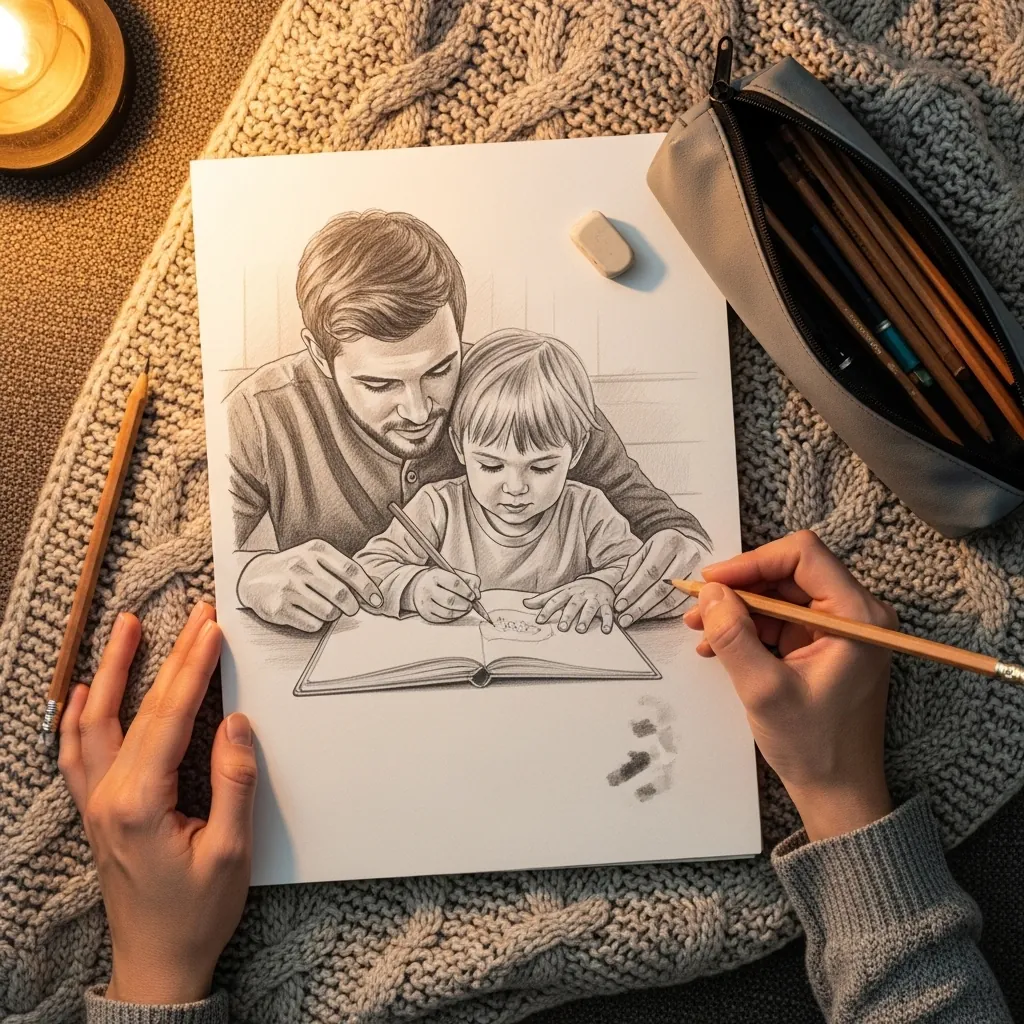
A picture about drawing should stay loose. Keep the linework visibly sketchy, let the construction lines show, and light the whole scene from one warm lamp so both faces catch the same soft edge. Show the sketchbook page tilted toward the viewer, so the drawing inside becomes a picture within a picture. It gives the eye somewhere extra to go.
31. Beach Walk in Watercolor
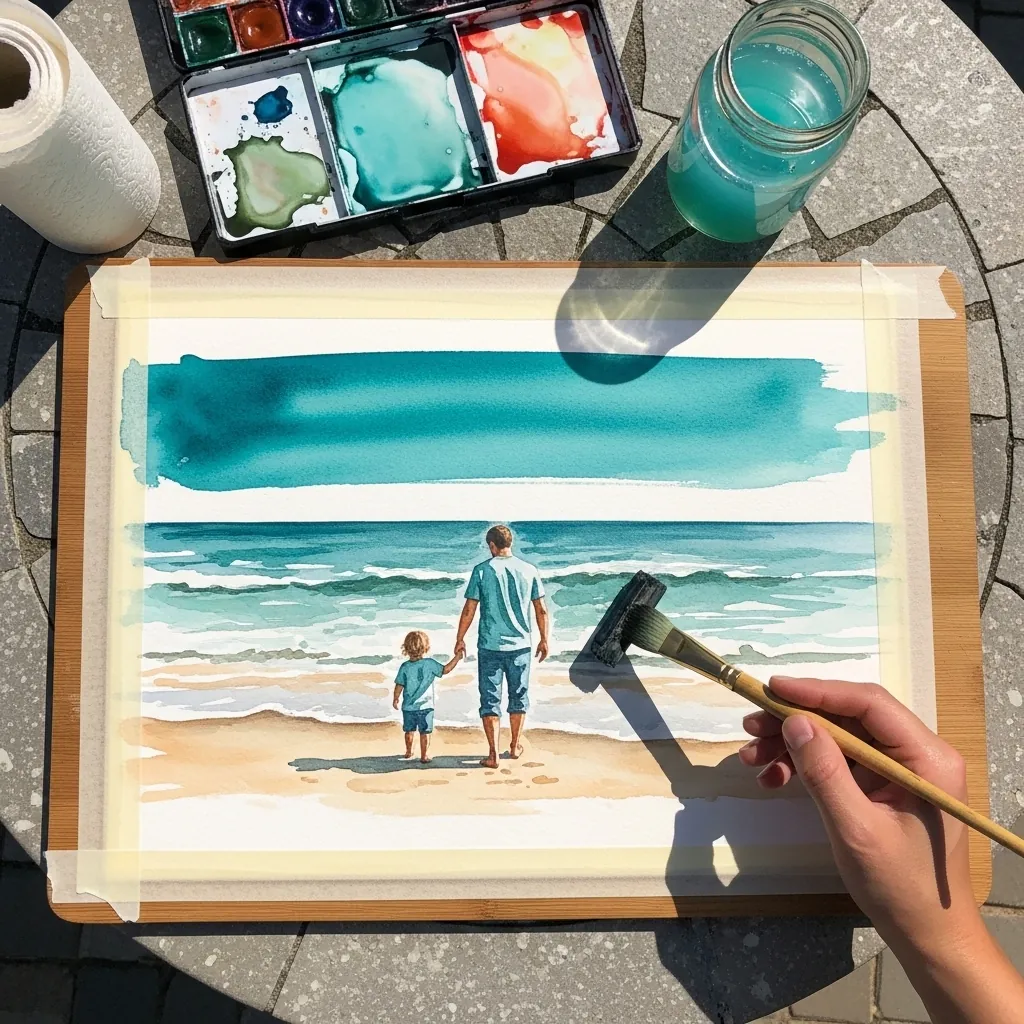
Wide empty space makes small figures feel intimate. Place the pair well off center, give them a great deal of sea and sand around them, and keep both figures small enough that the held hands are barely visible but clearly there.
32. Moonlit Canoe Silhouette
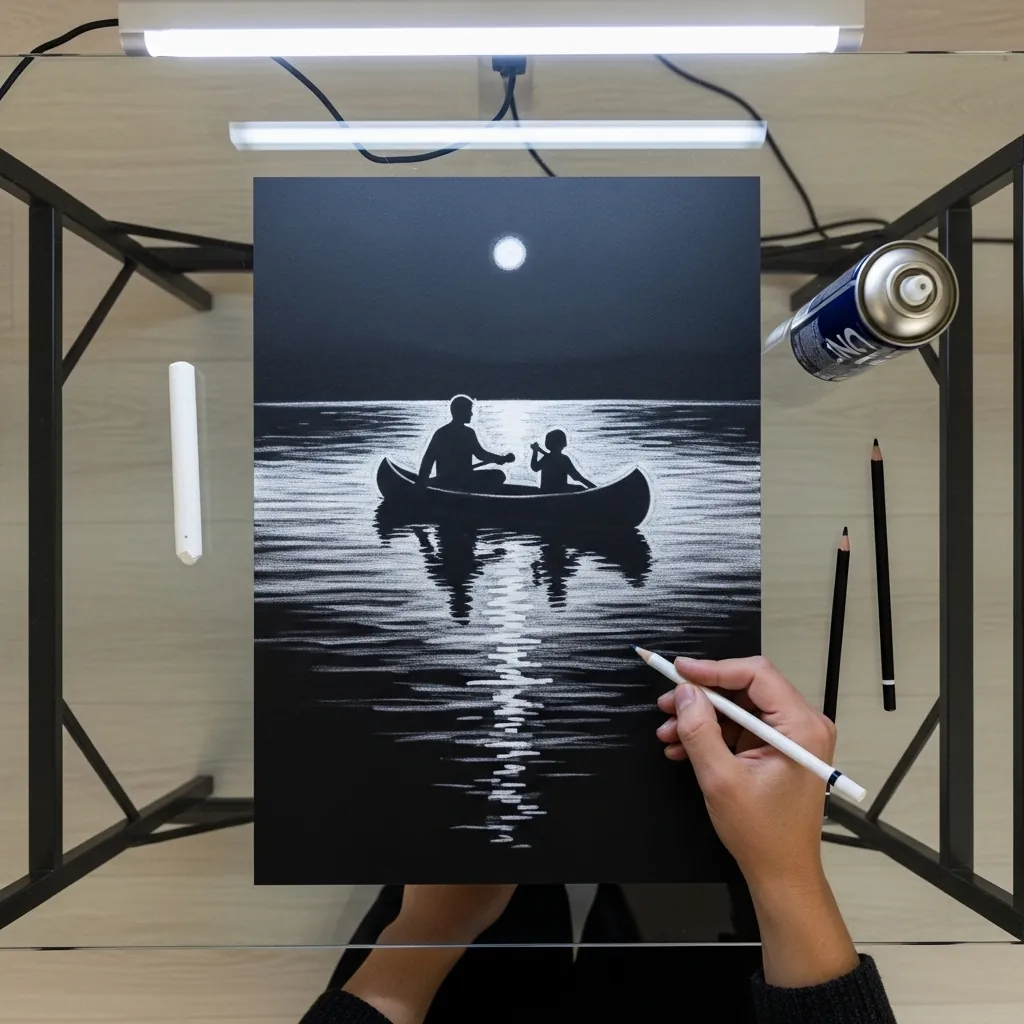
Working on black reverses everything. You add only light, so pick the moon, the water reflection and the top edges of both figures, and leave every other surface as untouched darkness. Break the moon reflection into short horizontal dashes rather than one solid line down the water. Continuous reflections never look like moving water. Dashes do.
33. Gardening Together in Colored Pencil
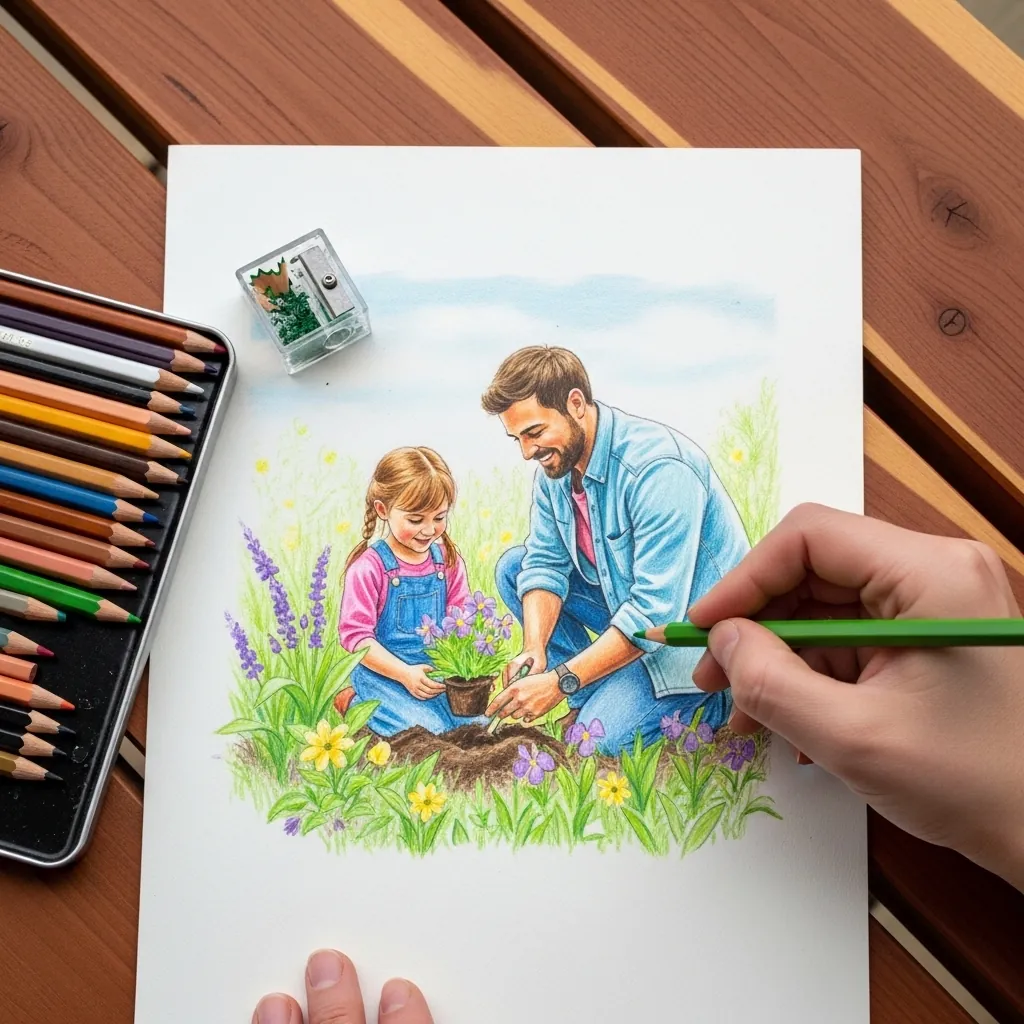
Both figures crouching keeps the composition low and wide. Put the seedling between their hands at the exact center, and let the surrounding flowers frame the pair without ever crossing in front of them. Add a few loose soil marks around the hole, because clean gardening always looks staged in a drawing. Small imperfections sell it.
34. Building a Treehouse in Ink
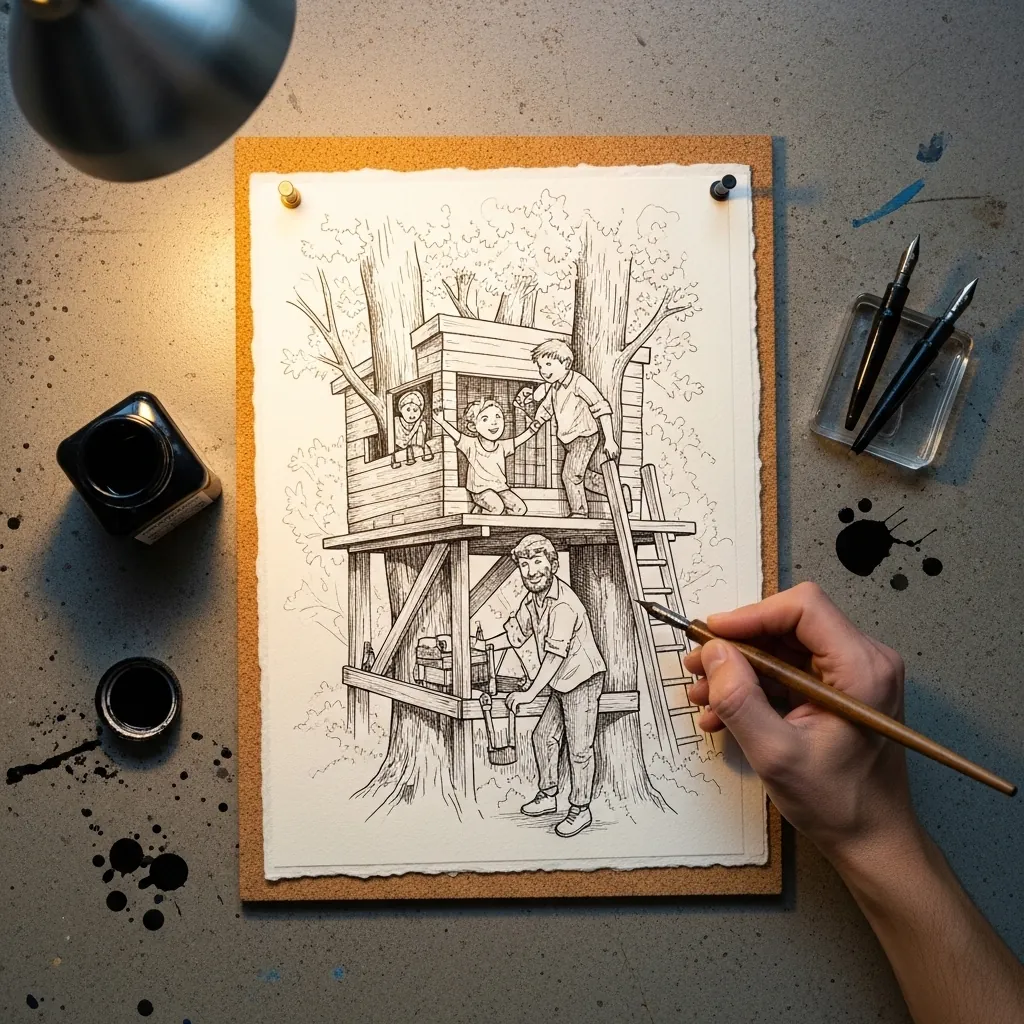
Three figures at three heights creates a natural diagonal. Place them on a rising line from bottom left to top right, and let the ladder and the tree trunk reinforce that same diagonal through the composition. Let the ladder cross in front of one figure and behind another, which stacks the three into real depth.
35. Giving Flowers in Soft Pastel
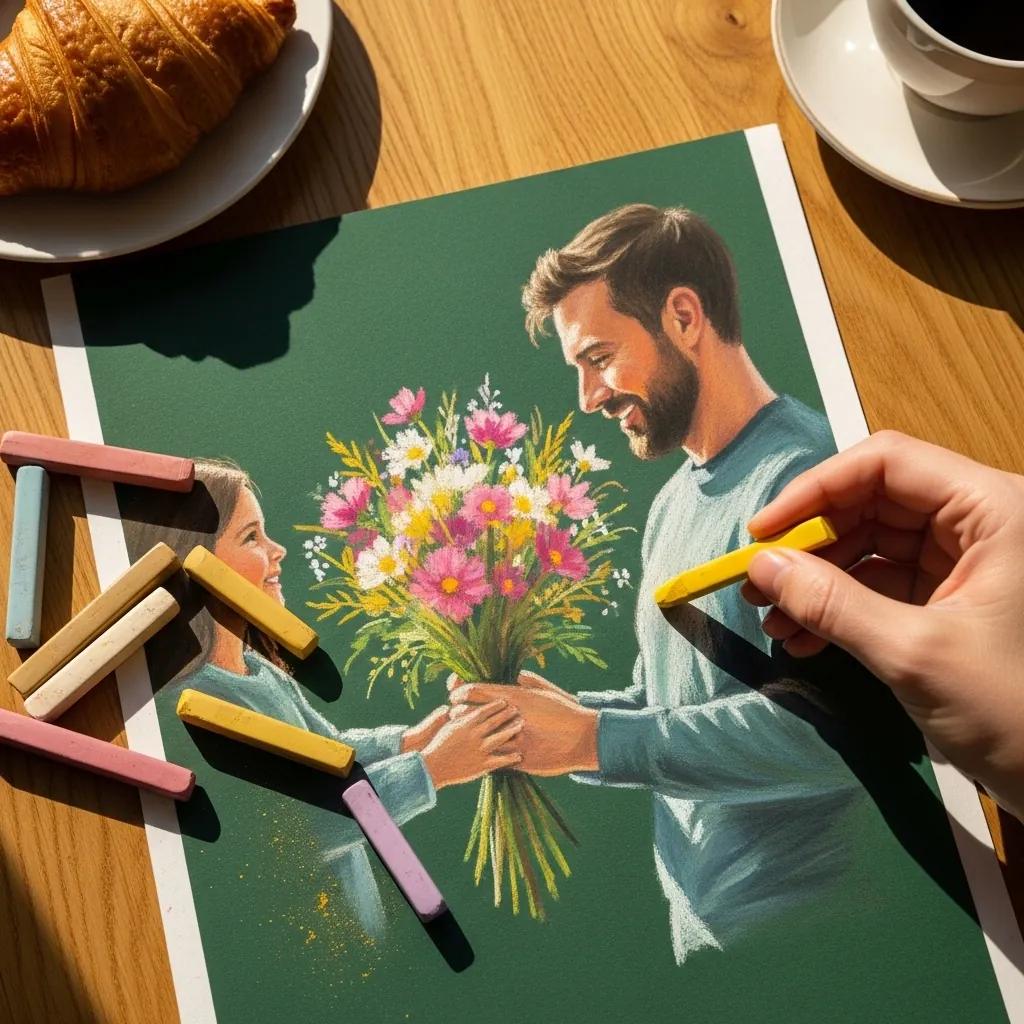
The gift itself becomes the connection point. Place the bouquet between the two figures where both pairs of hands meet, make it the most saturated color on the page, and let both faces angle down toward it. Keep the child’s arms fully extended, since a half hearted offer reads as hesitation rather than a gift.
36. Haircut at Home in Pencil
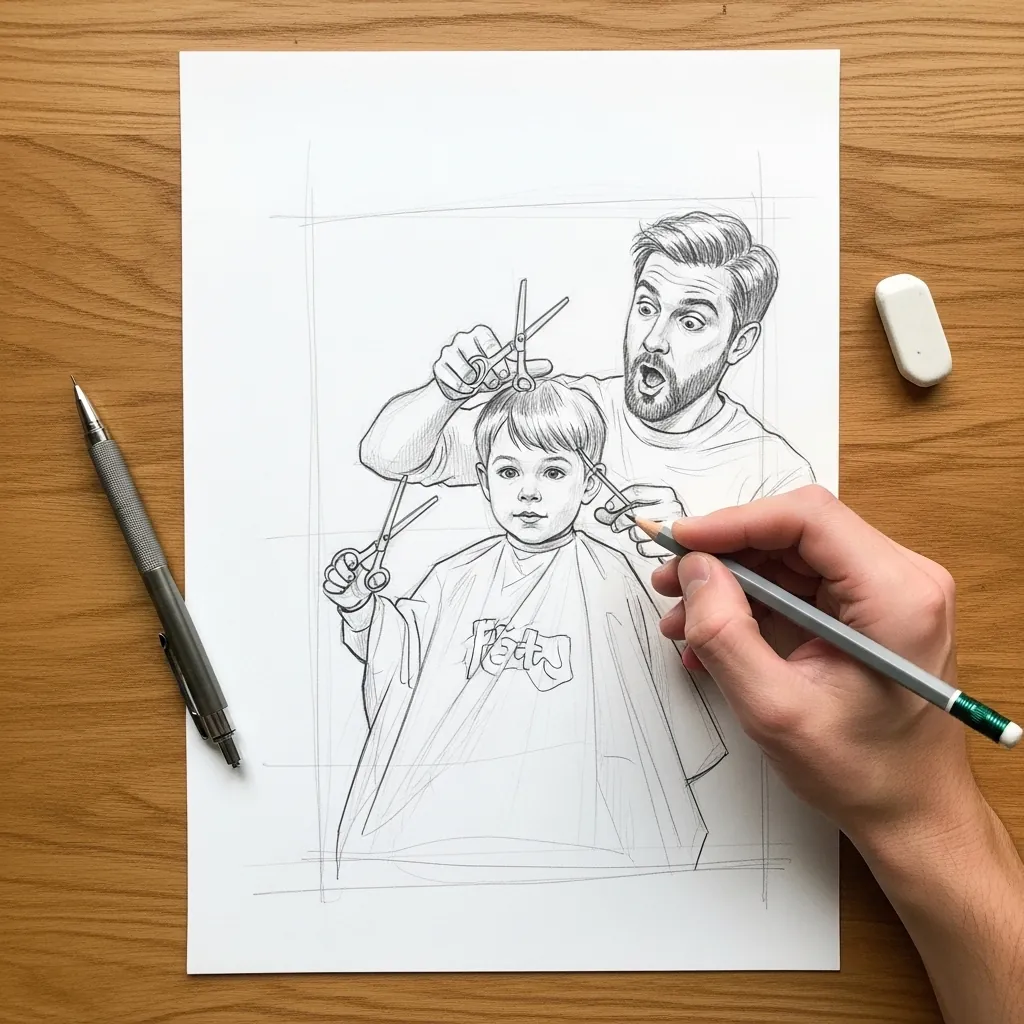
Humour comes from expression mismatch. The child sits calmly while the adult looks alarmed, and that gap between the two faces is the entire joke, so exaggerate the difference rather than either face alone. Draw the scissors small and the expressions large, as the tool matters far less than the two reactions. Scale the drama, not the props.
37. Painting Side by Side in Watercolor
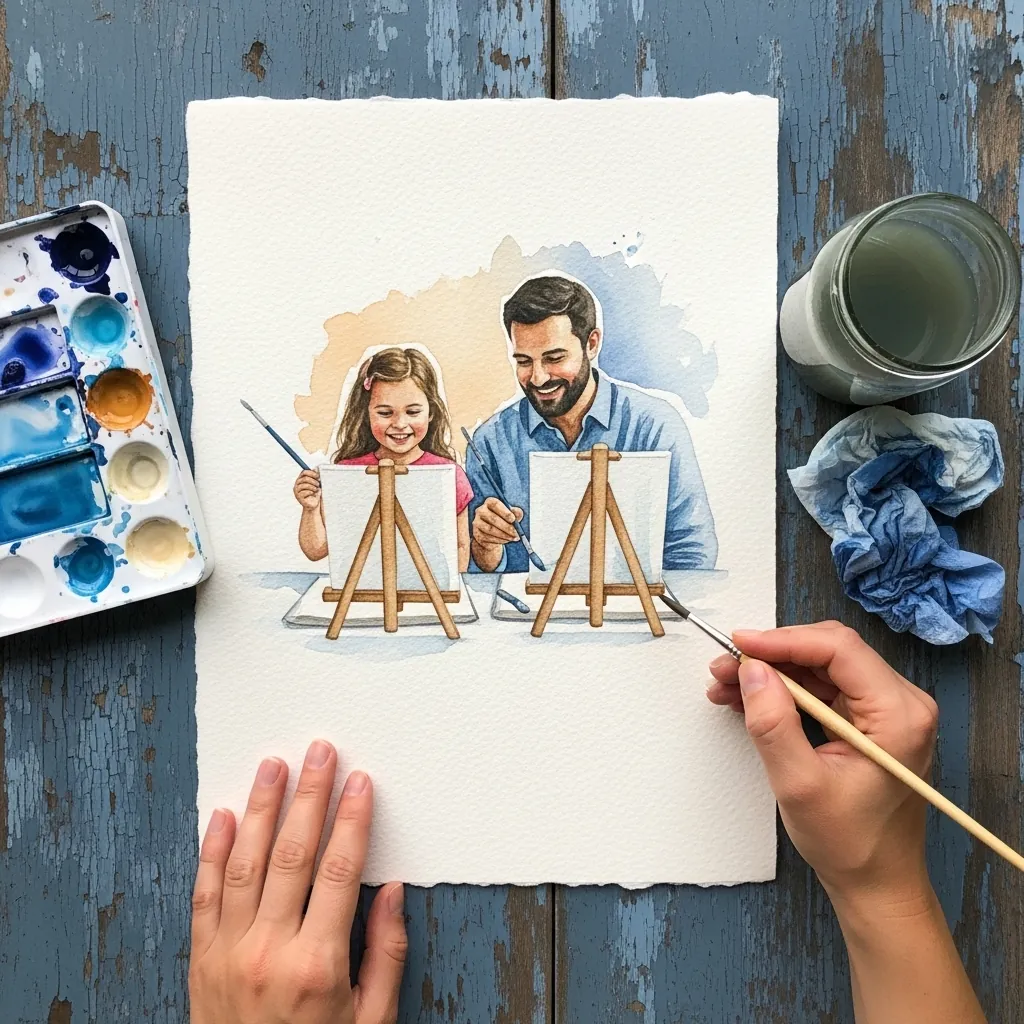
Two easels give you two strong verticals to compose against. Set them at slightly different angles so the arrangement does not go flat, and let both figures lean inward toward each other across the gap. Show one canvas partly finished and the other barely started, which quietly tells you who is who.
38. Cliff Top View in Charcoal
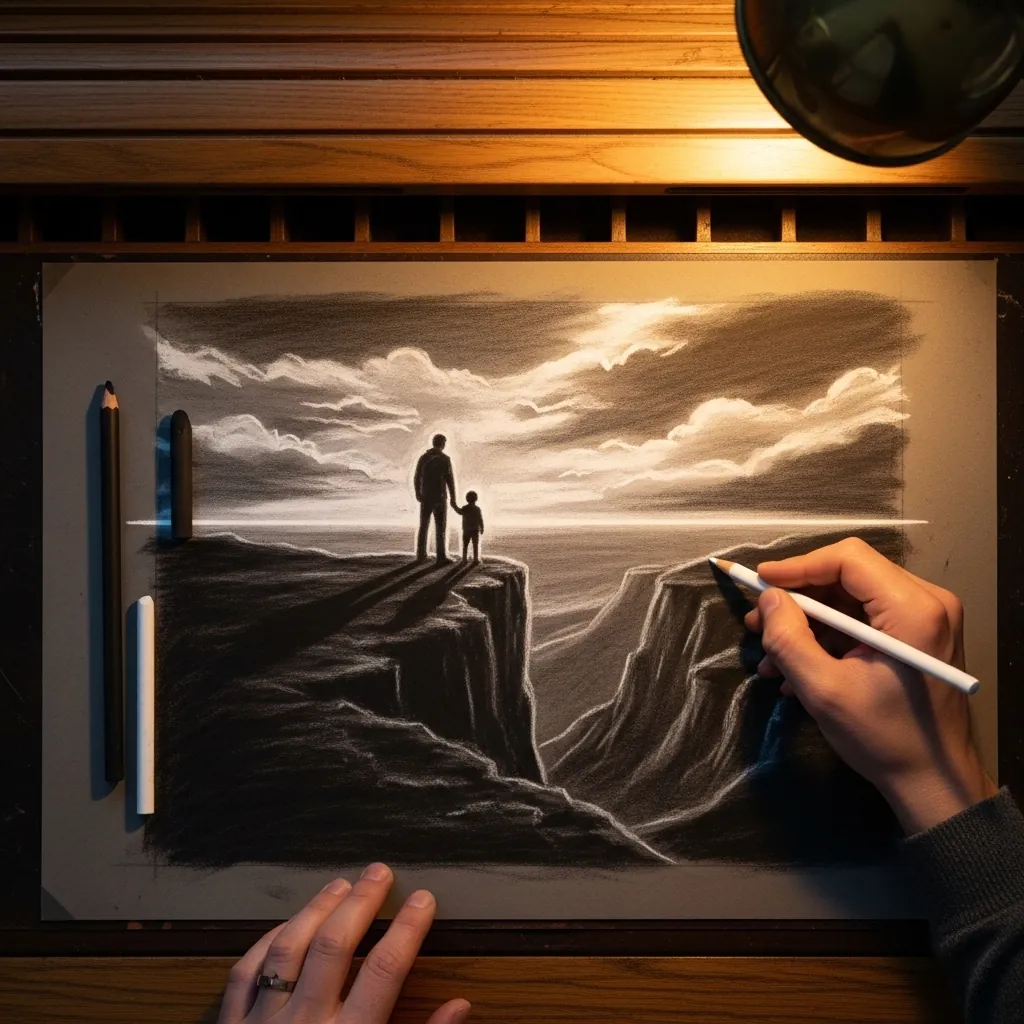
Scale is the subject in this one. Keep both figures genuinely small against an enormous sky and sea, place them on the darkest area of ground, and let the vast empty space around them do the emotional work. Drop the horizon line low so the sky occupies most of the sheet, and resist adding any detail to the water at all.
39. Shoulder Ride Stack in Colored Pencil
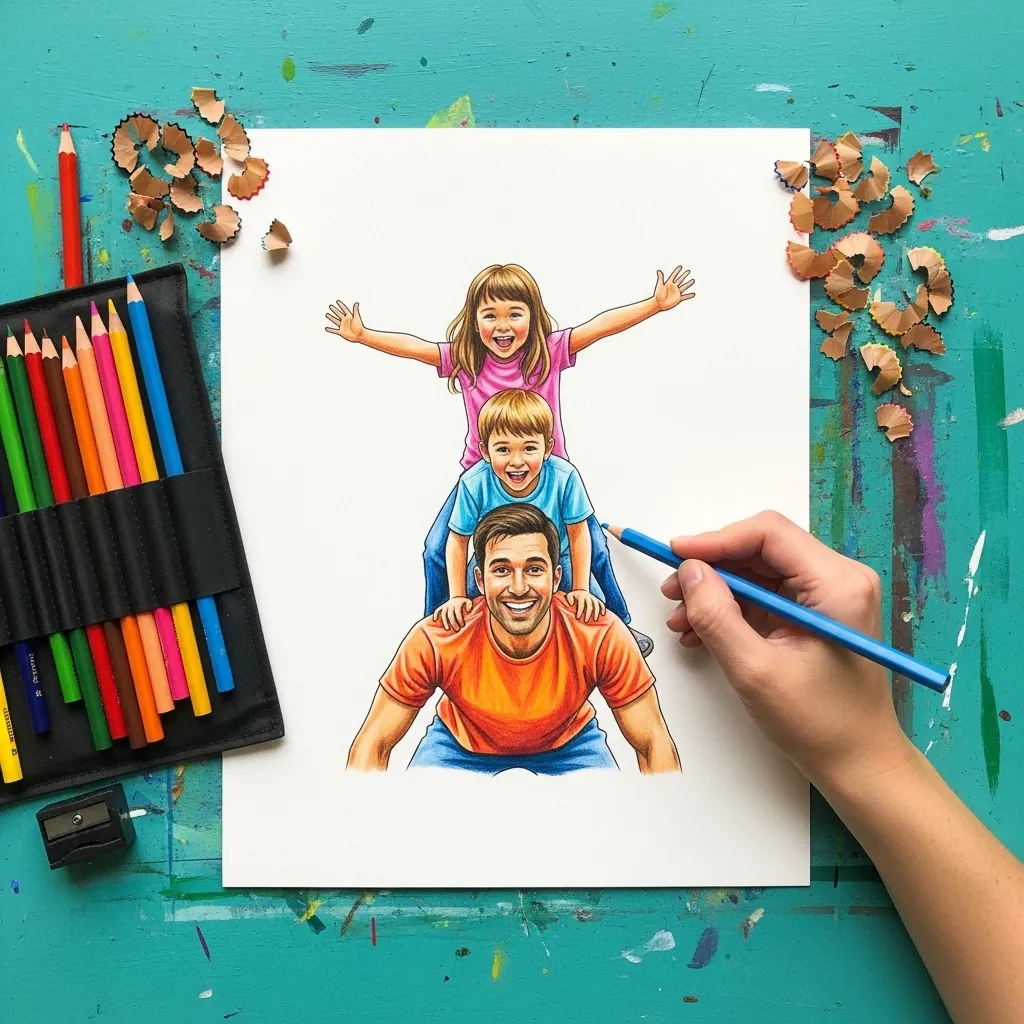
A vertical stack is an unusual and very readable arrangement. Line all three heads up on one axis, widen the arms at the top for balance, and keep the adult’s stance planted so the whole tower reads as stable. Draw the adult’s arms reaching up and outward, because arms held straight down make the stack look unstable.
40. Bedtime Prayer in Warm Line
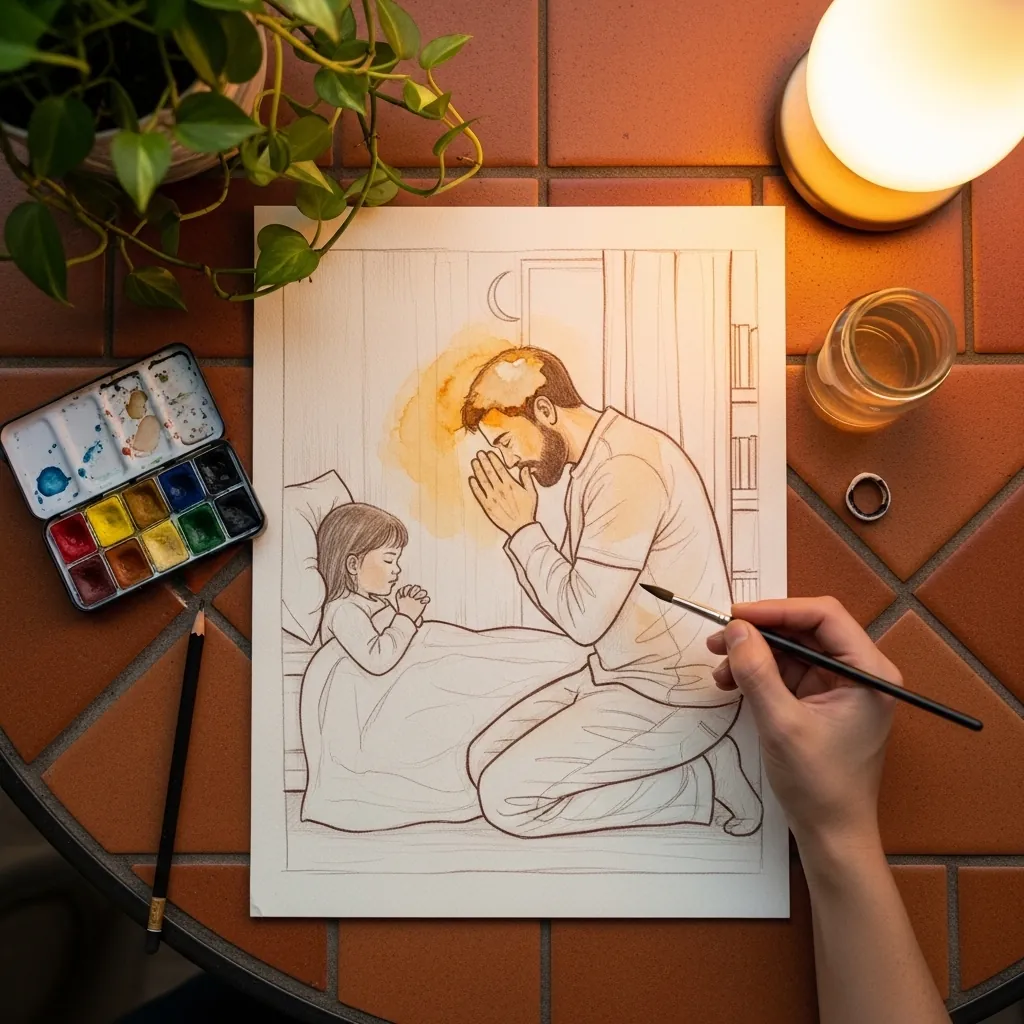
Quiet subjects need restraint above all. Keep the whole scene in light line with one warm glow from a bedside lamp, and let the two bowed heads and the small gap between them carry the entire mood. Let the bedcover fold irregularly, as flat smooth fabric drains the warmth out of an interior scene.
Frequently Asked Questions
What should I draw for Father’s Day?
A shared moment beats a portrait for most people. Fishing, cooking, teaching someone to ride a bike or reading together all give you two figures doing something specific, which is far easier to draw well than two people standing side by side.
How do you draw an adult and a child together?
Get the scale right first. A young child stands roughly half an adult’s height and has a proportionally much larger head. Sketch both figures as simple stick shapes at the correct relative sizes before adding any detail to either of them.
Why do my two figure drawings look stiff?
There is probably no contact point between them. Give the pair something physical, held hands, a hand on a shoulder, a child sitting on a knee, and let one figure overlap the other. That single overlap creates the relationship.
When is Father’s Day?
In the United States, the United Kingdom and India, Father’s Day falls on the third Sunday of June. Several other countries use different dates, so check locally if you are making something to send abroad rather than assuming June.
What is the easiest Father’s Day drawing for a beginner?
Two hands, one large and one small, resting together. There are no faces to get wrong, the size difference tells the whole story, and you only need to render one clear light source across two overlapping shapes.
References and Further Reading