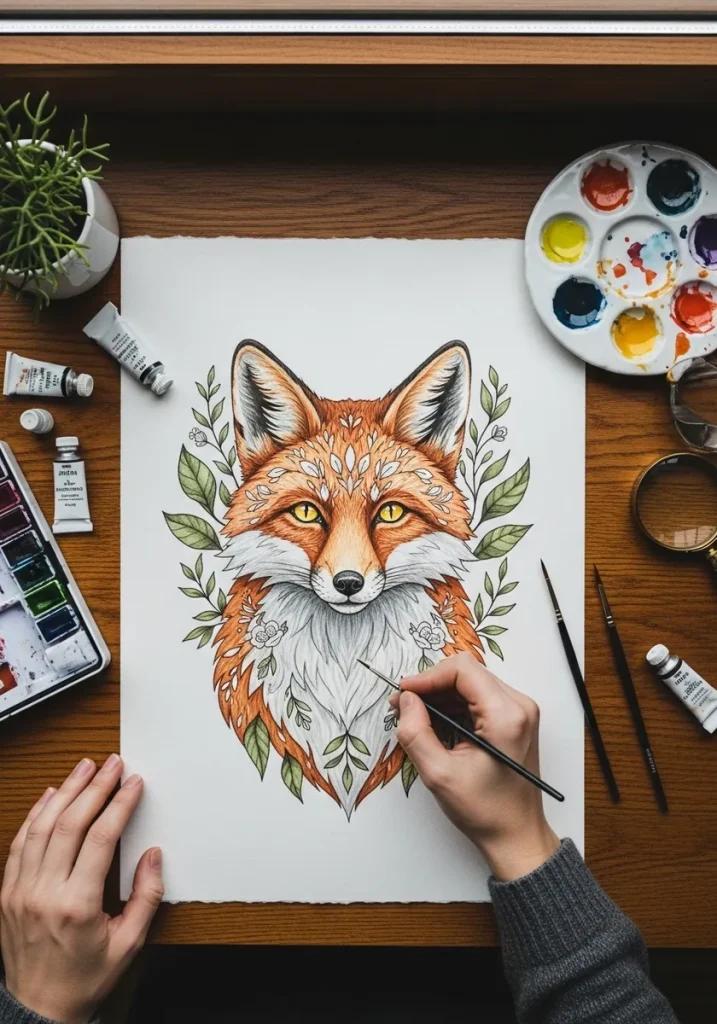
A fox character stays recognizable through three shapes: a long narrow wedge for the muzzle, two tall triangular ears set wide apart, and a tail as thick as the body. Keep those three and you can costume the character however you like.
Key takeaways
- The muzzle is a long narrow wedge, far thinner than a dog's, and it is the primary fox signal.
- Ears are tall triangles set wide on the skull, angled slightly outward rather than straight up.
- A fox tail is roughly as thick as its own body and usually carries a pale tip.
- The white throat and cheek markings are what separate a fox from a generic orange animal.
- For anthropomorphic versions, keep the head fully vulpine and let the body follow human proportions.
A fox survives almost any costume because three shapes carry it. A long narrow muzzle wedge, two tall ears set wide apart, and a tail as thick as the body. Keep those and you can dress the character as a samurai, a barista or an astronaut and it will still read as a fox.
The commonest mistake is drifting toward dog. A fox muzzle is noticeably thinner and more pointed than a dog’s, the ears are taller relative to the skull, and the white throat and cheek patches are essential rather than decorative. Lose those markings and you have a generic orange animal.
The thirty-one designs below cover a samurai, a kitsune with nine tails, a steampunk aviator, a graffiti writer, a mermaid and a viking, worked in ink, watercolor, marker, charcoal and colored pencil. For the underlying animal, deer and fawn sketches cover similar quadruped structure.
Several pieces are fully anthropomorphic, so clay style character art and these 3D cartoon character ideas are the closest companions, while the ornamental designs borrow from mandala construction.
Compiled by the GS Art Zone editorial team. Last updated August 2026. Each idea is paired with the specific step that produces the effect, so you can go from the reference straight to paper.
What You Need Before You Start
- An HB for construction plus a 2B, since almost every design here starts as a light head sketch
- Waterproof fine liners in two widths for the inked pieces, one for outline and one for fur detail
- Warm orange, burnt sienna and one cool gray, which covers natural fox color completely
- Alcohol markers or watercolor for the flat cartoon pieces, where hard edges suit the style
- Toned kraft or black paper with a white pencil for the folk and celestial designs later on
1. Samurai Fox in Full Armor
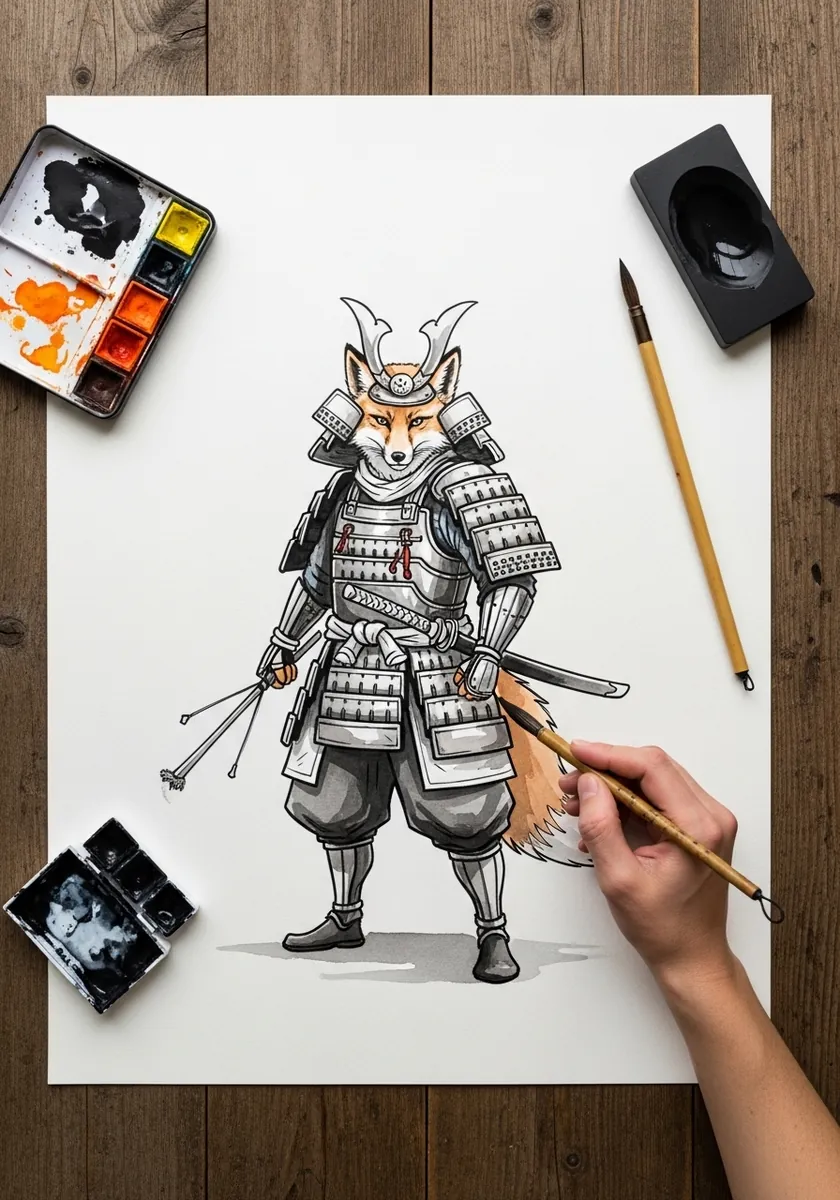
Armor on an animal head is the hardest combination to pull off. Draw the fox skull correctly first, then fit the helmet around it rather than drawing a helmet and pushing a face into the gap. Let the tail emerge below the armor skirt so it reads as part of the same body.
2. Kawaii Fox in a White Hoodie
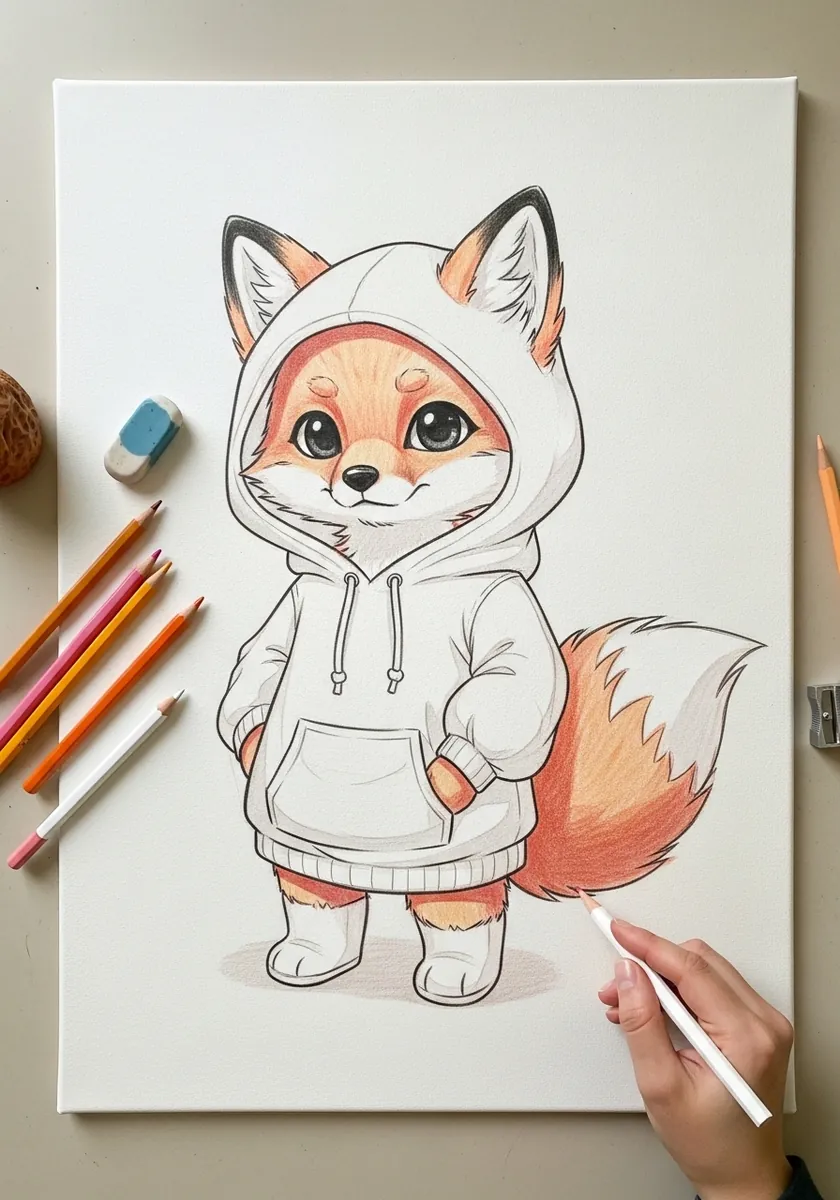
Cute design lives on proportion. Enlarge the head to nearly half the total height, set the eyes low and wide, and keep the limbs stubby. The hoodie hood framing the ears is doing real work, because it repeats the triangle shape twice.
3. Fox Wizard in Watercolor
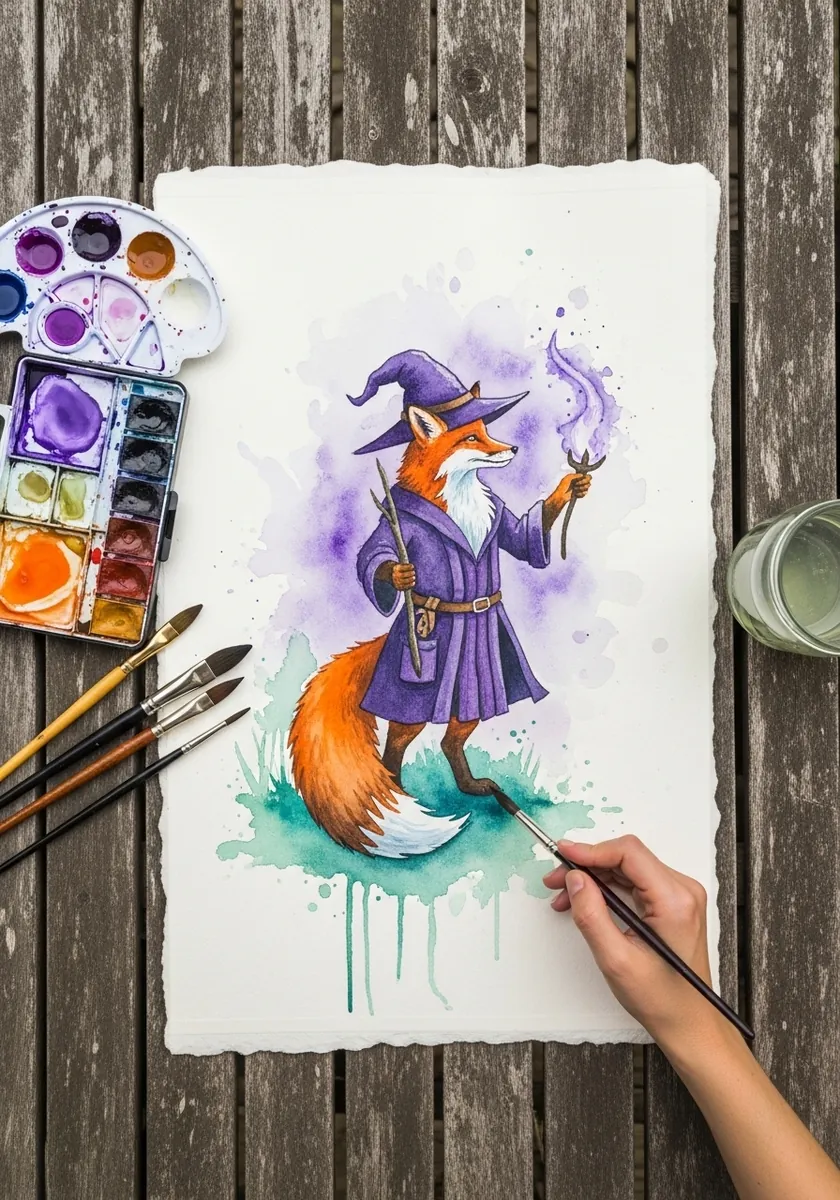
Loose watercolor suits a character who should feel slightly unstable. Paint the robe wet so the purple bleeds outward, then keep the face and staff crisp. The magic glow should be the only warm note against all that cool violet.
4. Cyberpunk Fox with Tech Implants
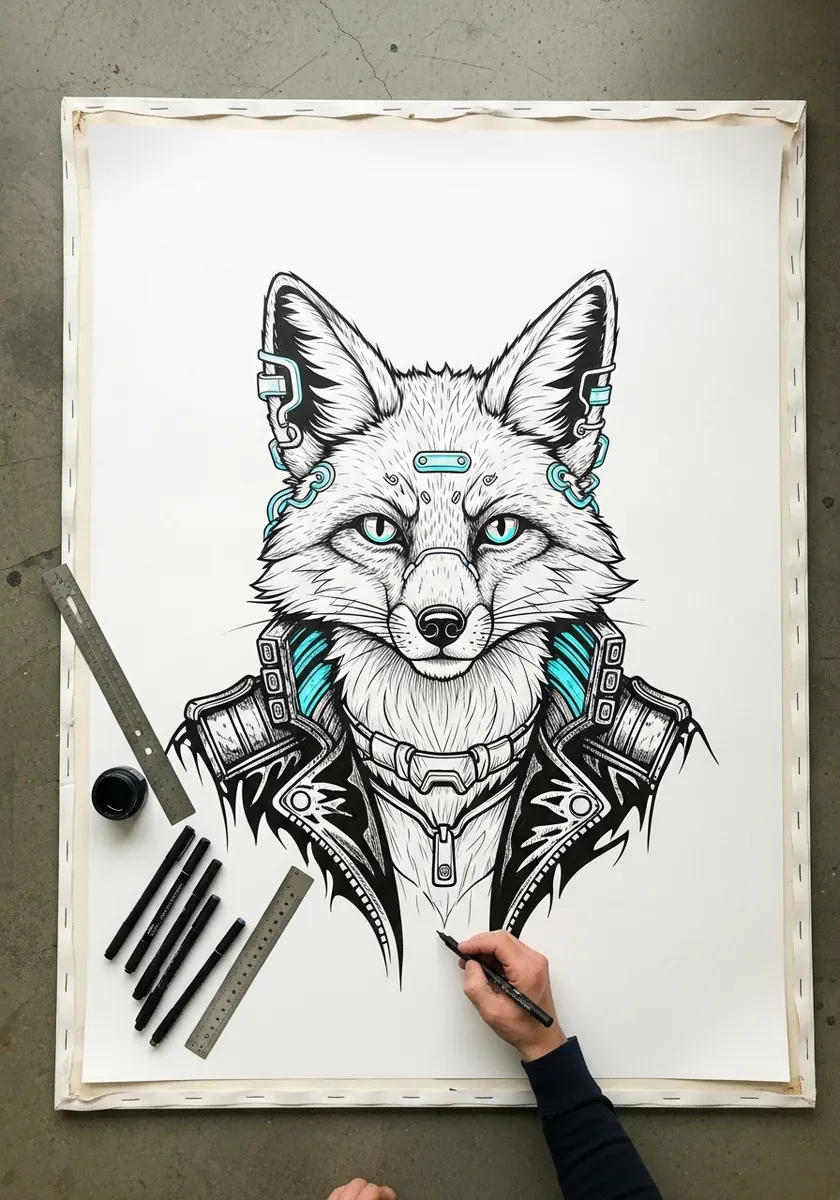
Technology needs to follow the skull rather than sit on it. Trace each implant along a bone line, the brow ridge or the cheekbone, so it looks fitted. The cyan accents work because everything else stays pure black and white.
5. Ornamental Fox with Botanical Frame
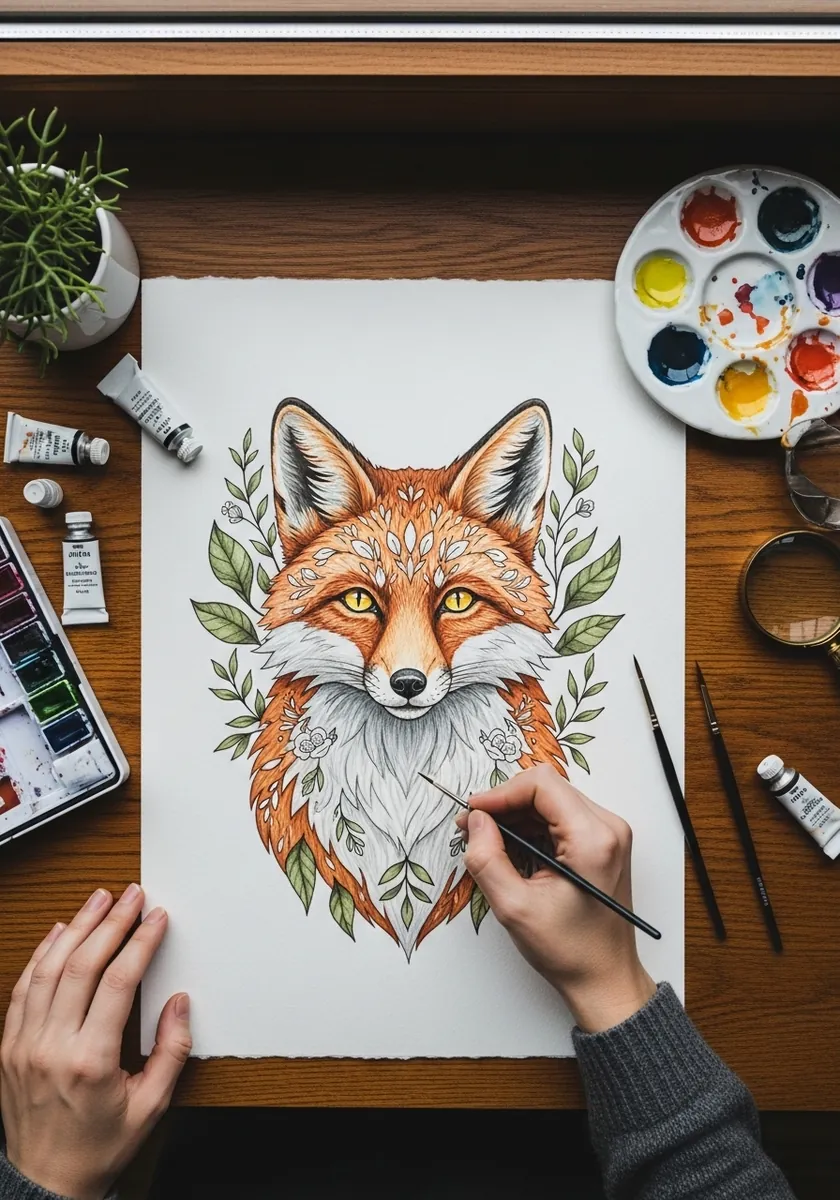
Ornament around a portrait needs to breathe. Draw the fox fully, then grow the foliage outward from behind the ears, leaving a clear gap of paper between the fur and the first leaf so neither element crowds the other. Keep the eye a warm amber, since that yellow-gold iris is one of the fox’s strongest signals.
6. Barista Fox in a Sketchbook
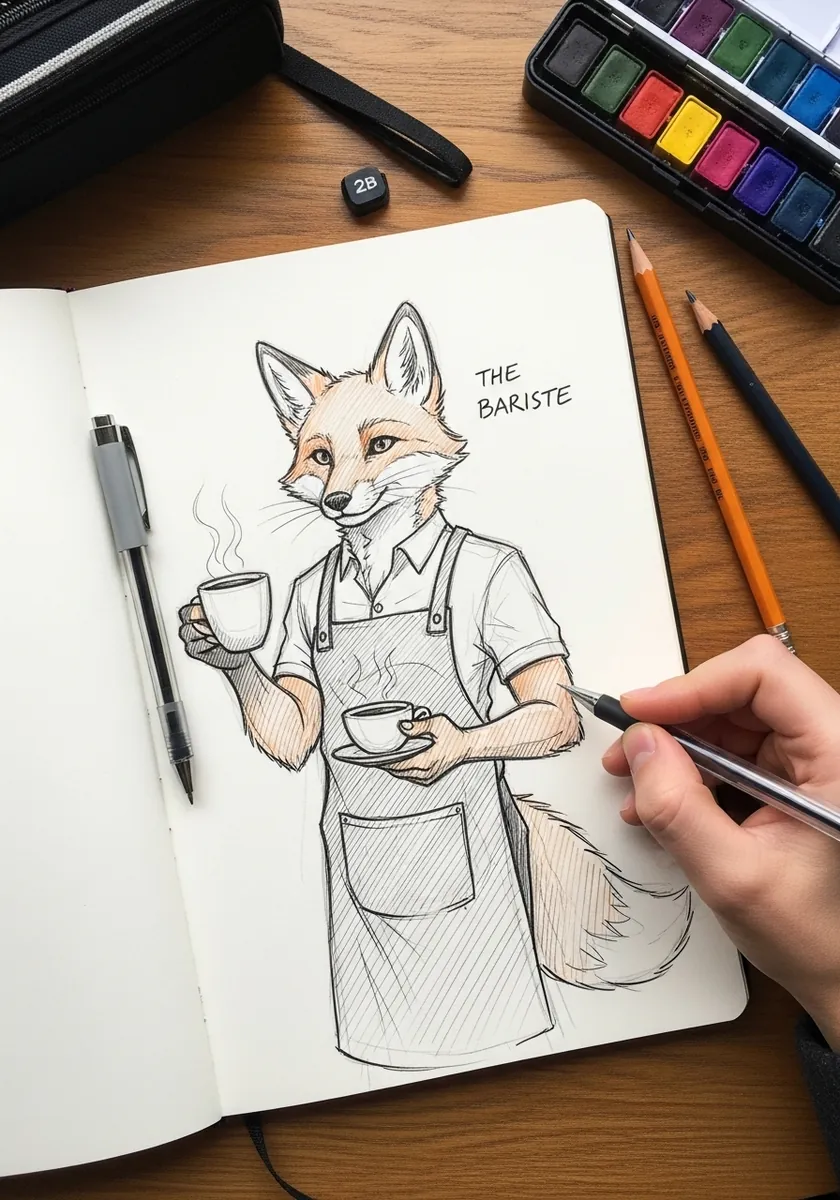
Anthro proportions need a decision made early. This one keeps a fully vulpine head on a human torso, with the shoulders at human width. Mixing the two systems is what makes most anthro drawings feel awkward. Sketch the apron strings loose, as a perfectly tied bow makes a working character look posed.
7. Nine-Tailed Kitsune in Fine Line
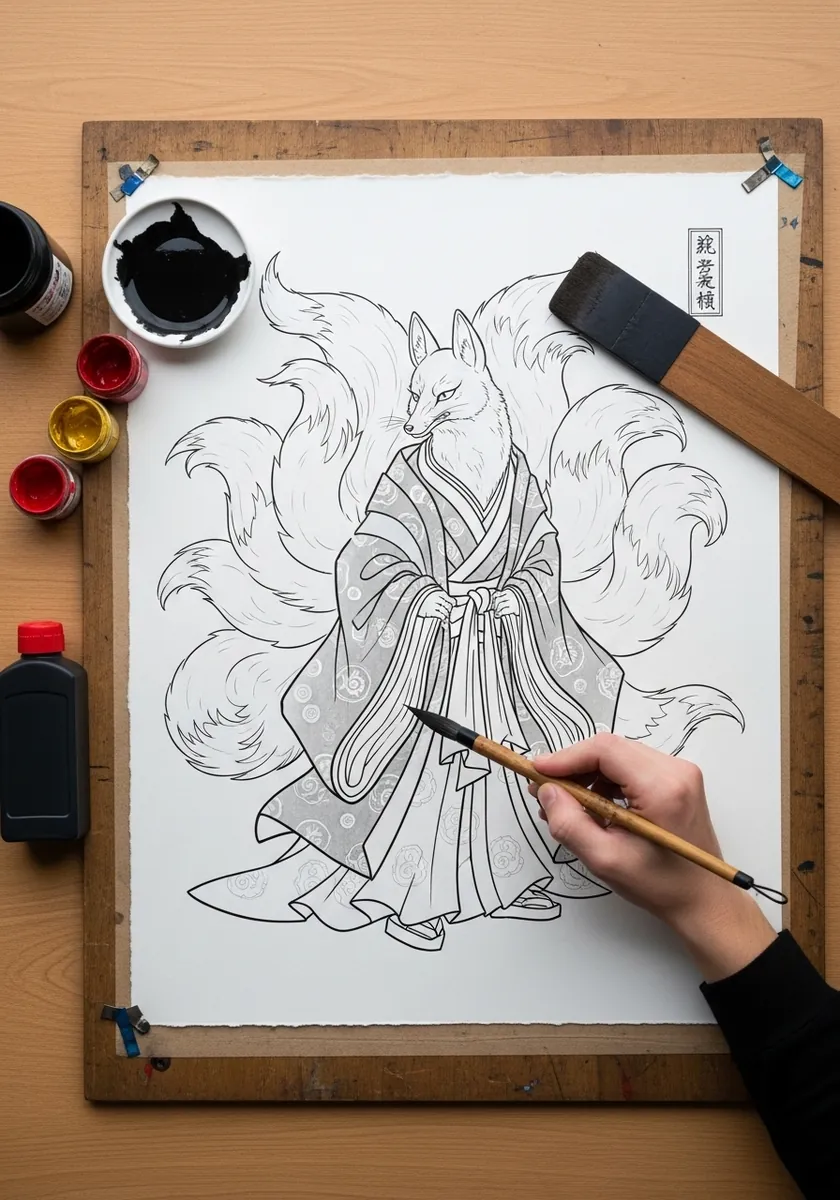
Nine tails could easily become chaos. Fan them all from a single point at the base and vary their length so they overlap in a readable order, with the nearest tails drawn heaviest. The robe hides the legs entirely, which simplifies everything.
8. Steampunk Aviator Fox
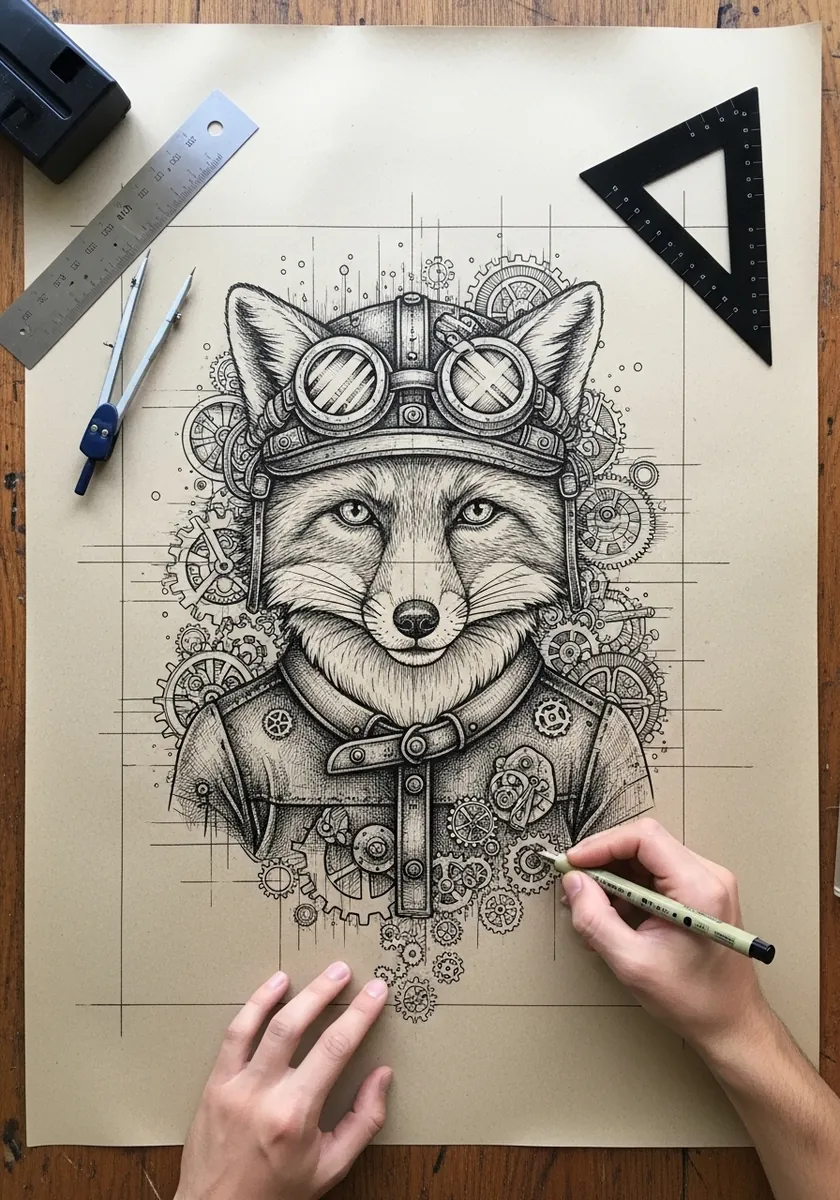
Goggles pushed up on the forehead solve a real problem. They frame the face without hiding the eyes, which are the most expressive part of any animal character. Keep the gear detail dense but confined to the lower half. Rivets and small dials read as machinery faster than gears do, and they crowd the page far less.
9. Sleeping Fox in a Leaf Nest
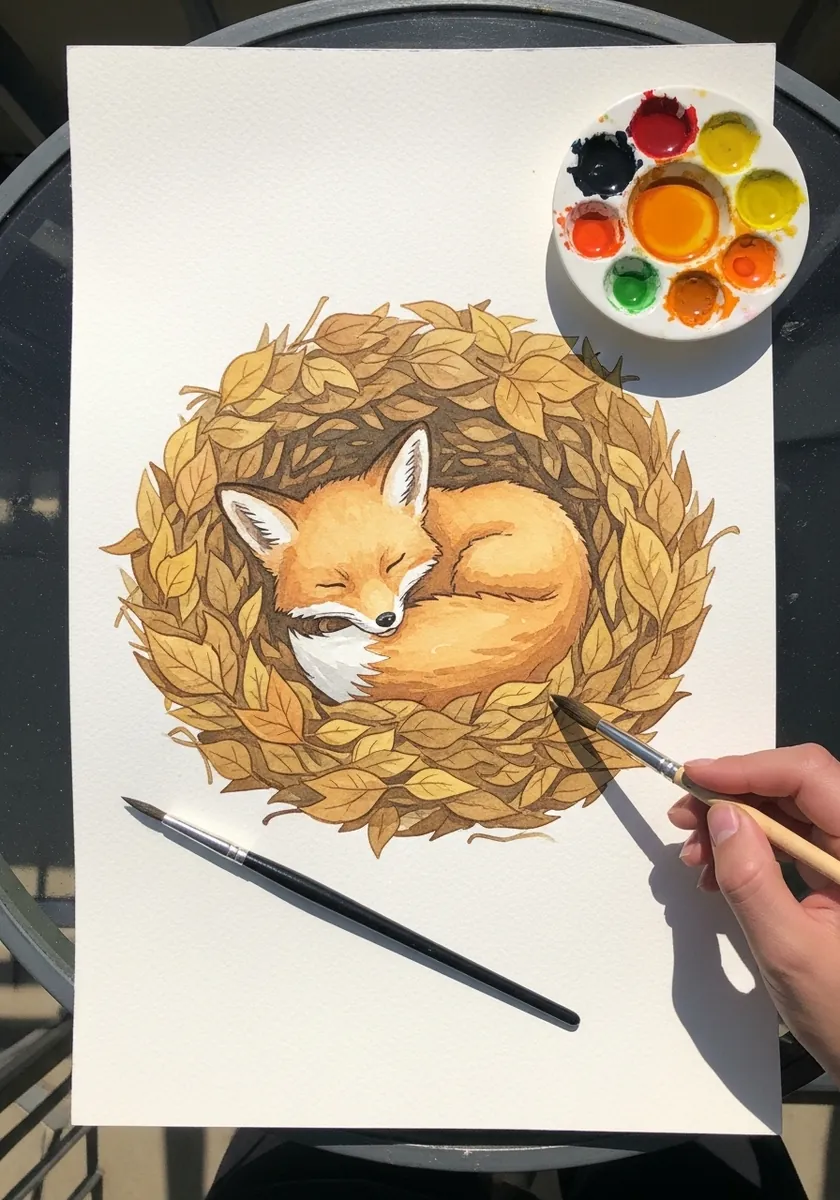
A curled pose hides every limb, which is why it is the easiest fox to draw well. Wrap the tail across the body so it becomes a blanket, and let the leaf nest form a complete ring around the animal.
10. Tribal Geometric Fox Portrait
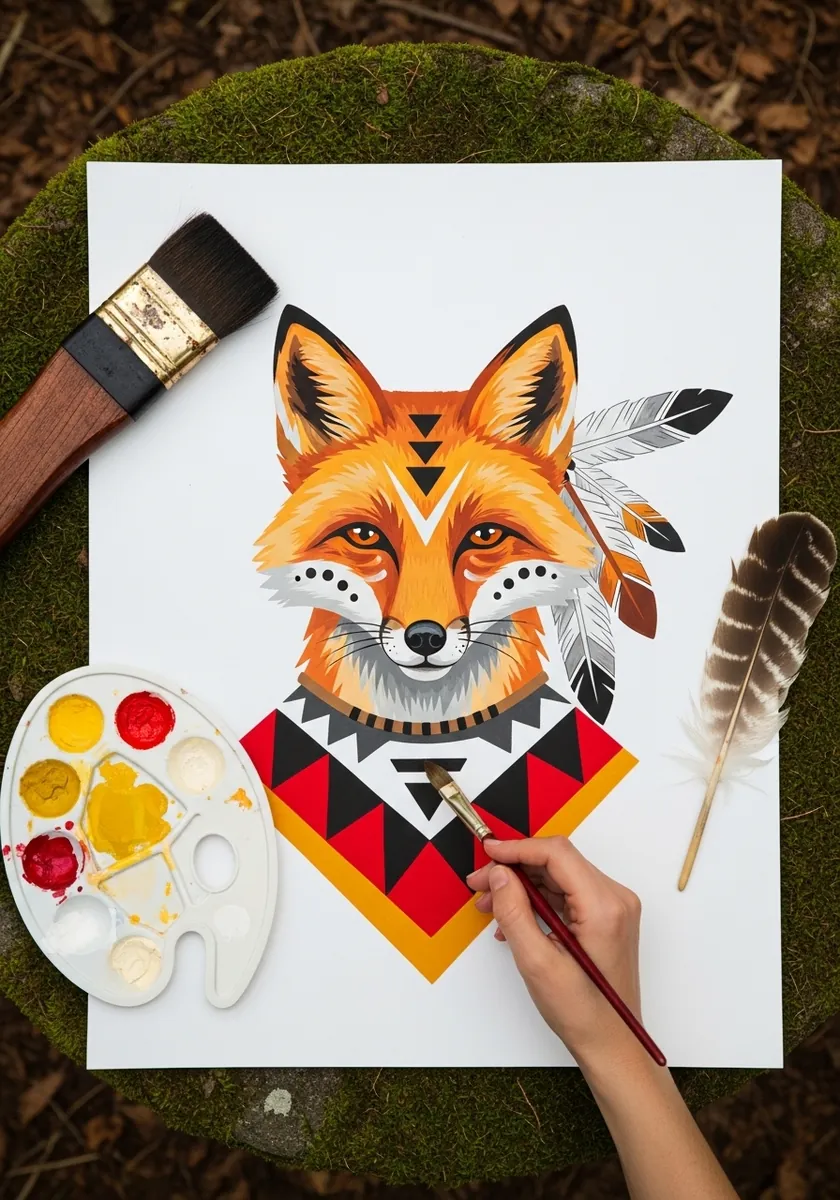
Flat geometric treatment strips the subject to essentials. Reduce the head to a few angular planes but keep the ear triangles exact and the muzzle wedge sharp, because those two shapes are all that identify it as a fox. Restrict the palette to three flats, because a fourth color immediately weakens a geometric design.
11. Astronaut Fox in a Spacesuit
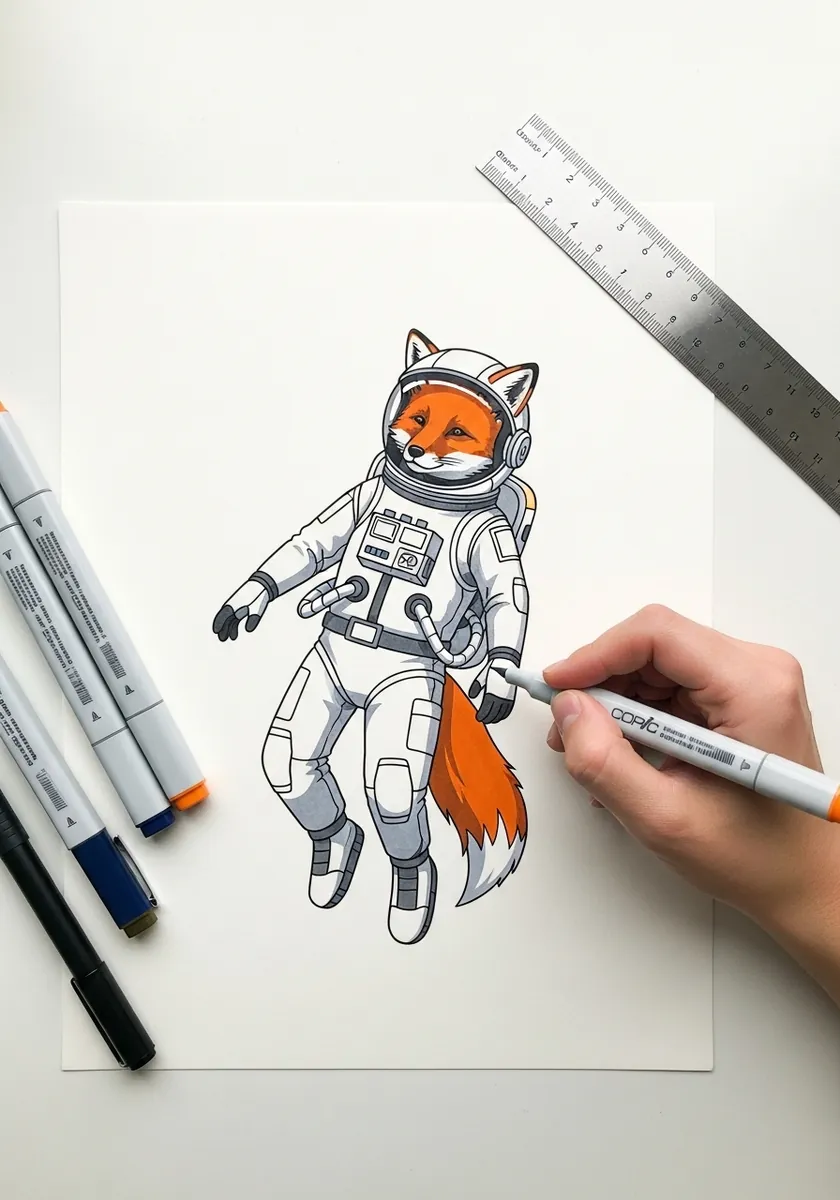
A helmet dome is a hard shape against soft fur. Draw the suit as stacked padded cylinders with visible ring joints, then let the tail escape through a gap so the character does not read as sealed inside a costume.
12. Victorian Gentleman Fox
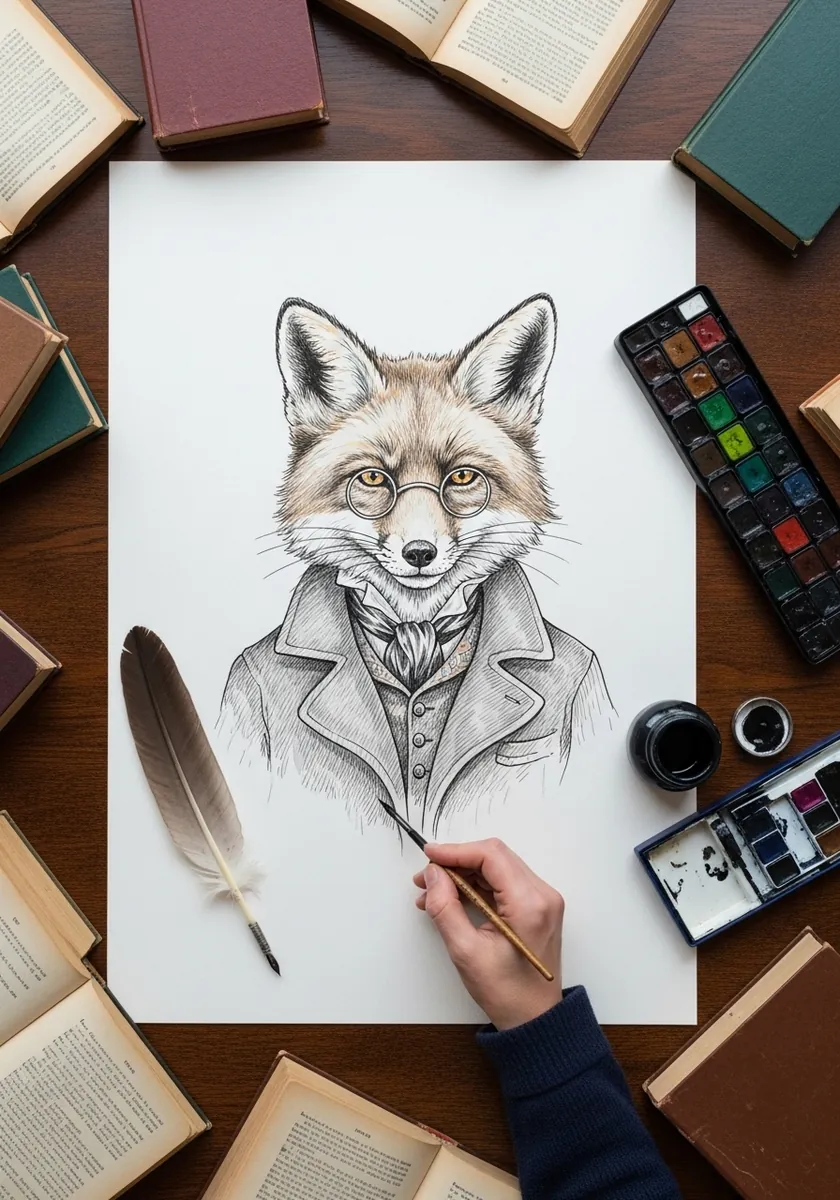
Period costume rewards accuracy in the tailoring. Draw the collar, lapel and cravat properly, since a well drawn coat carries the whole conceit. The monocle needs a fine chain to feel authentic rather than pasted on. Draw the fur breaking over the collar edge, which is what fuses the animal head to the human clothing.
13. Graffiti Fox with a Spray Can
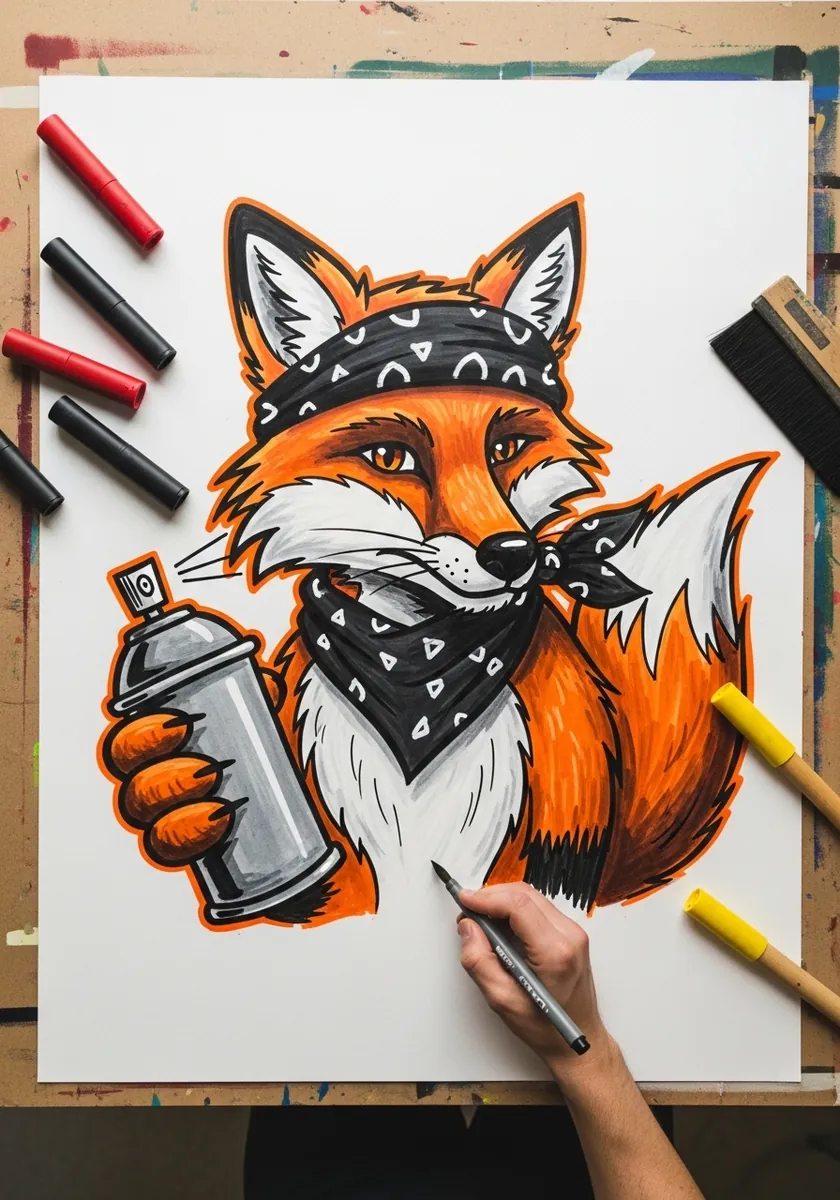
Street style uses heavy outline and flat color. Ink the whole character in a thick uniform line, use no shading anywhere, and add the orange keyline outside the black to make the figure pop off the page. Add a few drips below the can nozzle, since a spray can with no evidence of use looks like a prop.
14. Fox Mermaid in Soft Watercolor
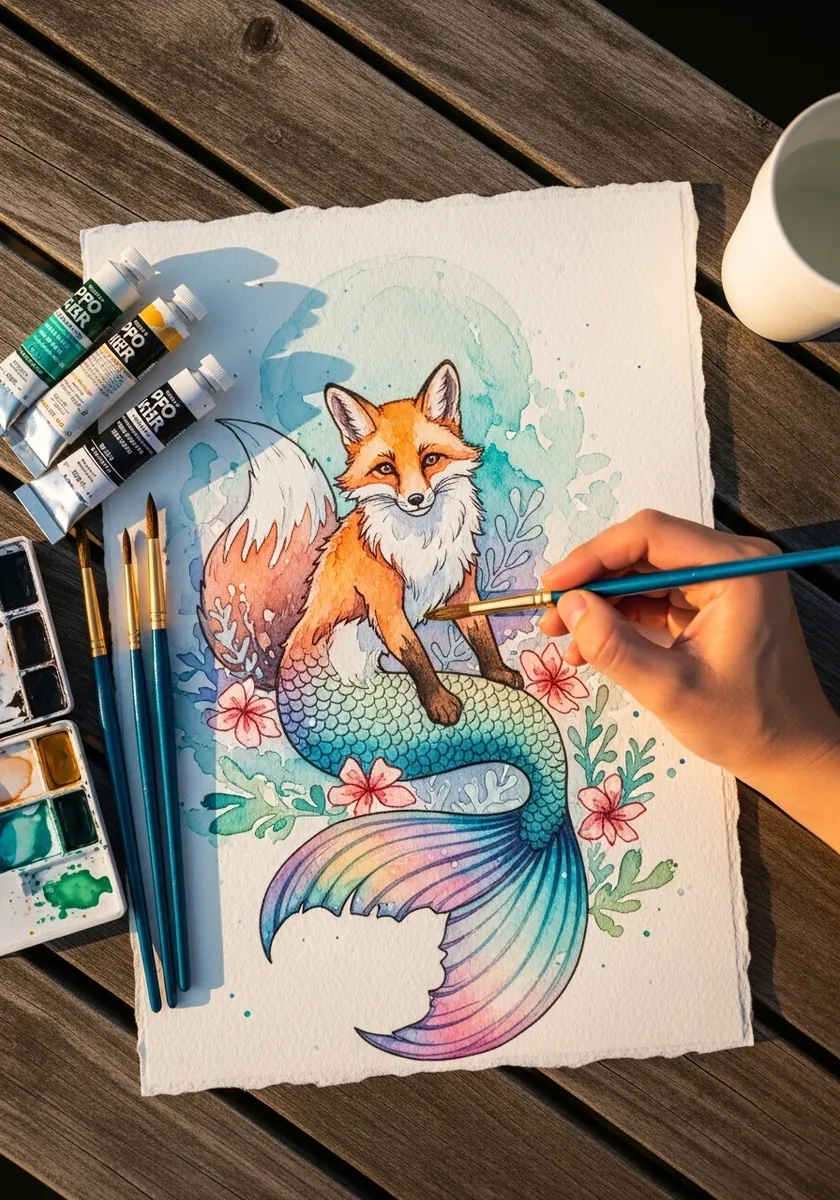
Two animals in one needs a clear transition point. Put the change at the waist and let a band of longer fur overlap the first row of scales, so the join looks grown rather than stuck together. Shift the scales cooler than the fur, as a temperature break separates the two halves cleanly.
15. Fox Violinist in Charcoal
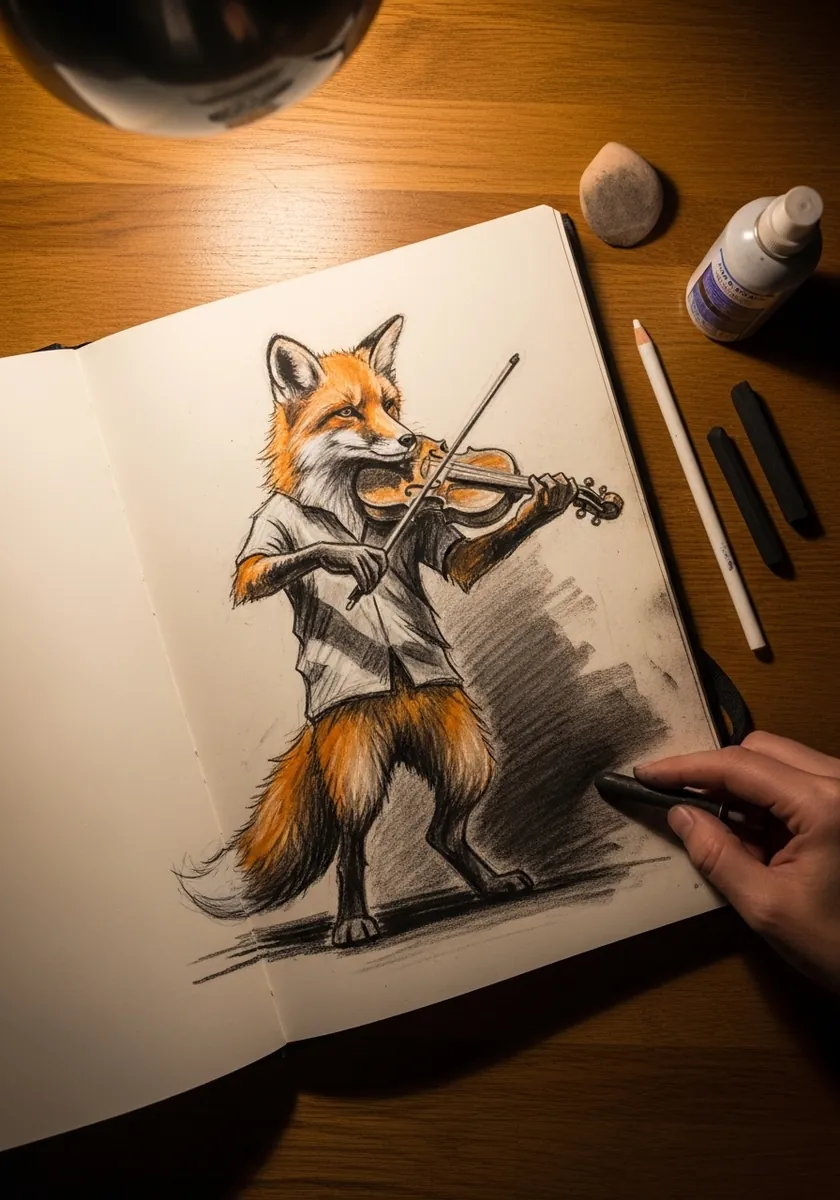
A musician needs correct arm geometry above all. Get the bow perpendicular to the strings and the left wrist properly turned, because a wrongly held instrument undermines an otherwise good drawing instantly. Charcoal suits a musician because it smudges into movement. Let the bow arm blur and keep the face sharp.
16. Low Poly Geometric Fox Head
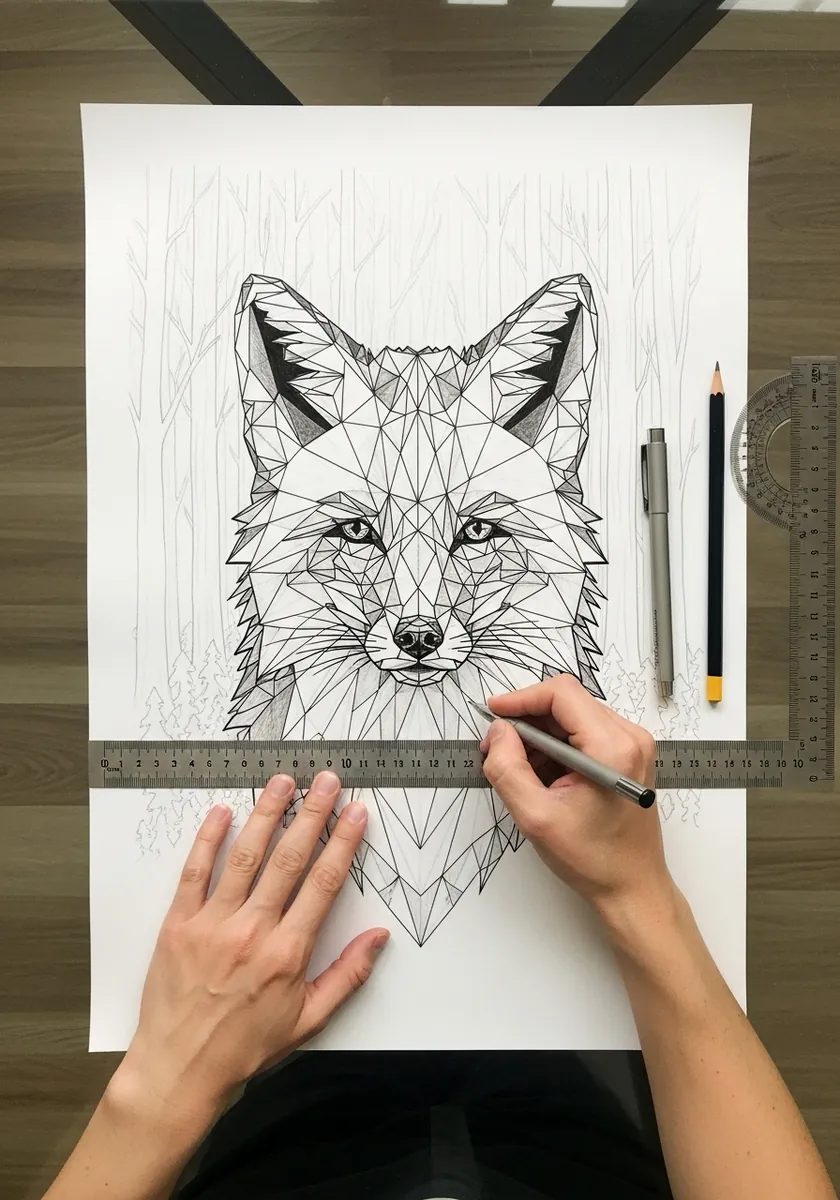
Faceting suits a fox because the head is already angular. Draw the portrait normally in light pencil, then lay the triangle map over it, keeping the smallest facets around the eyes and muzzle tip. Number your facets lightly before shading, which stops two adjacent planes ending up the same value.
17. Chef Fox with Wooden Spoons
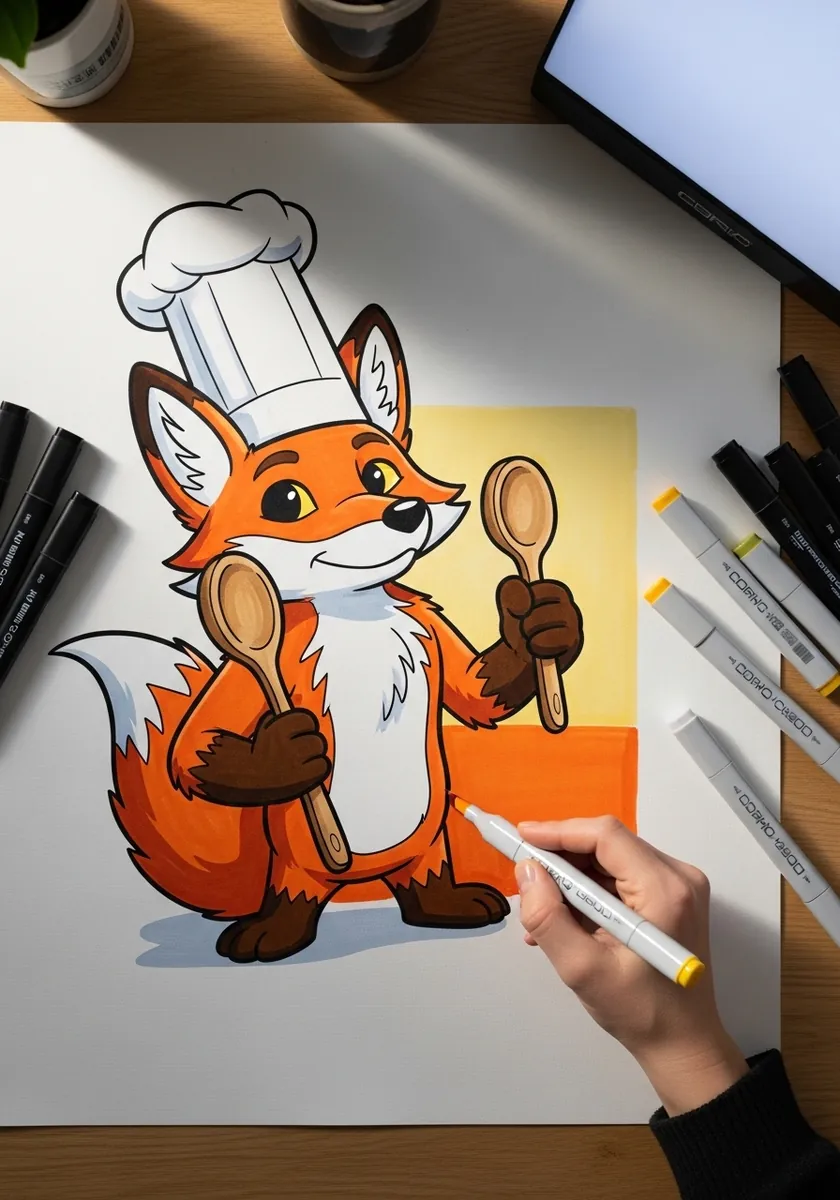
Flat cartoon color needs three values maximum. Use one orange for the body, a lighter cream for the chest and a darker brown for the limbs, and let the heavy black outline hold all three apart. Give the hat a slight lean and a soft crumple, because a rigid chef hat reads as plastic.
18. Ninja Fox in a Manga Panel
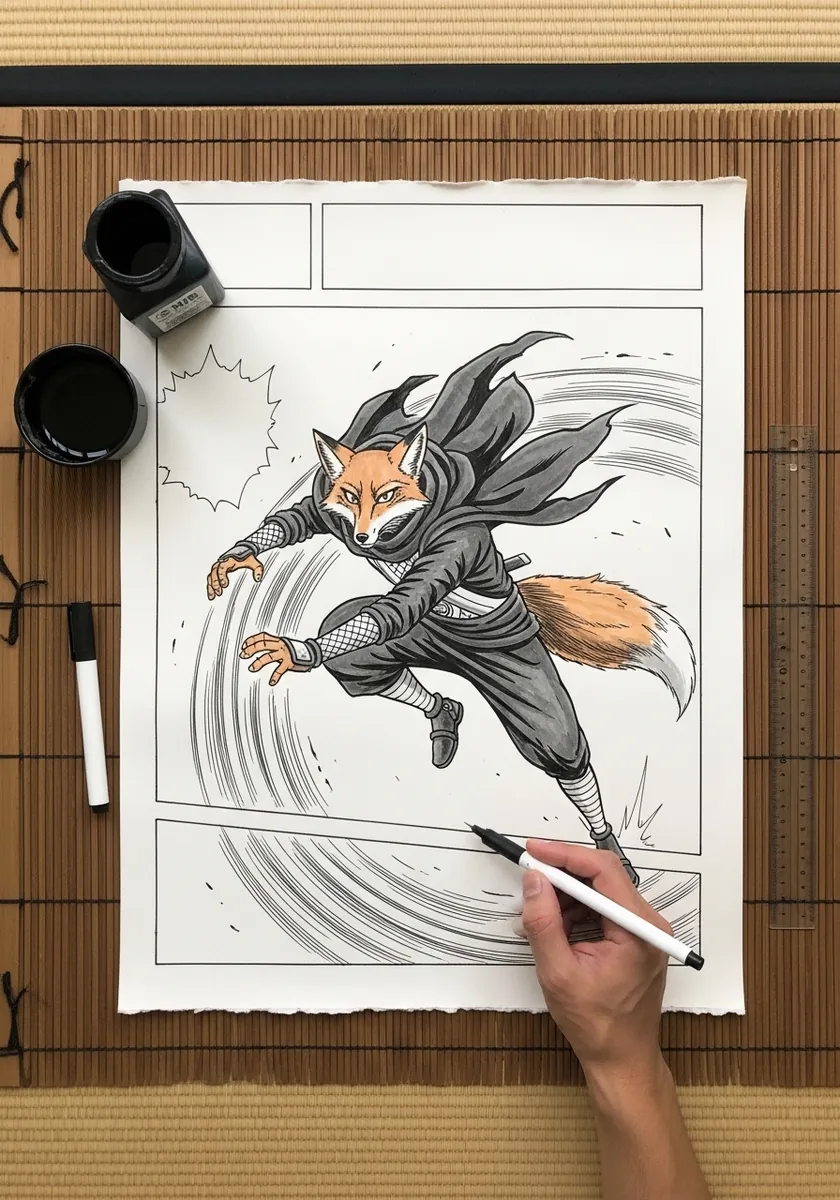
Panel borders change how you compose. Let the character break the frame at one edge, which is a standard manga device for energy, and rule every speed line from one point behind the figure. Break one hand or foot out past the panel border, which is the standard manga cue for speed.
19. Pirate Captain Fox on Deck
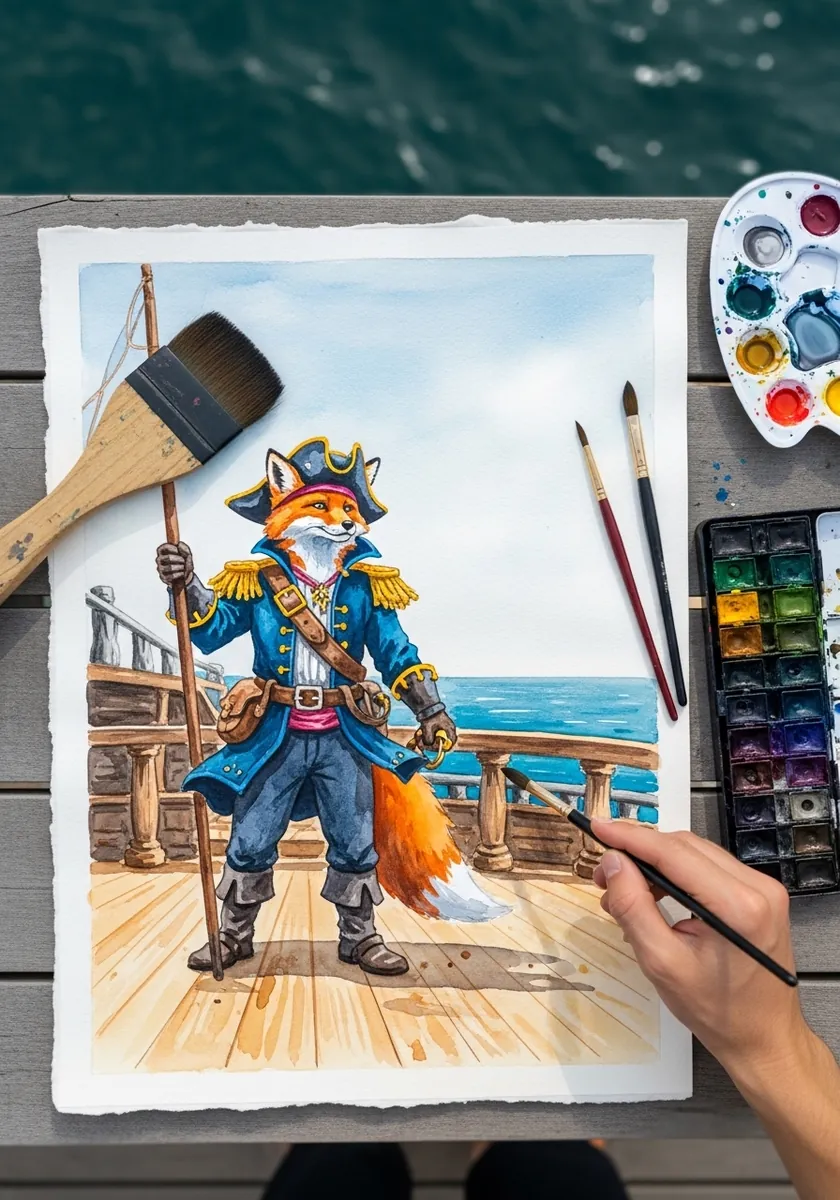
A tricorn hat sits at an angle, never square. Tilt it so one point drops toward an ear, and let the coat tails and the tail itself both blow the same direction so the wind reads consistently. Show a plank line or two on the deck receding to a vanishing point, and the ship becomes real.
20. Detective Fox in Dramatic Light
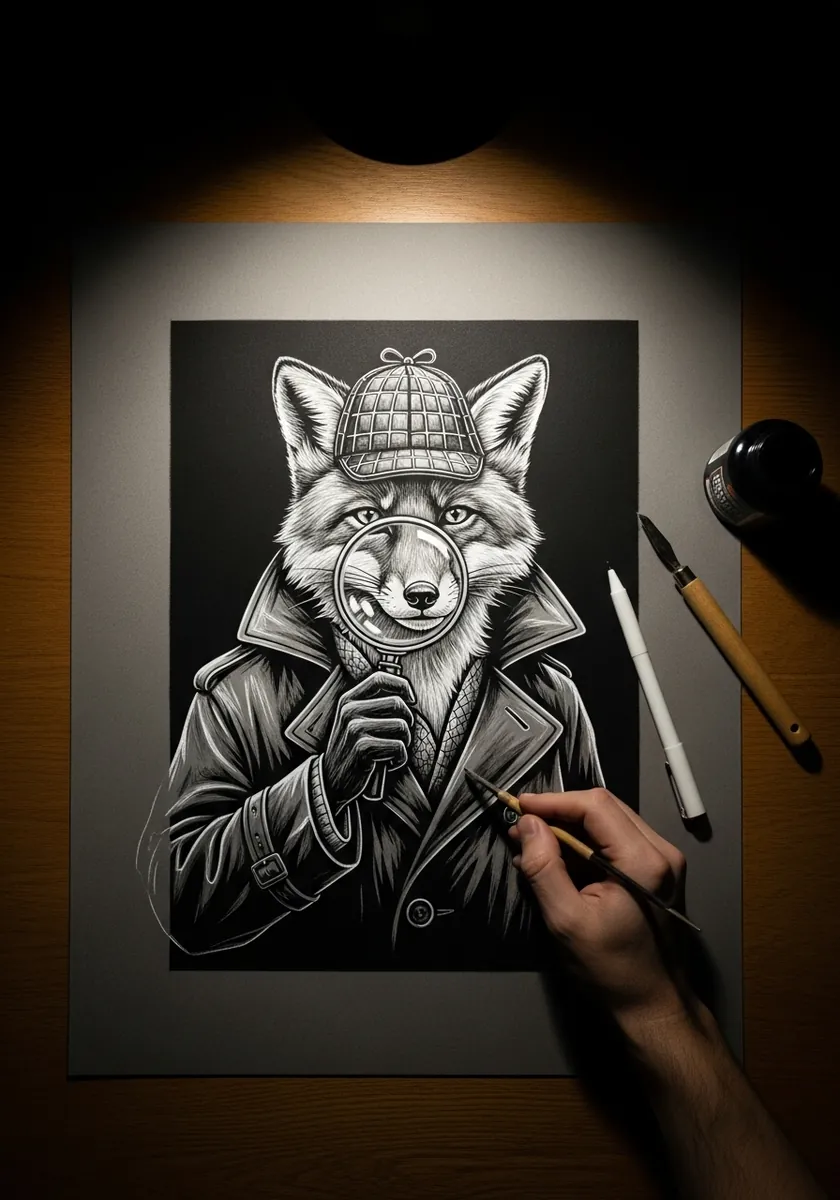
One hard light source builds the whole mood. Light the face from one side only and let the other half fall almost to black, then place the brightest highlight on the glass lens so the eye goes straight there. Enlarge the eye seen through the lens slightly, since a magnifier that magnifies nothing looks odd.
21. Ice Skating Fox in Pale Blue
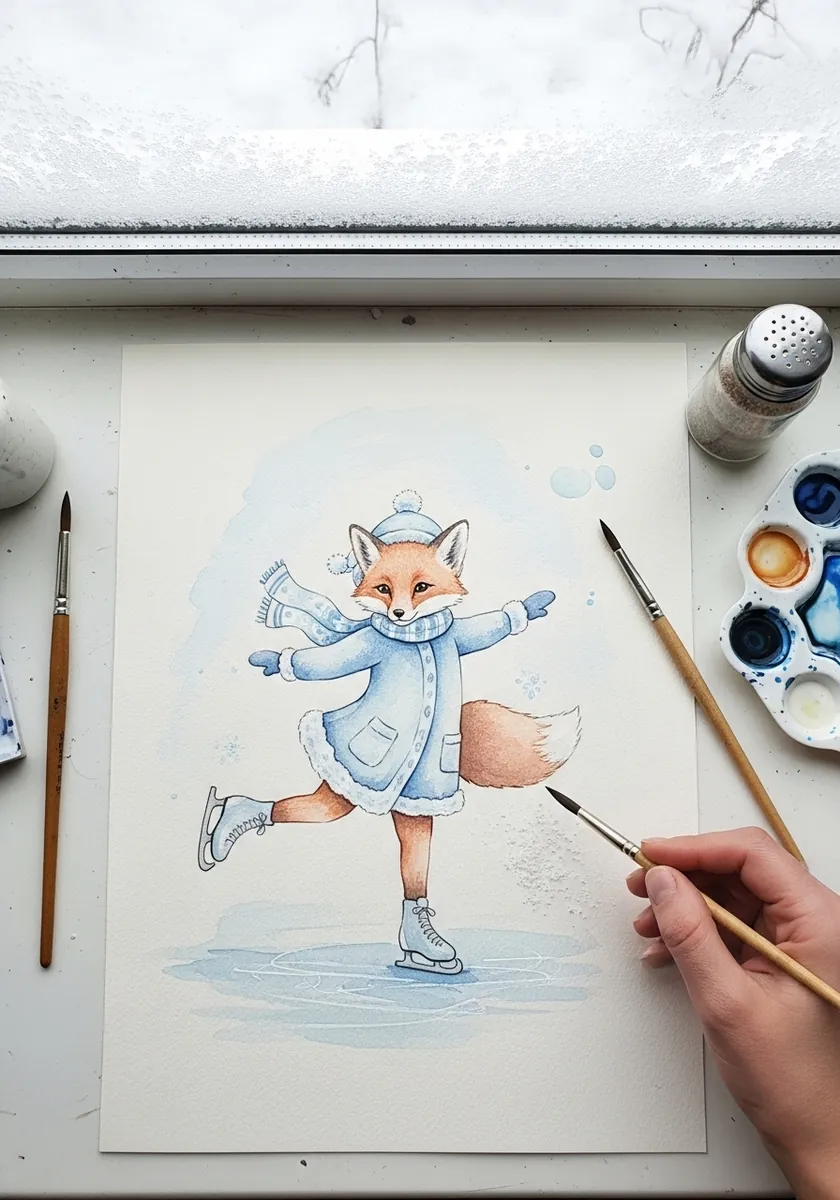
Balance is the subject in a skating pose. Draw a vertical from the supporting blade upward and hang the whole body off that line, then let the arms and free leg extend well past the body for momentum. Scratch a few curved lines into the ice behind the blade to record where the skater has just been.
22. Alchemist Fox with Potion Bottles
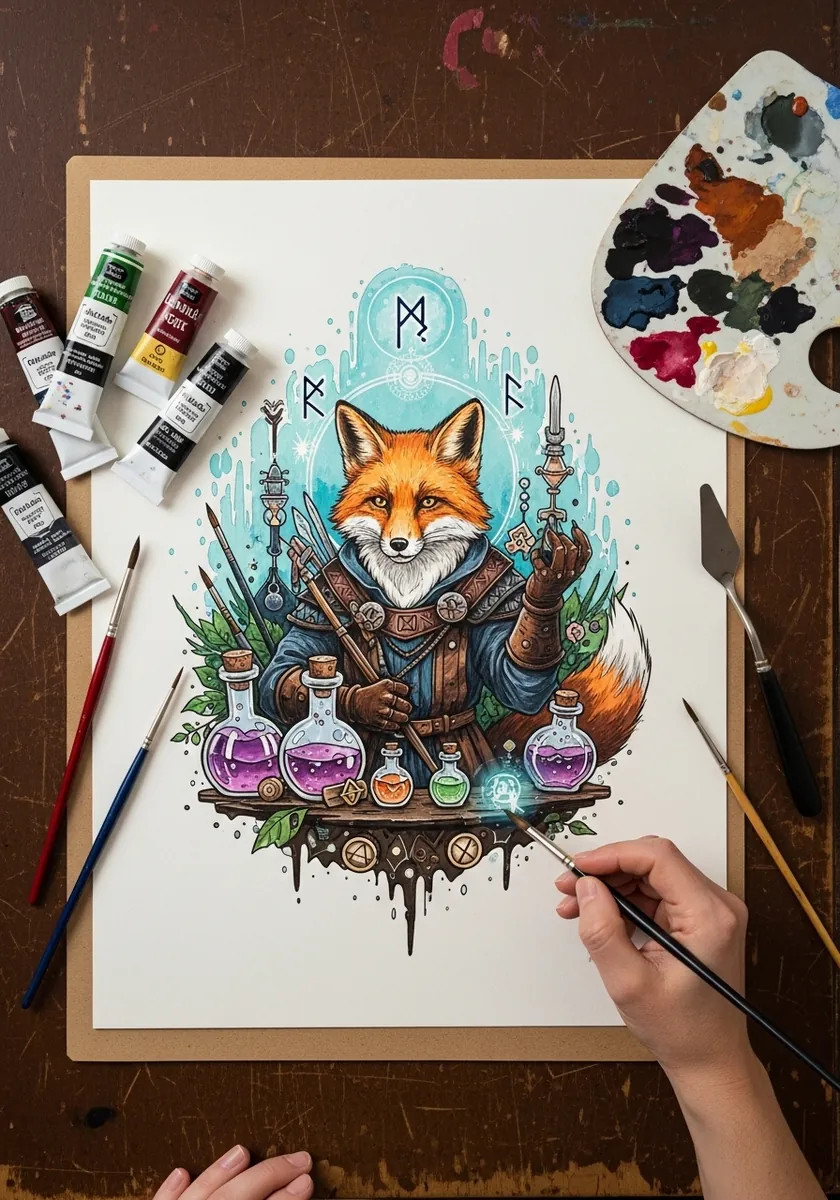
Multiple light sources are normally a mistake, but glowing bottles justify them. Give each potion its own small pool of colored light on the surface below, and keep the fox’s face lit by the brightest bottle only. Keep the bottle glass unpainted at its highlight, as a reserved white sells transparency instantly.
23. Flamenco Dancer Fox in Ink
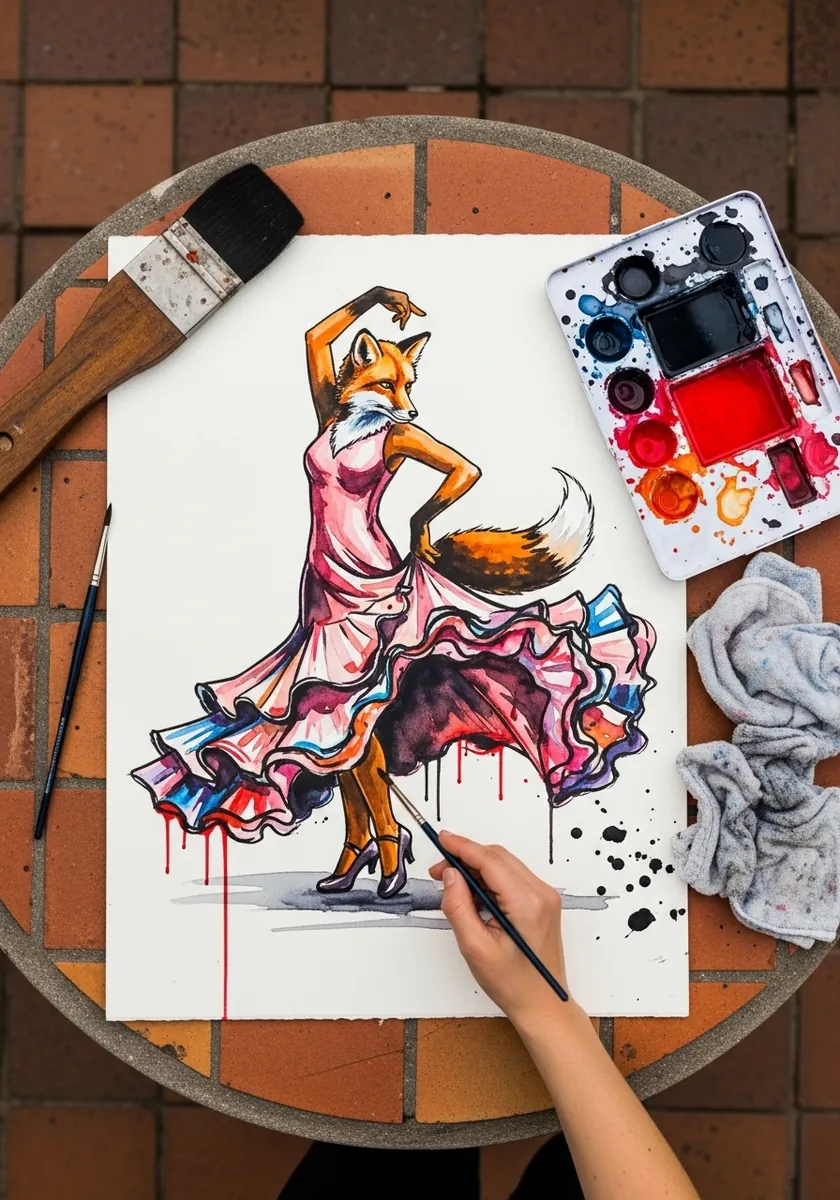
Movement comes from one long curve. Draw the line of action from the raised hand down through the spine and into the supporting foot, then hang the dress ruffles off that curve as stacked rounded bands. Let the dress hem lift on one side only, because symmetrical movement reads as standing still.
24. Minimal Continuous Line Fox
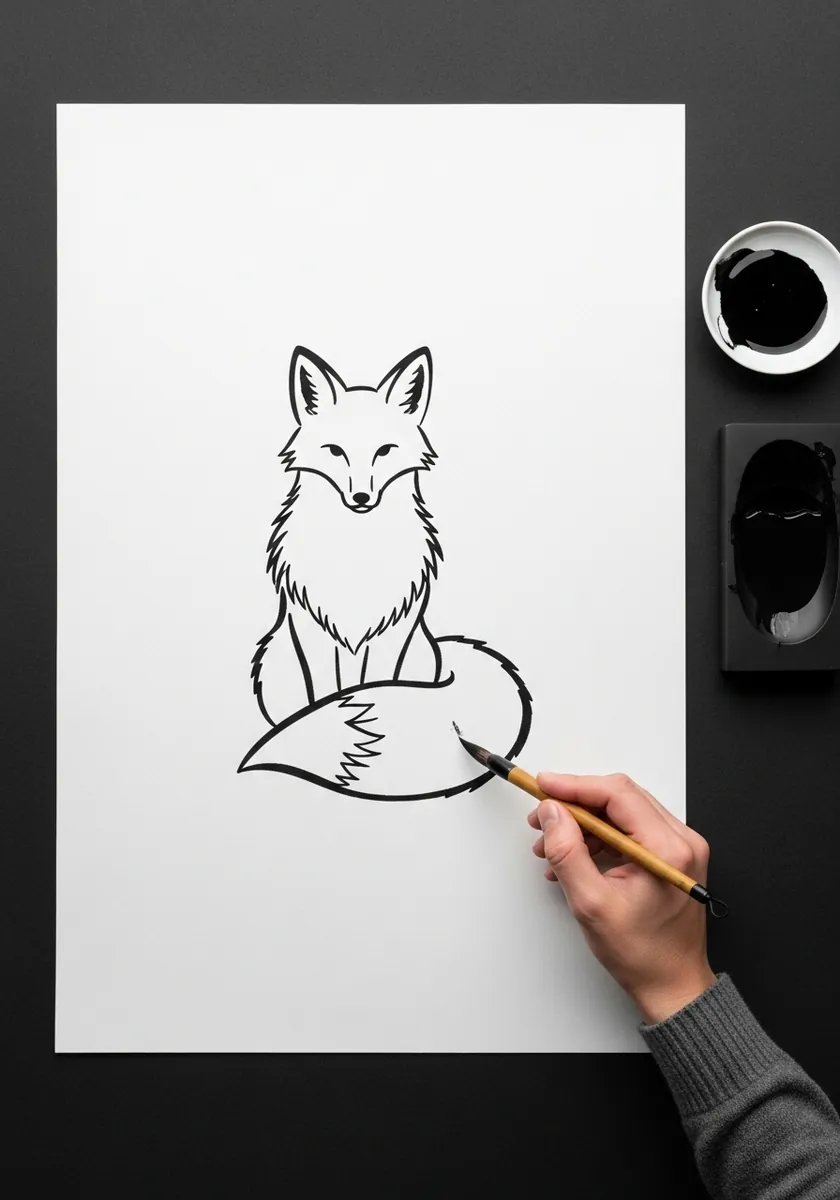
One unbroken line and nothing else. Plan the route before you start, because you cannot lift the brush, and let the tail curl form the final sweep. The muzzle wedge has to be right on the first attempt. Load the brush fully before you begin, since running dry halfway ruins a continuous line drawing.
25. Superhero Fox in Crayon
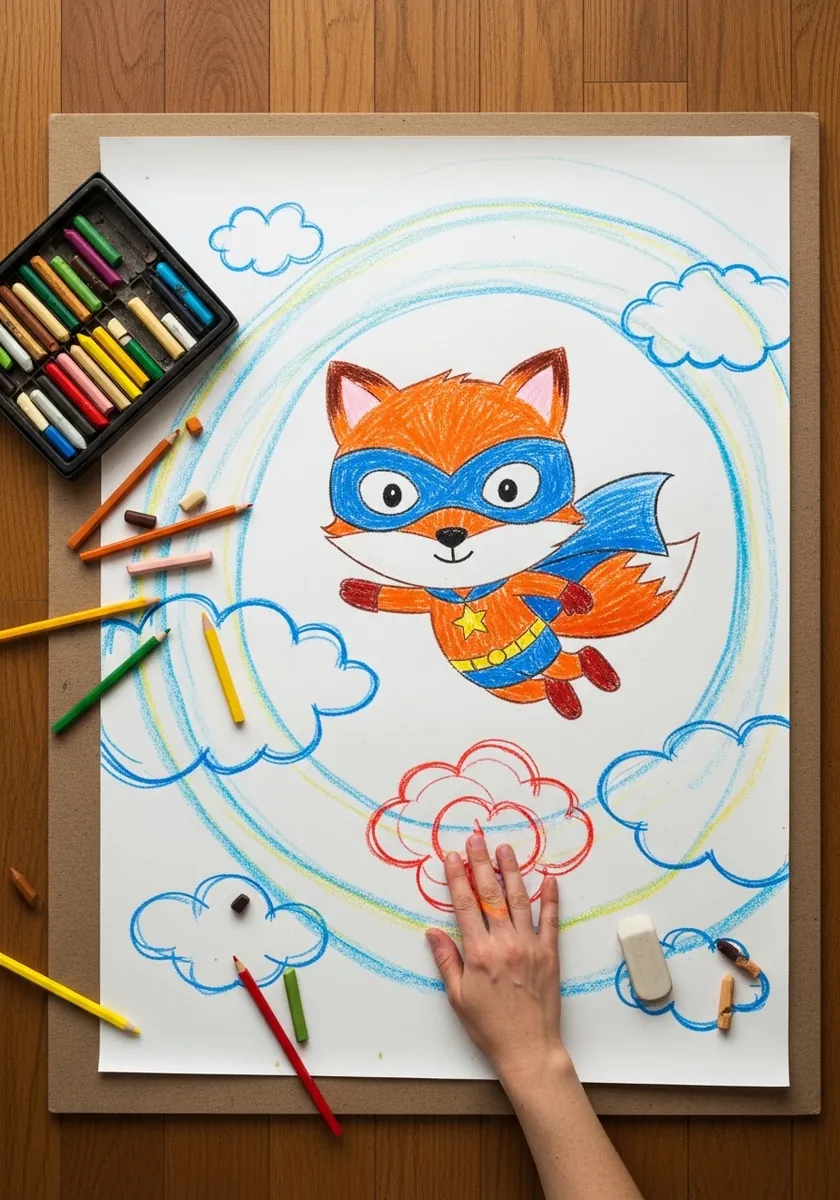
Crayon cannot make a fine line, which forces genuine simplification. Keep the fox to five or six shapes total, let the cape trail in one curved band, and scribble the clouds loosely in one direction only. Press harder on the cape than anywhere else, letting the wax build up so it dominates the page.
26. DJ Fox with Headphones
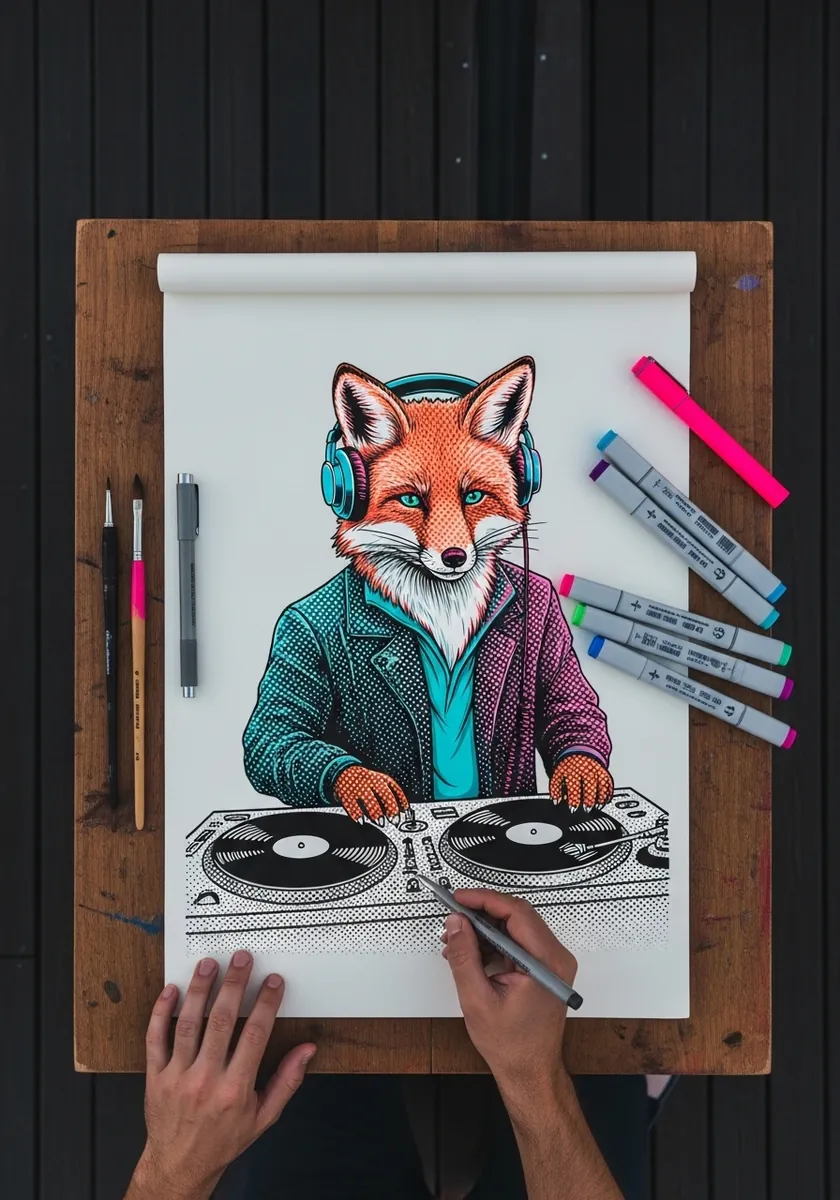
Headphones over tall ears is a design puzzle worth solving. Let the band pass behind the ears rather than crushing them, and put the ear cups slightly forward so both the ears and the equipment stay readable. Angle the turntables toward the viewer in slight perspective rather than drawing them flat on.
27. Fox Fairy on a Mushroom
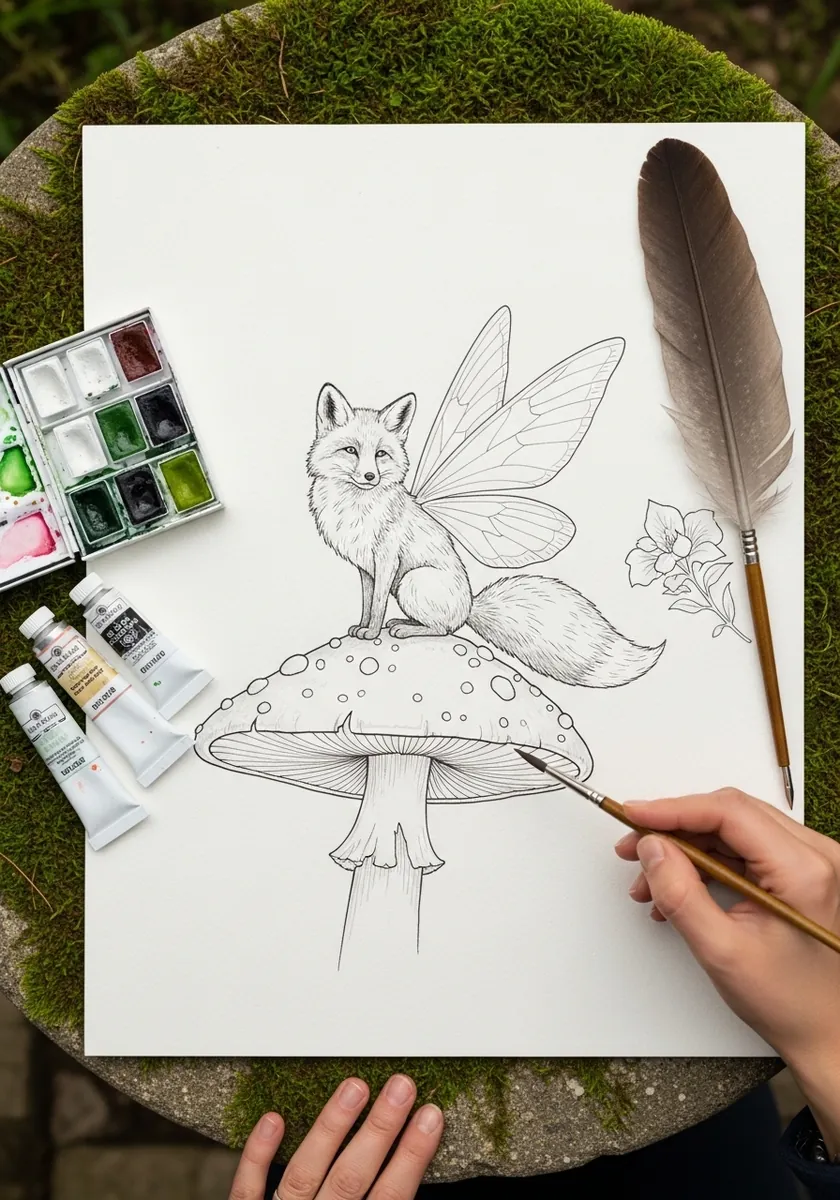
Translucent wings need restraint. Draw the vein structure in the lightest possible line and let the mushroom cap show through them, since anything opaque immediately turns them into solid paddles. Give the mushroom cap a visible underside gill texture, which anchors the fairy on a real object. Small botanical accuracy makes fantasy believable.
28. Rock Guitarist Fox
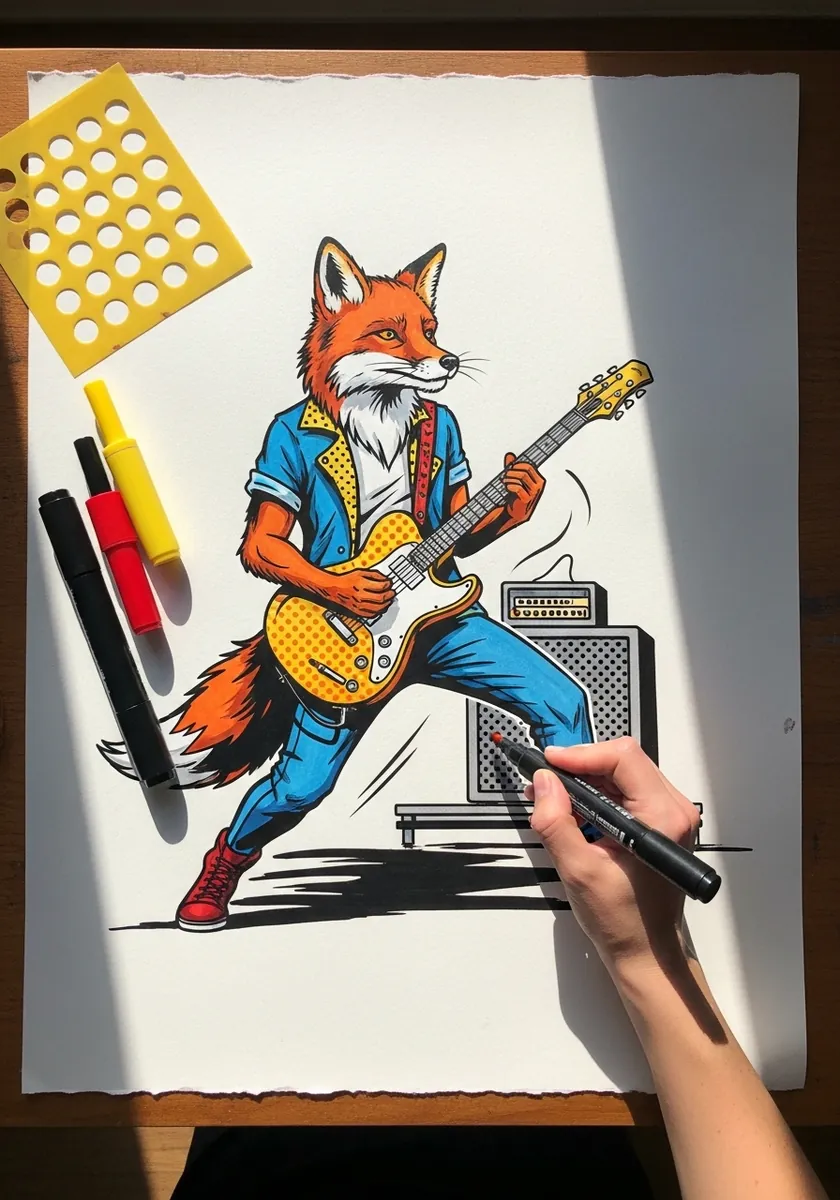
A performing pose needs weight on one leg. Bend the supporting knee, throw the hips off axis, and angle the guitar sharply downward so the whole figure sits on a strong diagonal. Tilt the amplifier away from the figure so it does not visually trap the guitarist in a box. Space around a performer reads as stage.
29. Celestial Fox with Swirling Tails
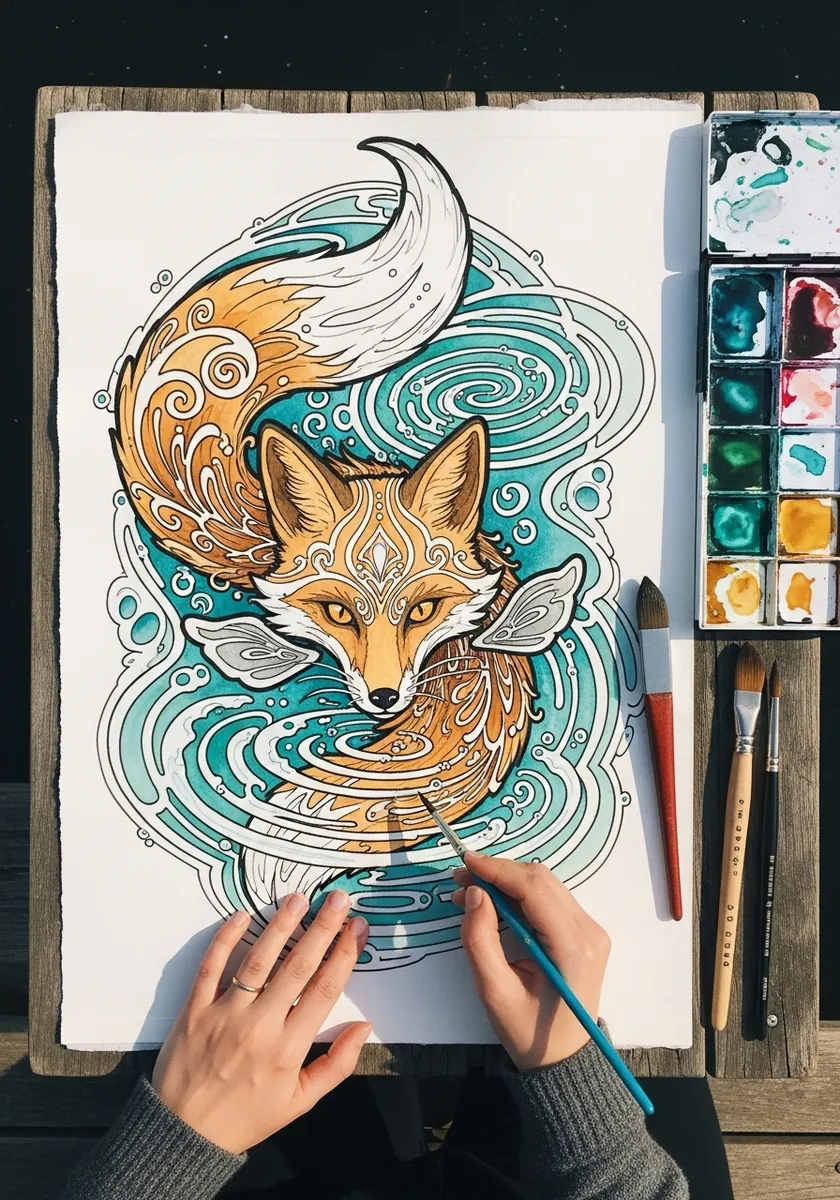
Decorative tails should still obey gravity somewhere. Anchor them at the base with a believable join, then let them spiral freely above, and keep the fox’s own face and body relatively plain by contrast. Repeat one small motif inside every swirl, which is what turns decoration into a deliberate pattern. Random ornament always looks unfinished.
30. Viking Fox with Axe and Shield
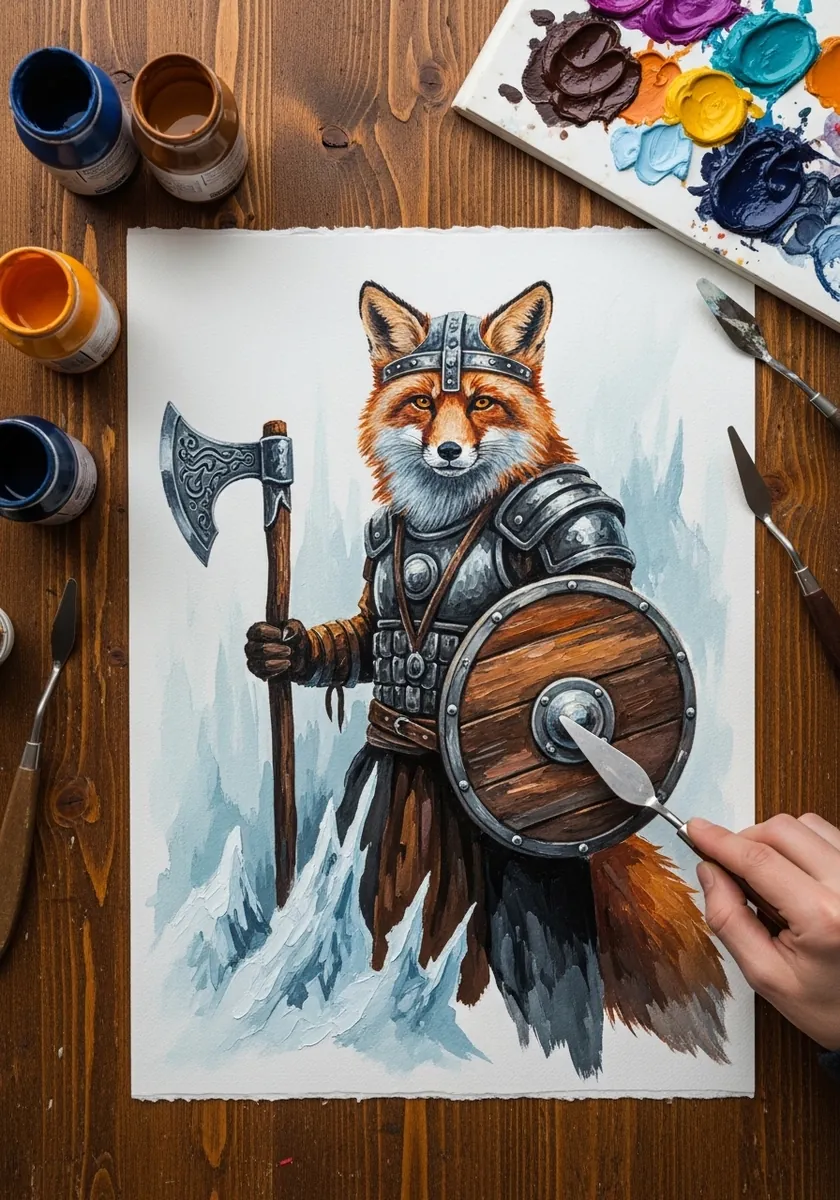
Props establish scale. Size the axe and shield against the character’s own shoulder width first, because oversized weapons make a figure look like a child in costume rather than a warrior. Keep the snow behind him almost blank, since detail there would compete with the armor rivets. Empty space is doing real work in this composition.
31. Framed Celestial Fox Portrait
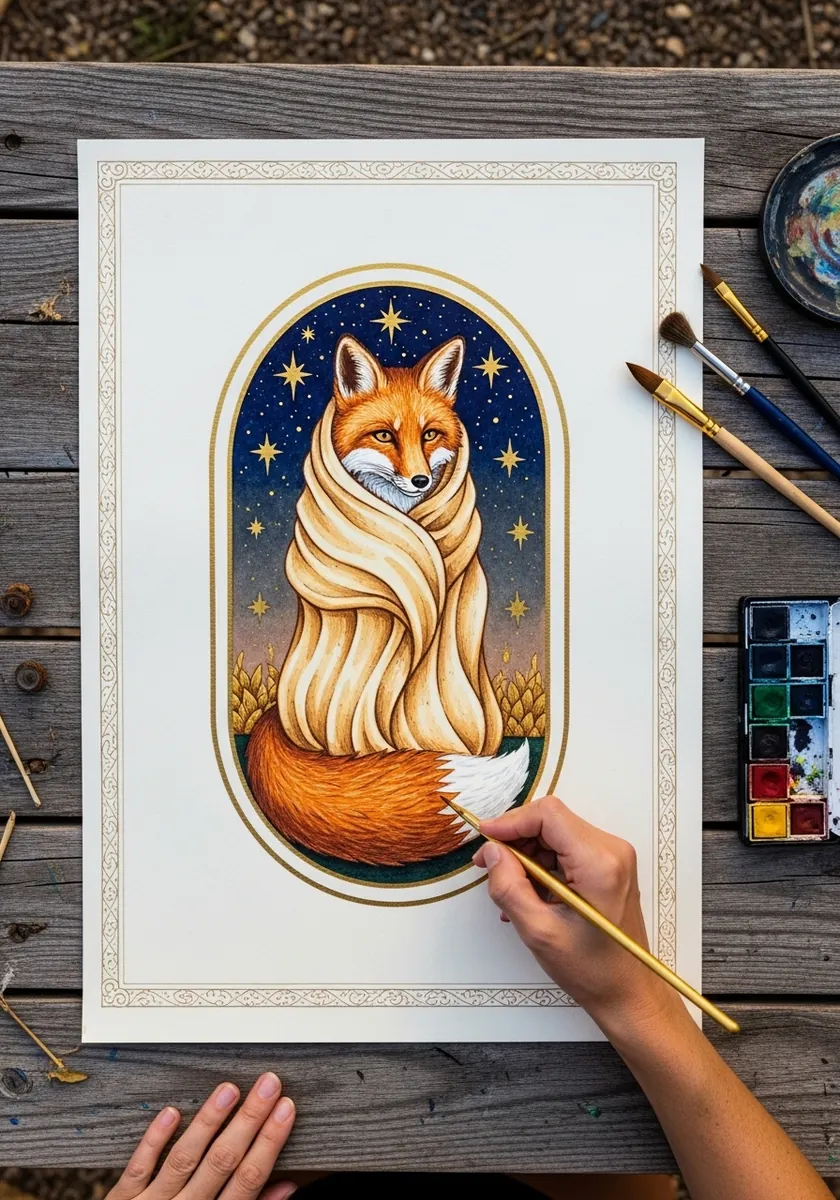
A drawn frame within the page is a strong device. Rule the border first and treat it as a hard container, keep the fox fully inside it, and let only the tail tip cross the line to link the two layers.
Frequently Asked Questions
How do you draw a fox character face?
Start with a circle for the skull and attach a long narrow wedge for the muzzle, much thinner than you would draw on a dog. Add two tall triangular ears set wide apart and angled slightly outward, then mark the white cheek and throat patches.
What makes a fox look like a fox and not a dog?
Three things. The muzzle is narrower and more pointed, the ears are proportionally taller and set wider, and the tail is far thicker, roughly matching the body in width. Change any one of those and the animal drifts toward dog or cat.
How do you design an anthropomorphic fox?
Keep the head entirely vulpine and let the body follow human proportions. Mixing the two, giving the character a human nose or fox-shaped shoulders, is what makes anthro designs look uncomfortable rather than deliberate.
What is a kitsune and how many tails does it have?
A kitsune is a fox from Japanese folklore, often shown with multiple tails. Nine tails traditionally indicates the greatest age and power. When drawing them, fan the tails outward from a single point at the base so they read as one mass.
What is the easiest fox character to draw?
A simple sitting fox in continuous outline. The pose is stable, the tail curls around the body to hide the legs, and you only need the muzzle wedge and ear triangles correct for the whole thing to read immediately.
References and Further Reading