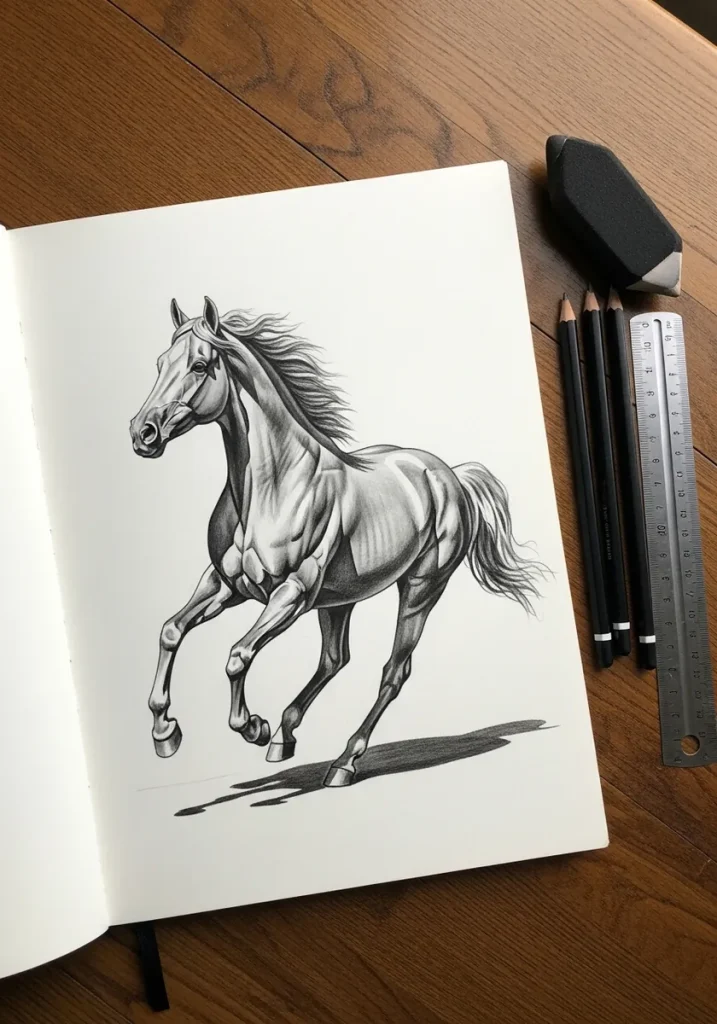
Most horse drawings fail at the legs. The forward joint on a front leg is the wrist, not a knee, and the backward-bending joint behind is the hock, which is the heel. Get those two right and everything else follows.
Key takeaways
- A horse's front knee is anatomically a wrist, and the hind leg's backward bend is the heel, not a knee.
- Build the body from two circles, chest and hindquarters, joined by the barrel of the ribcage.
- The head is a long wedge with a separate rounded muzzle box added at the end.
- At full gallop all four hooves leave the ground while gathered under the body, as Muybridge proved in 1878.
- Height is measured at the withers in hands, one hand being four inches.
Horses go wrong at the legs, almost every time. What reads as a knee on the front leg is really a wrist, and the joint bending backward on the hind leg is a heel. Once you know that, the strange zigzag of an equine leg stops being a puzzle and becomes a rule you can apply.
The body itself is simple. Two circles for chest and hindquarters, joined by the barrel of the ribcage, will carry any pose you want. The head is a long wedge with a rounded muzzle box added on the end, and the neck is a wedge running from the shoulder up to it.
These forty pieces run from a beginner construction sketch to graphite realism, pop art halftone, pixel art, folk pattern, collage and tattoo flash. For the wet-media approach specifically, watercolor horse drawing ideas goes deeper into washes and lifting.
If you want the same construction logic applied to other four-legged animals, look at fawn and deer sketches or these watercolor animal drawing ideas, and for the ornamental horses further down, mandala construction is the closest companion.
Compiled by the GS Art Zone editorial team. Last updated August 2026. Each idea is paired with the specific step that produces the effect, so you can go from the reference straight to paper.
What You Need Before You Start
- A 2H for construction and a 4B for depth, since most graphite pieces here need that full range
- A kneaded eraser, which lifts highlights out of a coat without disturbing the paper surface
- One warm brown and one cool gray marker, enough for bay, chestnut and dapple coats
- Fine liners in 0.1 and 0.5 for the patterned and tattoo-style designs
- Watercolor paper of at least 200gsm for the wet pieces, because thin paper buckles under a wash
1. Graphite Galloping Horse in a Sketchbook
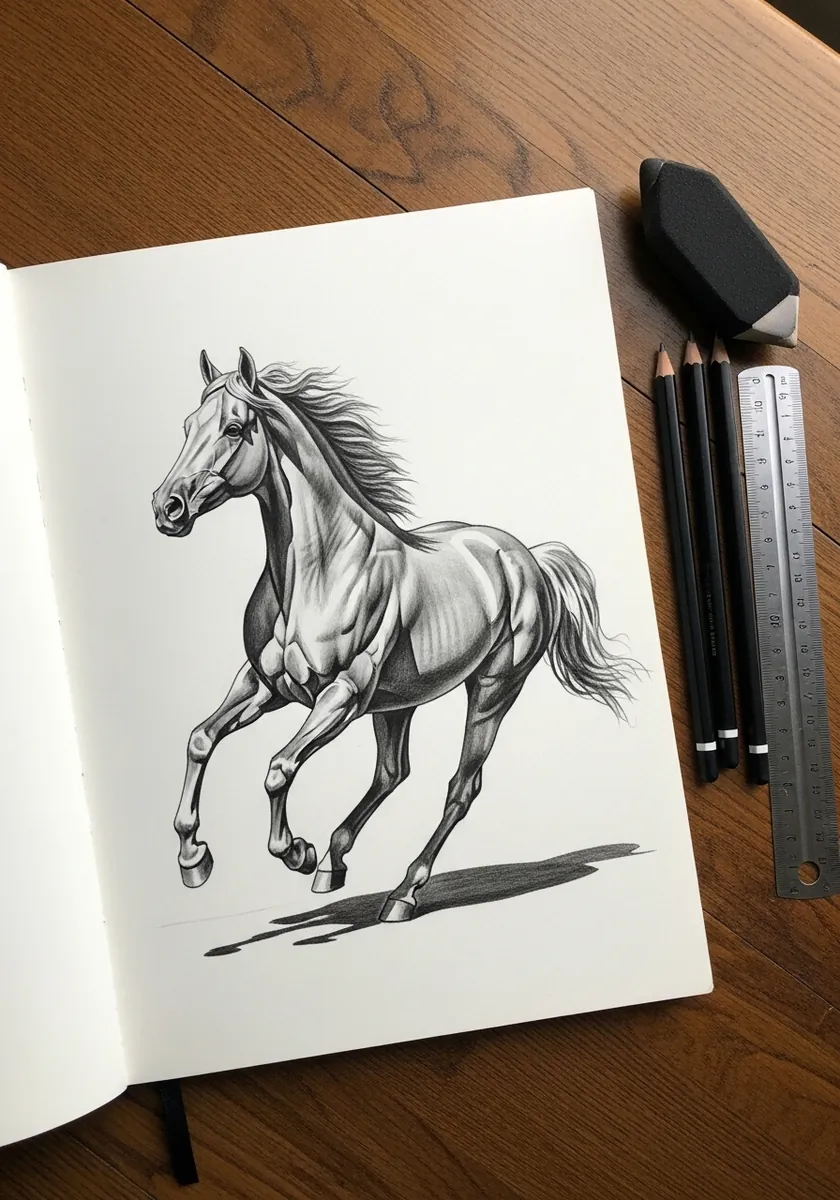
Gallop is the pose most people get wrong. All four legs gather beneath the body at the moment of suspension, which photography settled in 1878, so avoid the old rocking-horse pose with legs flung fore and aft. Keep the neck extended low and level with the spine.
2. Rainbow Watercolor Splash Horse
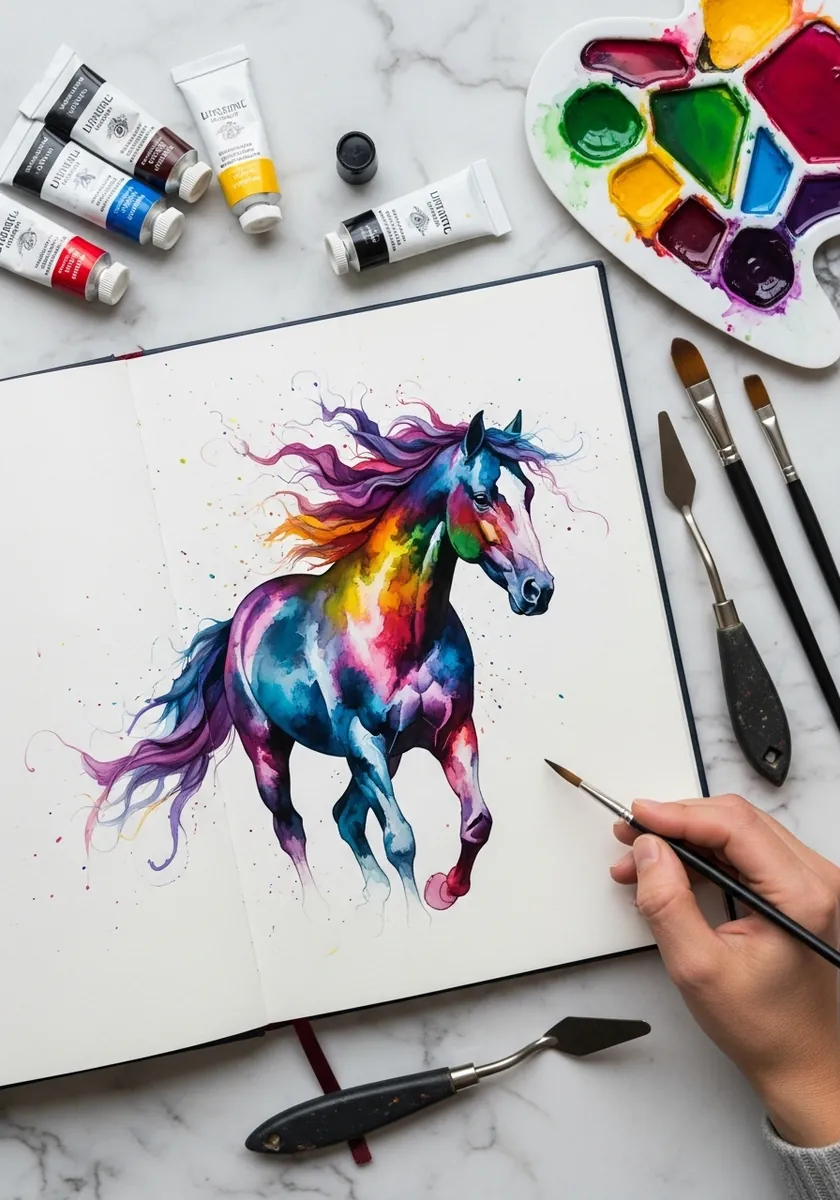
Uncontrolled color needs one controlled element to anchor it, so keep the head and the front of the chest reasonably accurate and let everything behind dissolve into splatter. Flick pigment from a loaded brush while the paper is still slightly damp at the edges of the form.
3. Clean Contour Line Horse
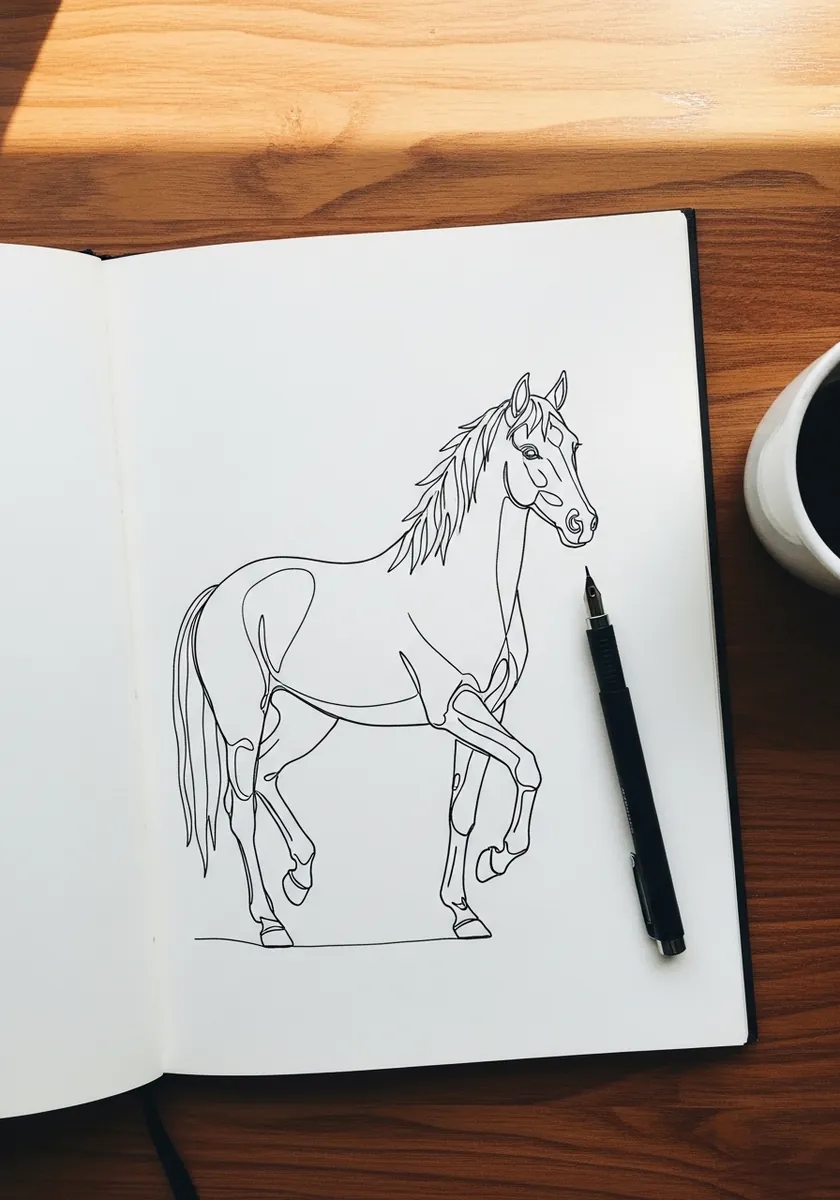
Pure outline exposes every proportional error, which makes it excellent practice. Check one relationship before inking: the distance from withers to ground should roughly match chest to rump. Vary line weight at the underbelly and behind the legs so the drawing does not read as flat wire.
4. Beginner Construction Sketch
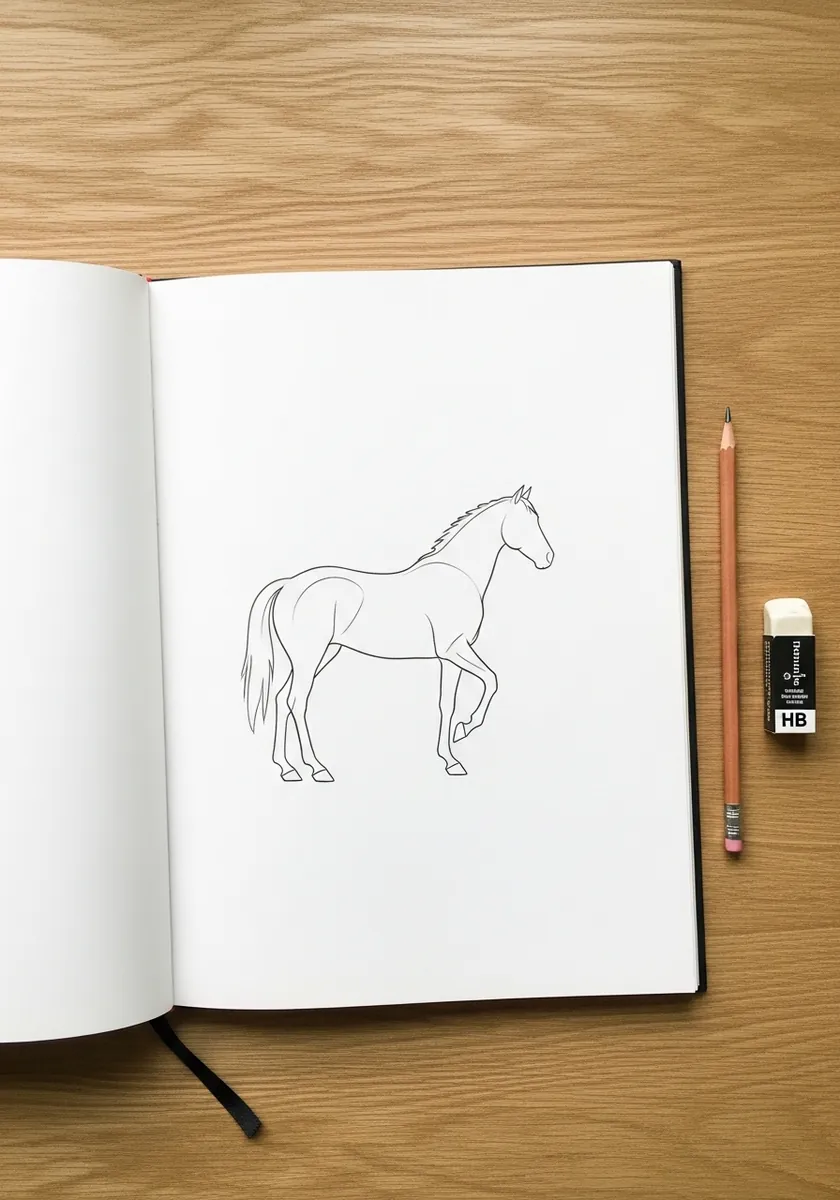
Everything begins here. Two circles, a connecting barrel, a wedge neck, and a stick framework for the legs with dots marking each joint. Spend real time on those joint dots. Five positions per leg decide whether the finished animal stands convincingly or looks collapsed.
5. Graphite Horse Head Portrait
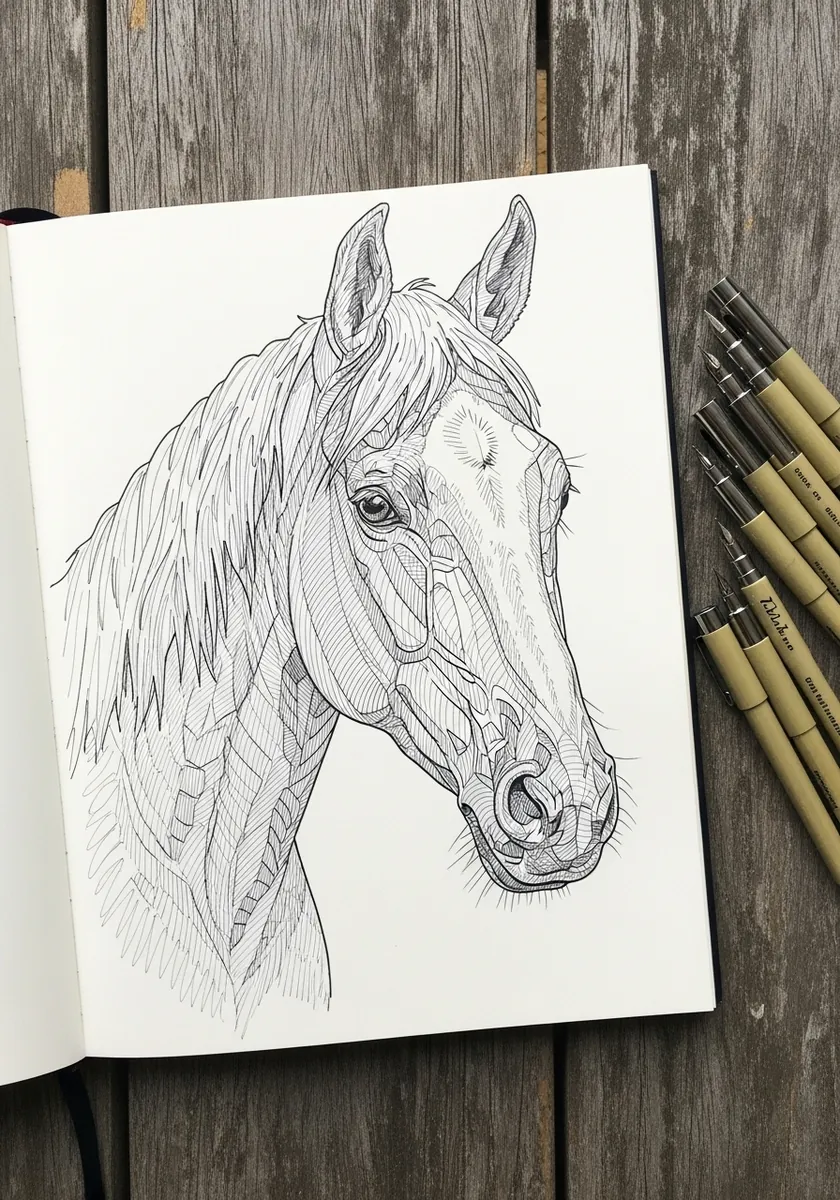
Portraits live in the eye and the nostril. Horse eyes sit on the sides of the skull, so from three-quarters you see one almost fully and the other barely at all. Build the coat with short directional hatching and reserve pure white paper for the muzzle whiskers.
6. Low Poly Faceted Horse
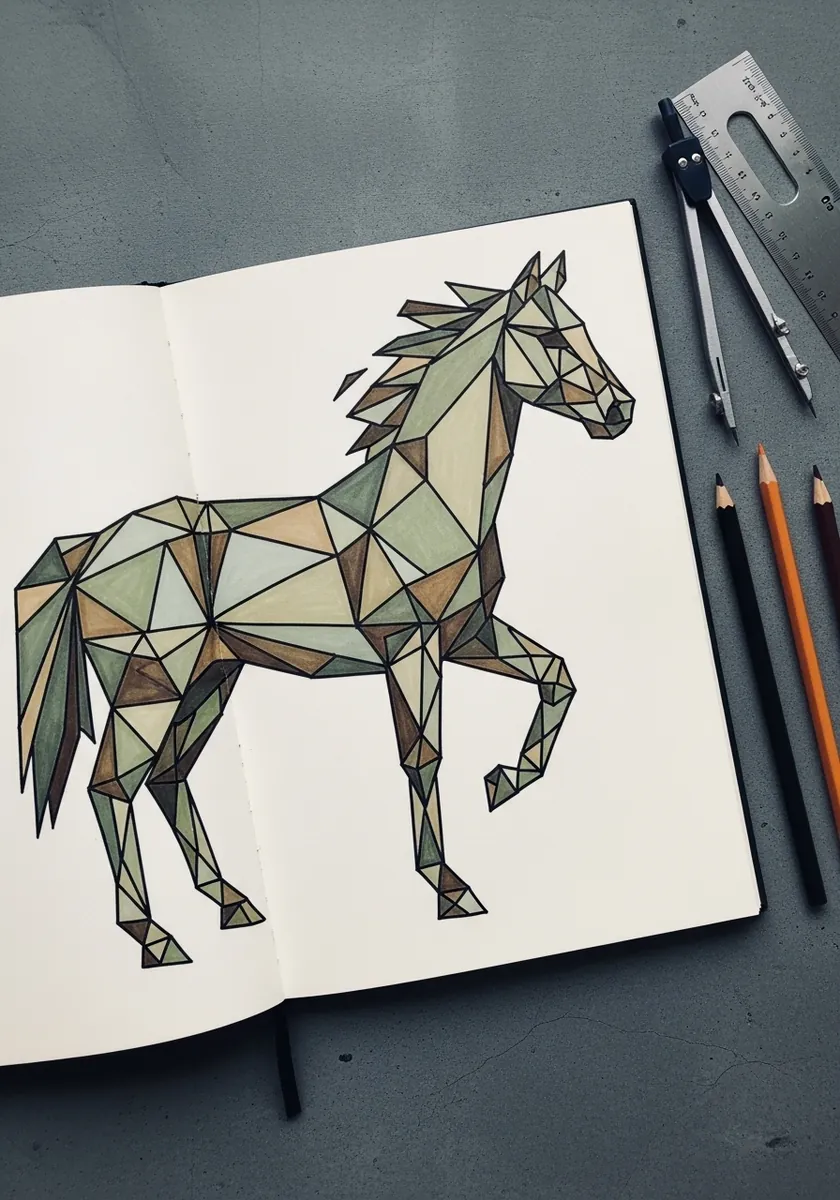
Faceting demands a plan before you shade. Map your triangles so their edges land on real anatomical divisions, along the shoulder, the point of the hip and the top of the hock, then fill each facet with one flat value. Seams that ignore anatomy always look arbitrary.
7. Pop Art Halftone Horse
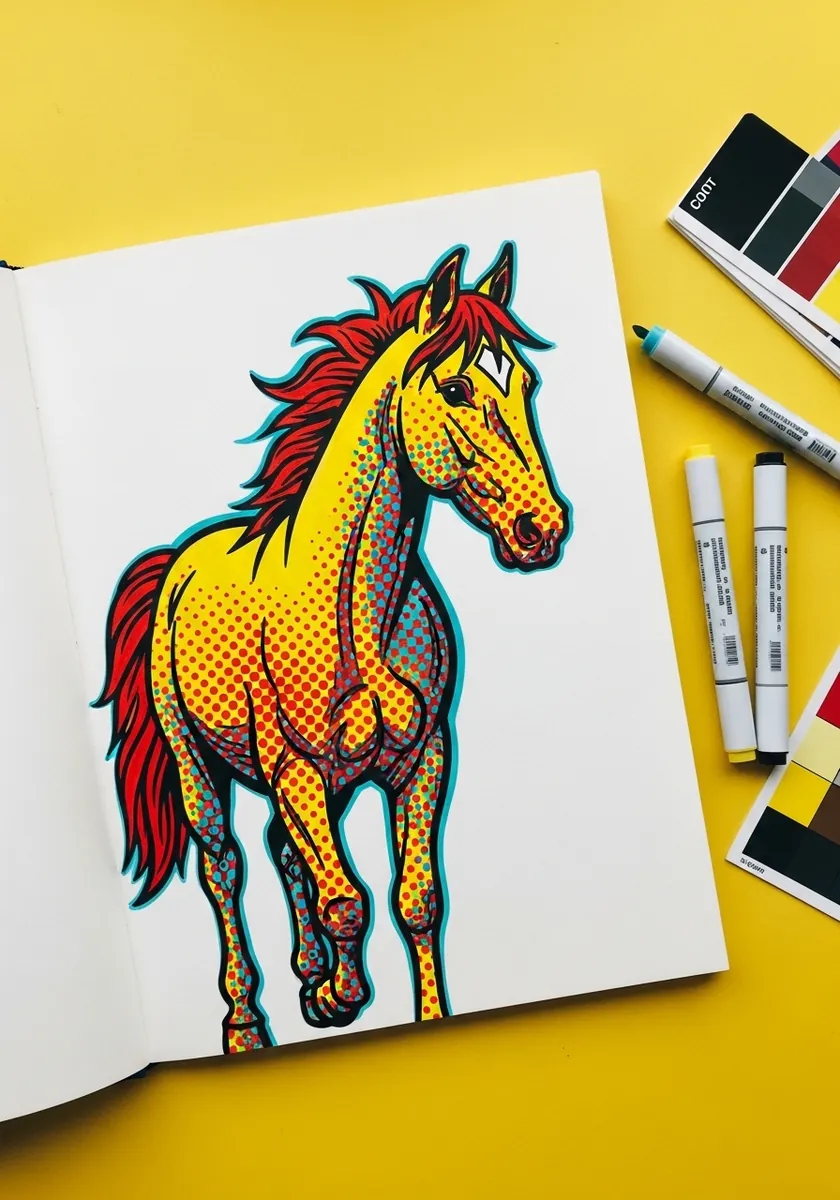
Comic styling wants no midtones whatsoever, so choose two or three flats, outline in a heavy uniform black, and let a halftone dot field stand in for every gradient you would normally blend. Treat the mane as one solid silhouette rather than individual strands.
8. Melting Ice Horse in Blue
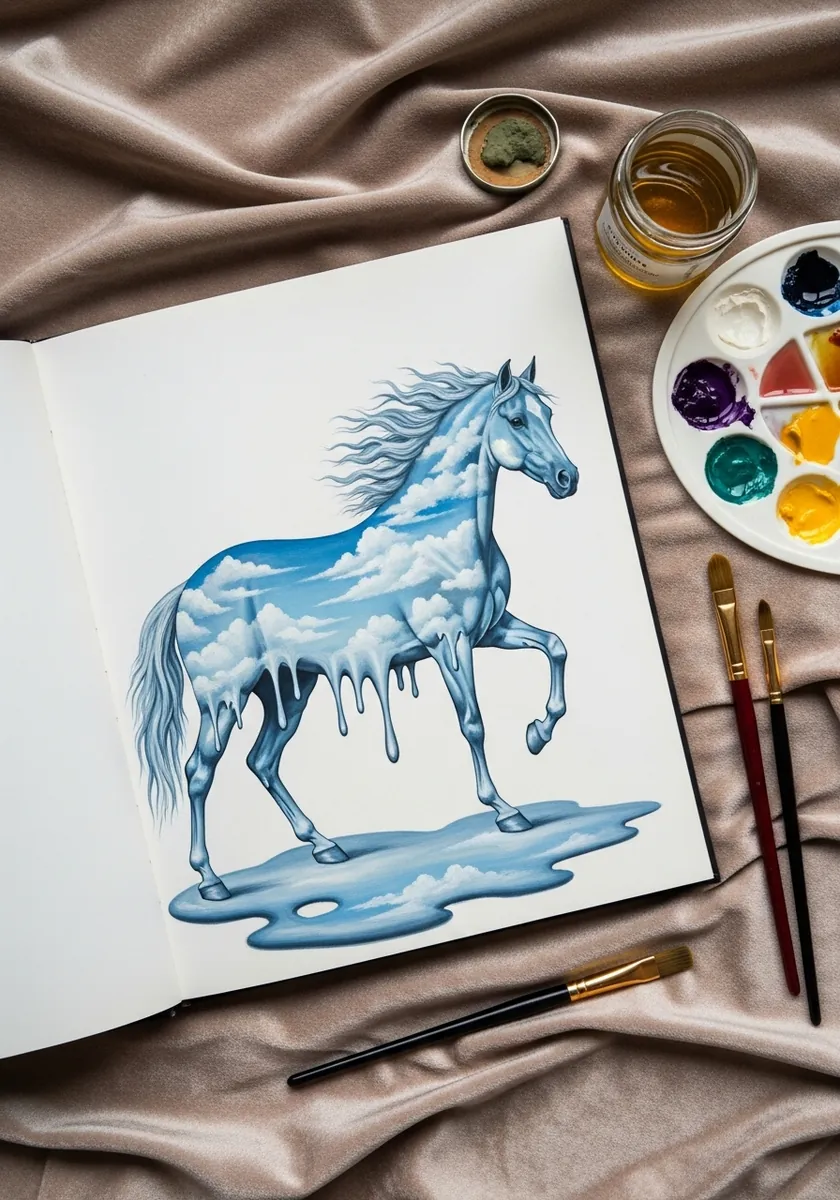
A melting subject needs a decision about where solidity ends. Keep the head and forequarters crisply drawn, then let the legs soften and run into the pool below. Vertical drip edges should stay parallel, since gravity does not vary across the page.
9. Palomino in a Watercolor Meadow
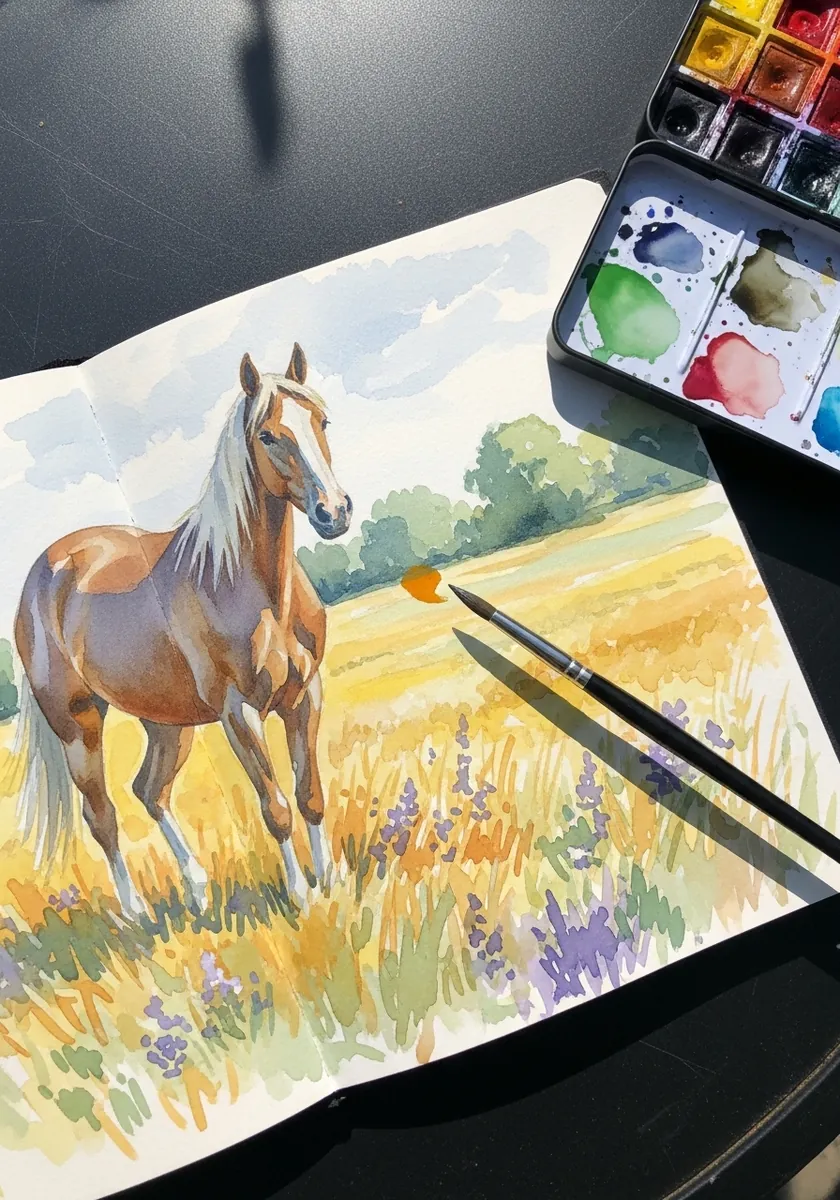
Landscape work asks you to solve the ground plane first. Lay the grass wash and let the horse’s lower legs disappear into it slightly, which instantly seats the animal in the field. A palomino coat is warm cream, so mix it from yellow ochre rather than reaching for brown.
10. Split Color Red and Blue Horse
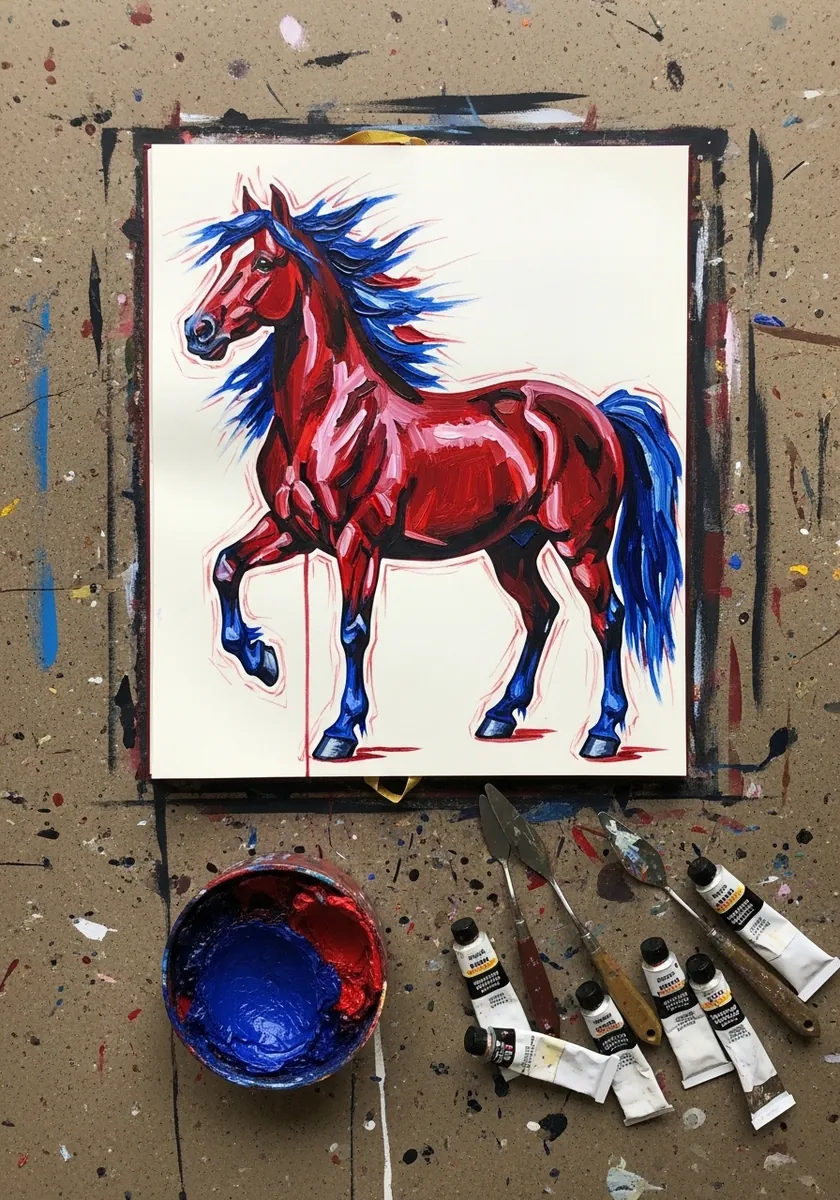
Splitting a subject between two hues works when the division follows the form. Run the color change down the spine. Keep each side consistent in temperature, warm on one and cool on the other, then overlap them slightly at the boundary so the join carries some depth.
11. Art Deco Geometric Horse
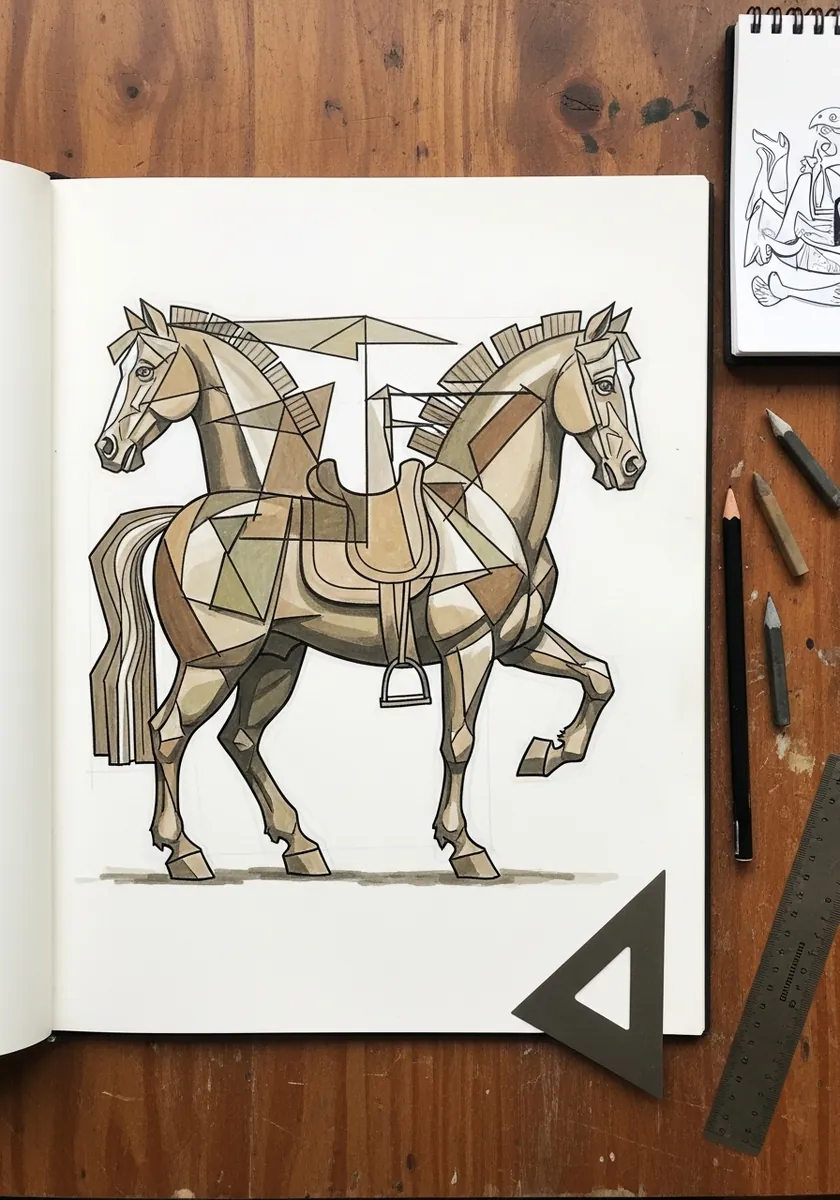
Deco styling reduces curves to arcs and straights. Redraw the neck as two long tapering planes, turn the haunch into a segment of a circle, and keep every line either straight or drawn with a compass. The saddle becomes a simple stack of trapezoids under the same rules.
12. Front-Facing Horse Head Study
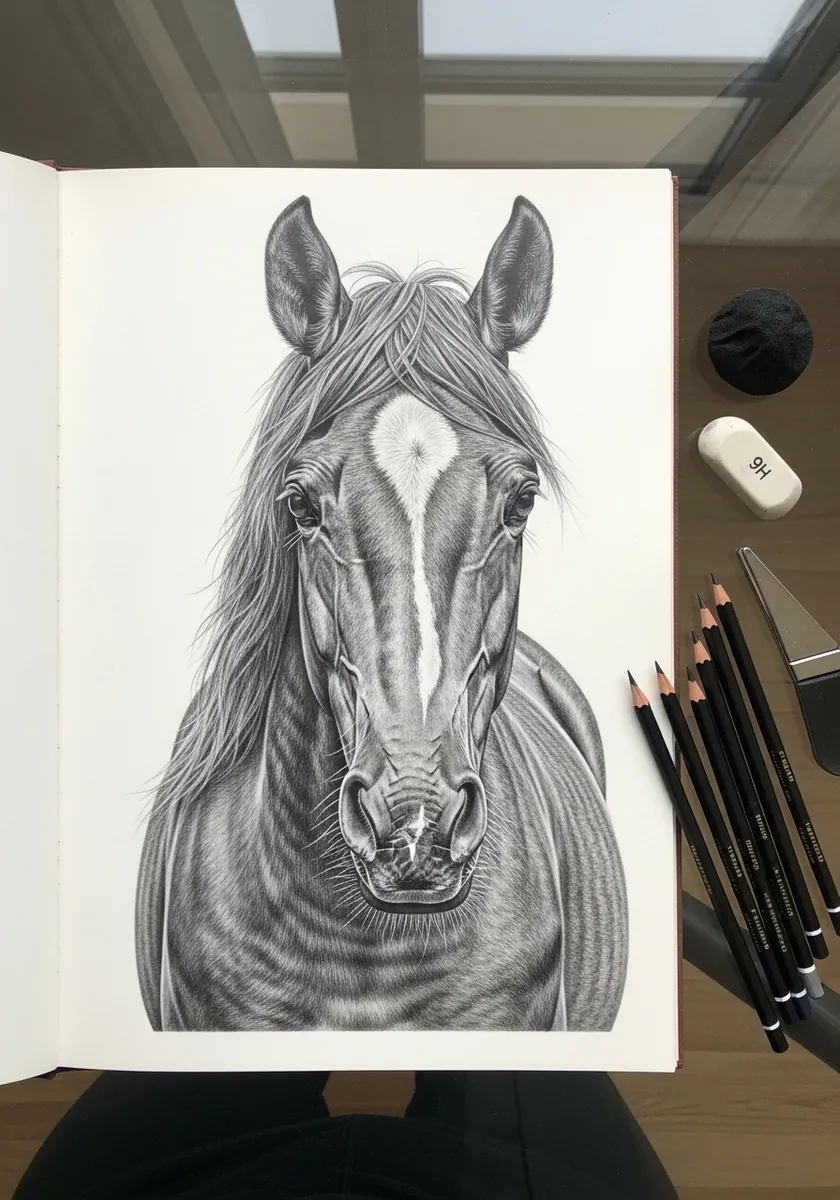
Head-on is the hardest angle and worth practicing, because the skull narrows sharply between the eyes and widens again at the muzzle, giving an hourglass silhouette that beginners straighten out. Watch the ears too, since from the front they become narrow vertical slivers.
13. Realistic Full Body Graphite Horse
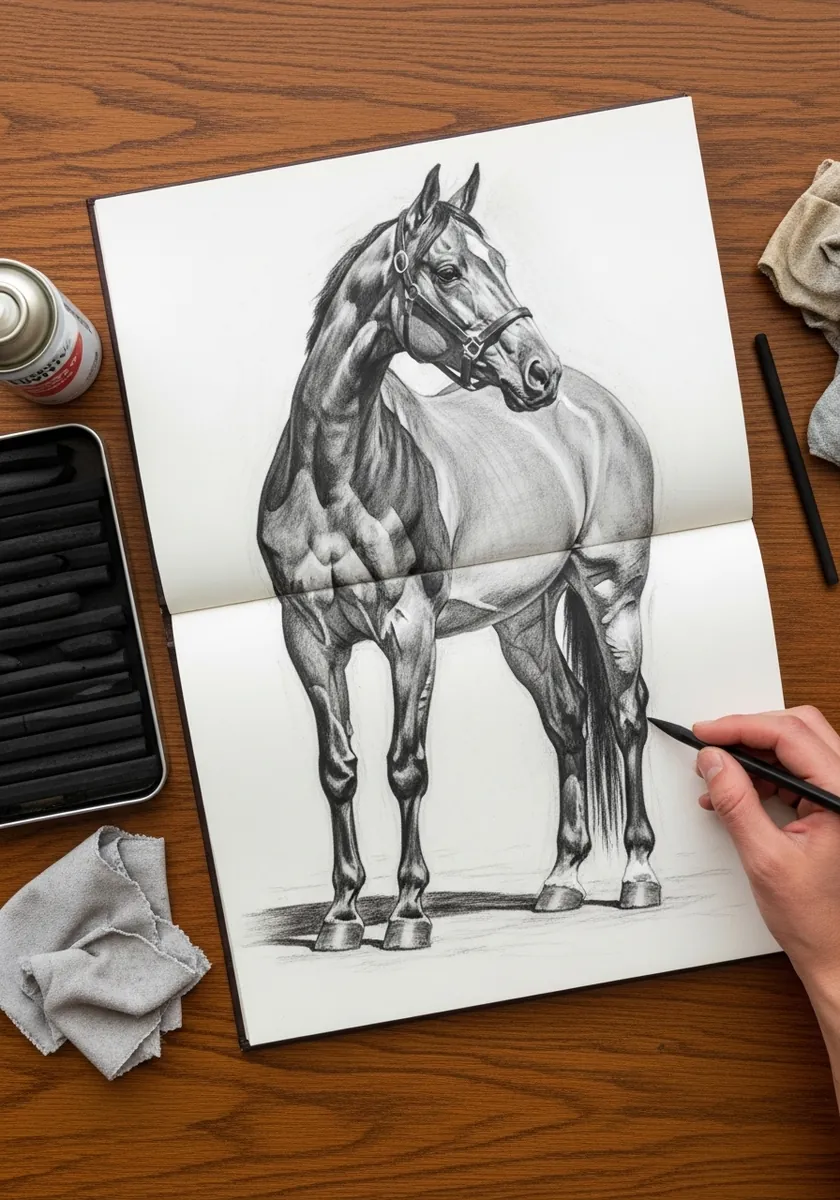
Long careful renders need a value plan you can commit to. Squint at your reference and reduce the animal to three tones, then build slowly toward that map, keeping the topline of the back near paper white throughout. See 3D pencil shading practice for the layering method.
14. Neon Gradient Marker Horse
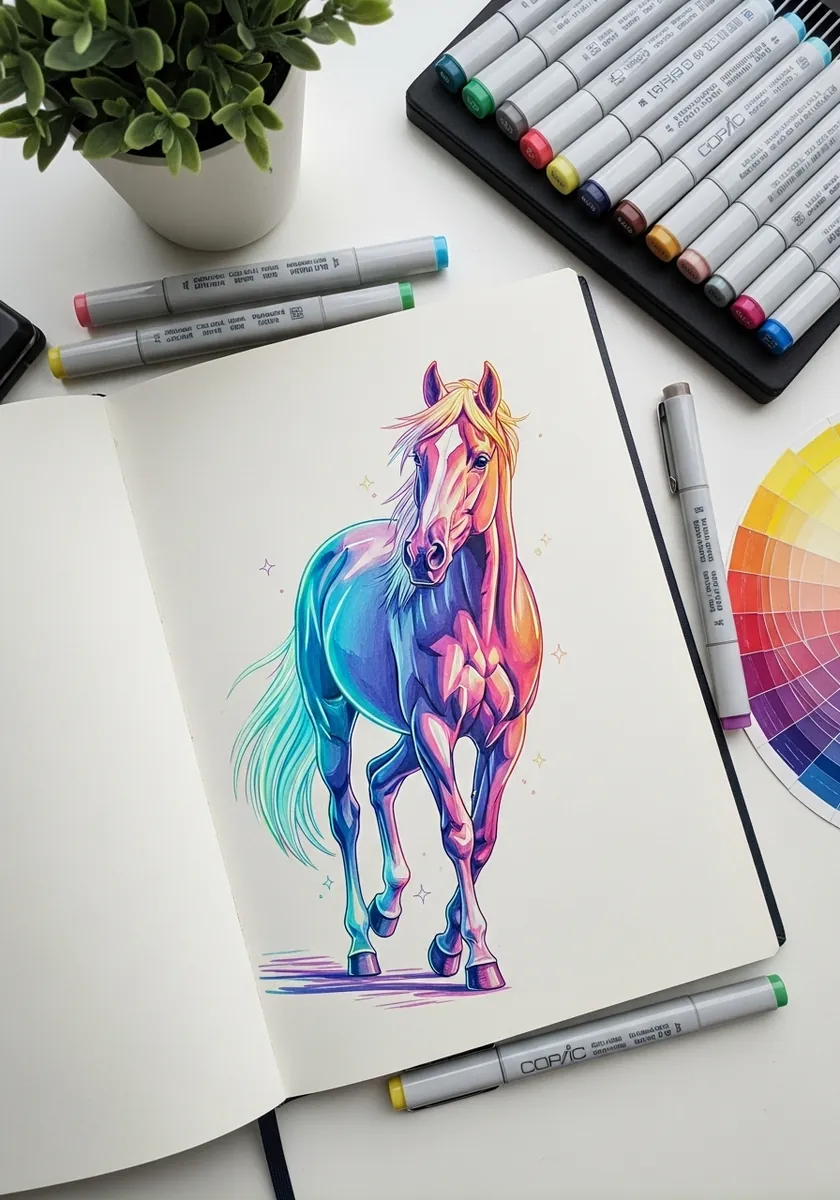
Alcohol markers blend only while wet, so gradients have to be laid fast and in order. Work light to dark, keep a colorless blender in your other hand, and finish the mane before the body. Neon on white paper needs a thin dark outline or the shape dissolves.
15. Flat Pastel Toy Horse
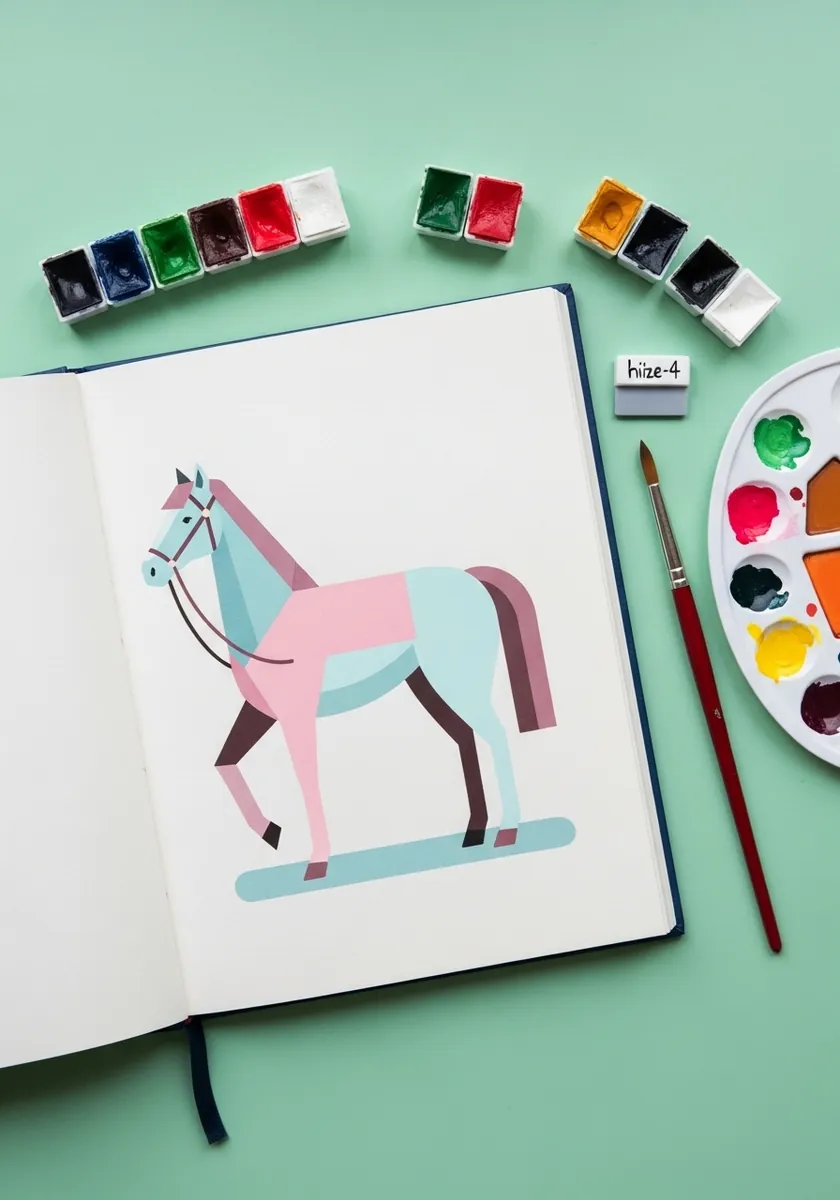
Toy styling is a discipline in subtraction. Reduce the animal to five or six flat shapes, keep every edge geometric, and drop the legs to simple tapered rectangles. Muted pastel colors do the emotional work here, so avoid any outline that would sharpen the mood.
16. Faceted Crystal Horse in Jewel Tones
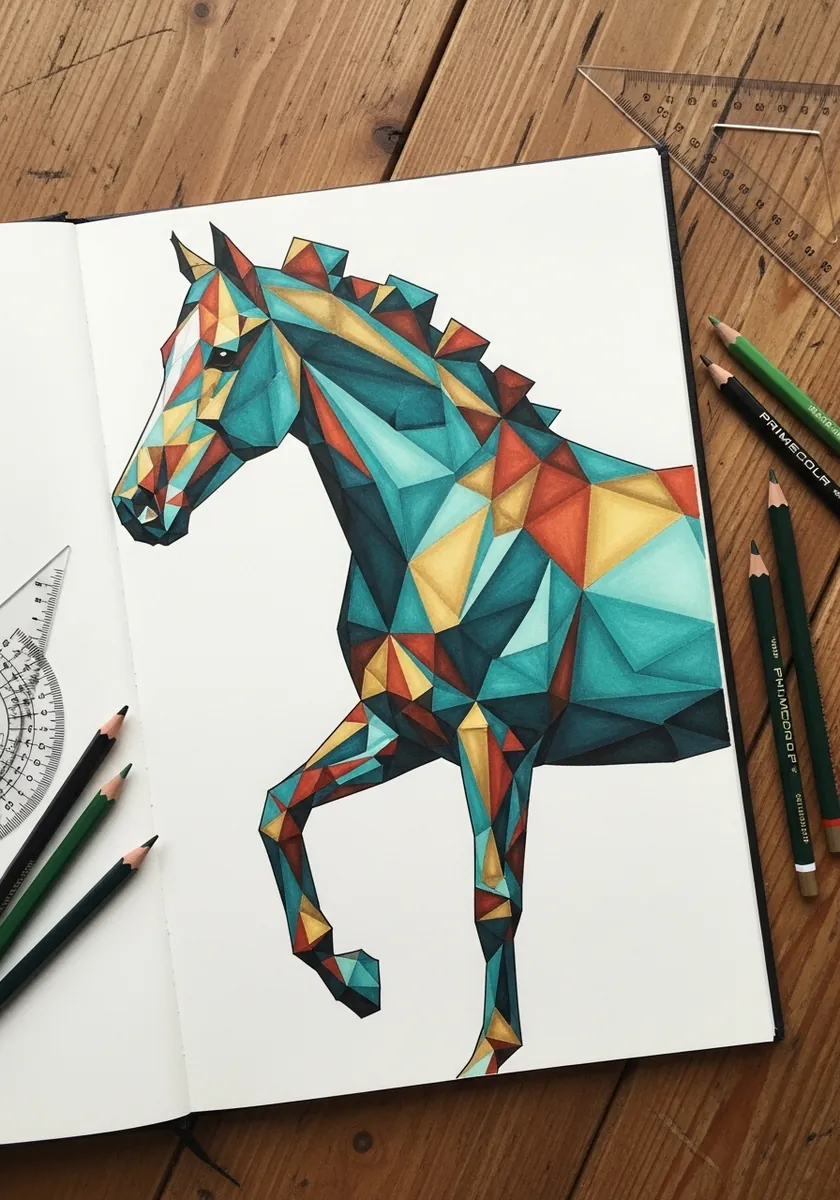
Jewel colors need a value structure underneath or they turn to mud. Assign each facet a light, mid or dark value first, in pencil, and only then choose which hue fills it. Neighboring facets should never share both the same hue and the same value.
17. Pixel Art Horse on Graph Paper
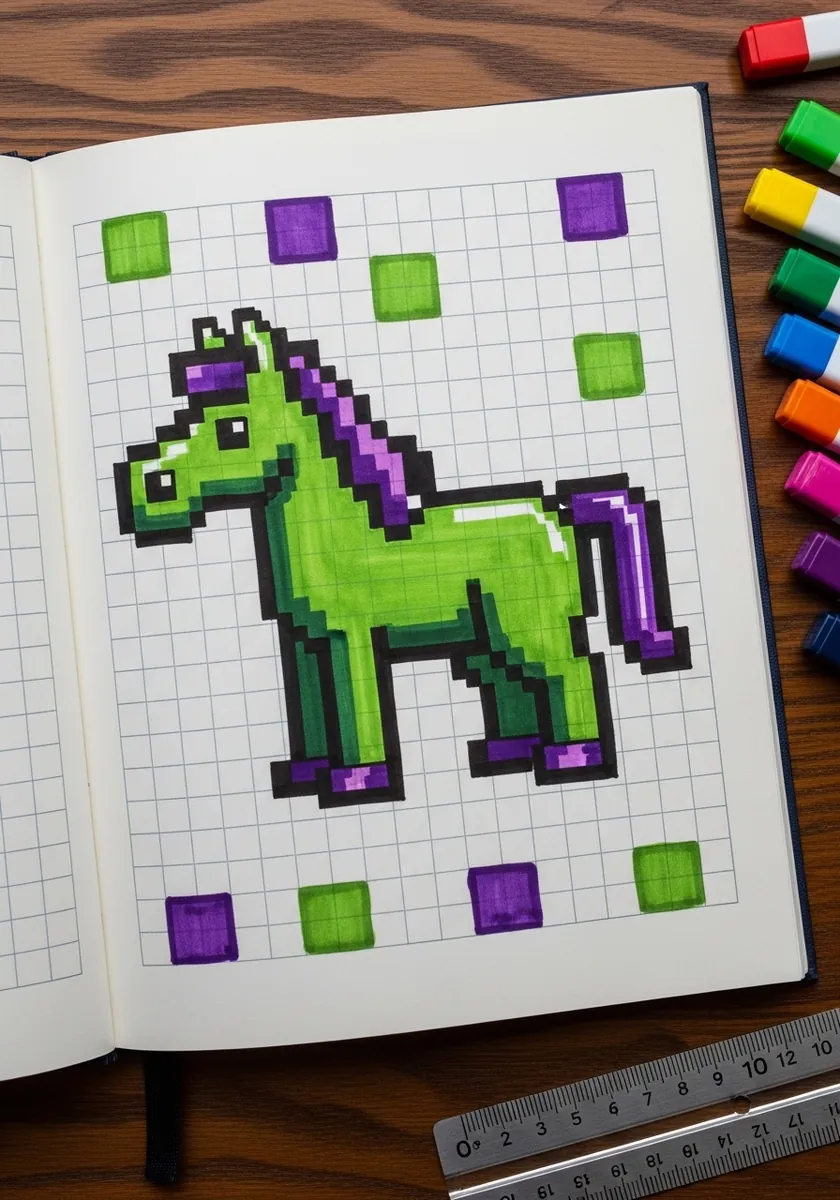
Grid work forces brutal simplification, which is exactly its value as an exercise. Give yourself around twenty squares of height. Block the silhouette first, then place two squares for the eye and mane. Step diagonal legs one square at a time, never two.
18. Splash Watercolor Horse in Blue
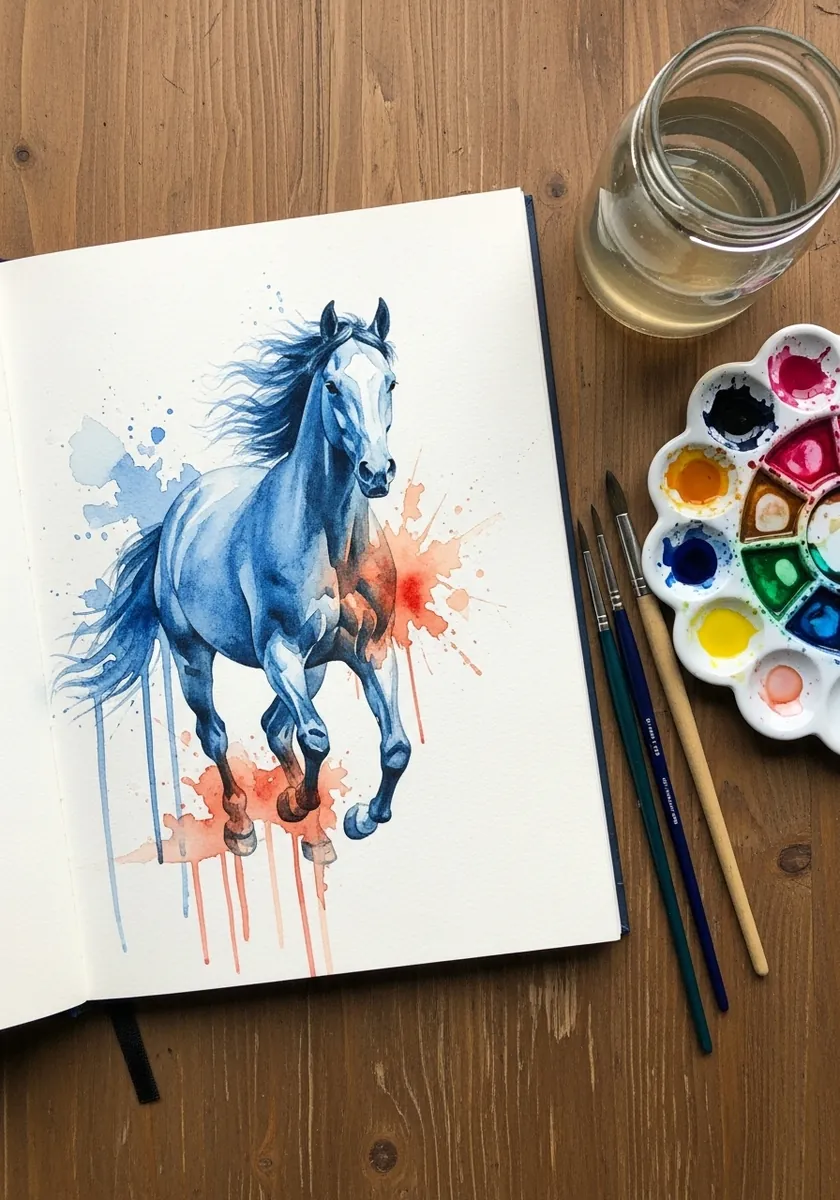
Complementary accents rescue a monochrome wash. Paint the horse entirely in blues, then flick a few small orange marks near the hooves and muzzle while everything is still damp. Restraint is essential, because more than a few touches of orange will fight the main color.
19. Quill and Ink Gesture Horse
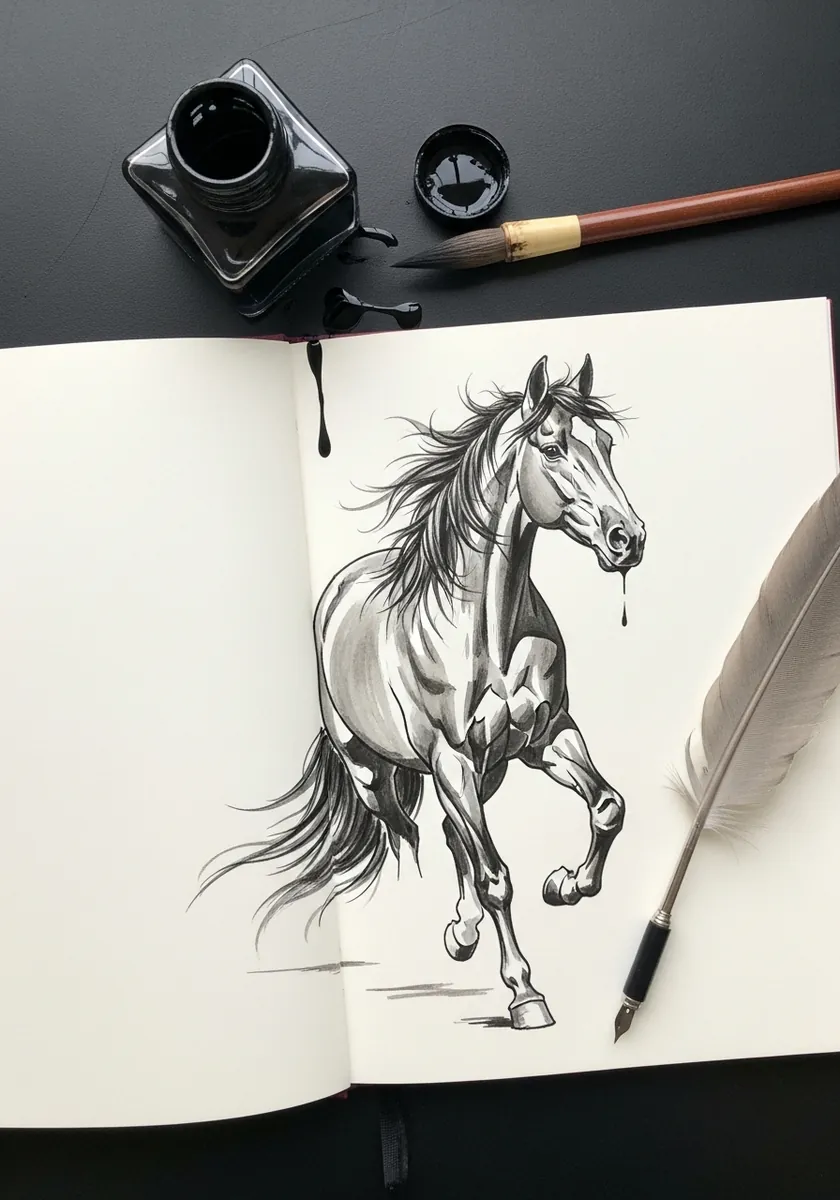
Gesture drawing is about the line of action, nothing else. Find the curve running from poll through withers to tail and lay it down in one confident stroke, then build the rest around it quickly. A quill nib varies its own weight, which suits this kind of urgency.
20. Charcoal Horse Head on Toned Paper
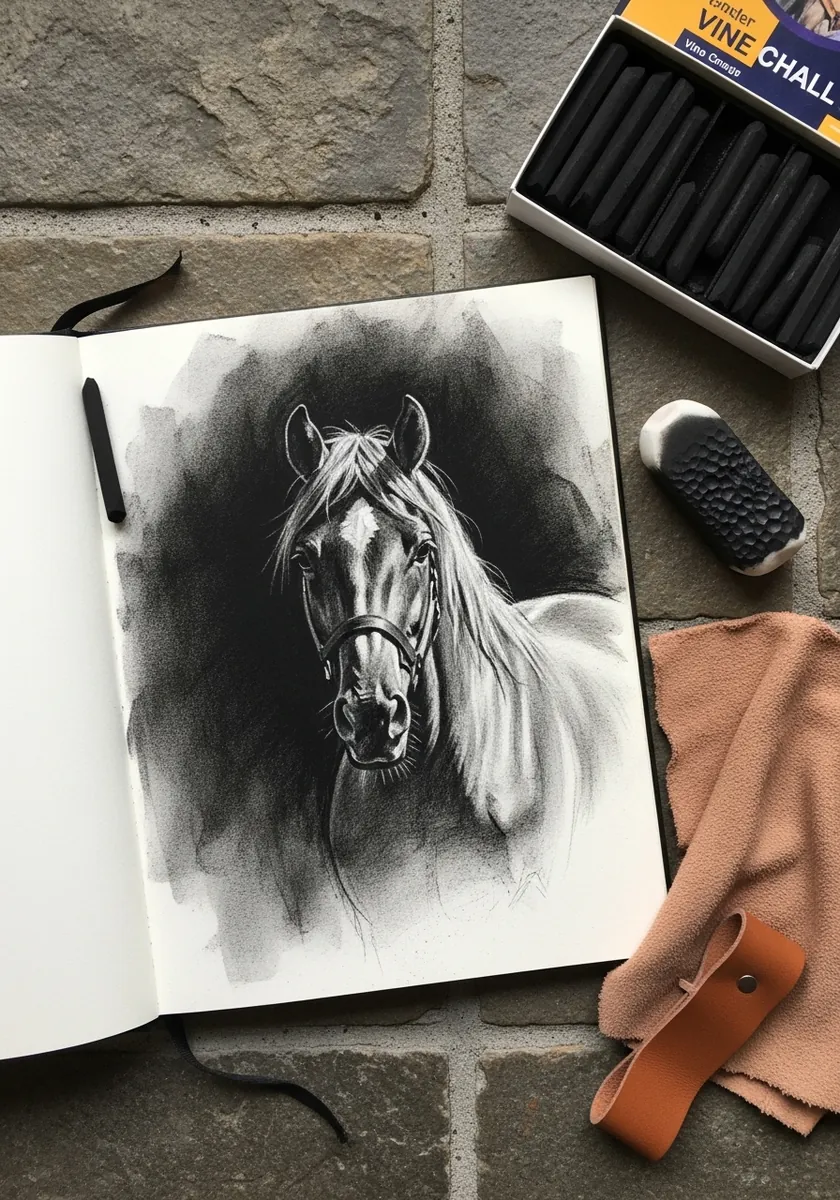
Toned paper lets you work in both directions at once, pushing darks in with compressed charcoal and pulling the mane and blaze back out with white chalk, so the paper itself serves as your mid value across the cheek and jaw.
21. Chestnut Horse in Colored Pencil
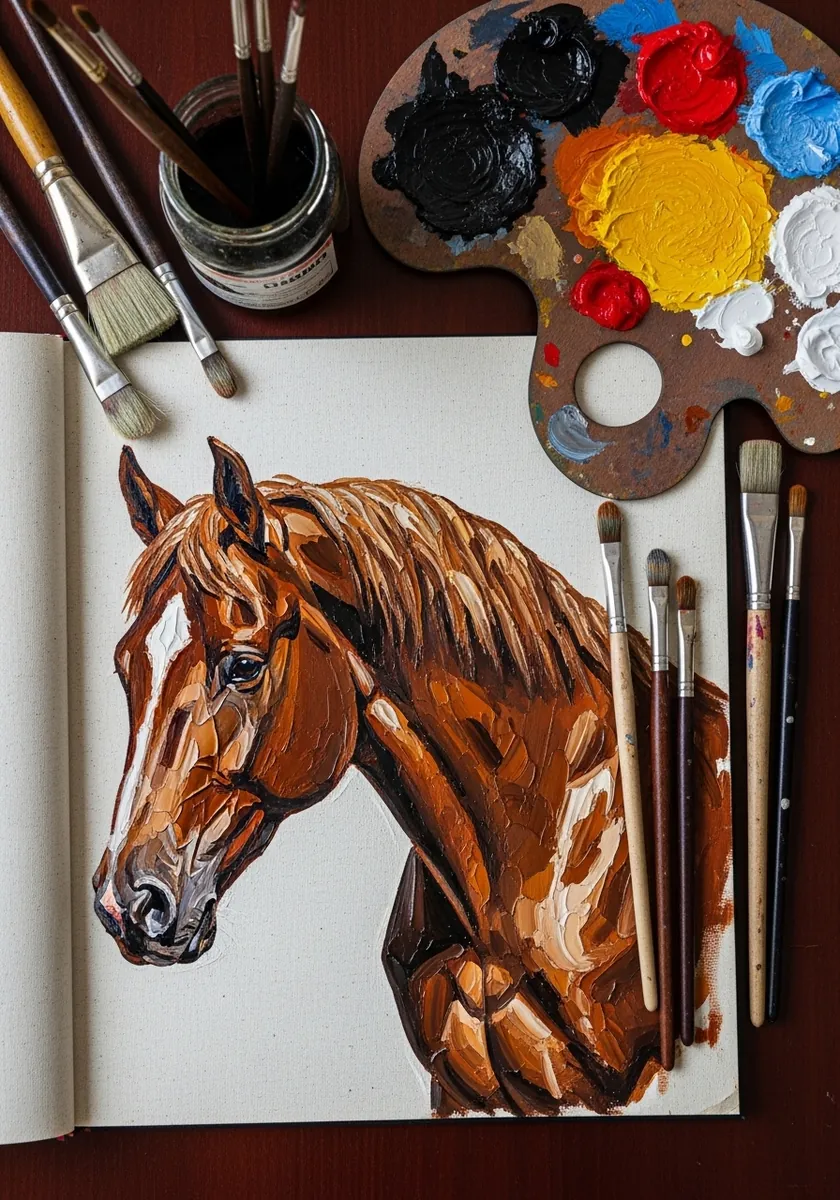
A chestnut coat is never one brown. Layer burnt sienna over a base of ochre, then glaze a violet-gray into the shadow side so the color stays lively. Burnishing with a colorless blender at the end gives the coat the sheen that a healthy horse actually has.
22. Soft Pastel Horse in Mist
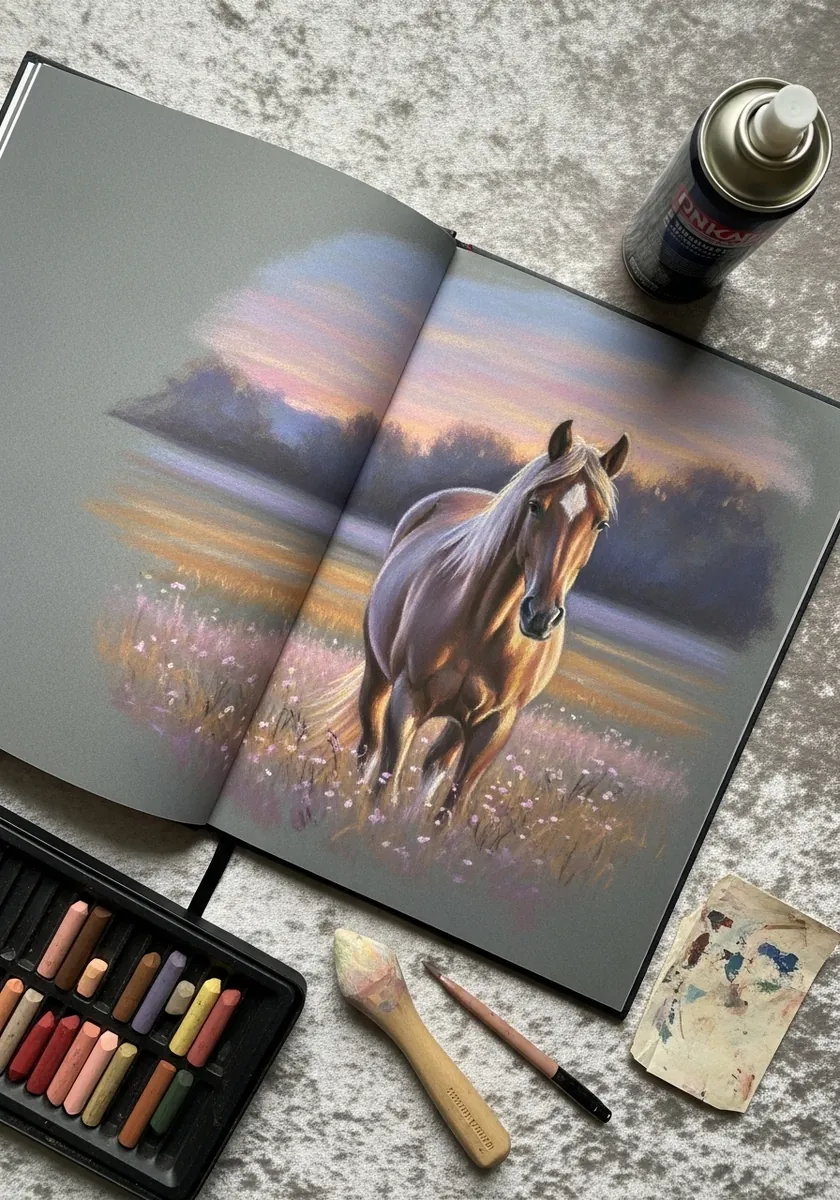
Atmosphere is a matter of edge control. Keep the head reasonably sharp and let the hindquarters lose their edges entirely into the mist, dragging a clean finger along the boundary. Every color in a misty scene shifts toward the gray of the air itself.
23. Cut Paper Collage Horse
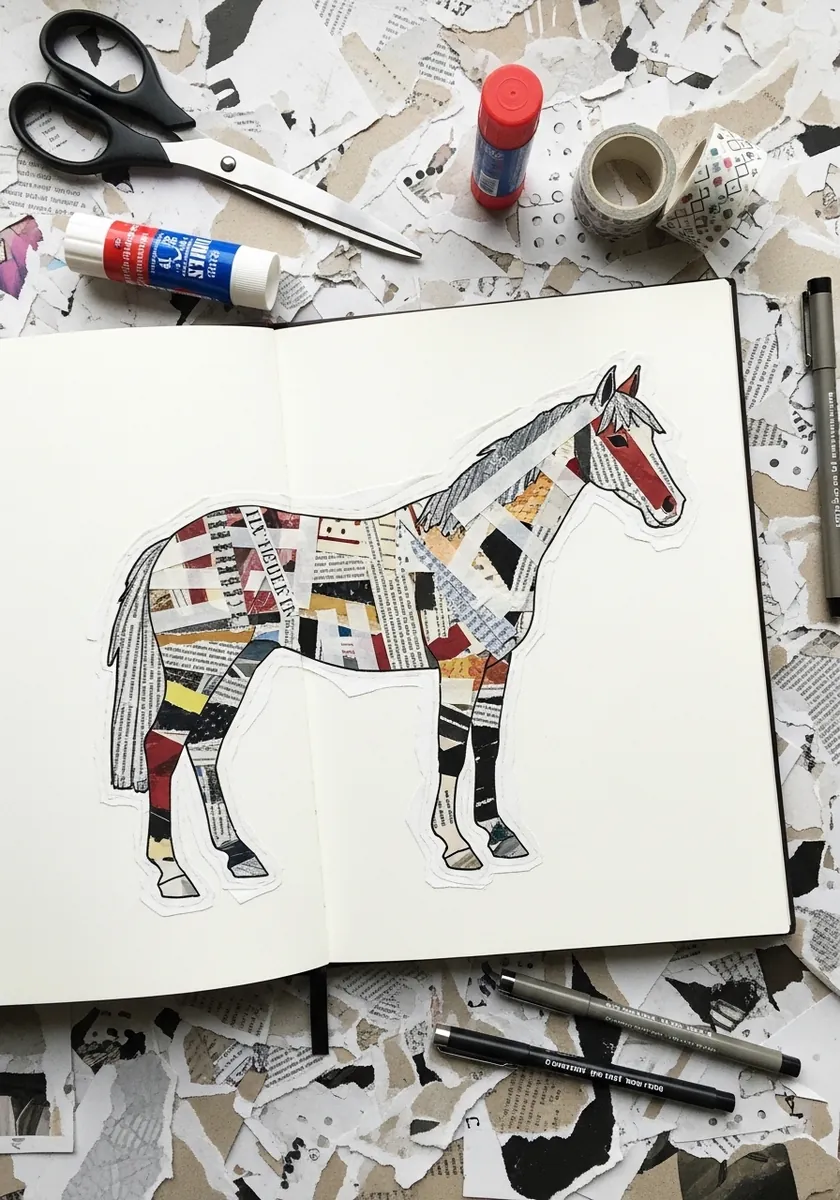
Collage teaches value fast. You cannot blend your way out of a mistake, so sort your torn scraps into three piles by lightness before gluing anything down. Printed text and pattern inside each piece supply texture. A drawn version would need hours to match it.
24. Psychedelic Tie-Dye Horse
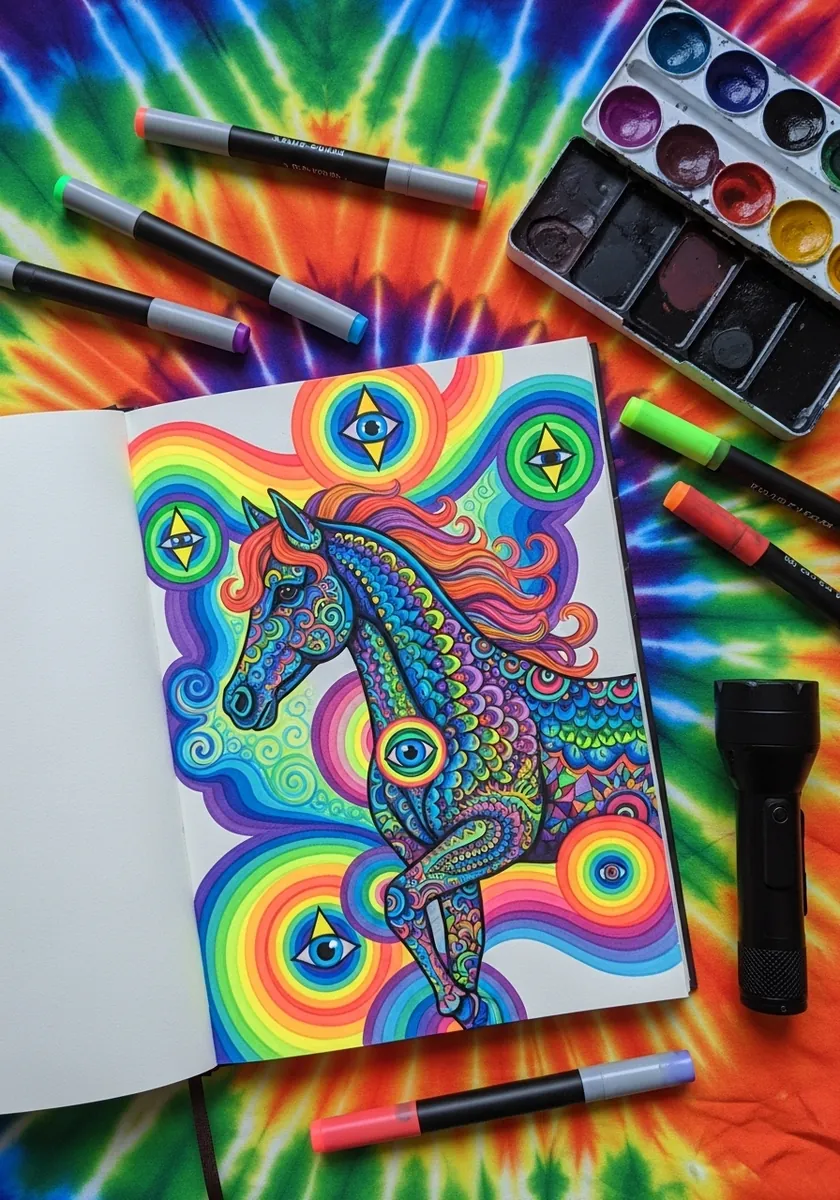
Pattern on pattern needs one separating device. Ring the entire horse with a dark outline so the swirls on the body never merge with the swirls behind, and keep the internal patterns rotating around the shoulder and haunch. Concentric rings suit the round haunch particularly well.
25. Graffiti Spray Paint Horse
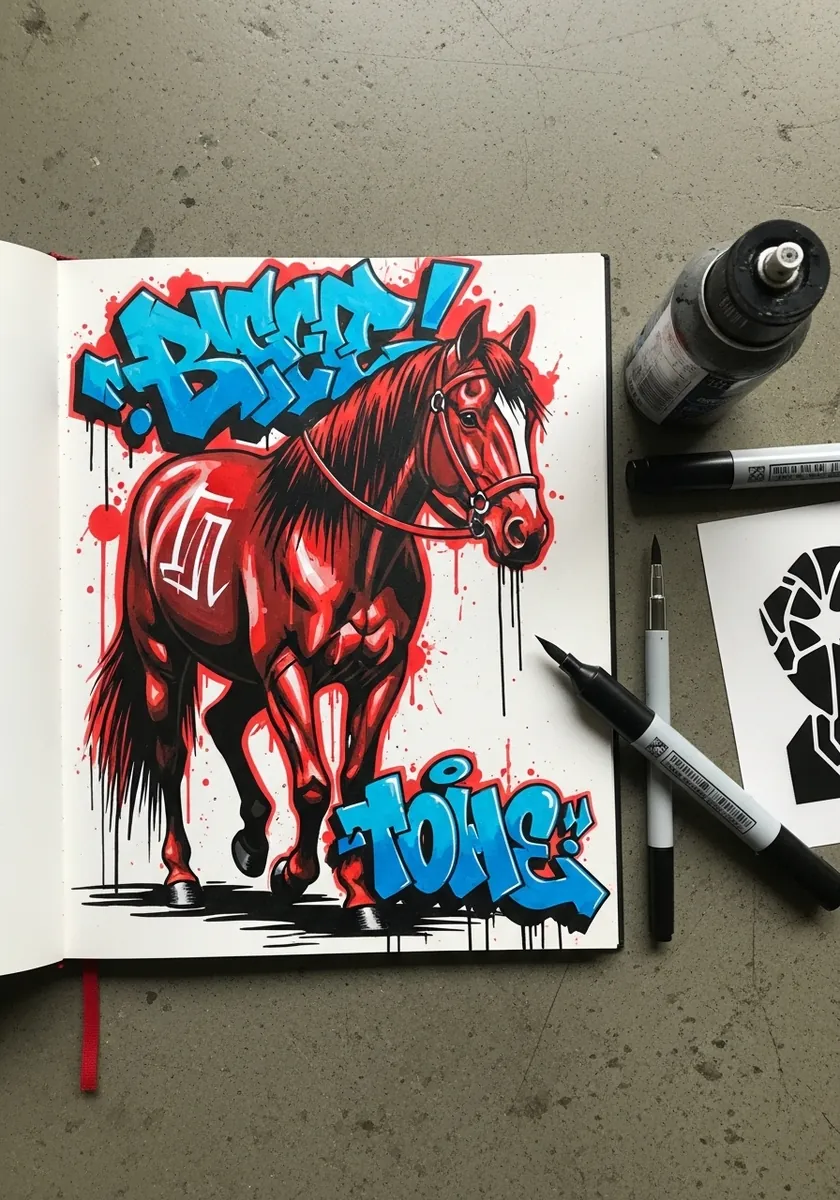
Wall styles rely on layers reading in the correct order. Lay the flat body color, add the black outline over it, then a bright keyline outside the black, and finish with the tag on top of everything. Drips belong under the lowest edges only.
26. Vintage Engraving Style Horse
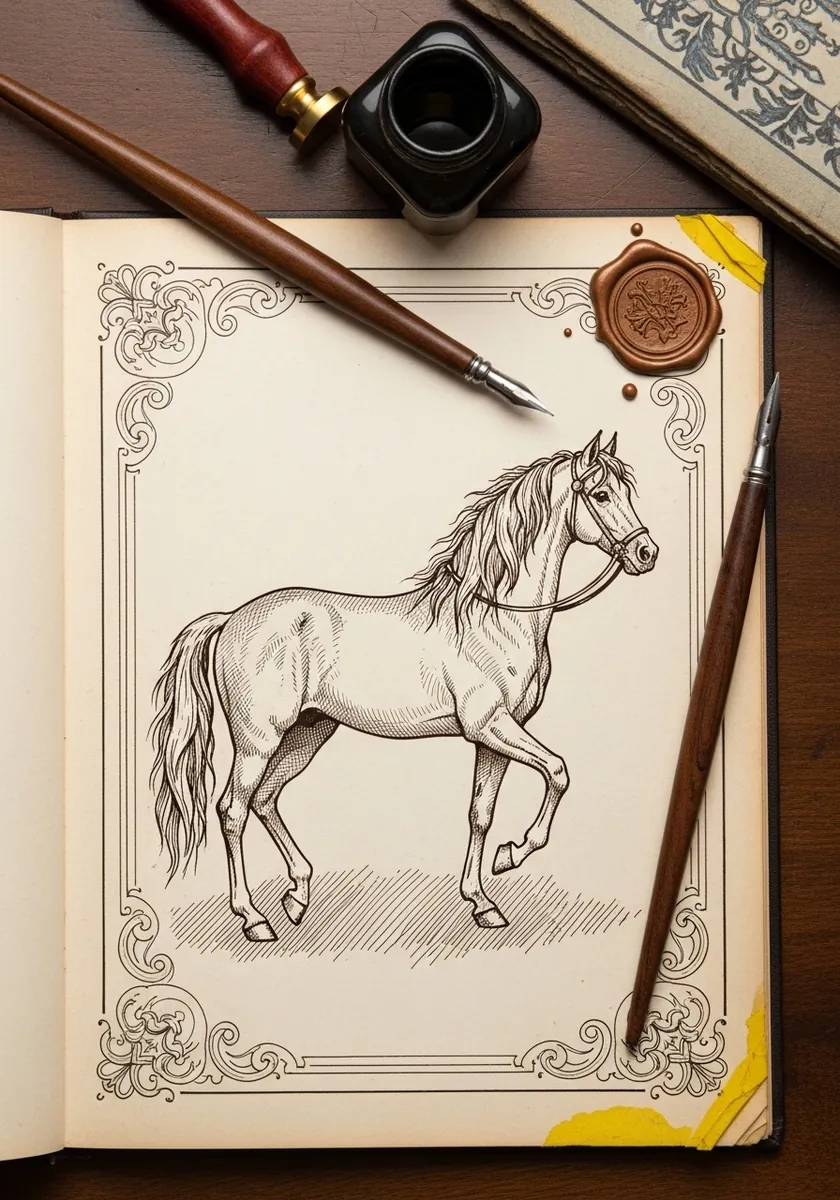
Engraving builds tone entirely from parallel lines that curve with the form. Run your hatching around the barrel like contour lines on a map, cross-hatch only in the deepest shadow, and keep the surrounding border strictly symmetrical so it reads as a printed plate.
27. Bauhaus Flat Color Horse
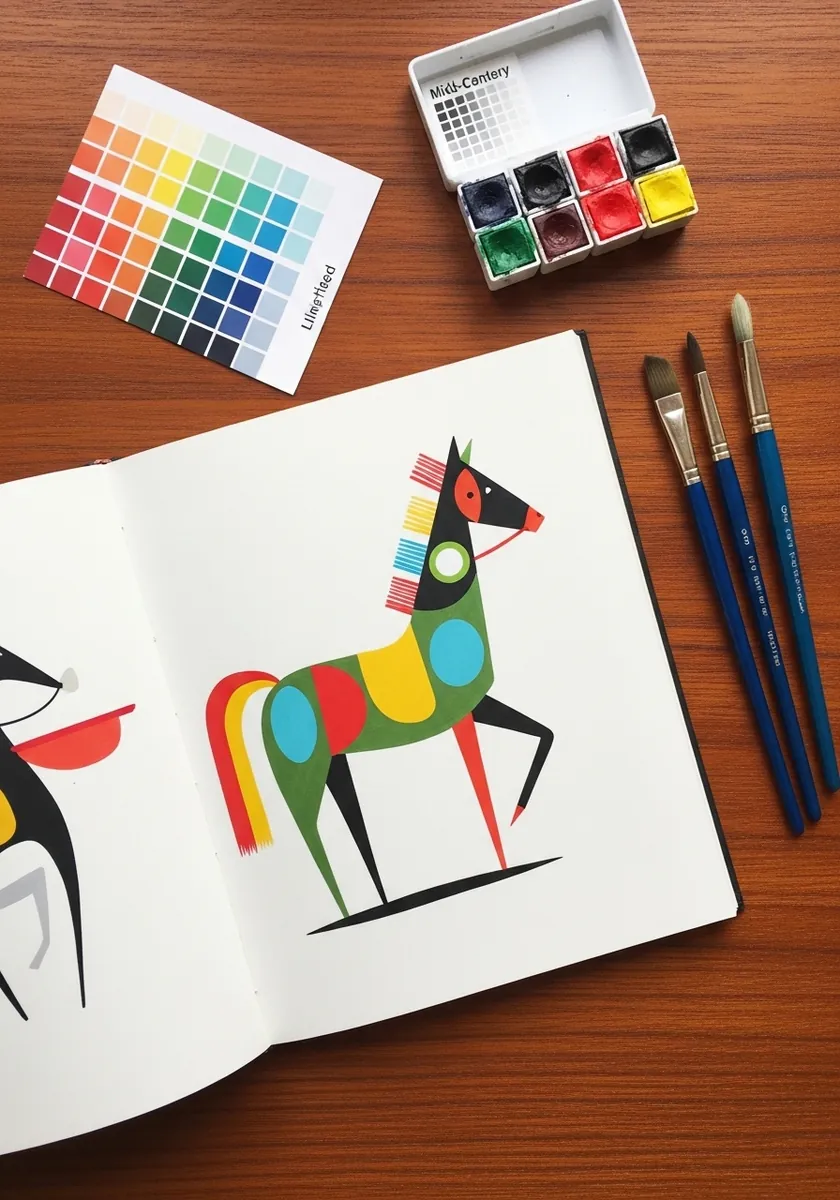
Modernist reduction means each body part becomes one primitive shape: circle for the haunch, rectangle for the barrel, triangle for the head, all in unmixed primaries against black. Overlap those shapes slightly rather than butting them together edge to edge.
28. Boho Horse With Feathers
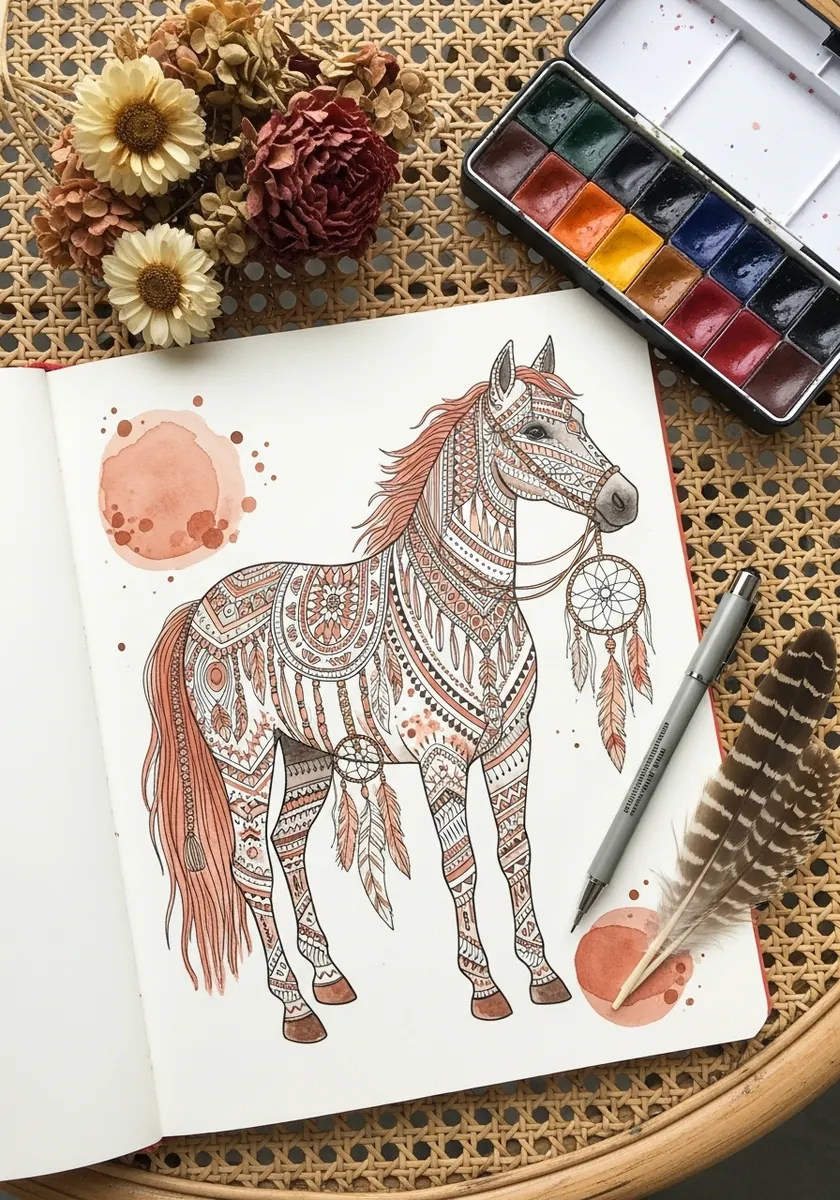
Decorative work needs breathing room somewhere. Pattern the blanket, bridle and haunch heavily, then leave the face and lower legs almost bare so the eye has a place to rest. Feathers hanging from the bridle should all fall the same direction under gravity.
29. Botanical Horse Made of Leaves
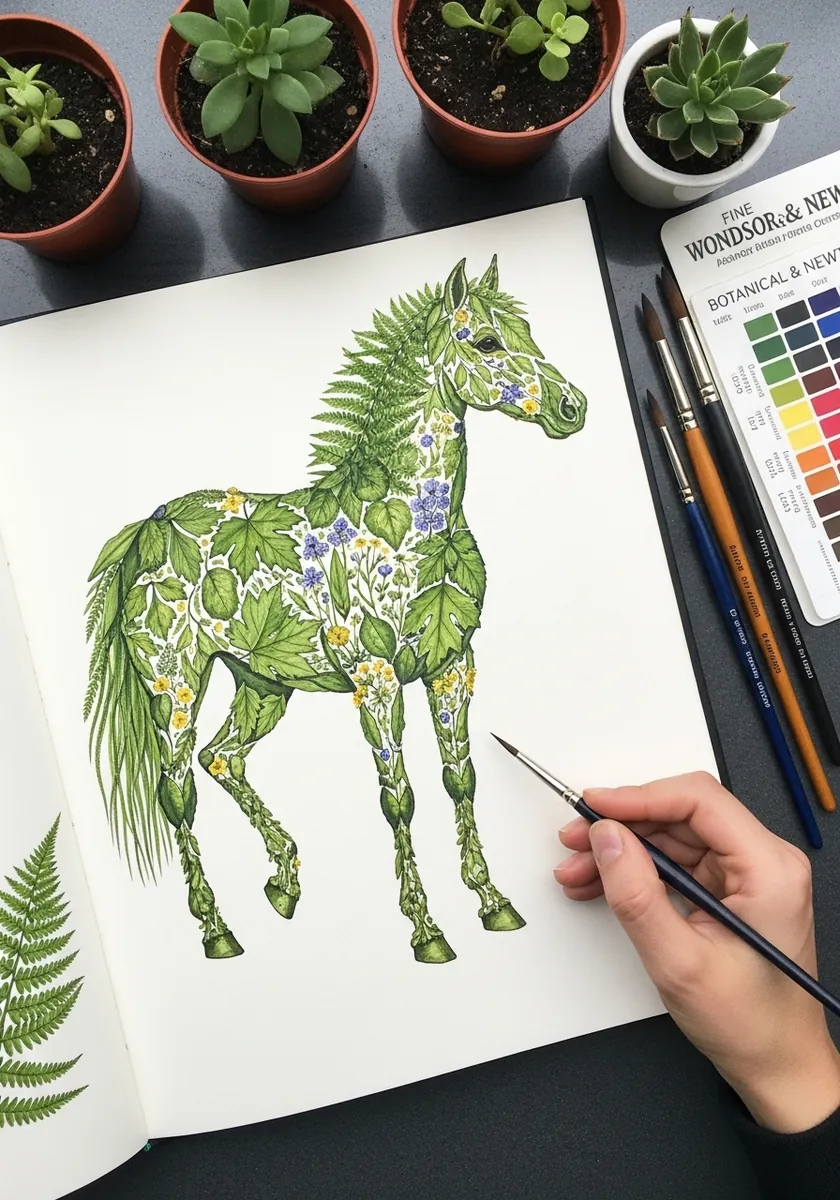
Building an animal from plants works only if the silhouette stays intact. Draw the horse in light pencil first, then grow foliage strictly inside that outline, letting a few leaf tips break the edge at the mane and tail where a soft boundary is natural anyway.
30. Floral Wreath Horse Portrait
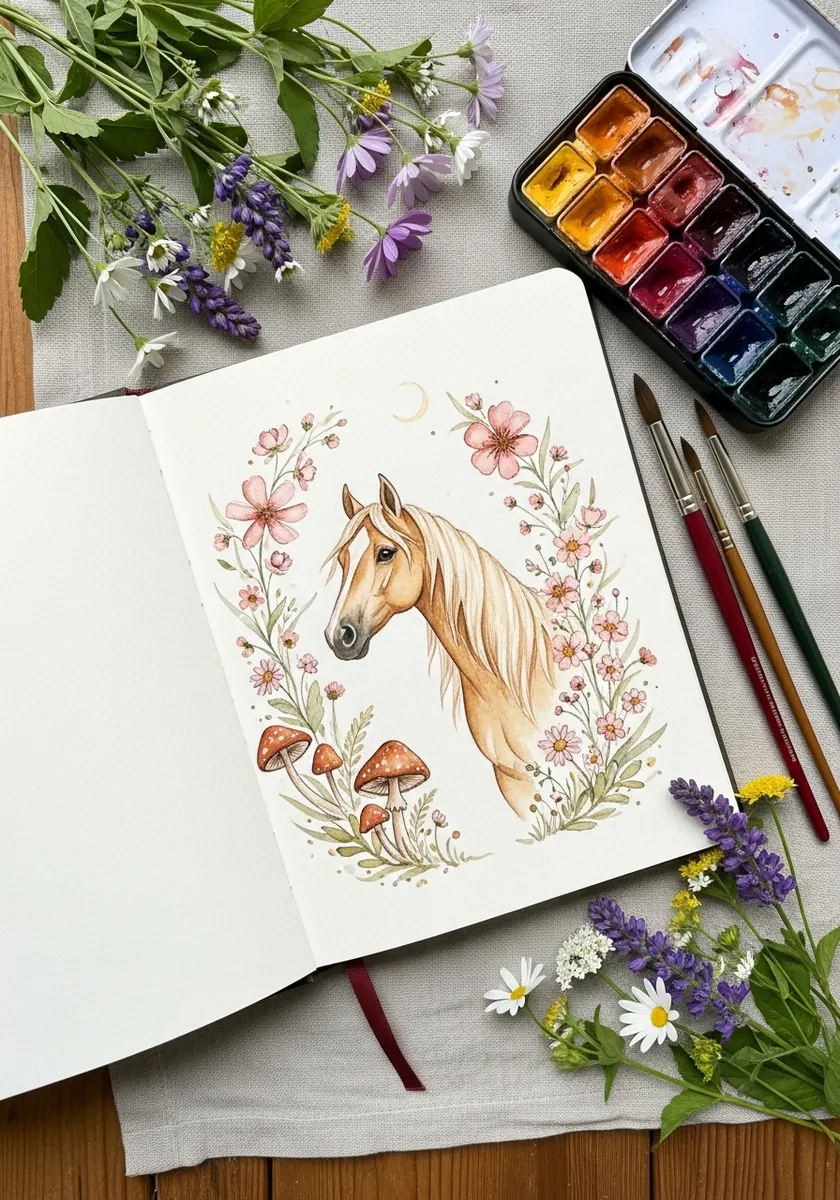
Wreath compositions need an uneven distribution or they look like clip art. Cluster the blooms heavily at two opposite points of the circle and let the rest thin out to single leaves. Keep the horse itself paler than the flowers so it stays the calm center.
31. Rose Gold Ethereal Horse
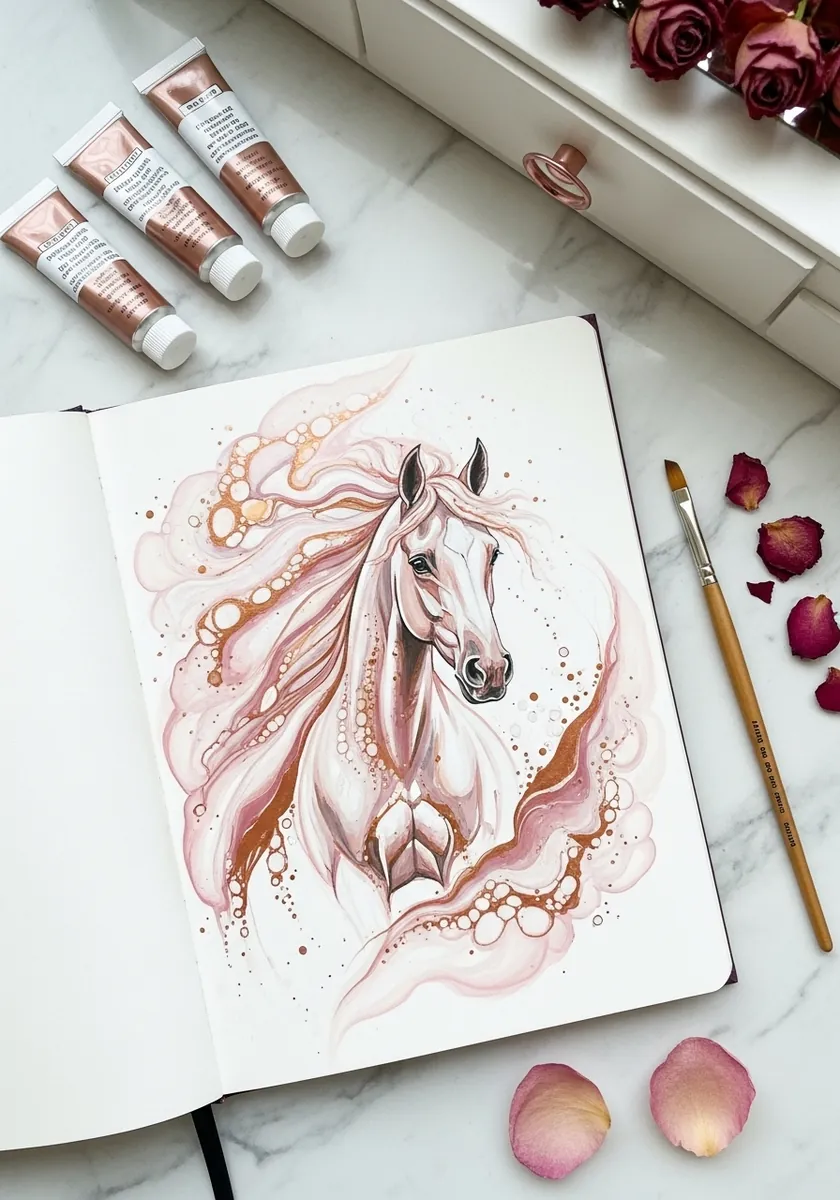
Metallic ink reads as metal only when everything around it stays matte. Keep the washes soft and unsaturated. Apply gold sparingly along the crest of the neck and in scattered dots. Smooth hot press paper keeps the metallic particles sitting up on the surface.
32. Calligram Horse Made of Script
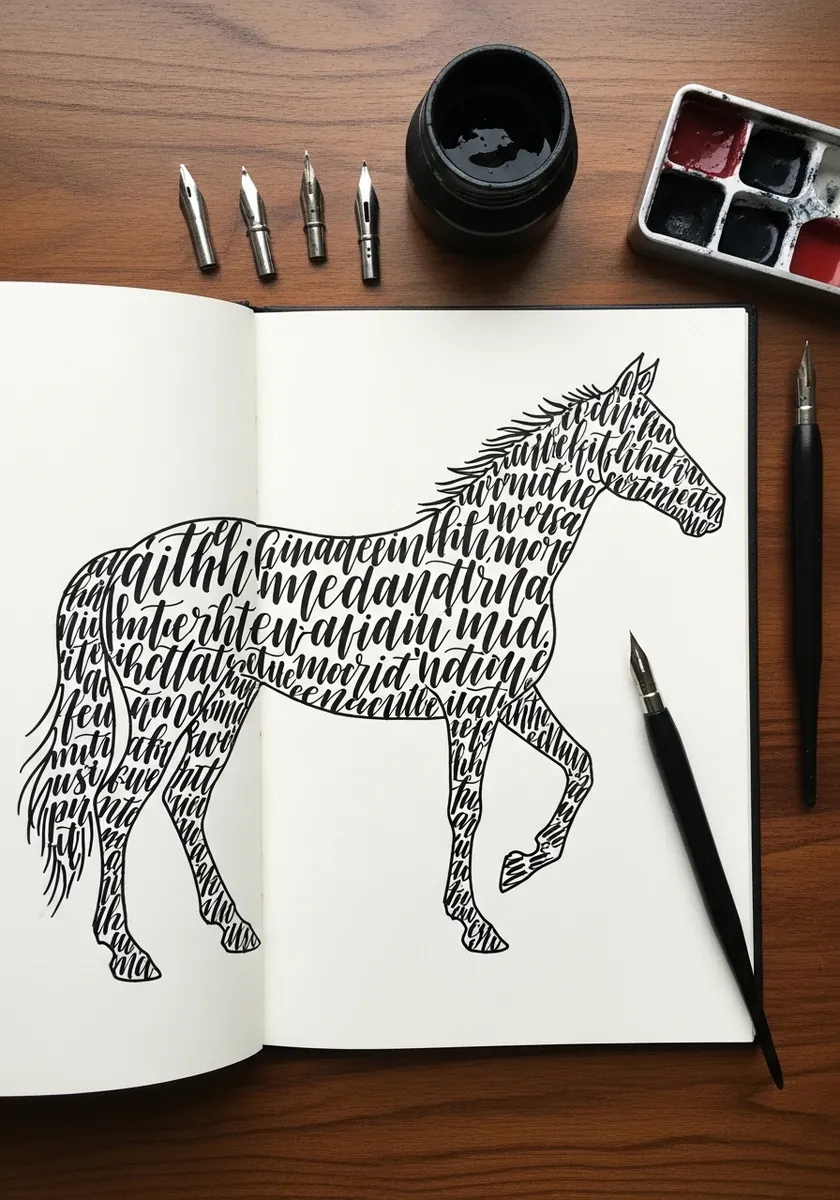
Text as texture needs consistent letter height to read as one tone. Rule faint guidelines that curve around the body, write smaller where the shadow deepens, and let the words run in the direction the coat hair grows. Legibility matters less than even density here.
33. Neo-Traditional Tattoo Flash Horse
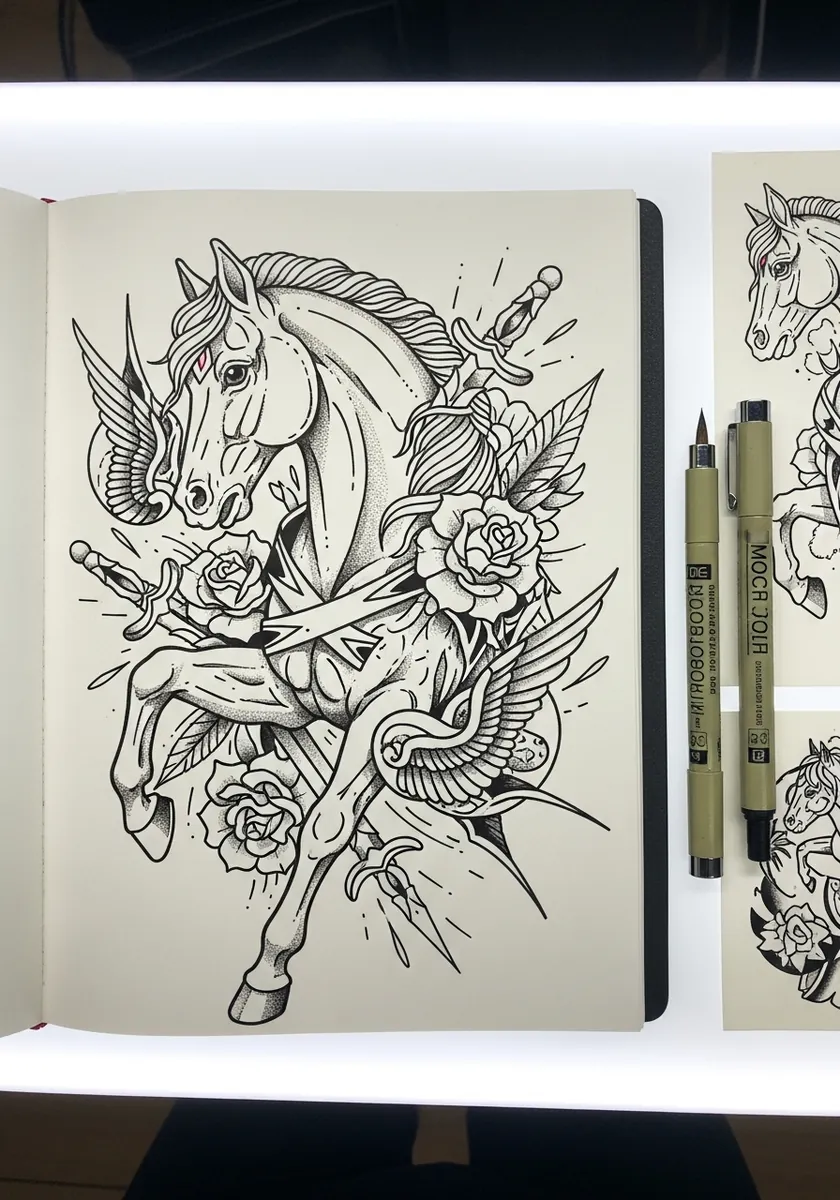
Flash design is built for readability at small size. Use a bold uniform outline, keep the black shading in solid patches rather than gradients, and make sure the silhouette works when squinted at. Roses and dagger should overlap the horse, never float beside it.
34. Marker Study of a Galloping Horse
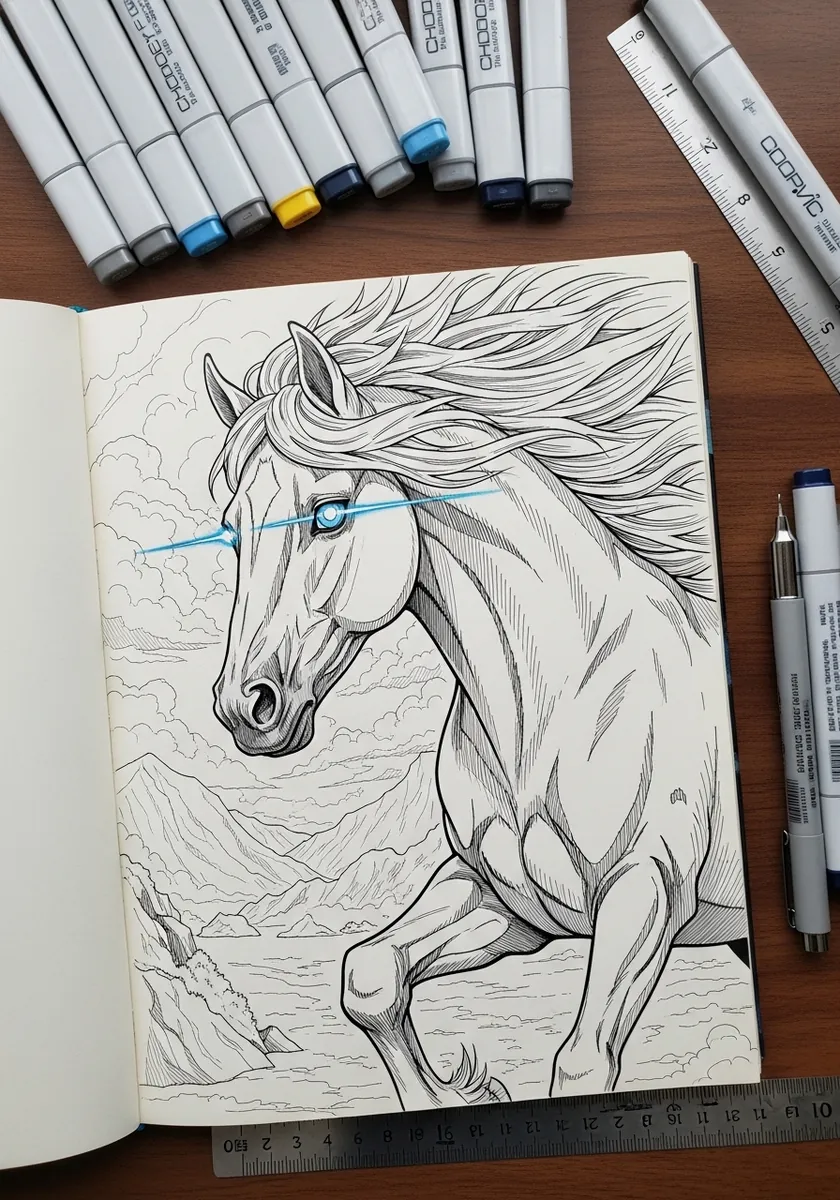
Leaving a drawing partly unrendered is a legitimate choice. Finish the head and neck fully, then let the marker work fade out along the hindquarters into bare line. That contrast pulls attention exactly where you want it and takes half the time of a full render.
35. Fine Line Horse in Motion
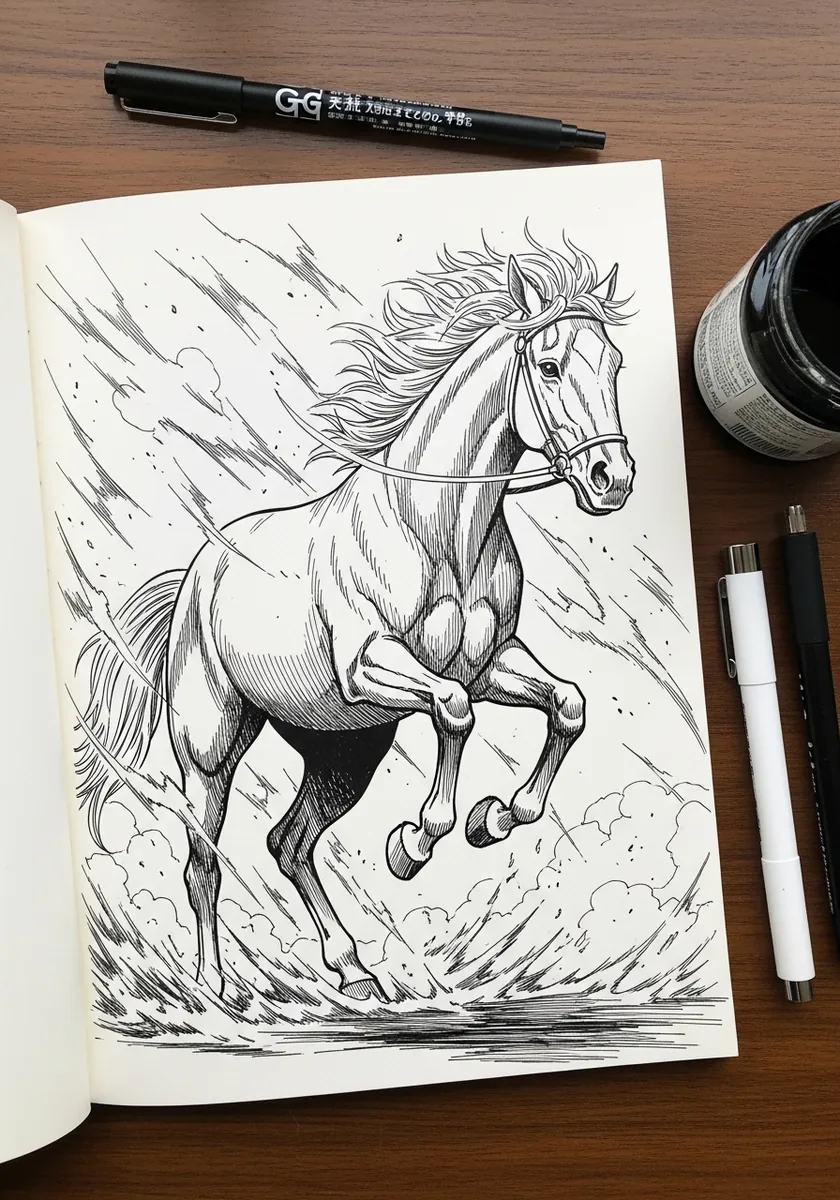
Hatching direction carries the form entirely in pen work, so curve every stroke around the barrel, run them lengthwise down the legs and let them radiate outward through the mane. Avoid cross-hatching on the light side, since ink cannot be lightened afterward.
36. Cartoon Smiling Horse in Marker
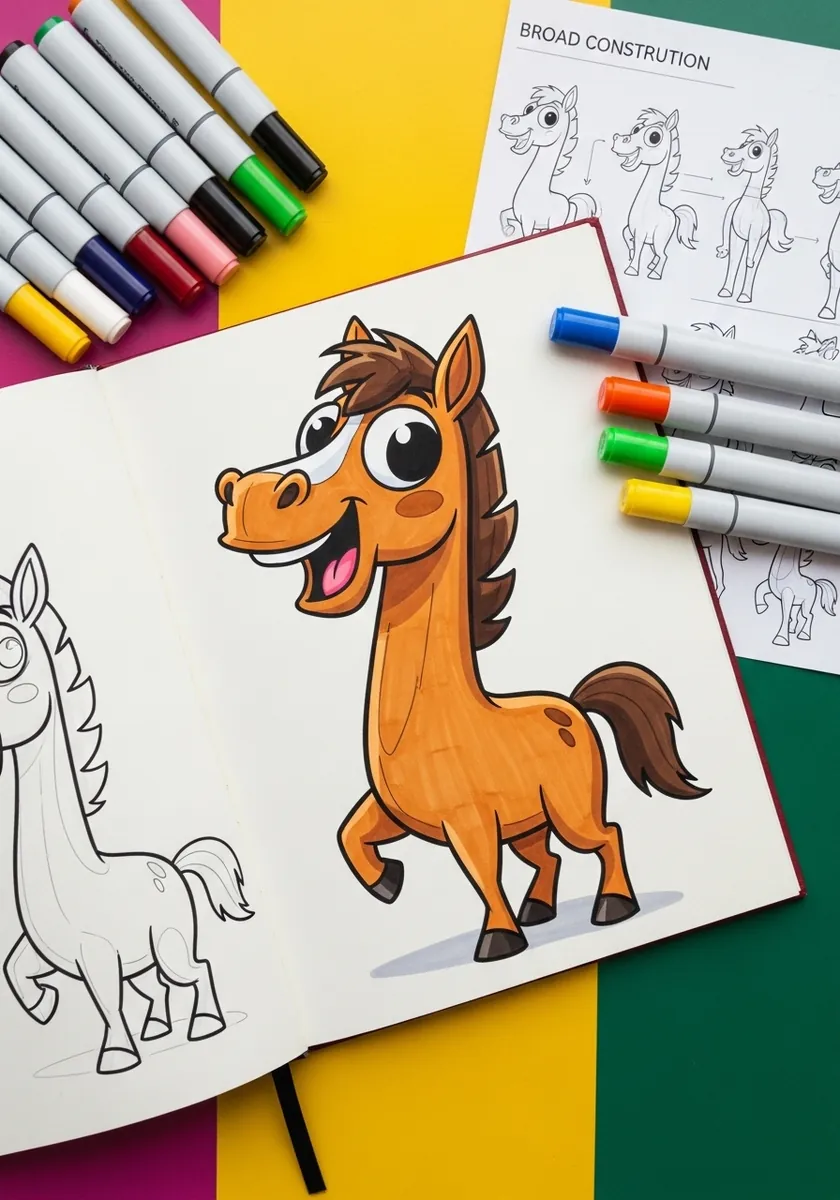
Cartooning a horse means shortening the muzzle and enlarging the eyes, which are naturally on the side of the head. Bring both eyes to the front, exaggerate the leg joints into simple bends, and keep the mane as three or four bouncy flag shapes.
37. Zentangle Patterned Horse
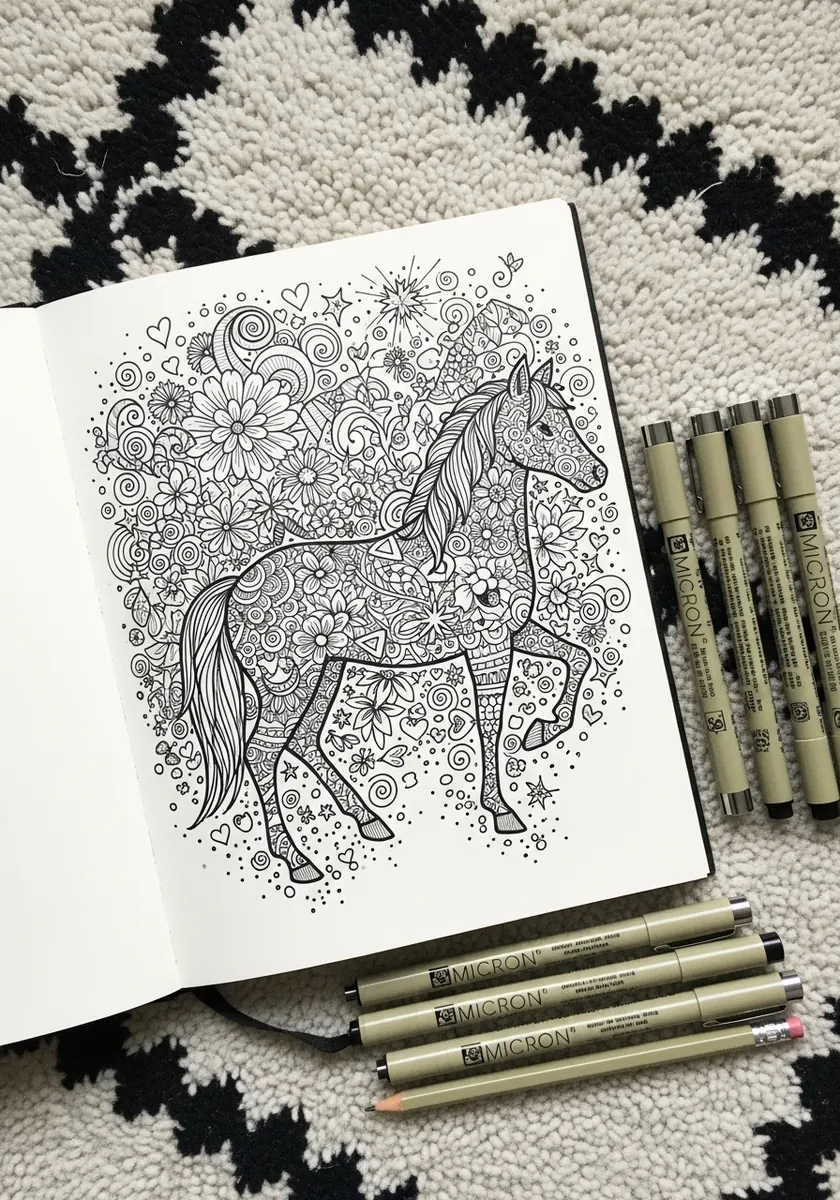
Dense pattern still needs an underlying value structure. Divide the horse into zones and give each a distinct motif, packing your patterns tighter along the underbelly and behind the legs. This is the same discipline used in zentangle watercolor work.
38. Scandinavian Folk Dala Horse
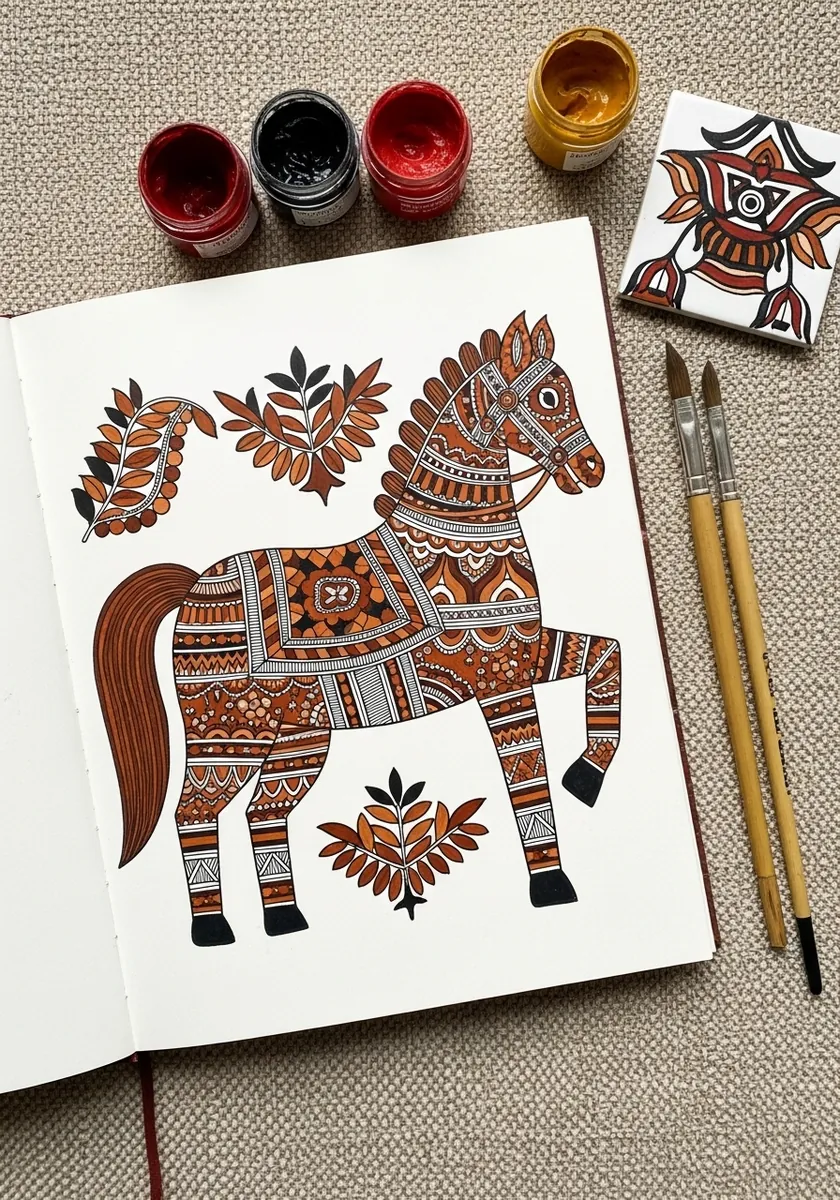
Folk painting follows fixed rules, and copying them faithfully is the point. Keep the body a single flat color, apply the strokework symmetrically on both sides, and load your brush so each petal stroke tapers naturally. Improvised asymmetry breaks the tradition immediately.
39. Minimal Line Horse Study
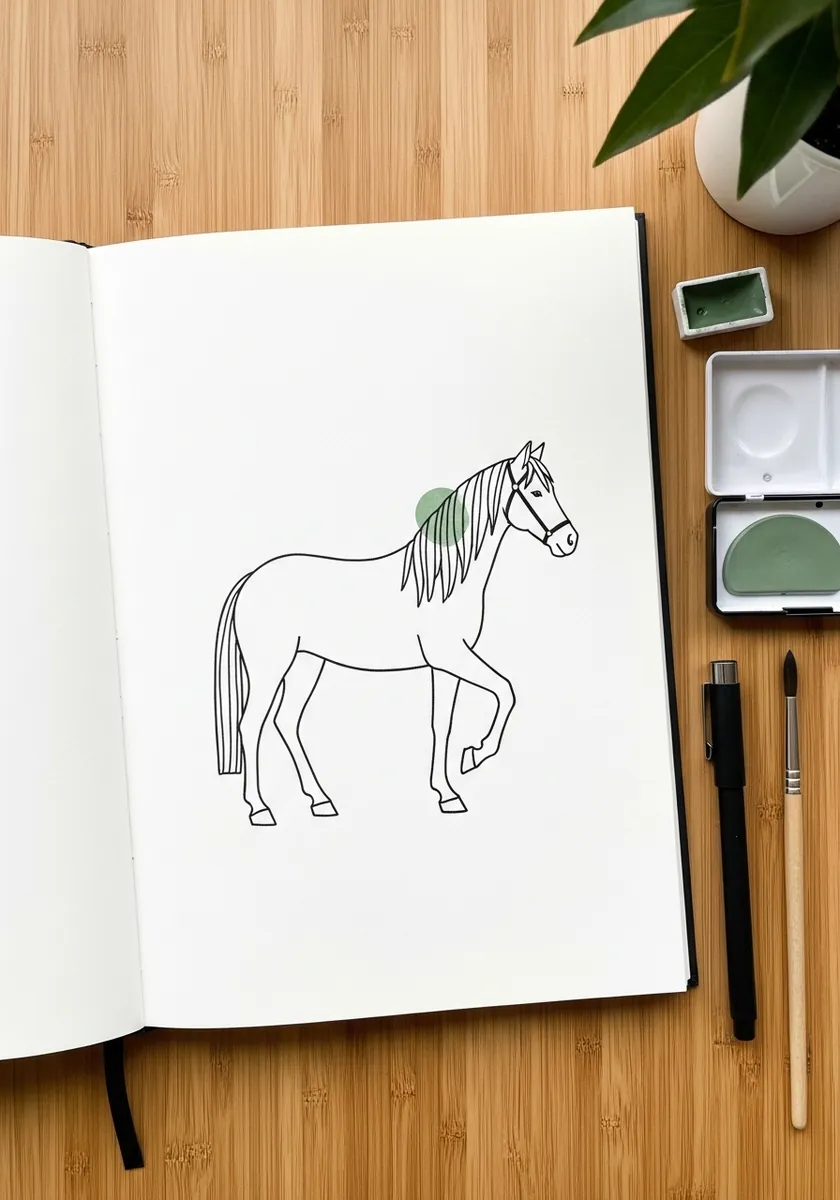
Small drawings force economy. Give yourself perhaps fifteen lines in total. Spend most of them on the topline and the legs, and let one spot of color in the mane carry the interest. Working small is also the fastest way to test a pose before committing.
40. Mixed Media Collage Horse
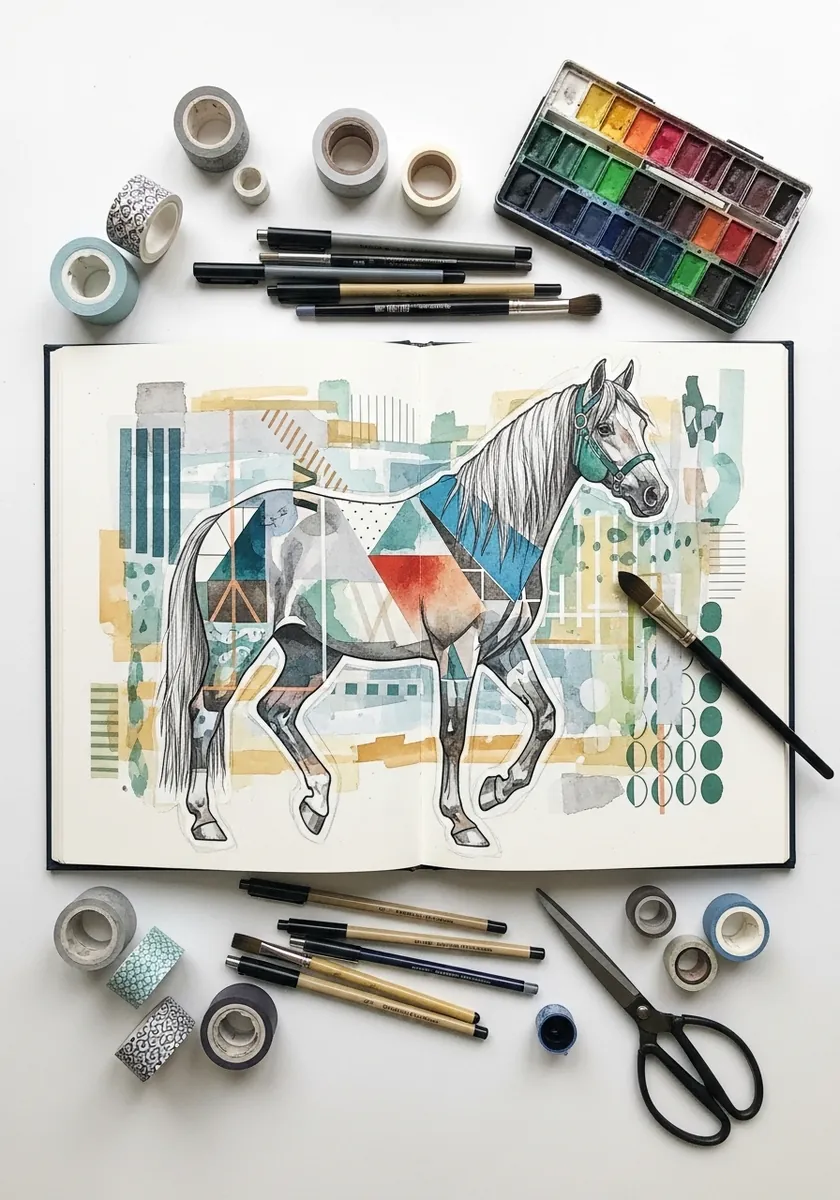
Mixing media works when one element stays representational. Draw the horse carefully in graphite, then lay flat geometric paper and tape shapes across and behind it, keeping them all in one narrow color family. Let a few strips cross the animal so the layers genuinely interlock.
Frequently Asked Questions
How do you draw a horse for beginners?
Start with two circles, one for the chest and one for the hindquarters, and connect them with the barrel of the ribcage. Add the neck as a wedge, the head as a long block with a rounded muzzle, then place the legs last, using joint positions rather than outlines.
Why do horse legs look wrong in most drawings?
Because people draw them as human legs. The forward-bending joint high on the front leg is a wrist, and the joint that bends backward on the hind leg is the heel. What looks like a long shin is actually a single elongated toe bone.
How do you draw a horse in motion?
Work from the spine outward. Draw a curved line of action through the neck and back first, then hang the legs off it in diagonal pairs. At a full gallop the legs gather under the body and all four hooves leave the ground at once.
What is the easiest horse pose to draw?
A standing side view with the near foreleg slightly forward. It shows the full silhouette, avoids foreshortening completely, and lets you check proportions against the simple rule that a horse is roughly as tall at the withers as it is long from chest to rump.
How do you shade a horse’s coat?
Follow the hair direction, which swirls at the flank and shoulder rather than running straight. Keep your strokes short and layered, leave the paper untouched along the top of the back and haunch, and let the darkest values sit under the belly and inside the legs.
References and Further Reading