A jellyfish reads correctly when three parts stay separate: a smooth bell, four or more thick frilly oral arms hanging from its center, and fine tentacles trailing from the bell rim. The tentacles always lag behind the direction of travel.
Key takeaways
- Oral arms are thick and frilly and hang from the center of the bell; tentacles are fine and hang from its rim.
- Because the bell pulls the animal along, tentacles always trail behind the direction of motion.
- Real jellyfish bioluminescence is blue-green, near 470 to 490 nanometers, since that light travels furthest in seawater.
- Glow needs a dark ground: the paper does the shadow work and you only draw the light.
- A jellyfish is roughly 95 percent water, so almost nothing inside it should be opaque.
Dive into the enchanting world of jellyfish drawing, where graceful tentacles and glowing bells offer a canvas for your creativity. Exploring these ethereal creatures on paper is a beautiful way to enhance your artistic skills and express your unique vision.
From simple line art to complex, vibrant masterpieces, drawing jellyfish can improve your handling of form, light, and fluid motion. Let these ideas guide you as you capture the mesmerizing dance of the ocean’s most mysterious wonders.
How do you draw a simple minimalist jellyfish?
A simple minimalist jellyfish drawing focuses on clean lines and basic shapes to capture its essence. The best way to start is with a simple dome or semi-circle for the bell, keeping the shape smooth and uncluttered.
- Use single, continuous lines to draw long, flowing tentacles. Vary their length and curve to create a sense of gentle movement.
- Focus on negative space to define the jellyfish’s form against the background. This technique adds elegance and sophistication to your artwork.
- Limit your color palette. A single color, like black ink on white paper or white on a dark background, enhances the minimalist aesthetic.
- Avoid adding excessive details. The beauty of a minimalist drawing lies in its simplicity and the power of suggestion.
What are some creative fantasy jellyfish drawing ideas?
To create a fantasy jellyfish, combine its natural form with imaginative elements from other worlds. The key is to blend the familiar jellyfish silhouette with magical, surreal, or futuristic details for a truly unique piece of art.
- Imagine a cosmic jellyfish drifting through space. Replace its bioluminescence with swirling galaxies, stars, and nebulae inside its bell.
- Create a floral jellyfish by drawing petals instead of a bell and using vines or stems for tentacles, adorned with leaves and buds.
- Design a biomechanical jellyfish with metallic plates, glowing wires, and intricate gears, blending organic grace with robotic precision.
- Envision a crystal jellyfish with a translucent, faceted bell that refracts light like a gemstone and tentacles made of sparkling shards.
Grab your sketchbook and let the ocean’s magic flow through your pen. Explore these ideas and share your unique jellyfish creations with a community of fellow artists.
1. Realistic Glowing Jellyfish on Dark Paper
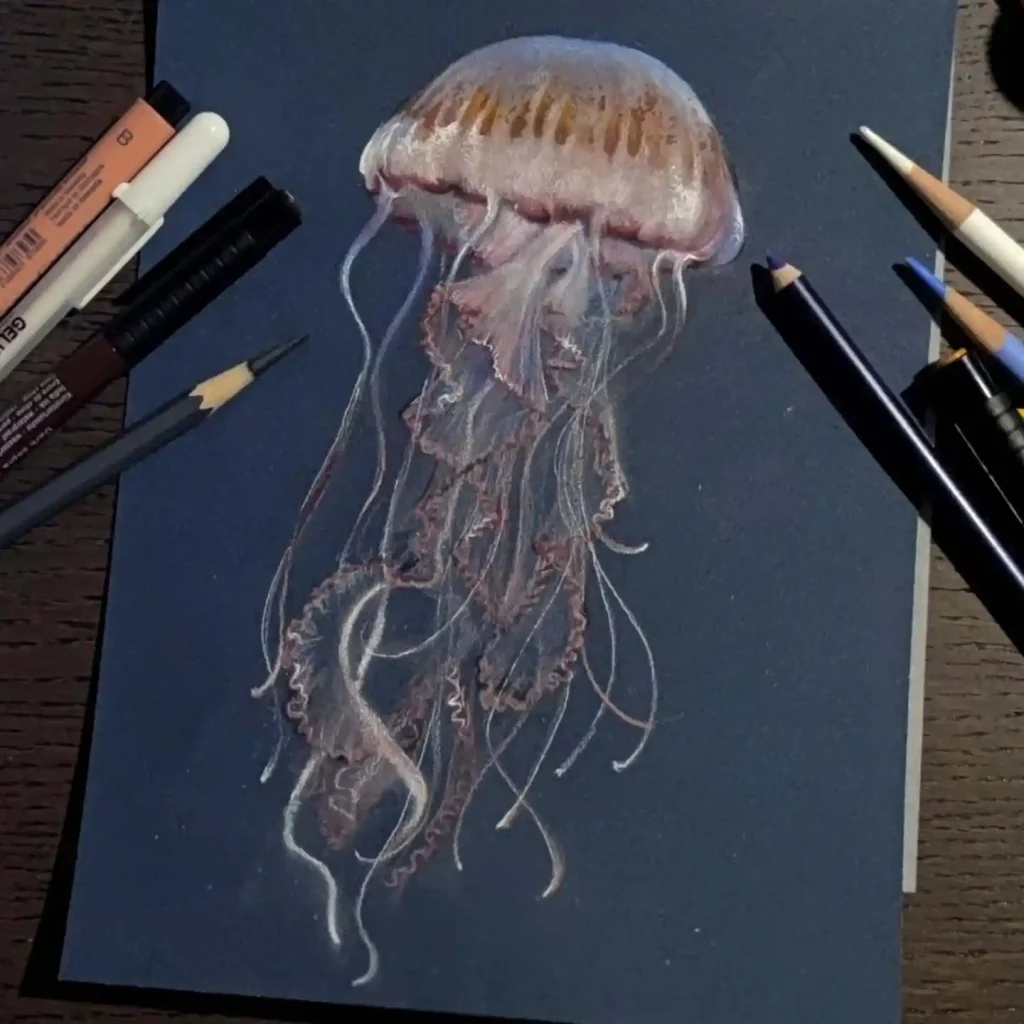
Using dark paper is the key to this stunning piece. The artist used white and light-colored pencils to make this jellyfish glow. It’s a hyper-realistic drawing, capturing the delicate, translucent body and the lacy, trailing tentacles. It feels like a quiet, bioluminescent creature floating in the deep, dark ocean.
2. Bioluminescent Jellyfish on Black Paper
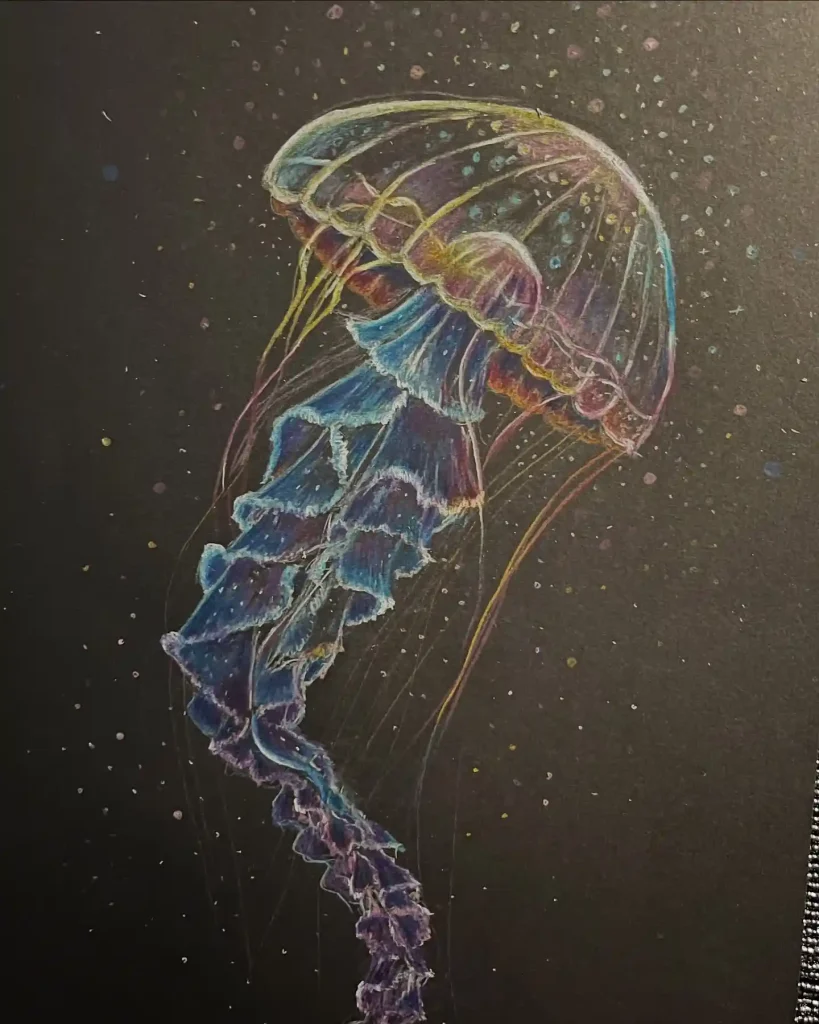
This is another beautiful example of colored pencils on black paper. This one is pure magic. The artist created a “cosmic jellyfish” with an iridescent, rainbow-colored bell. The tiny white dots surrounding it look like both air bubbles and distant stars. It’s a perfect blend of marine biology and celestial fantasy.
3. Surreal Jellyfish with Flower Tentacles on Sketchbook Paper
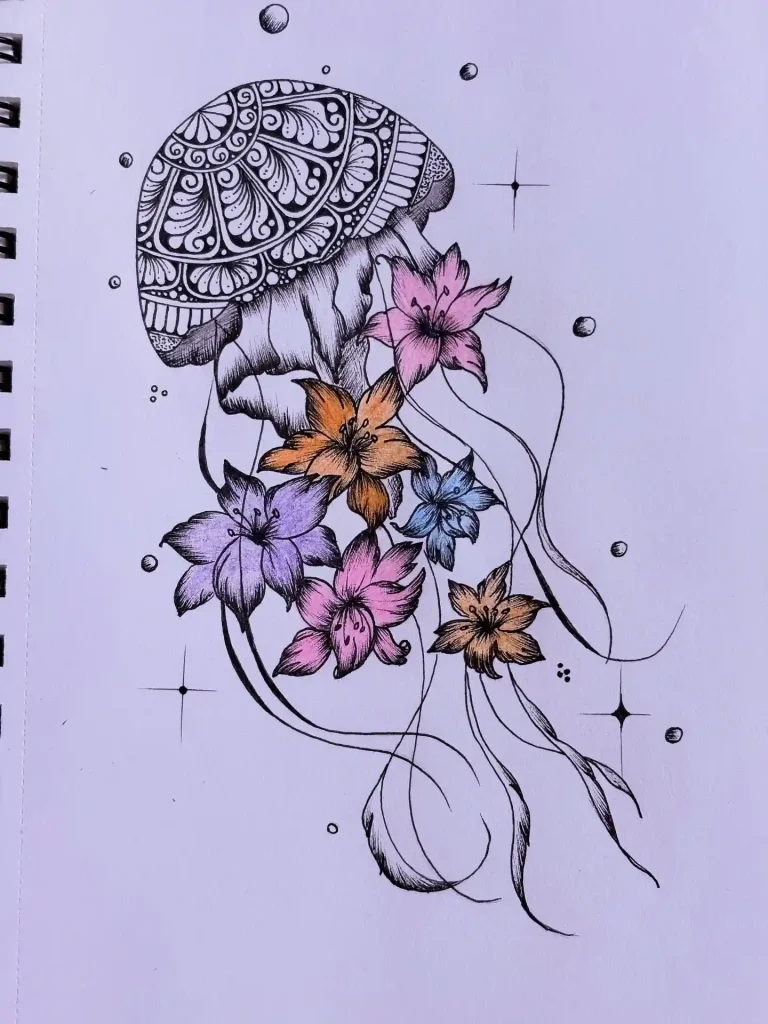
What a creative, surreal idea. This piece, done in ink, combines two different worlds. The bell of the jellyfish is a highly detailed, black-and-white mandala pattern. But instead of tentacles, colorful, blooming flowers trail below. It’s a beautiful symbolic drawing, merging the grace of the sea with the beauty of a garden.
4. Simple Jellyfish Sketch on Sketchbook Paper
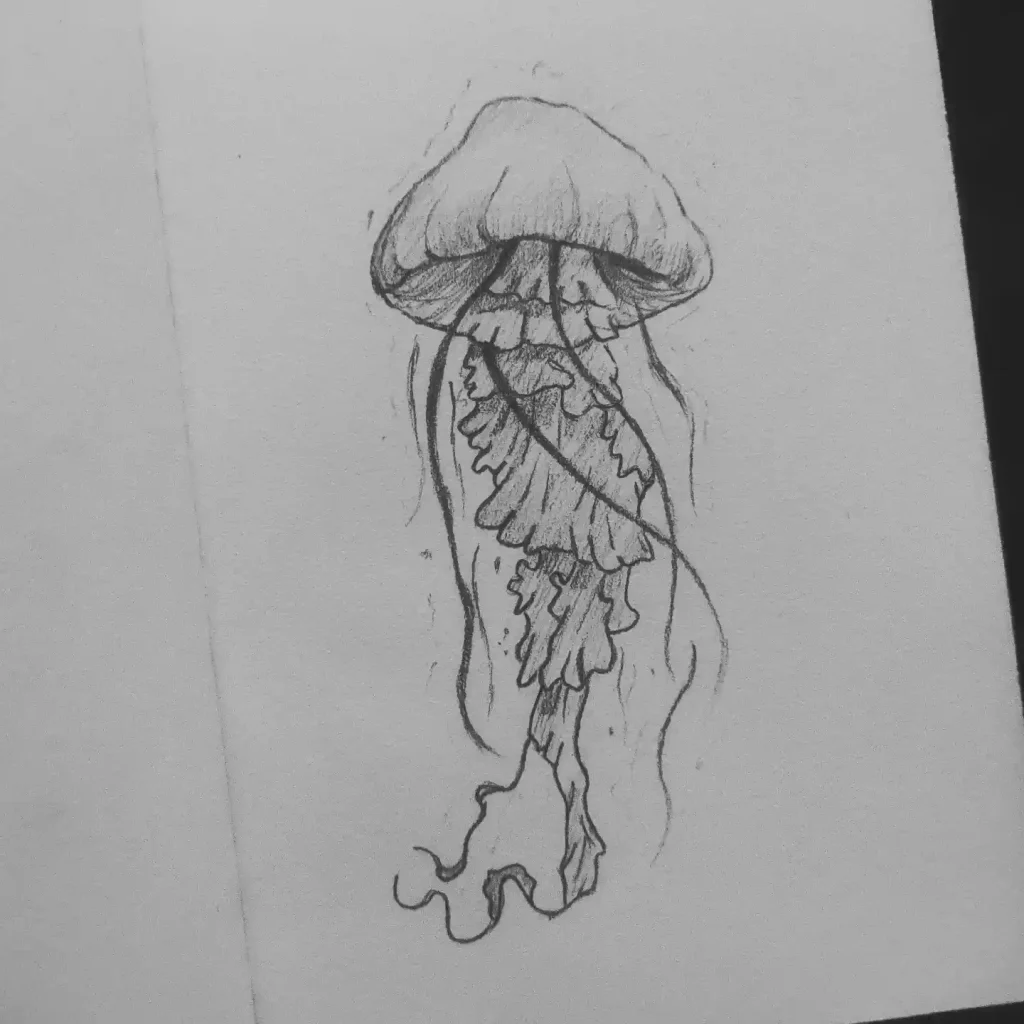
A classic graphite sketch, this is all about capturing the basic form. The artist focused on the complex, ruffled texture of the oral arms, contrasting them with the simple, smooth outline of the bell. The long, trailing tentacles are just suggested with a few quick lines. It’s a great, simple study of the jellyfish’s anatomy.
5. Magical Ink Jellyfish on Sketchbook Paper
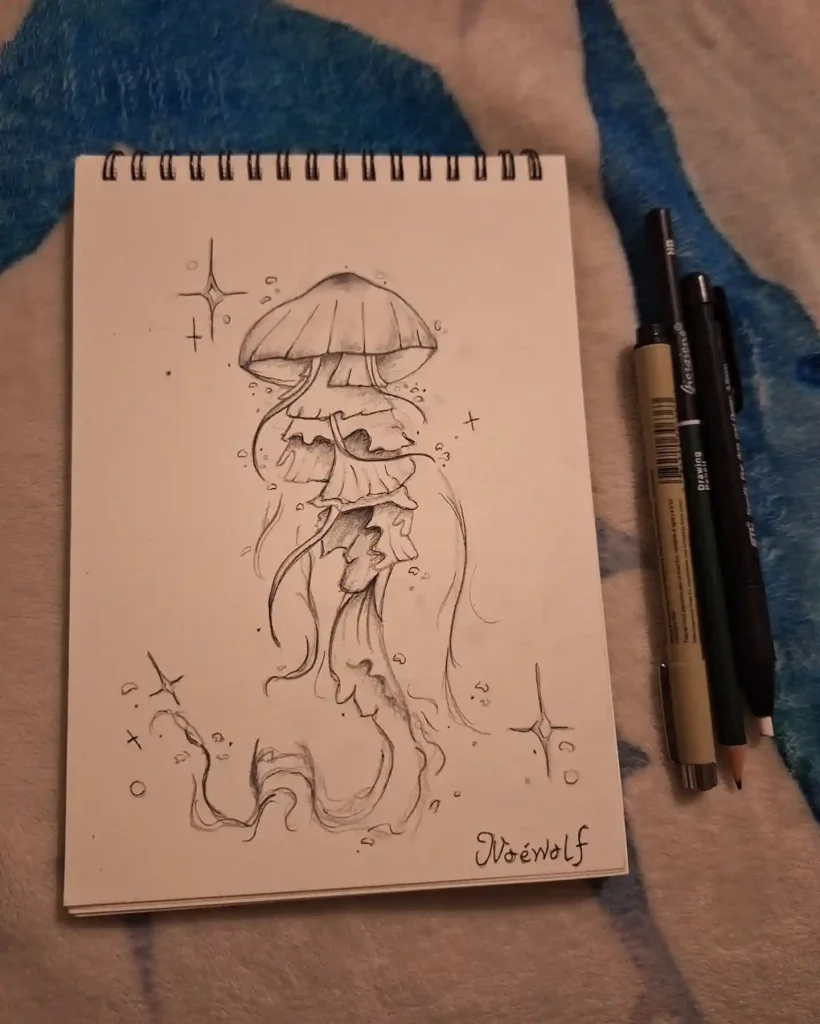
This one has a really magical, illustrative vibe. Drawn with fine-line pens, it’s a clean and simple design. The artist gave the jellyfish an almost mushroom-like, whimsical shape. The little sparkles and bubbles floating around it add to the enchanted, storybook feel. It’s a perfect, clean-lined tattoo concept.
6. Vibrant Colorful Jellyfish on Toned Paper
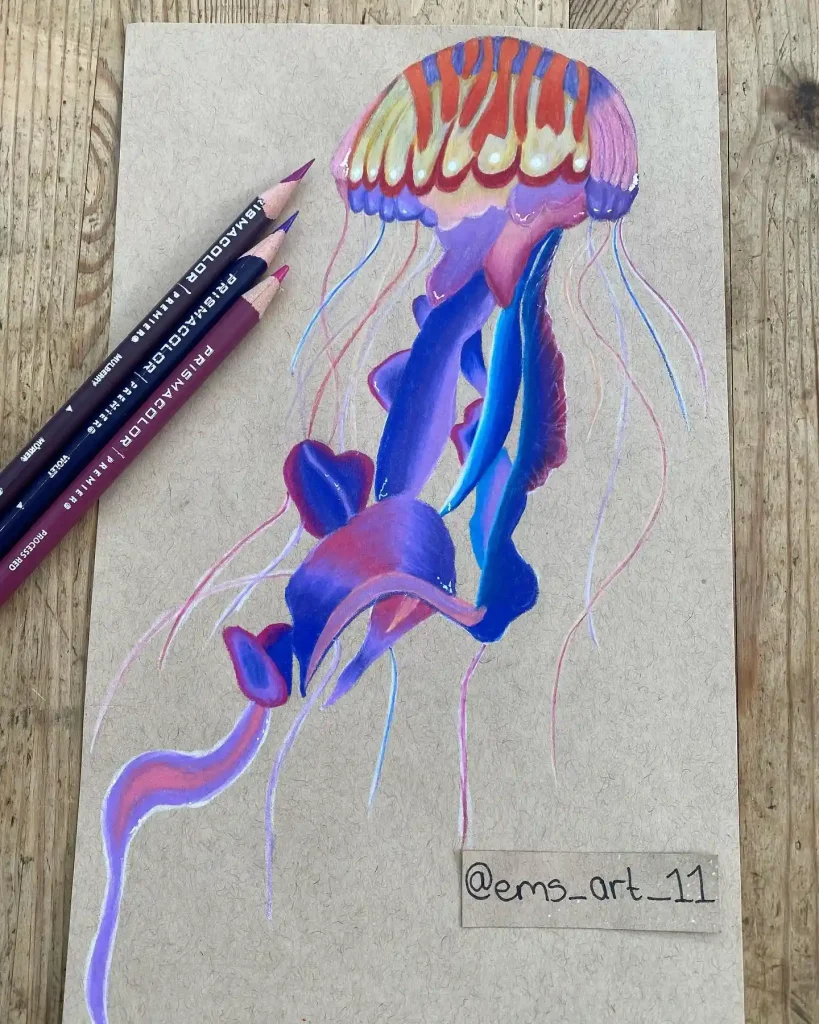
The toned paper really makes these colors explode. This artist used colored pencils to create a jellyfish with an electric, neon palette of deep purples, bright pinks, and fiery oranges. The white highlights pop like lights. It’s a fantastic study in color, sacrificing realism for pure, vibrant, psychedelic energy.
7. Detailed Ink Jellyfish on Sketchbook Paper
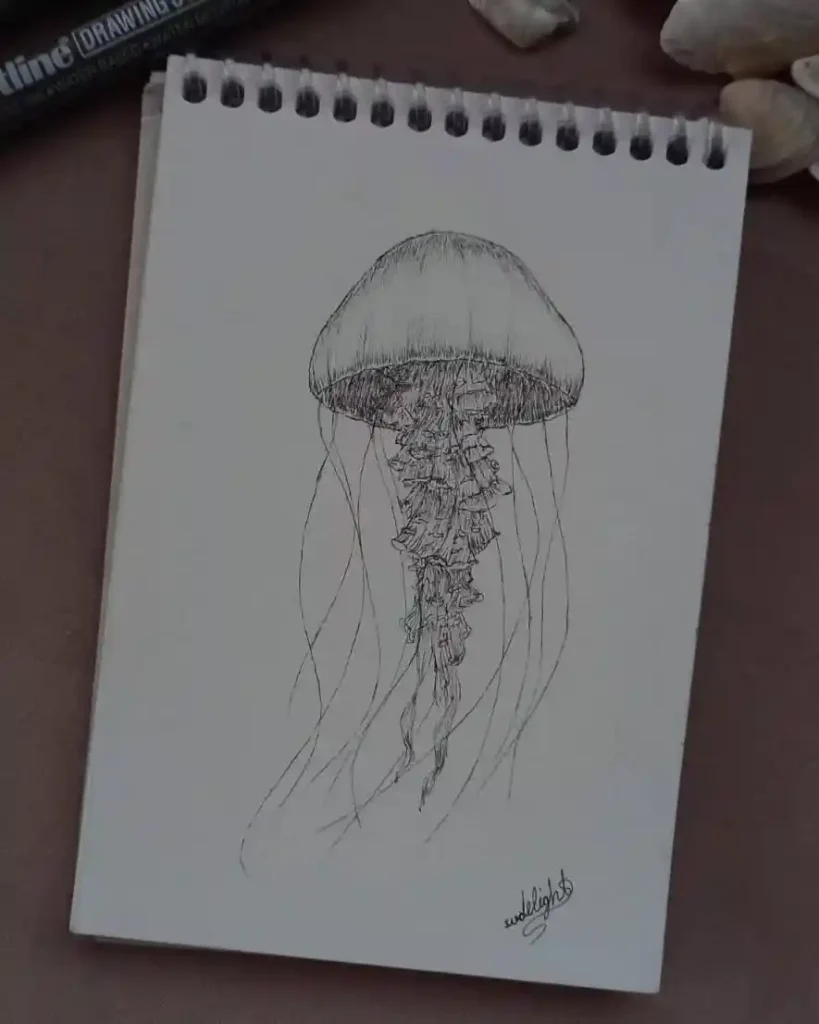
A very detailed and technical ink drawing. The artist used a fine-tipped pen to build up all the forms with hatching and cross-hatching. You can see the careful work in the shadow of the bell and the complex, lacy texture of the tentacles. It’s a very patient, realistic, and illustrative approach.
8. Minimalist Line Art Jellyfish on Drawing Paper
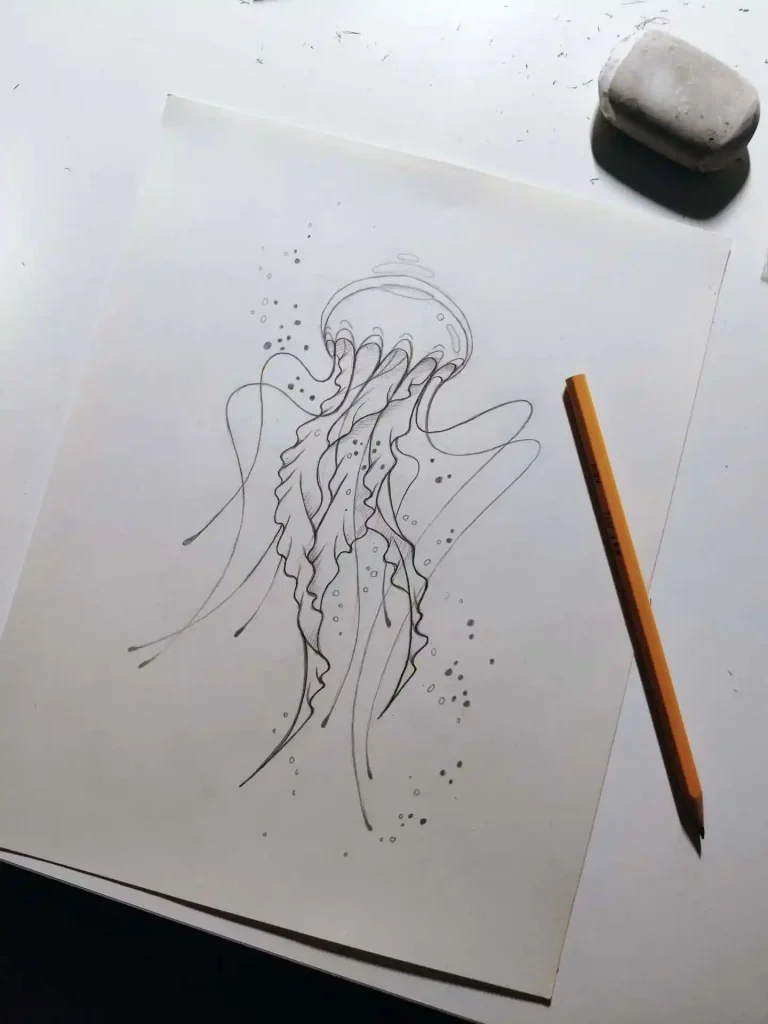
This is all about elegant, clean line art. The artist used a single pencil to create a minimalist jellyfish, focusing only on the essential outlines. The flowing, graceful lines of the tentacles are simple but perfectly placed. The little bubbles add a sense of place. It’s a “less is more” piece, symbolizing pure grace.
9. Cosmic Jellyfish Doodles on Sketchbook Paper
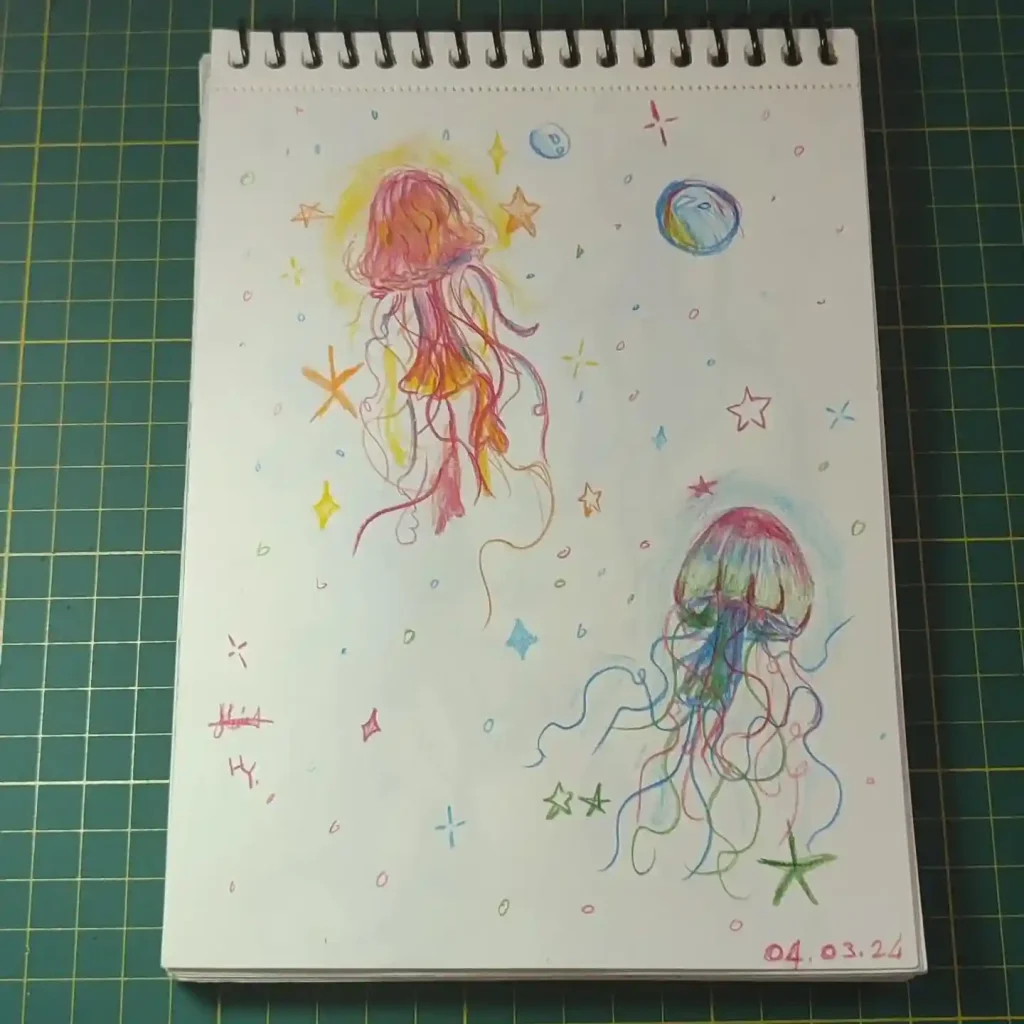
What a whimsical and playful sketchbook page. These look like “cosmic” jellyfish, floating in space instead of the ocean. The artist used warm colors for one and cool colors for the other, surrounding them with little stars and planets. It’s a very imaginative, colorful, and lighthearted doodle.
10. Soft Realistic Jellyfish on Sketchbook Paper
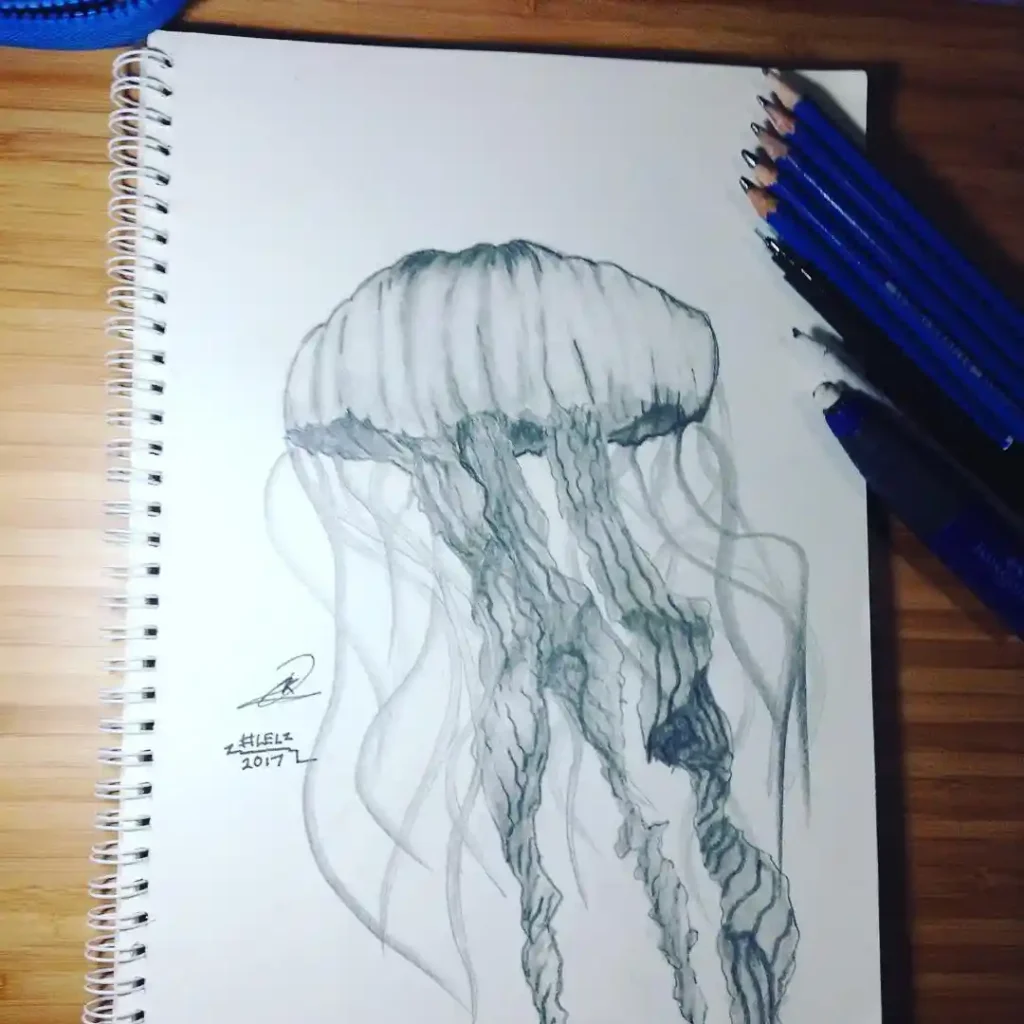
A beautiful, soft graphite drawing. The artist used a pencil and likely a blending stump to create the smooth, rounded shape of the bell. The real skill is in the tentacles, which are drawn with such a light, delicate touch they look translucent and almost fade into the paper. A great, realistic study.
11. Colorful Doodles in a Dotted Journal
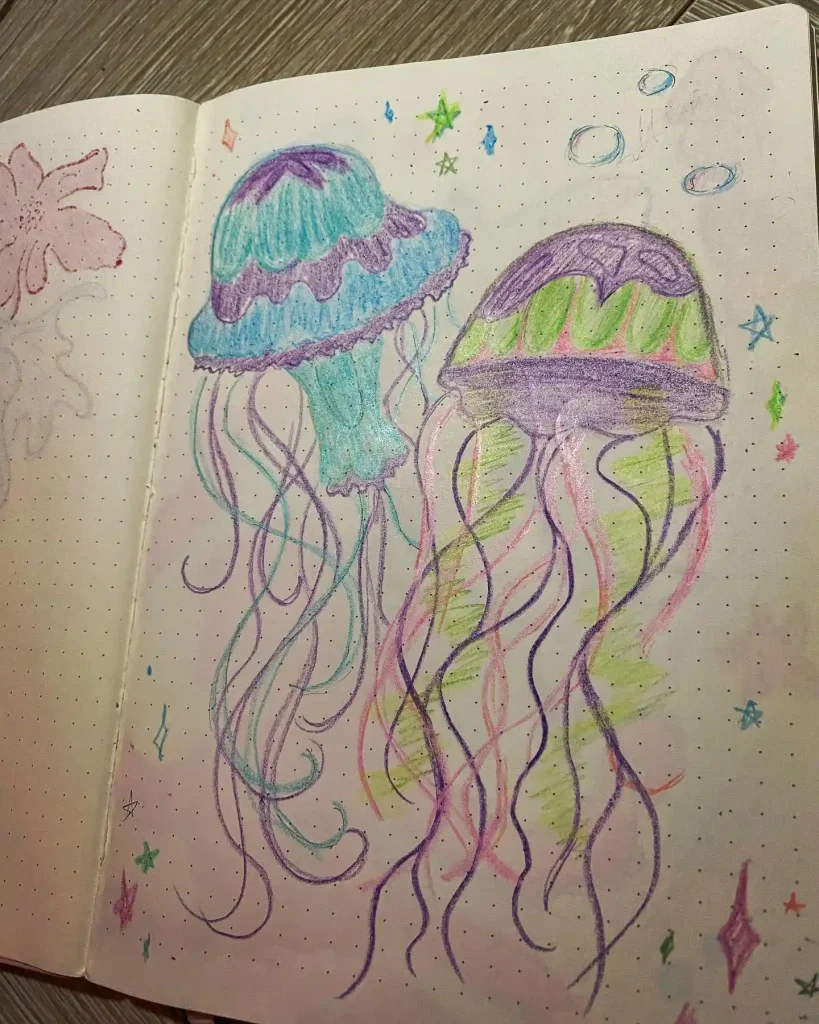
Here are some purely fun and imaginative jellyfish doodles. Using bright colored pencils, the artist filled a dotted journal page with whimsical, spacey jellies. Surrounded by little stars and bubbles, this isn’t about realism but about capturing a feeling of playful, childlike wonder and creative joy.
12. Elegant Illustrative Jellyfish on Sketchbook Paper
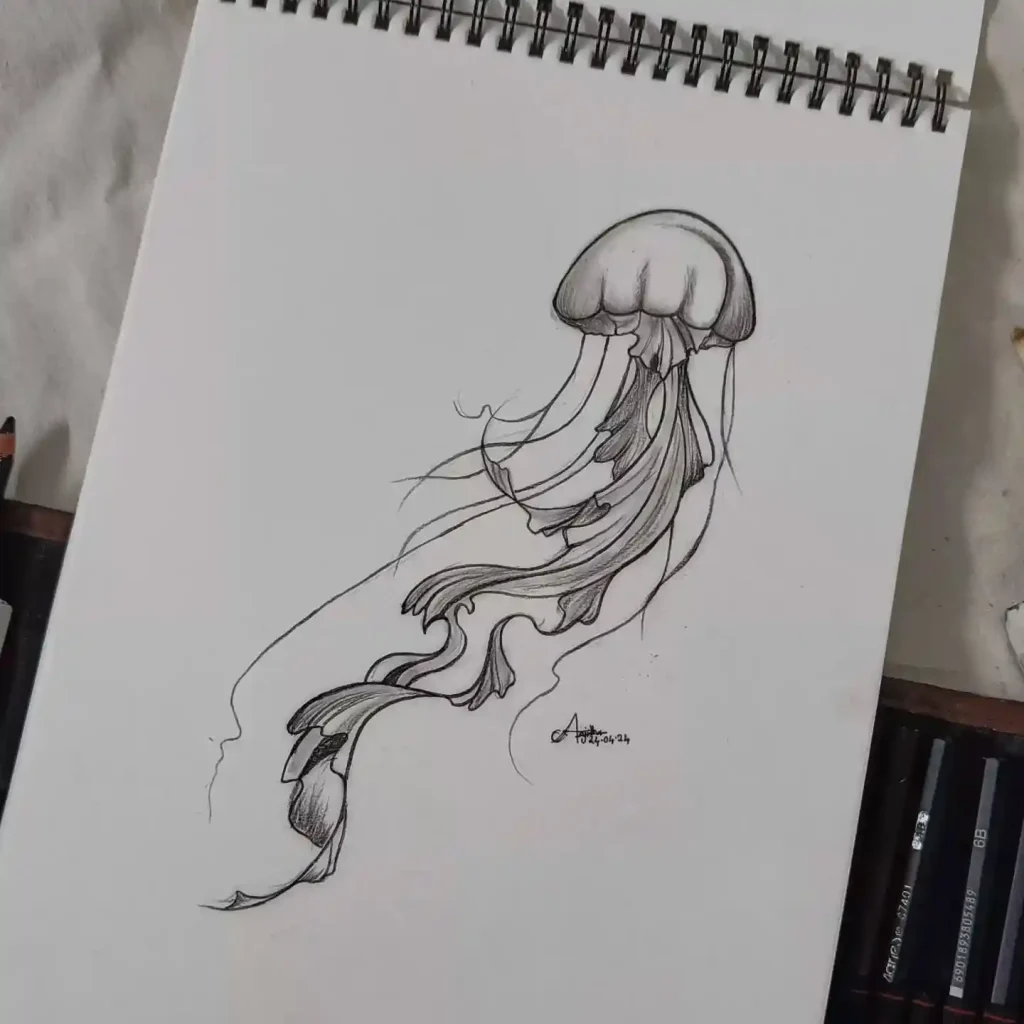
This is a beautiful, flowing black and grey drawing. It’s a very illustrative, tattoo-ready design, with a strong focus on the graceful, ribbon-like movement of the oral arms. The artist used clean lines and soft shading to create a piece that feels both delicate and dynamic, like it’s drifting across the page.
13. Soft Pastel Jellyfish on Sketchbook Paper
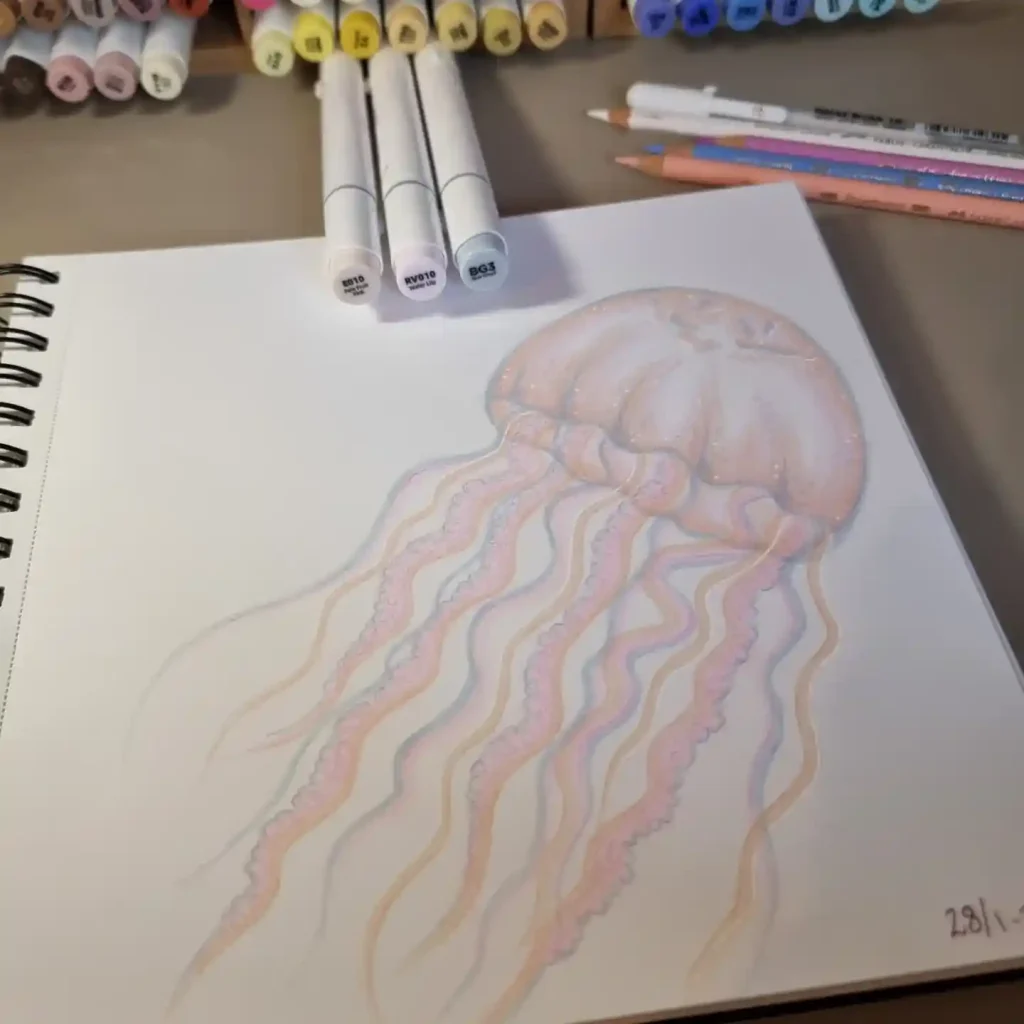
What a soft and delicate piece. Using a mix of light markers and colored pencils, the artist created a jellyfish in a gentle, pastel palette of peach, pink, and light blue. The white gel pen highlights add a magical, shimmery quality, perfectly capturing that translucent, “glowing” look these creatures have.
14. Simple Beginner Pencil Sketch on Paper
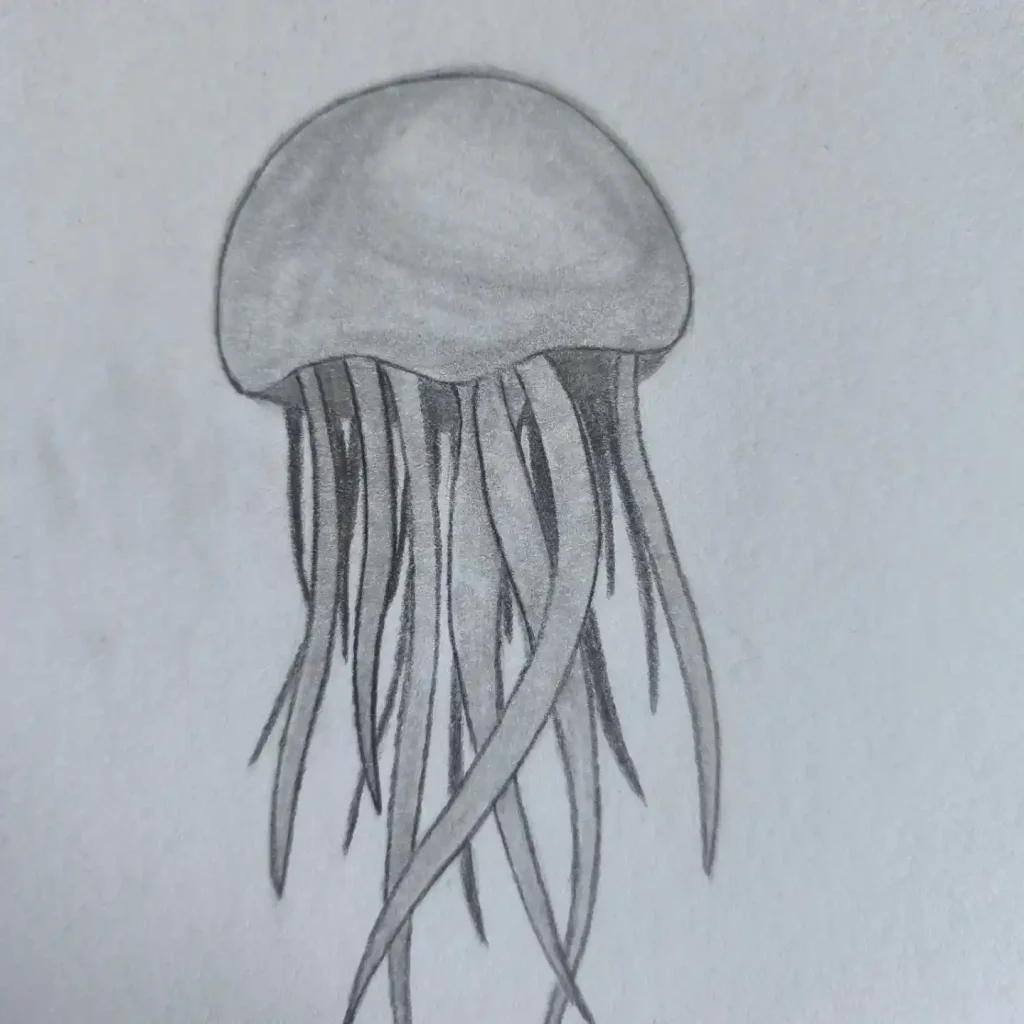
A simple, classic graphite drawing. This is a great example of a beginner’s sketch, focusing on the most basic, iconic shapes of the jellyfish. The artist used simple, soft shading to make the bell look round and the tentacles hang down. It’s a straightforward study of a very recognizable form.
15. Clean Ink Jellyfish on Lined Sketchbook Paper
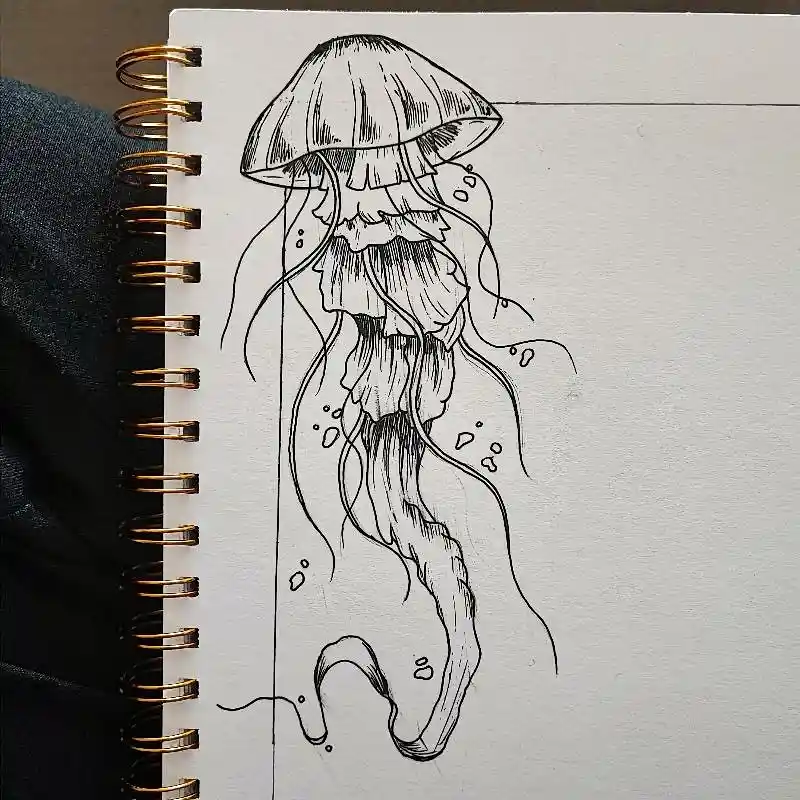
This is a crisp, clean ink drawing in a spiral-bound sketchbook. It has a great illustrative, “tattoo flash” style. The artist used bold hatching on the bell to show shadow and let the long, single tentacle trail off the page. The little bubbles give it a perfect, simple underwater feel.
16. Ornate Mandala Jellyfish on Sketchbook Paper
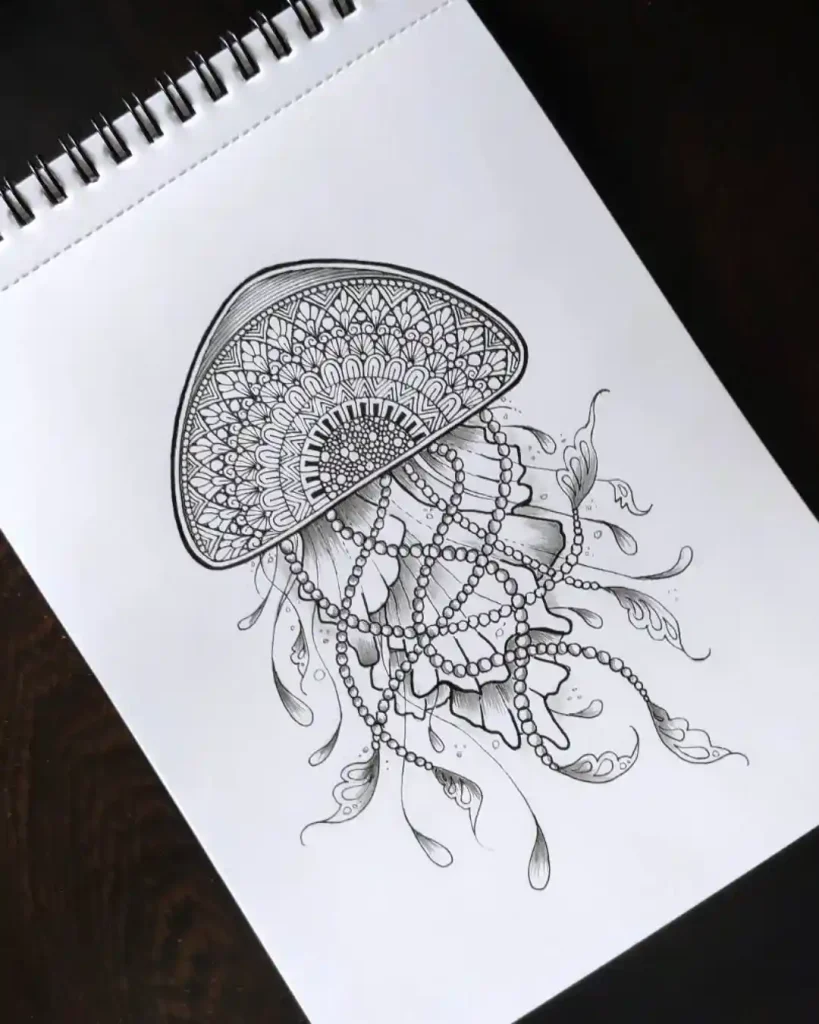
This is a stunning ink drawing that blends nature with decorative art. The bell of the jellyfish is filled with an incredibly intricate mandala pattern. The tentacles are drawn like delicate, hanging jewelry and leafy fronds. It’s a very spiritual and ornamental piece, transforming the animal into a work of art.
17. Floral Jellyfish with Bubbles on Sketchbook Paper
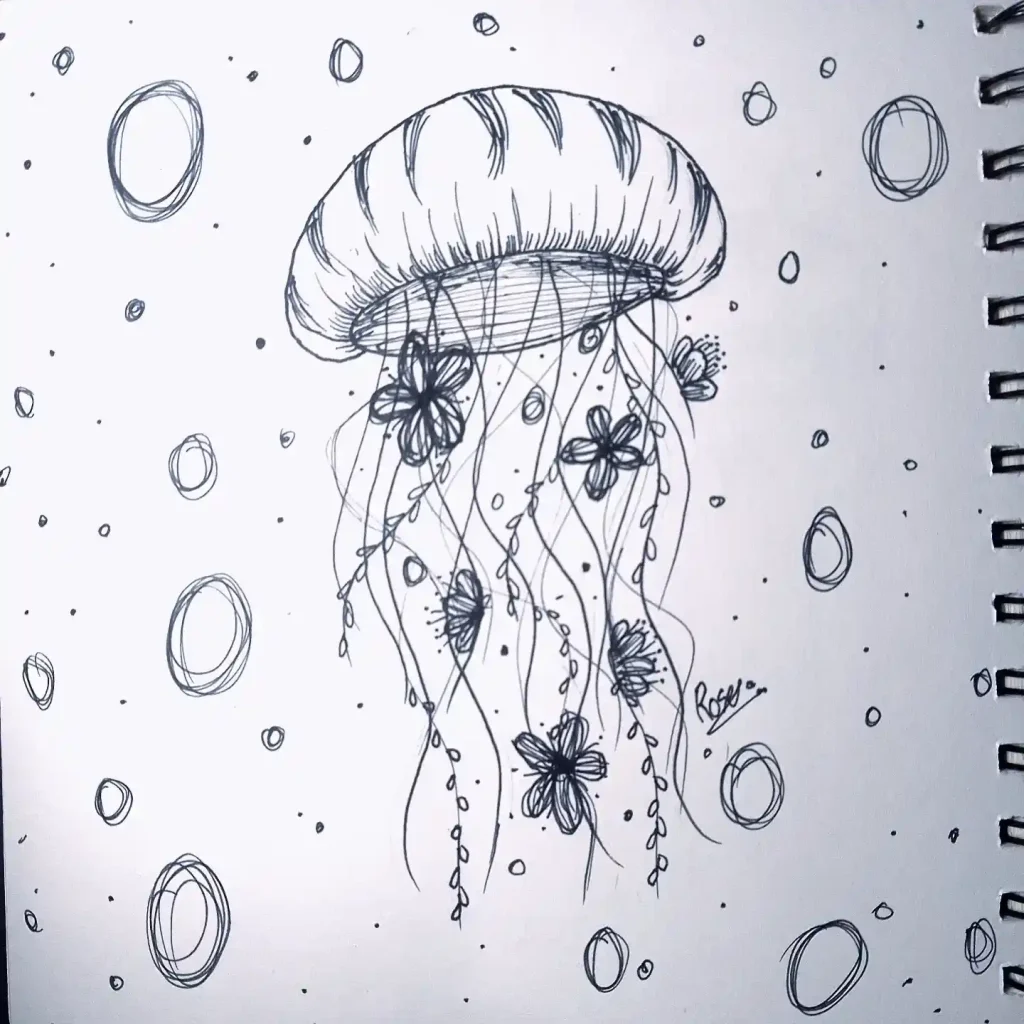
A very whimsical and creative ink concept. This drawing takes the jellyfish’s form and replaces its stinging tentacles with delicate, dangling vines and simple flowers. The bell is shaded with simple hatching, and the whole scene is surrounded by big, cartoonish bubbles, giving it a magical, storybook quality.
18. Sea Turtle with Magnolia on Drawing Paper
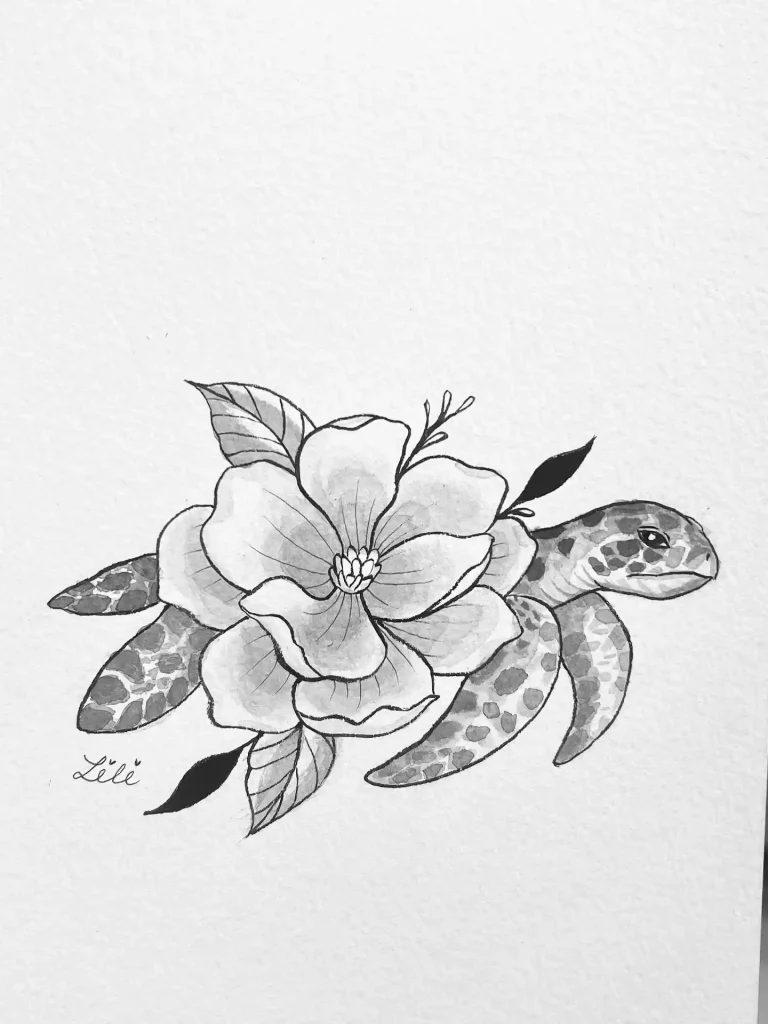
This beautiful ink and wash drawing features a gentle sea turtle, not a jellyfish. Its shell is artistically replaced by a large, blooming magnolia flower. The artist used soft grey washes and crisp black lines to blend the animal and the flower, creating a lovely, symbolic piece about life and nature.
30 More Jellyfish Ideas: Neon Tentacles and Bioluminescent Bells
The eighteen ideas above cover the classic approaches. Added for 2026, the thirty below push into glow: neon tentacles, blacklight pigment, dark-ground work and the anatomy that makes a drifting jellyfish read correctly. One rule runs through all of them, and it is the one most drawings miss. Tentacles always lag behind the direction of travel, because the bell pulls and they follow.
Compiled by the GS Art Zone editorial team. Last updated August 2026. Each idea is paired with the specific step that produces the effect, so you can go from the reference straight to paper.
What You Need for the Glow Pieces
- Black or deep navy paper, which is the fastest route to a convincing glow
- A white gel pen and white colored pencil for the brightest cores of the light
- Fluorescent or neon markers, which read far brighter against a dark ground than against white
- A fine liner in 0.05 for tentacle work, since anything thicker turns them into ropes
- Watercolor plus a clean damp brush for lifting soft light back out of a wet wash
19. Teal and Blue Glow in Watercolor
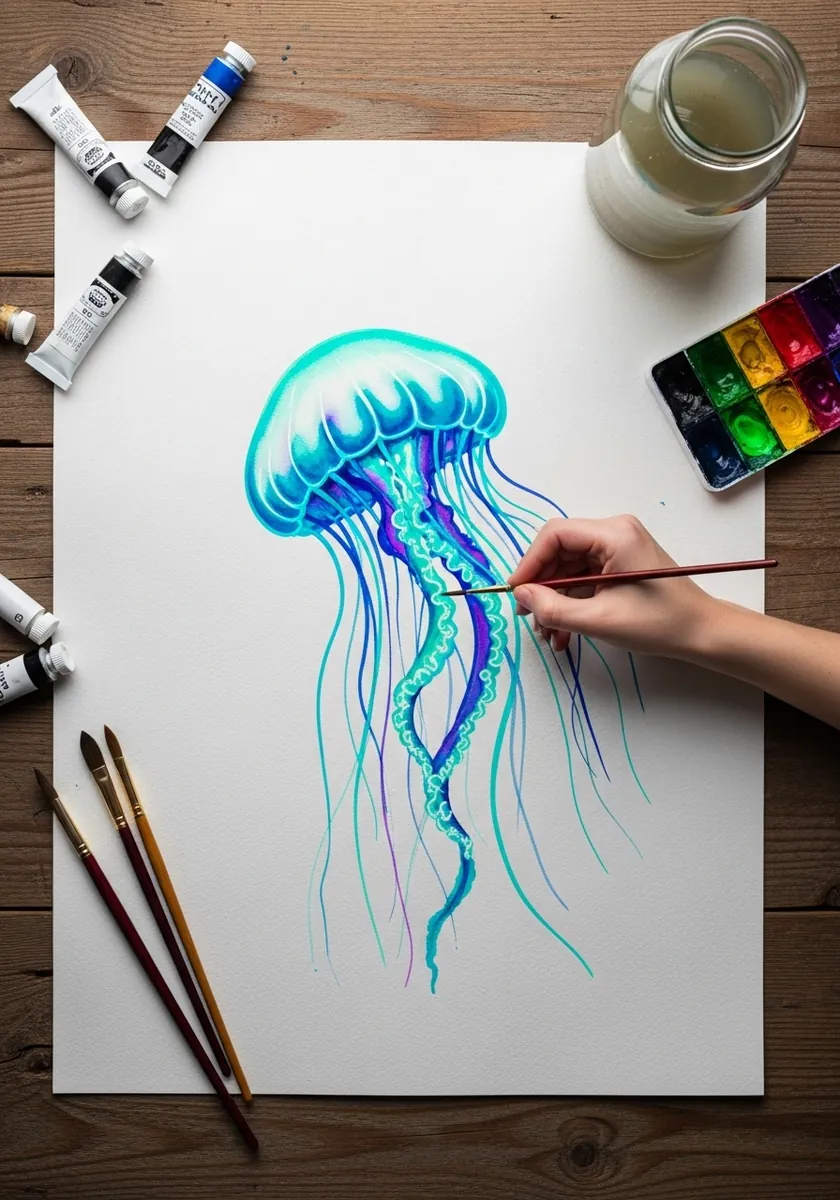
Glow in a transparent medium comes from what you leave alone. Reserve a pale core down the middle of the bell and along each tentacle, then build the saturated teal outward from those reserved lines. Painting the glow on top afterward never works, because watercolor has no opaque white.
20. Fine Ink Bell With Copper Tentacles
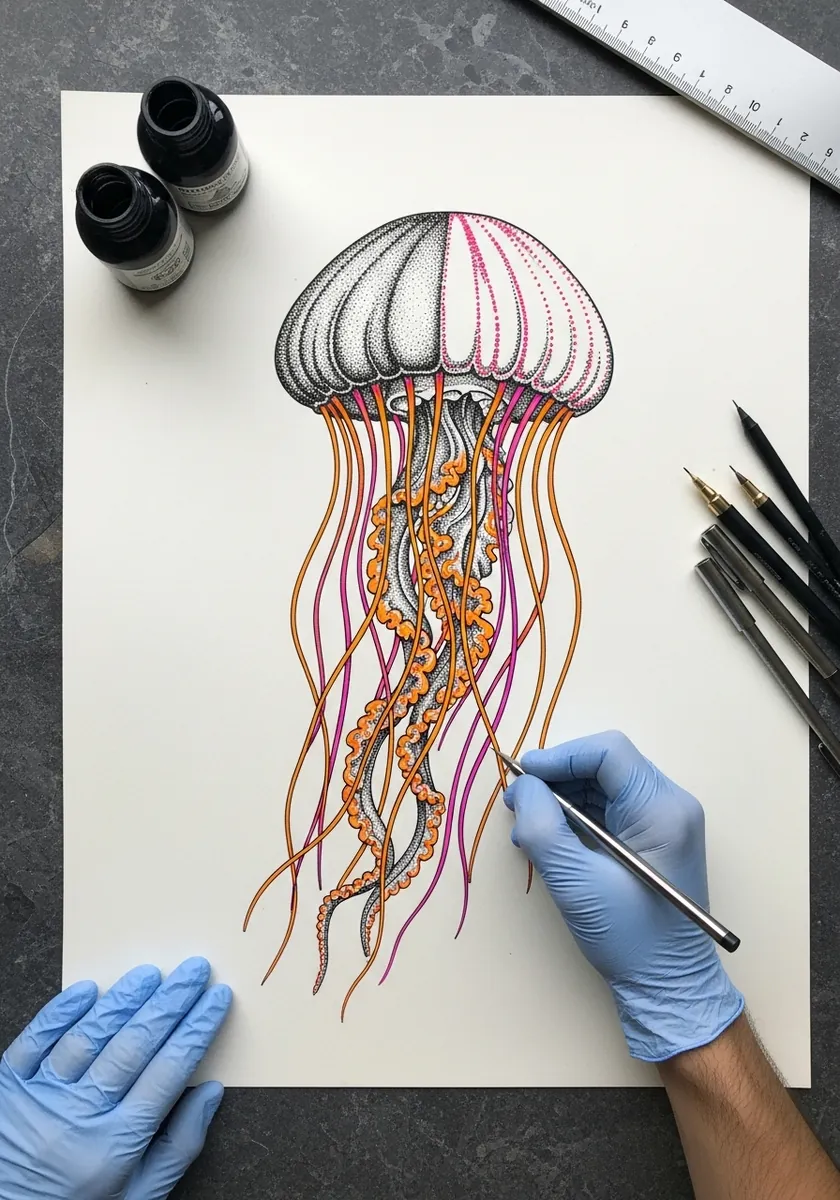
Splitting the palette between a cool bell and warm tentacles gives the piece depth without any shading at all. Ink the bell ribs as evenly spaced parallel curves converging toward the top, then switch to copper for the oral arms and keep the two zones from overlapping anywhere.
21. Purple and Green Marker Jellyfish
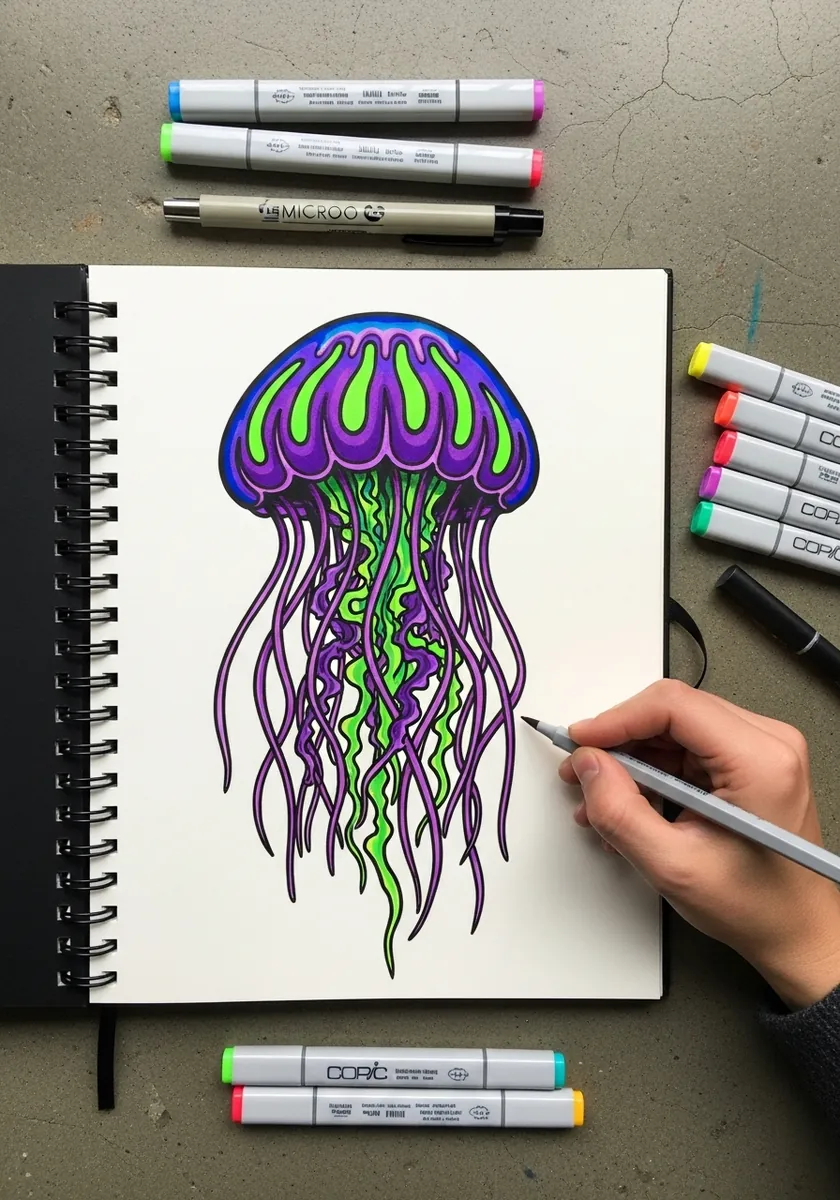
Complementary neon pairs fight each other unless one dominates. Give purple roughly three quarters of the area and let the lime appear only inside the oral arms, which pulls the eye straight to the center. Alcohol marker suits this because the flat color keeps both hues at full strength.
22. Cyan Neon Jellyfish on Charcoal Black
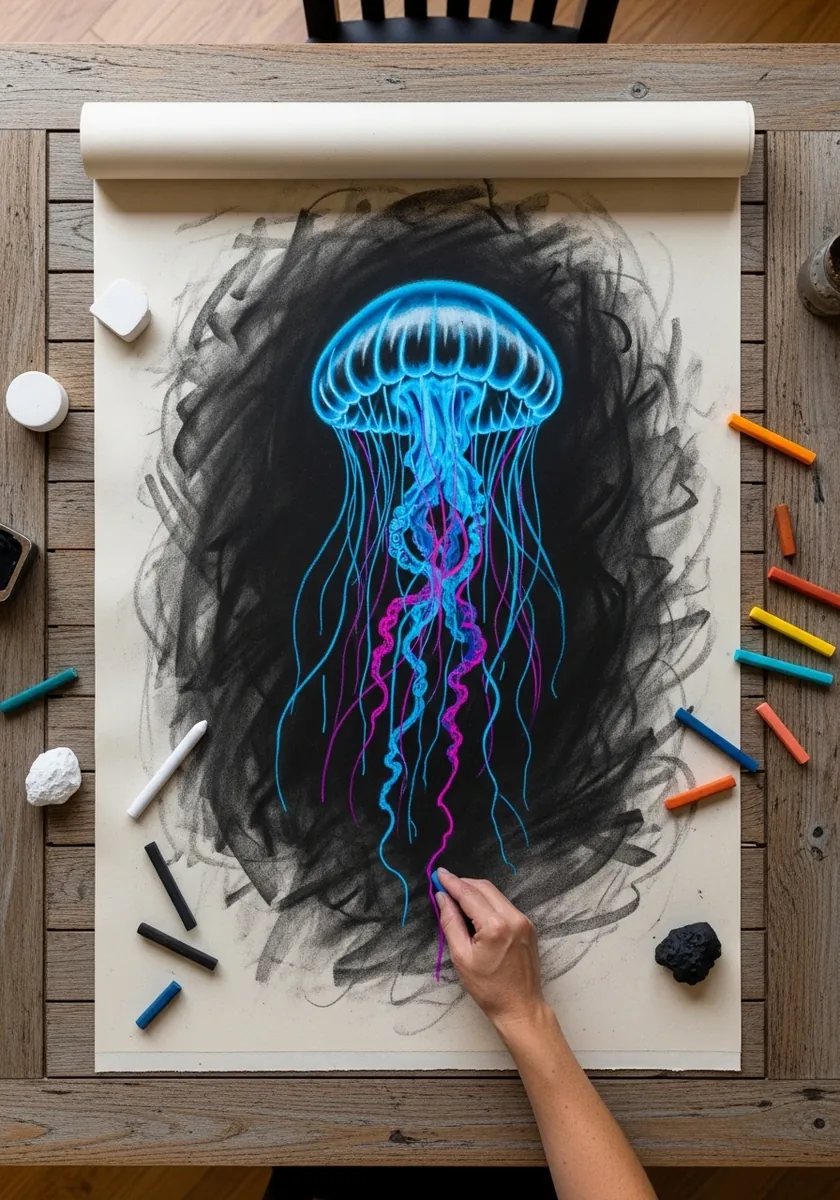
Scrubbing a full black ground around the subject is worth the effort. Lay the charcoal densely and unevenly so it varies slightly. Work the cyan on top afterward. That variation in the black is what makes the surrounding water read as water rather than as flat paper.
23. Kawaii Pink Jellyfish With Big Eyes
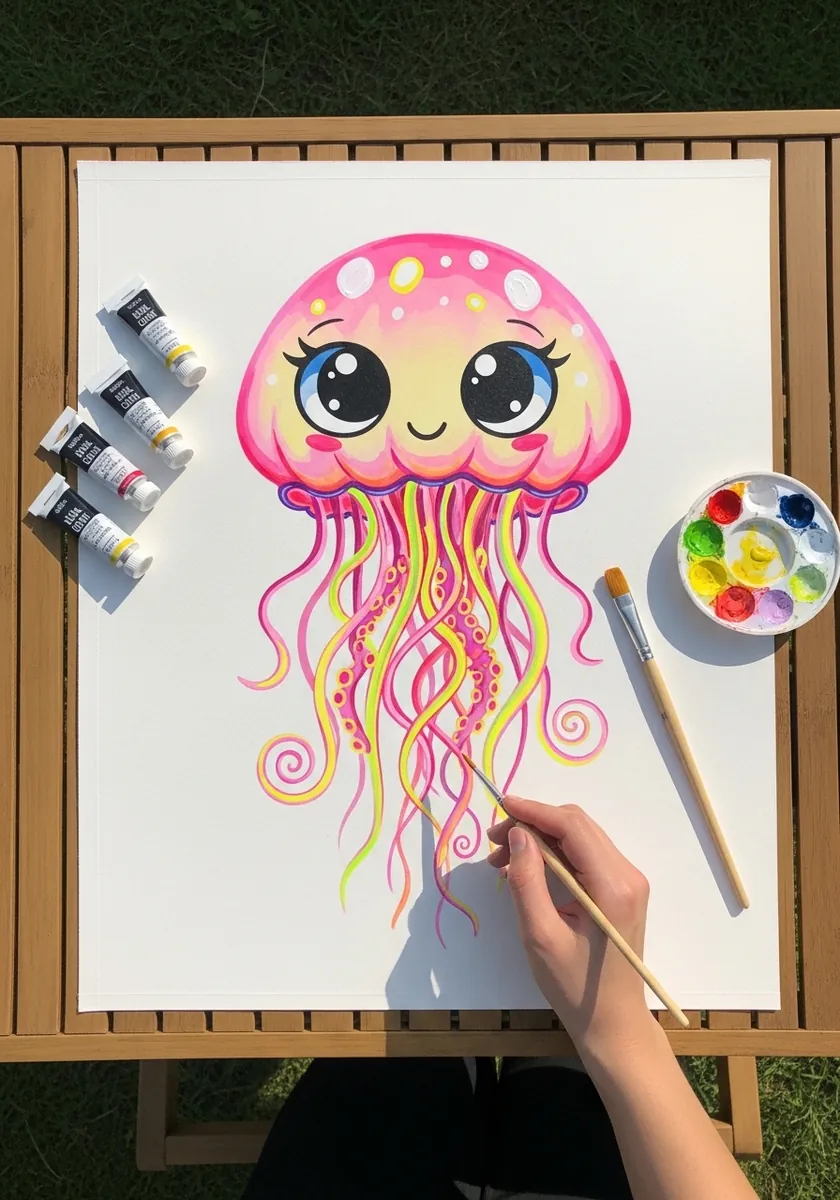
Cute versions still benefit from correct structure underneath, so keep the bell dome wide and low, set the eyes in its lower third, and curl the tentacle ends into loose spirals instead of letting them hang straight, because spirals read as friendly where straight lines read as cold.
24. Black Bell With Dripping Color
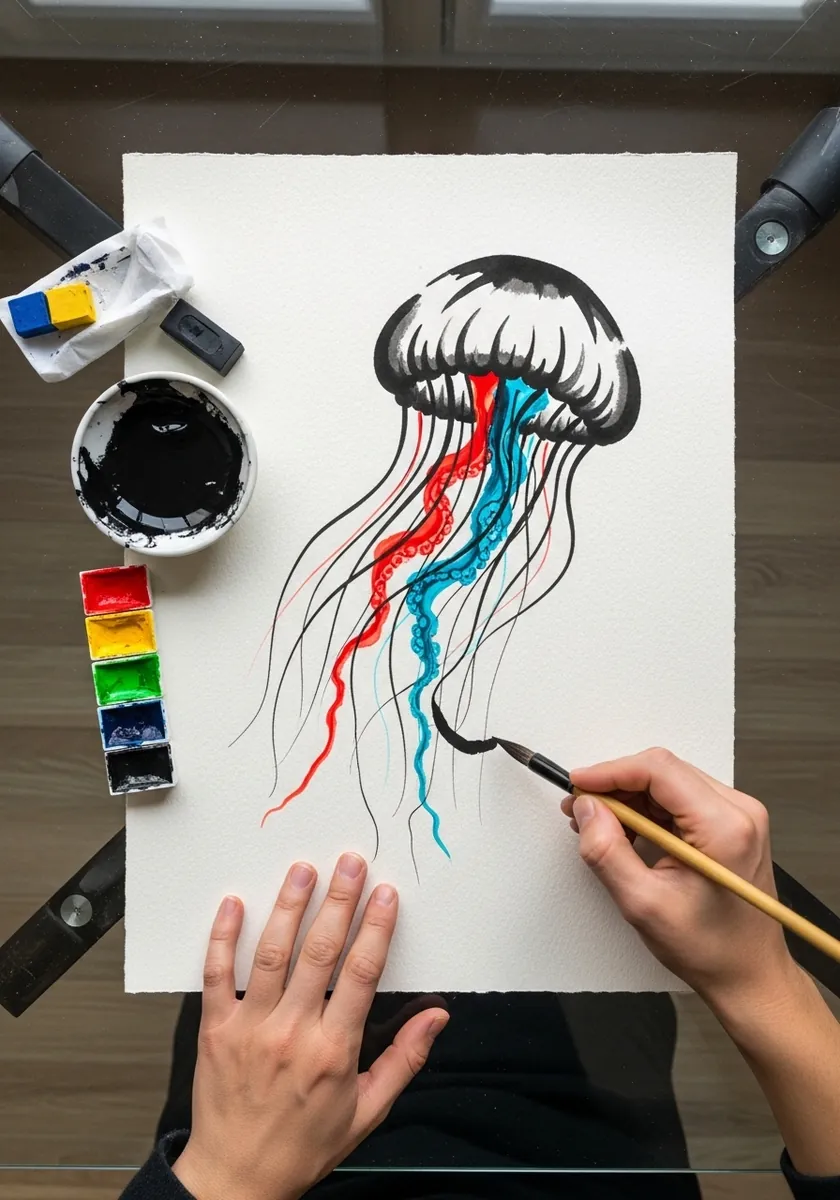
Letting paint drip do the tentacle work is a real technique, not a shortcut. Ink the bell solid and let it dry completely, then load the brush heavily at the rim and tip the paper vertical. Each run finds its own path, which is more convincing than drawn lines.
25. Wireframe Grid Bell in Teal
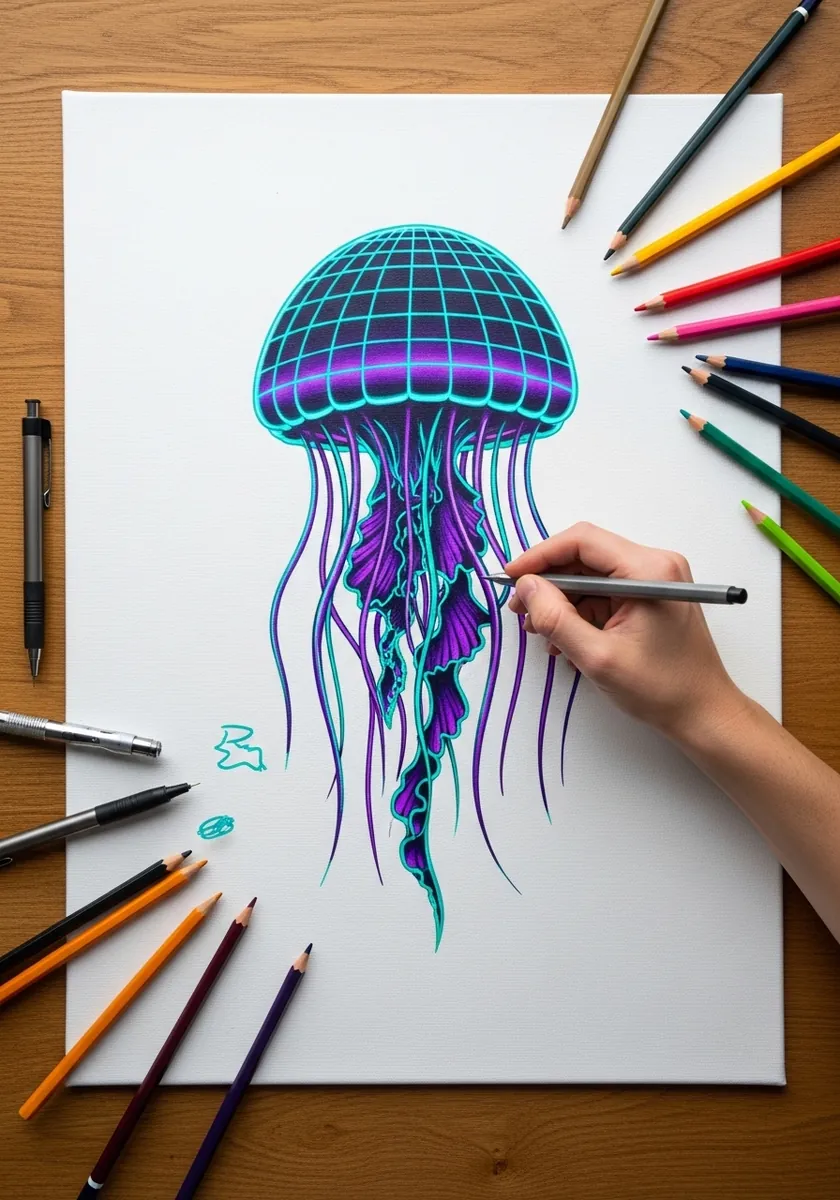
Mapping a grid onto a dome is a useful perspective exercise, so curve every horizontal line into an ellipse that flattens as it approaches the top and let the vertical lines converge there. Get those two families of curves right and the bell reads as solid volume.
26. Rainbow Watercolor Jellyfish
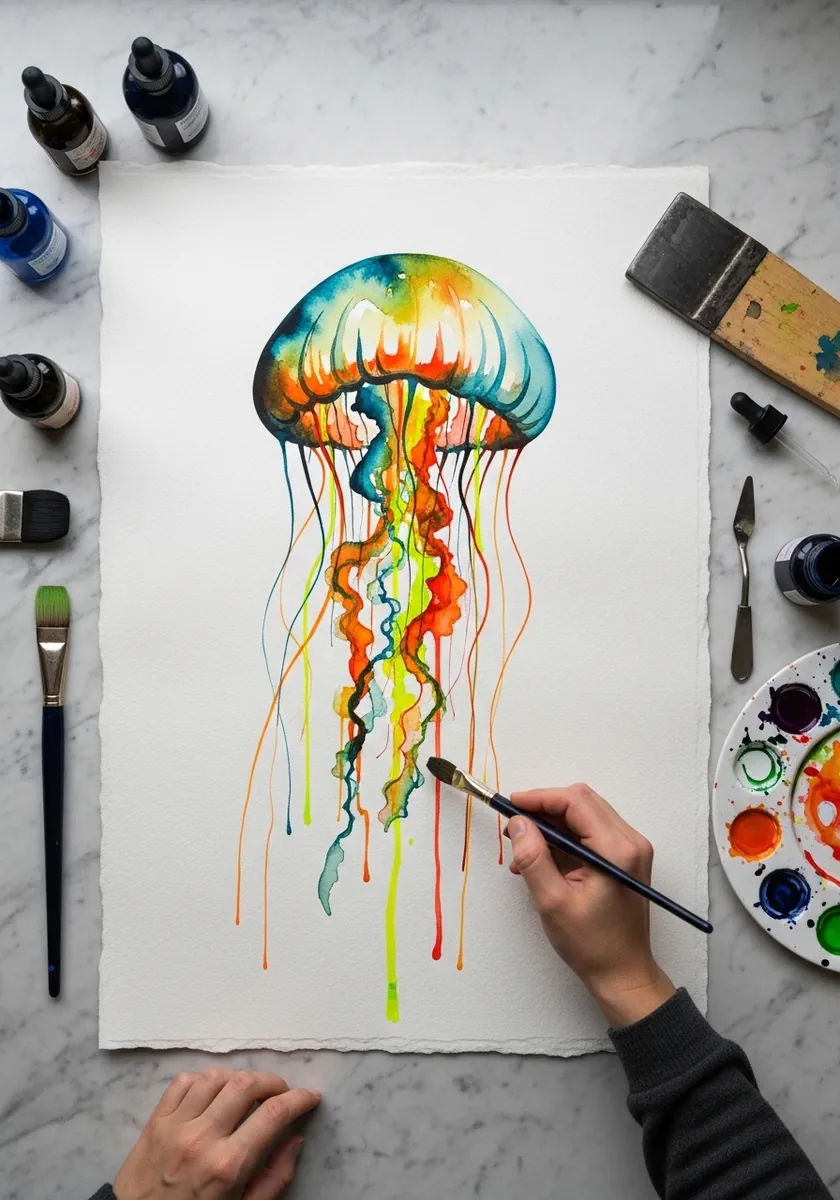
Running a full spectrum through one subject needs a fixed order. Move around the color wheel from top to bottom without doubling back, and let each color bleed slightly into the next while damp. Jumping randomly between hues produces mud at every junction.
27. Fine Line Bell With Green Tentacles
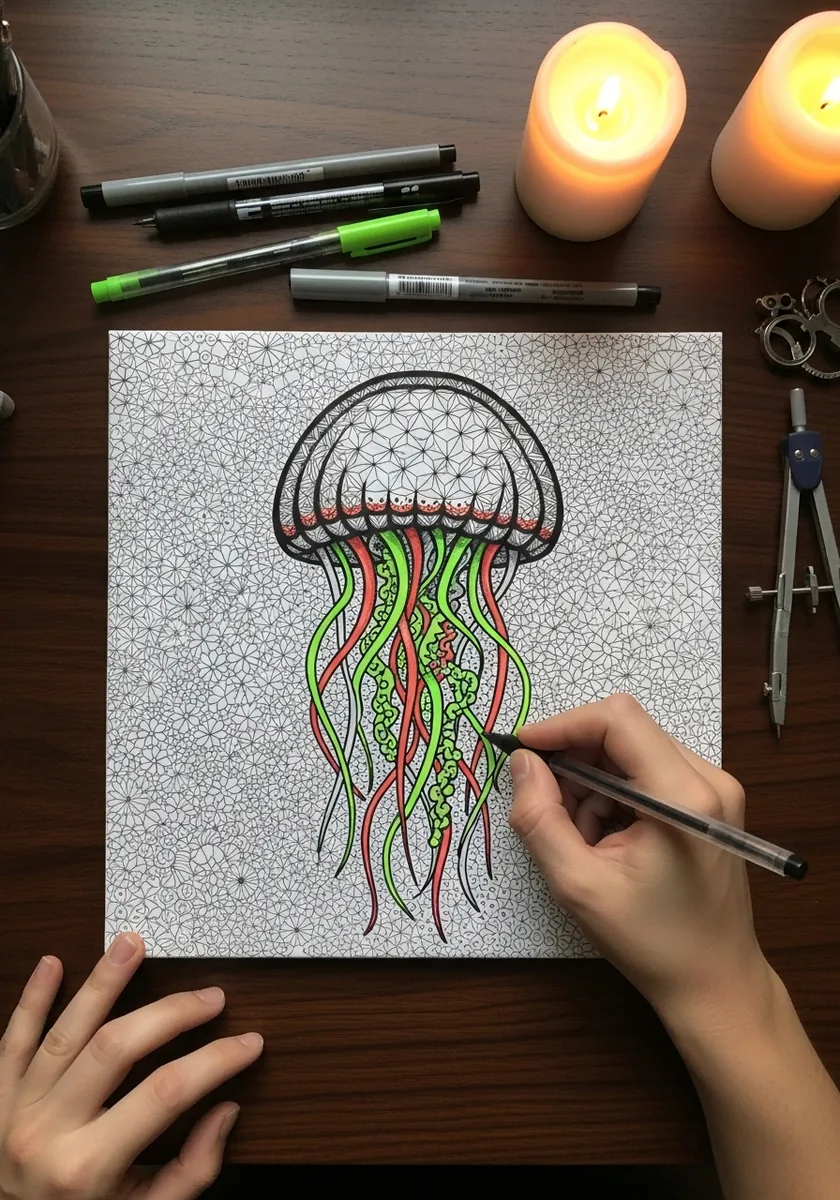
Rough textured board changes how a fine line behaves, breaking it into a dotted, granular edge. Use that instead of fighting it. Draw the bell slowly with an even pressure and let the paper add the shimmer, which suits a translucent animal remarkably well.
28. Labeled Anatomical Jellyfish Study
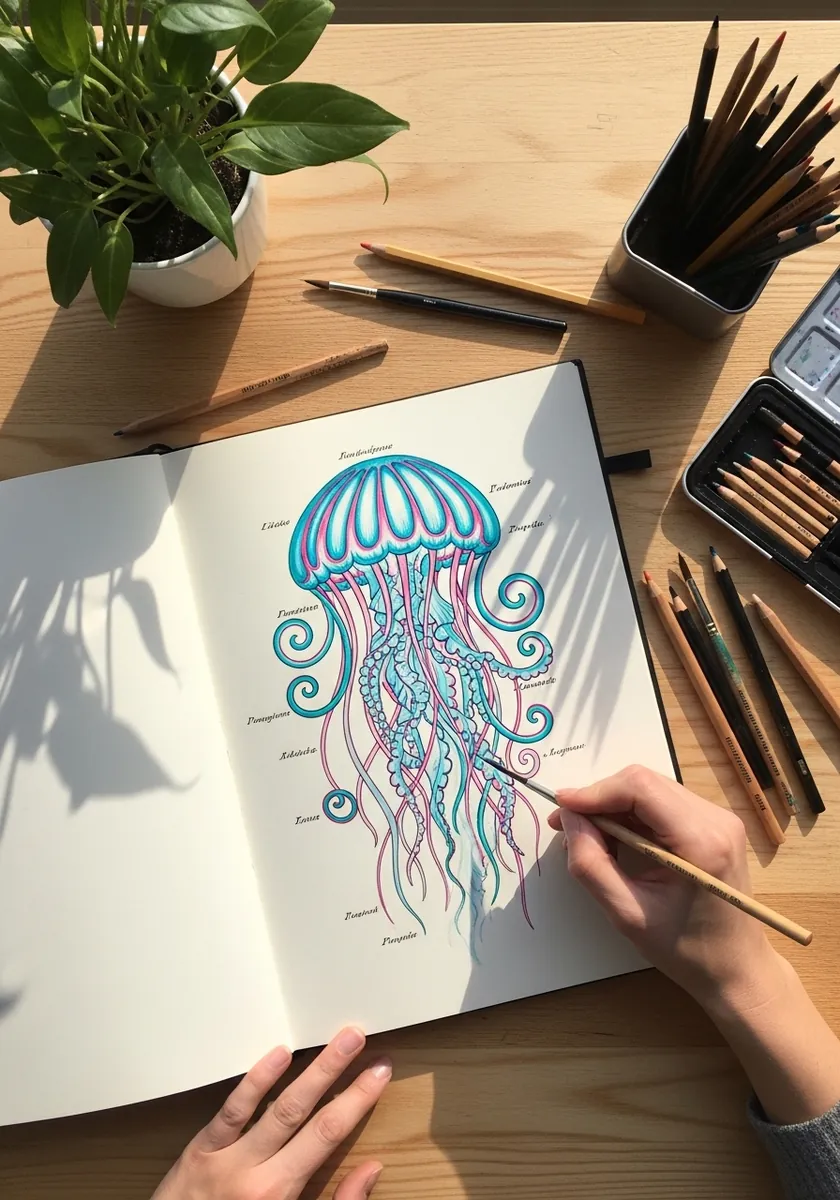
Drawing a labeled study once fixes the anatomy in your head for good. Mark the bell. Mark the four oral arms hanging from the center, and the fine tentacles at the rim, as three separate systems. Nearly every unconvincing jellyfish drawing merges the last two.
29. Blue-Green Jellyfish With Long Trails
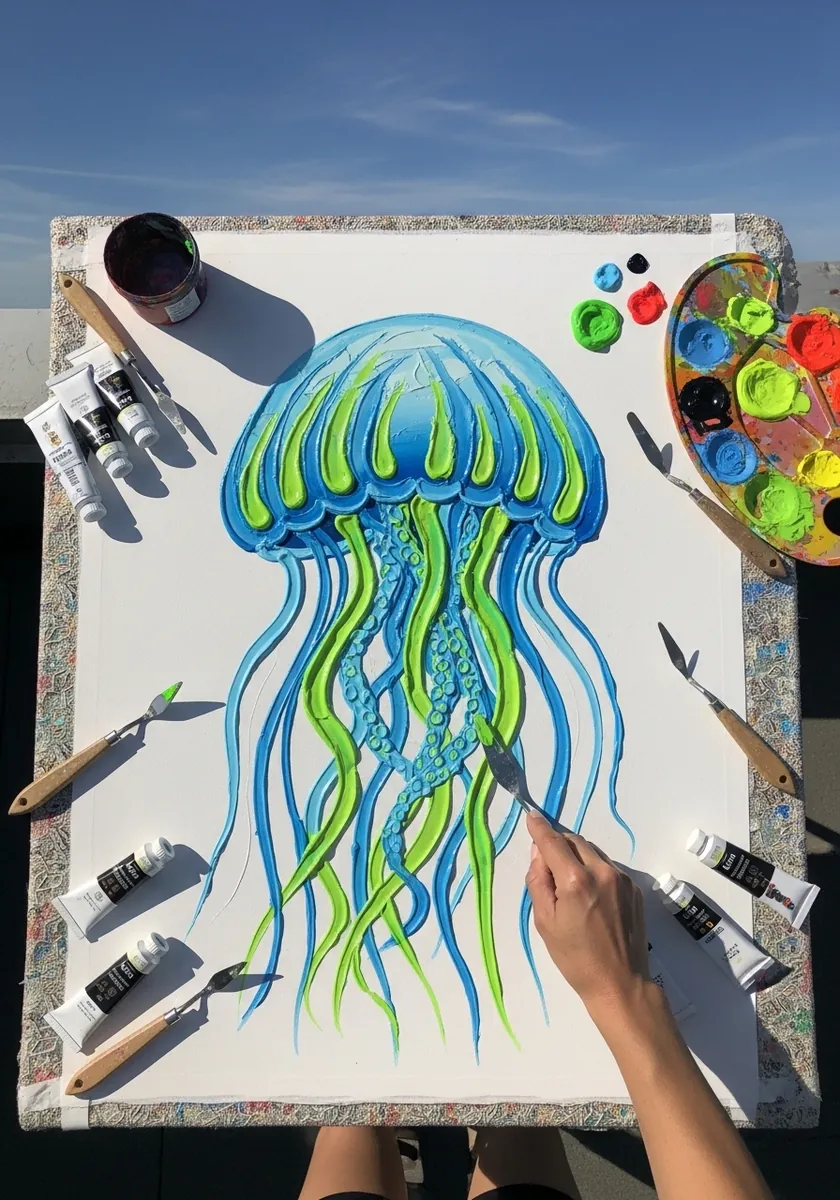
Extreme tentacle length is a compositional decision. Let them run off the bottom edge rather than stopping neatly. Vary the spacing so a few cluster together and others drift wide. Evenly spaced trails of matching length always end up looking like a comb.
30. Magenta and Lime Ink Jellyfish
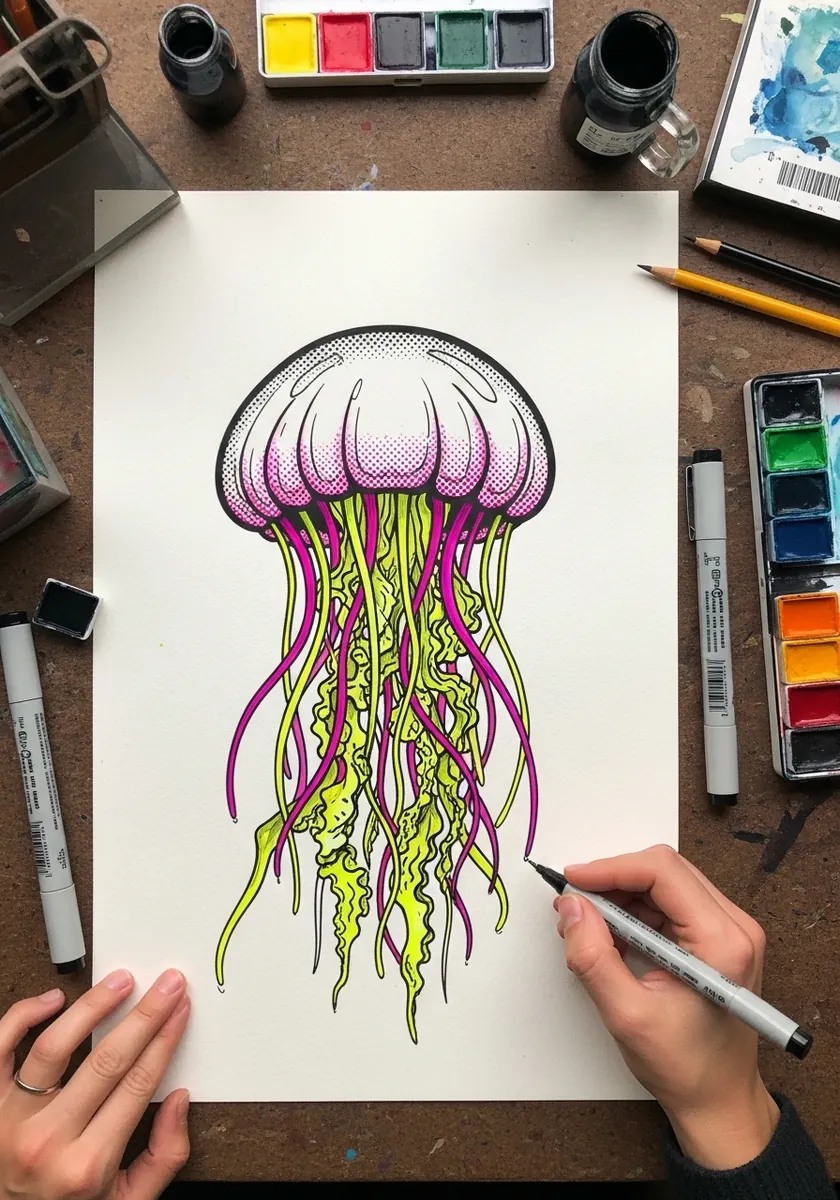
Hard black outlines around neon color intensify both. Ink the whole silhouette first with a broad nib, then flood the fluorescent color inside, keeping it slightly away from the line so a thin white gap survives. That gap is what makes the color appear to emit light.
31. Pale Cyan Light Sketch
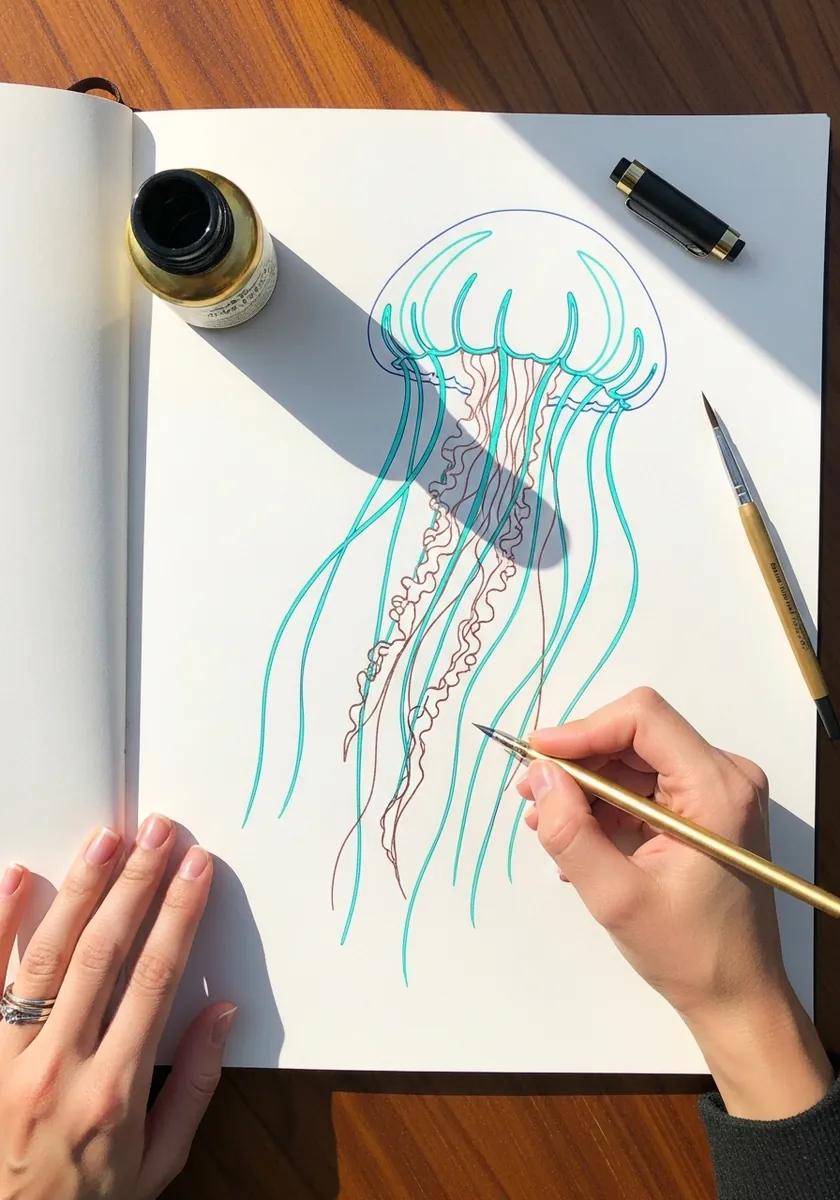
Not everything needs to be finished. A whisper-weight sketch is the right place to test tentacle rhythm before committing, and the pale cyan reads as underwater atmosphere on its own. Vary your line pressure across each tentacle so it fades in and out of visibility.
32. Loose Pastel Watercolor Jellyfish
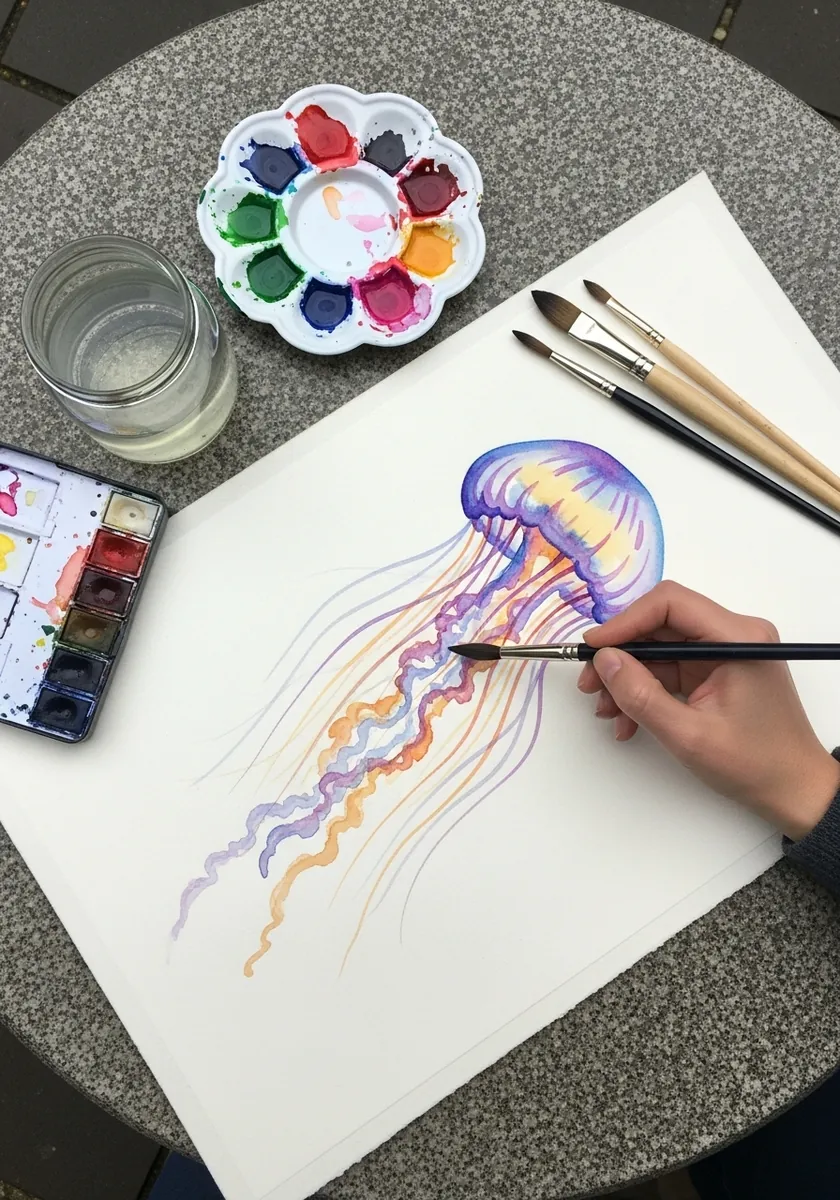
Wet-in-wet suits a creature that is mostly water, so flood the bell with clear water first, drop lavender into the top and let it settle downward on its own, then pull the tentacles out from the damp edge with a rigger brush before the paper dries.
33. Ornate Teal and Gold Jellyfish Print
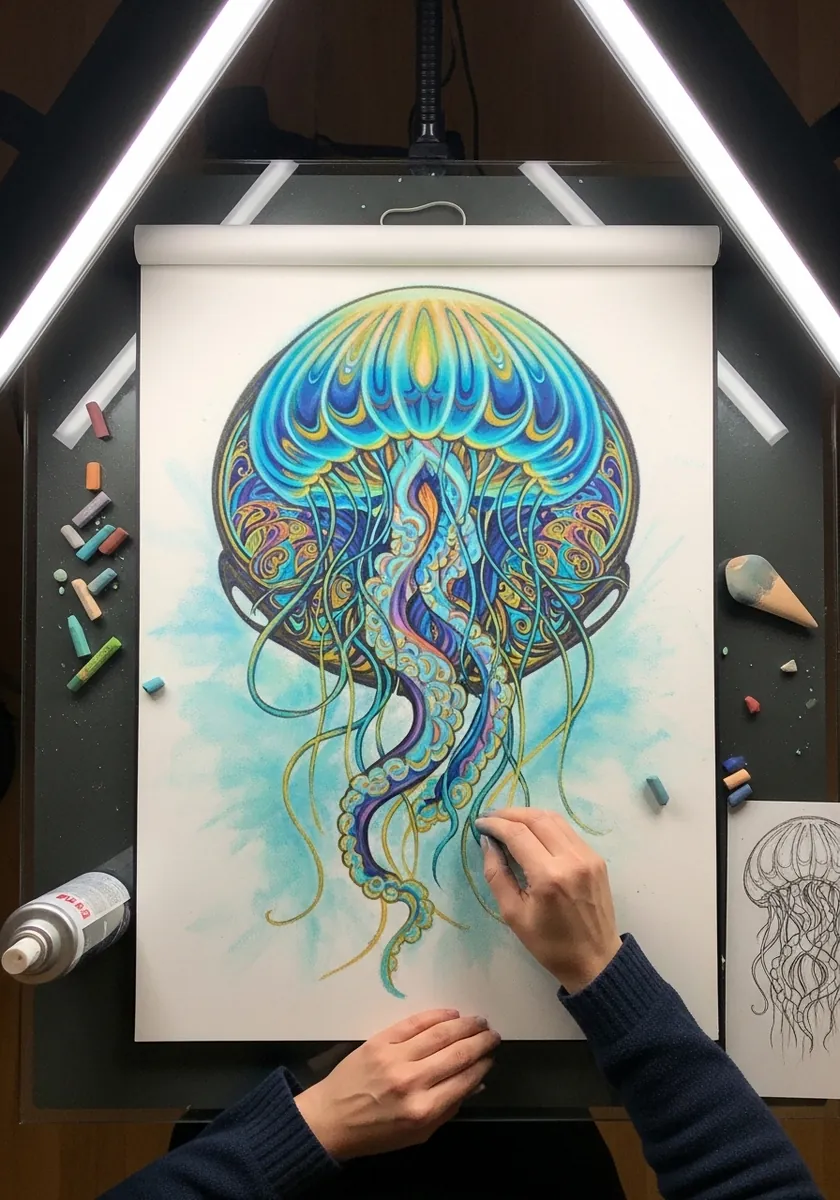
Symmetry turns an animal into an emblem. Fold your intent down a center line. Mirror the bell pattern exactly, then break that symmetry only in the tentacles so the piece still feels alive. Gold reads best when the surrounding teal stays desaturated by comparison.
34. Folk Floral Bell With Coral
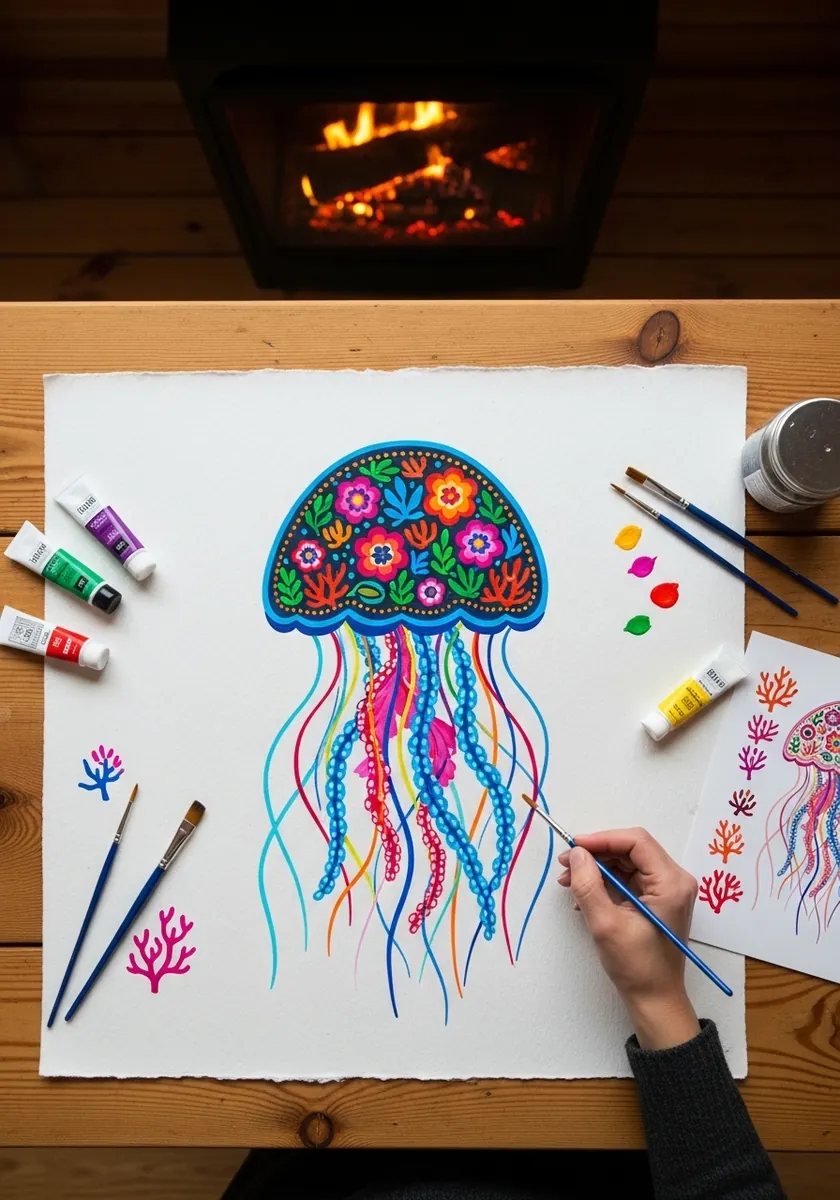
Placing folk pattern on a marine subject works if the motifs stay flat. Paint the bell as a decorative field with no shading whatsoever, then let the tentacles carry all the dimensional work. This is the same split used in mandala construction.
35. Neon Green and Magenta Drip Piece
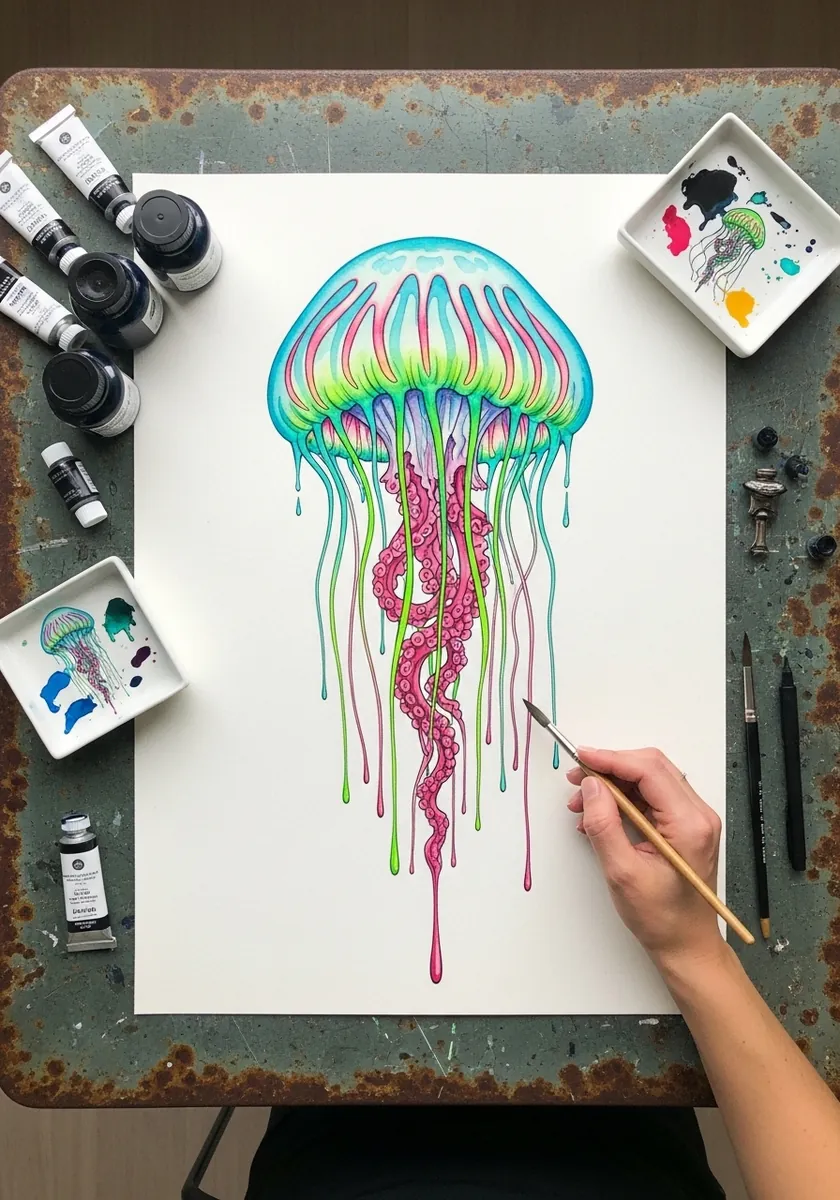
Controlled drips need a horizon of their own. Decide where the bell ends and let every run begin at exactly that line, so the transition from painted form to gravity-made mark happens all at once. Scattered starting points make the effect look accidental.
36. Radiating Pink and Yellow Burst
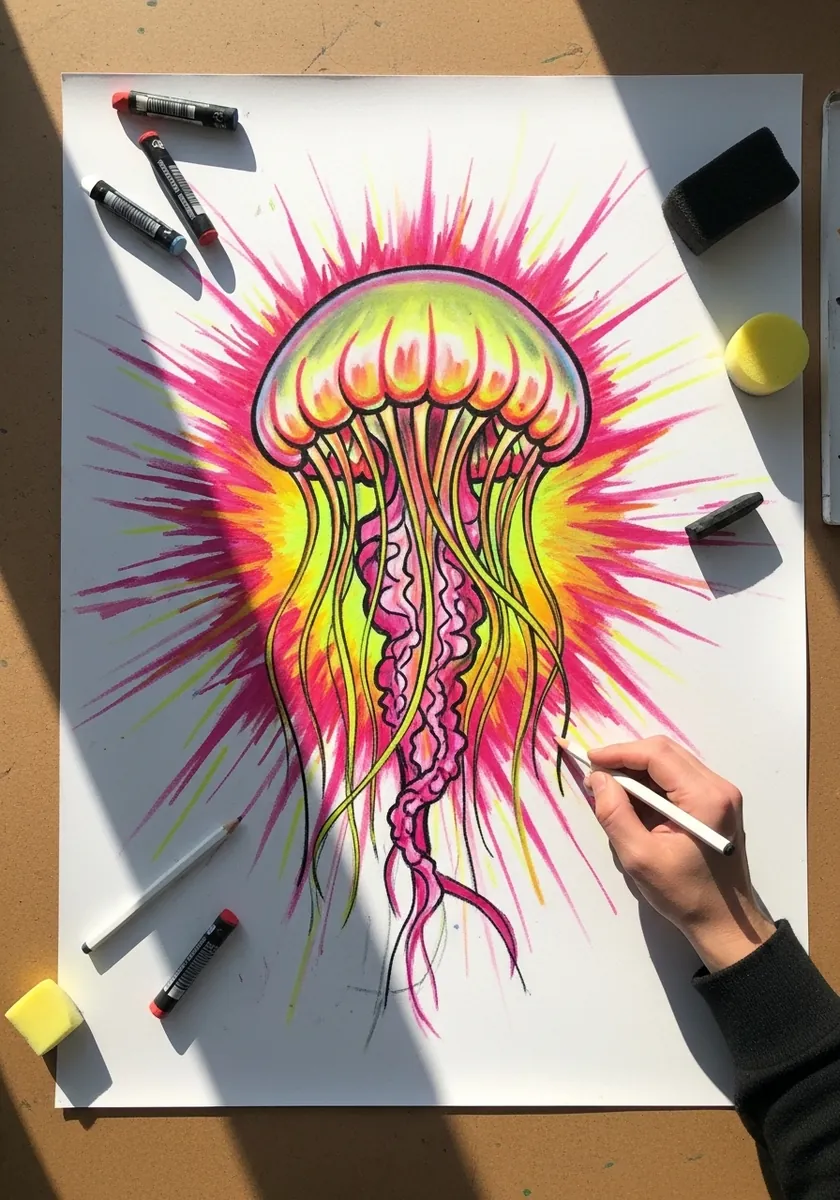
A radiating halo draws energy rather than light. Rule every spike from a single point at the center of the bell. Vary their lengths in an irregular rhythm, and keep them all in warm hues so the burst reads as one glow rather than as separate rays.
37. Dark Blue Ornamental Jellyfish
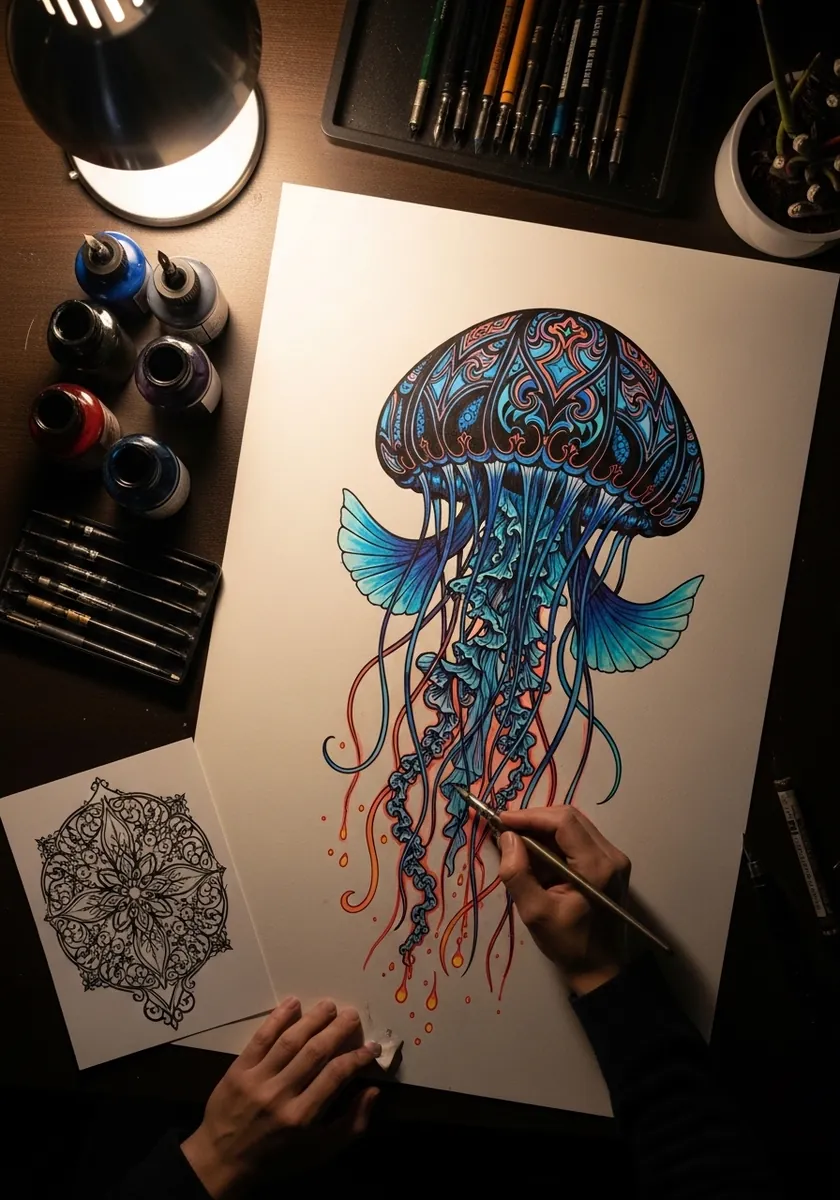
Working dark on dark is a value problem, not a color problem. Keep the whole piece within a narrow band of blues and let the pattern itself carry the contrast, packing the linework tighter where you want depth. One small light accent anchors the entire composition.
38. Graphite Bell With Neon Tentacles
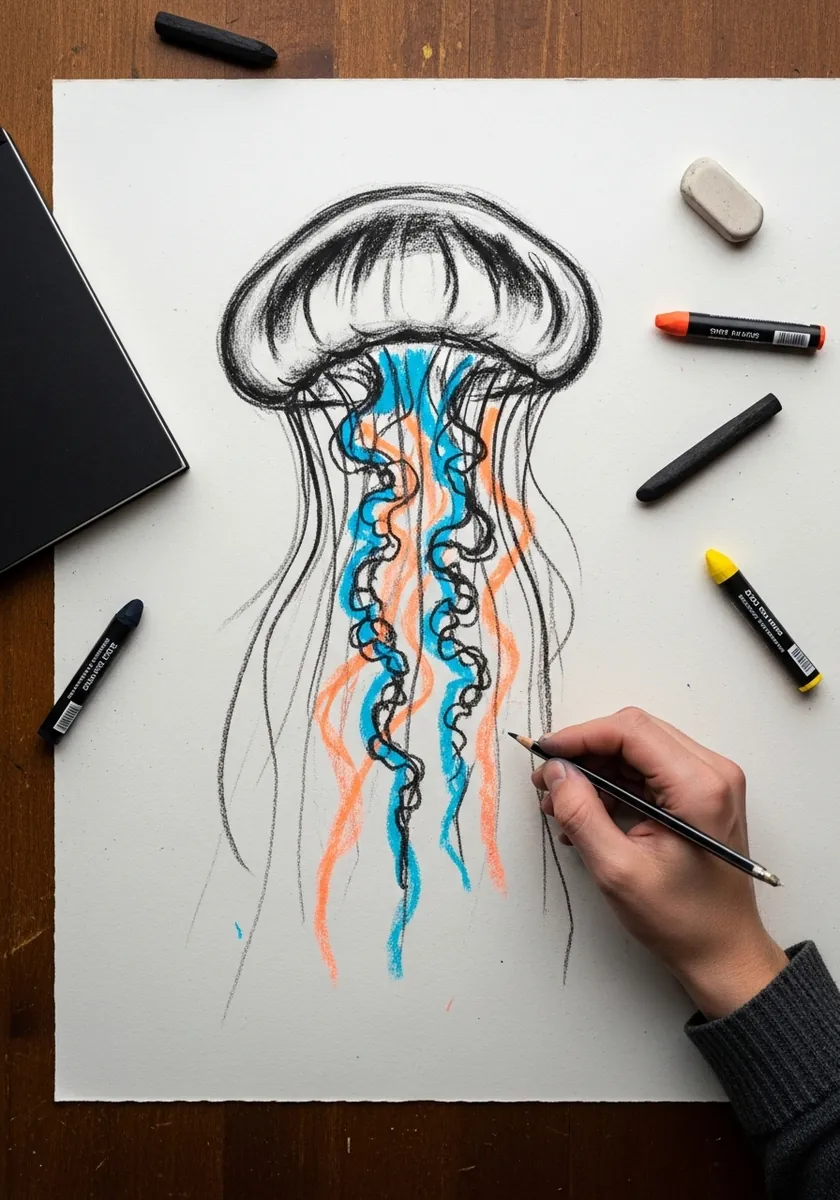
Mixing a realistic passage with a stylized one needs a clear boundary. Render the bell fully in graphite, then start the neon exactly at the rim with no transition at all. The abrupt change is the point, and softening it would weaken both halves.
39. Stained Glass Geometric Jellyfish
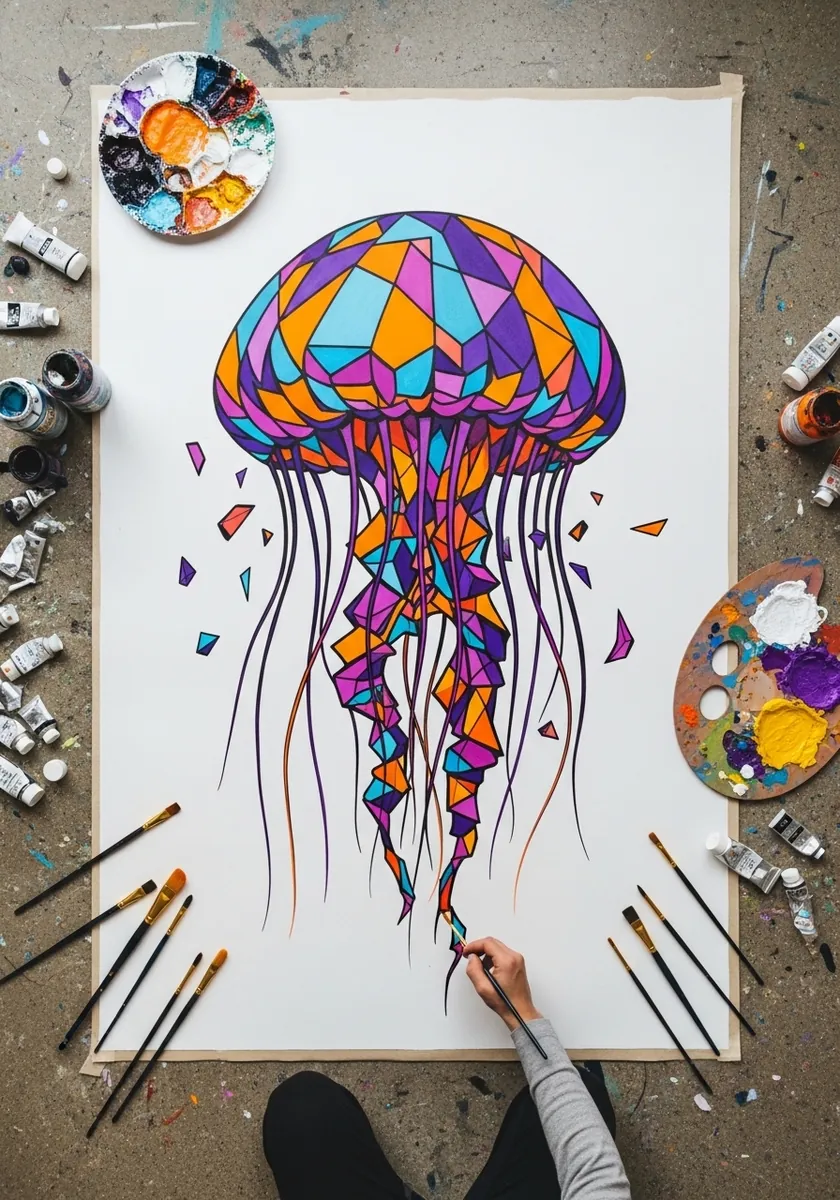
Faceting a soft-bodied animal creates useful tension, so keep the facets larger across the top of the bell and smaller toward the rim, and let the tentacles stay as flowing lines rather than breaking them up too. That contrast between rigid and fluid carries the piece.
40. Rainbow Ribbon Tentacle Study
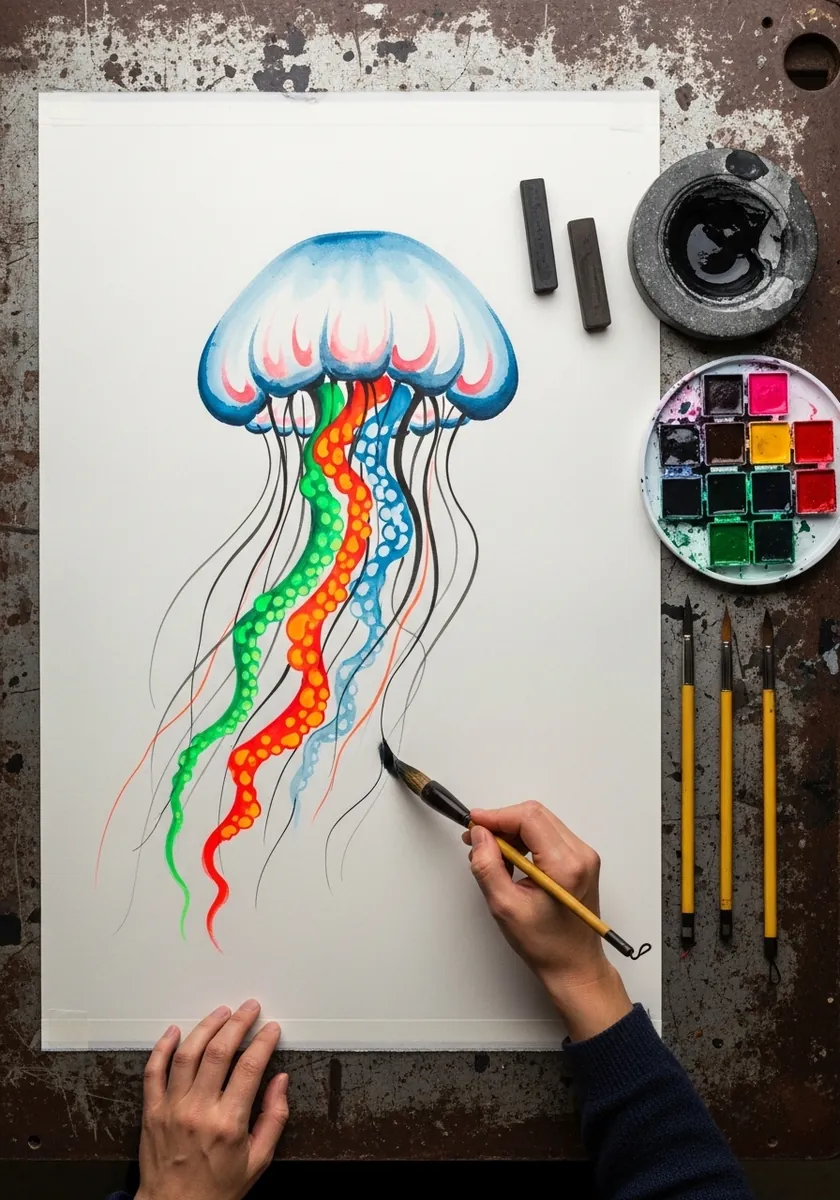
Ribbons need to turn to read as ribbons. Give each band a twist somewhere along its length where it narrows to a line and reappears with its shading flipped. Without that turn they are just colored stripes, whatever width you draw them.
41. Smiling Pastel Jellyfish for Kids
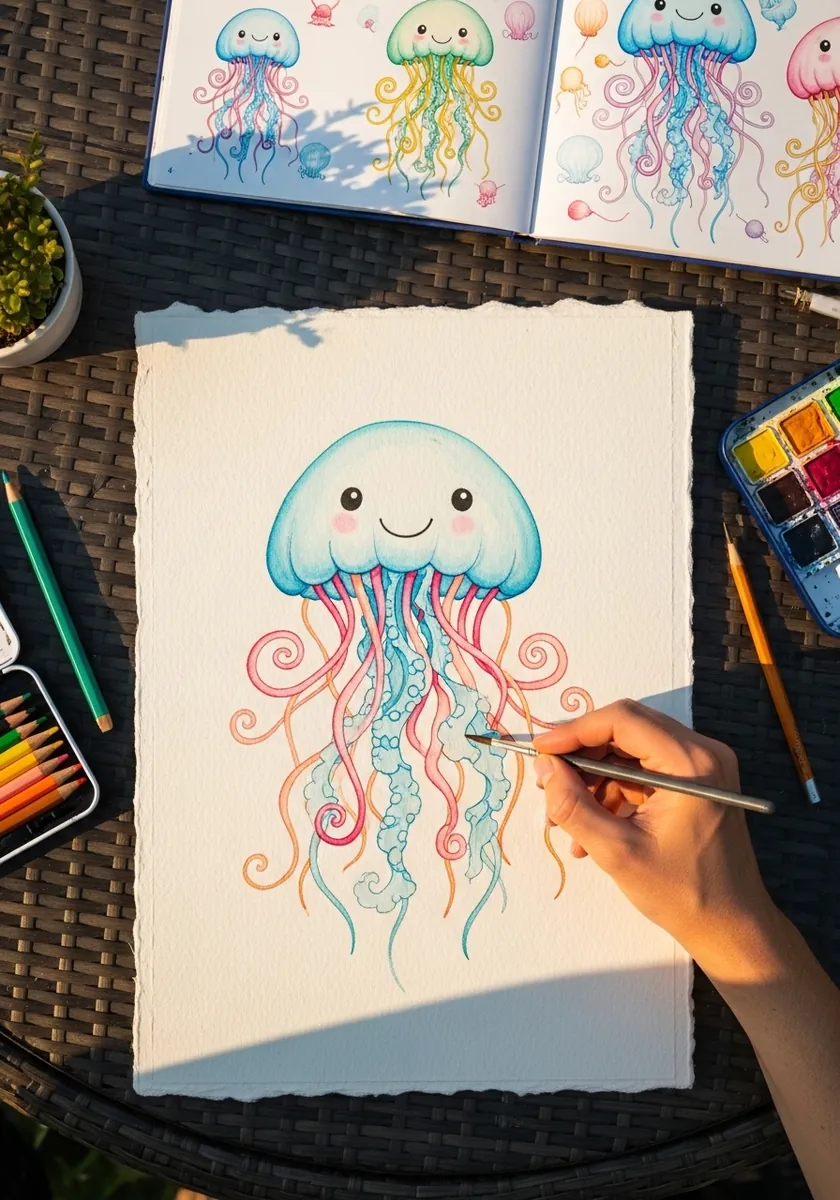
Designing for children means removing choices rather than adding charm. Three colors, one dome, six curly tentacles and two dots for eyes is genuinely enough. Keep every line thick enough that a child can trace it, and leave large flat areas open for coloring.
42. Blacklight UV Neon Jellyfish
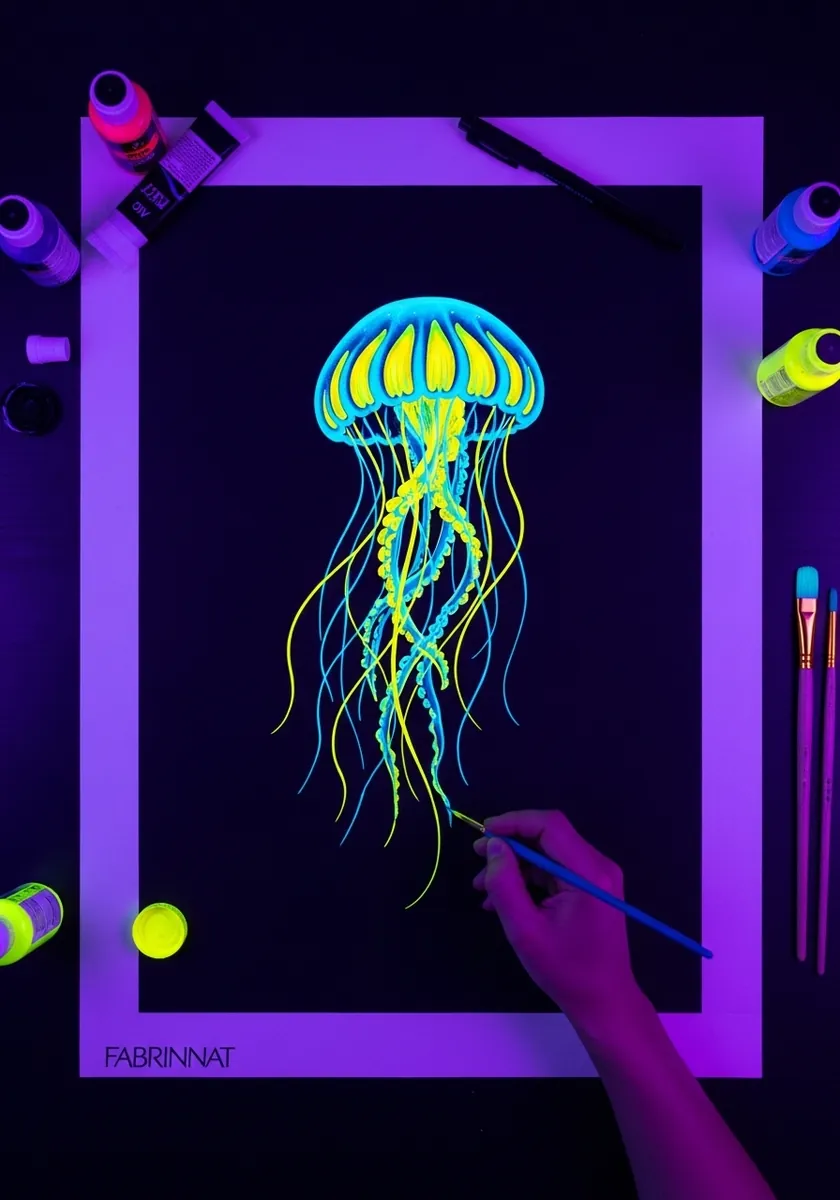
Fluorescent pigment behaves oddly under normal light, looking chalky and weak, so judge the piece under the blacklight while you work rather than trusting your desk lamp. Apply the paint thickly in a few decisive strokes, since fluorescence weakens as coats build up.
43. Muted Study Beside Its Line Version
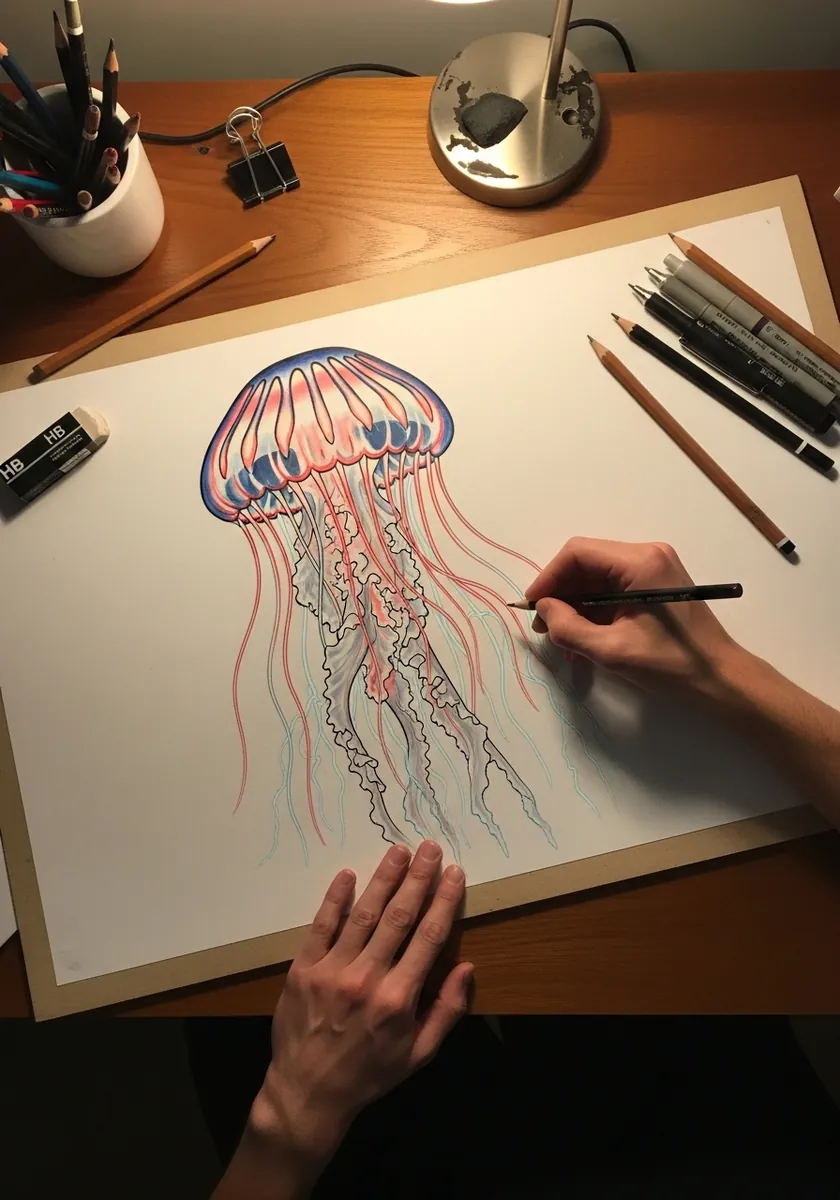
Keeping the line version beside the finished piece is a good working habit. It shows exactly what the color added and what it buried, and it gives you a clean reference if the painting fails. Photograph the line stage before you touch it with paint.
44. Rainbow Bell With Teal Trails
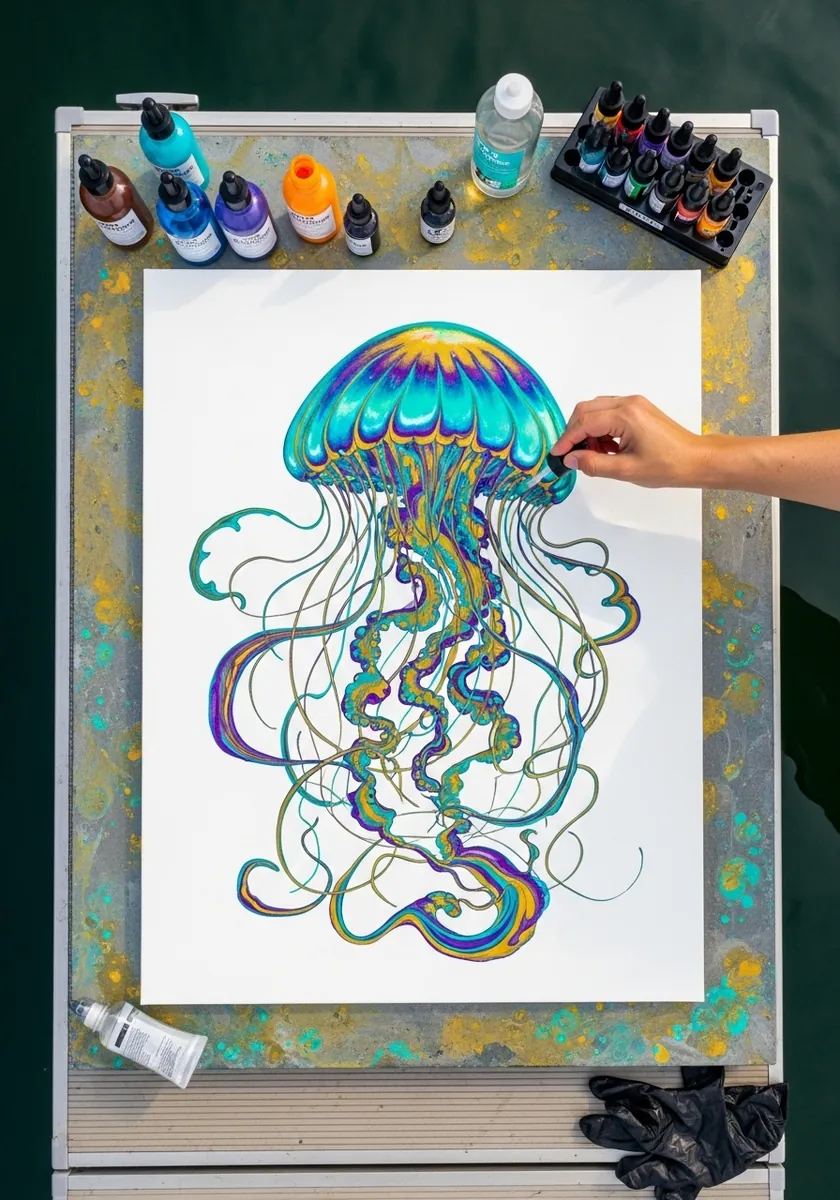
Loading all the color into the bell and leaving the tentacles nearly monochrome creates a hierarchy that lands the eye on the bell first and then walks it down the calm trails, whereas busy tentacles under a plain bell scatter attention immediately.
45. Small Minimal Ink Wash Jellyfish
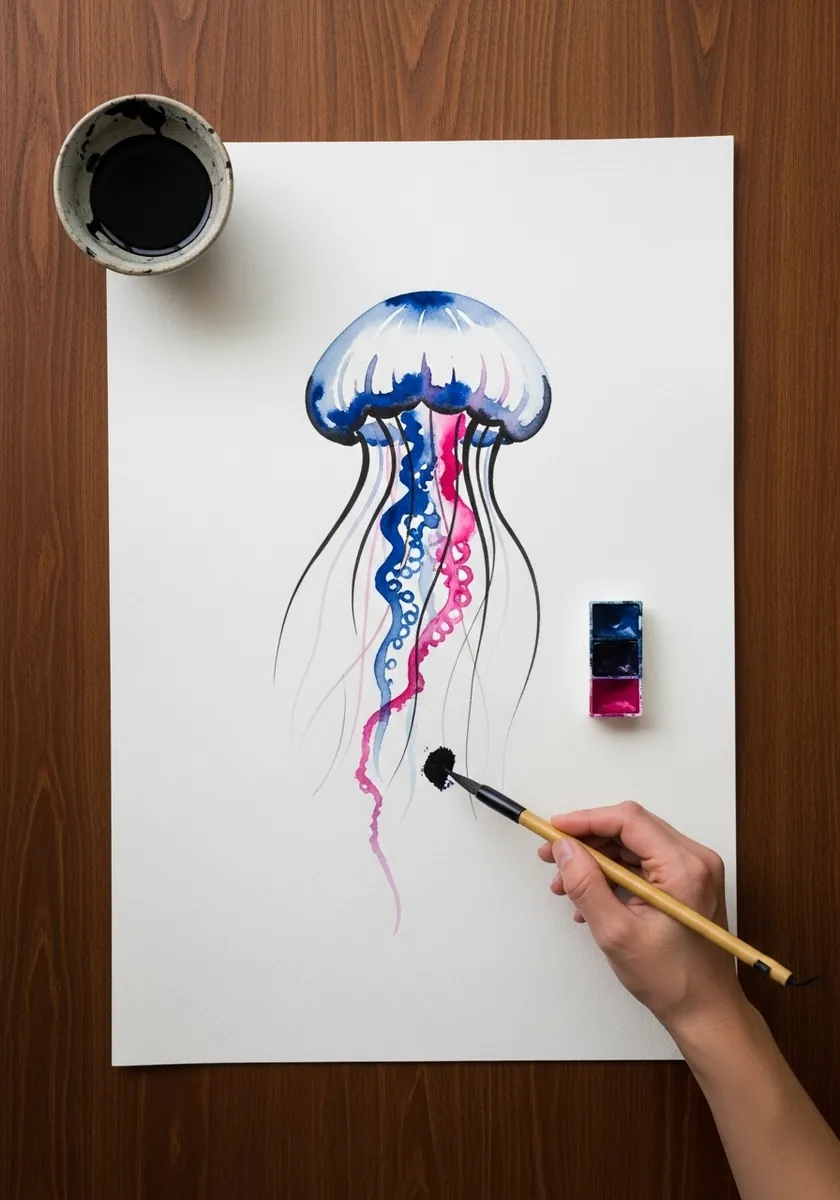
Scale down deliberately once in a while. A jellyfish occupying a third of the page, surrounded by empty paper, reads as a creature in open water, which is exactly right. Two washes and a handful of tentacle strokes are all it needs.
46. Art Nouveau Gold and Green Jellyfish
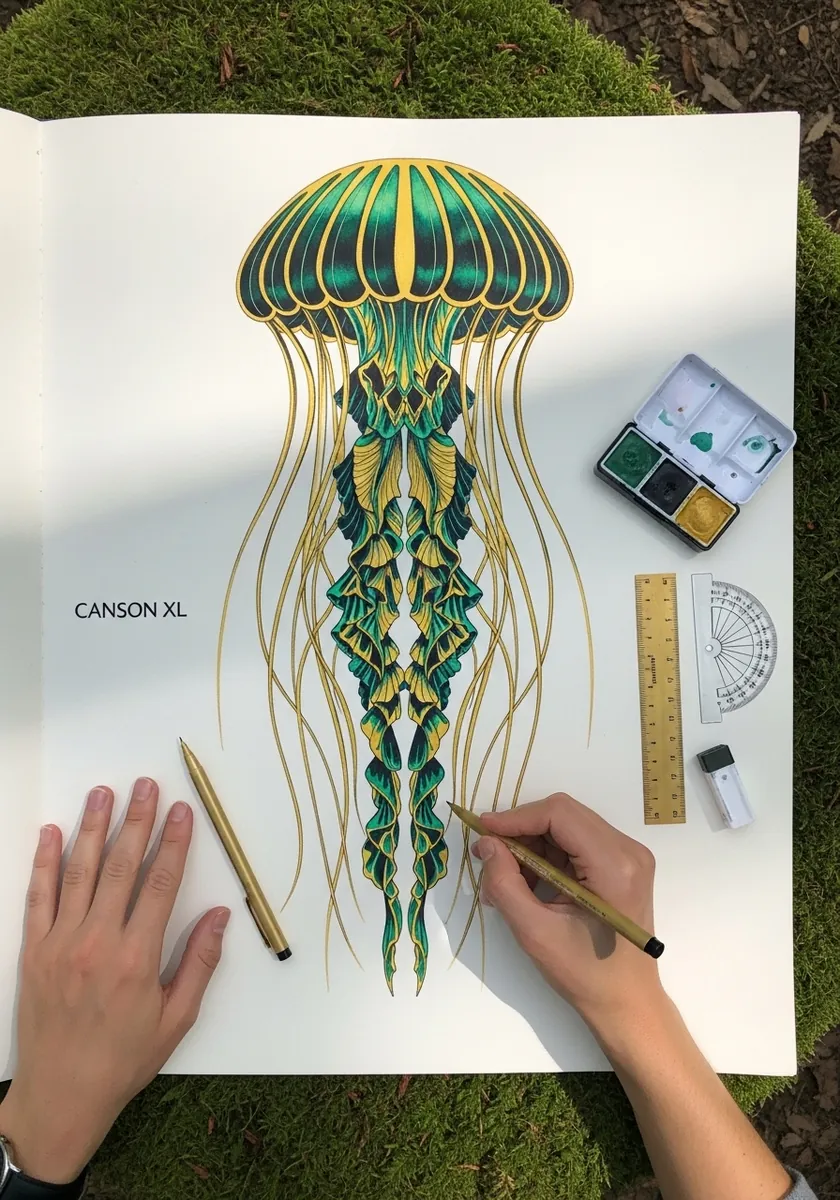
Nouveau line has a specific quality, swelling and tapering along its length rather than staying even. Use a brush pen. Vary the pressure through every curve, and let the tentacles interlace with one another the way vine work does in that tradition.
47. Rainbow Halo Burst Jellyfish
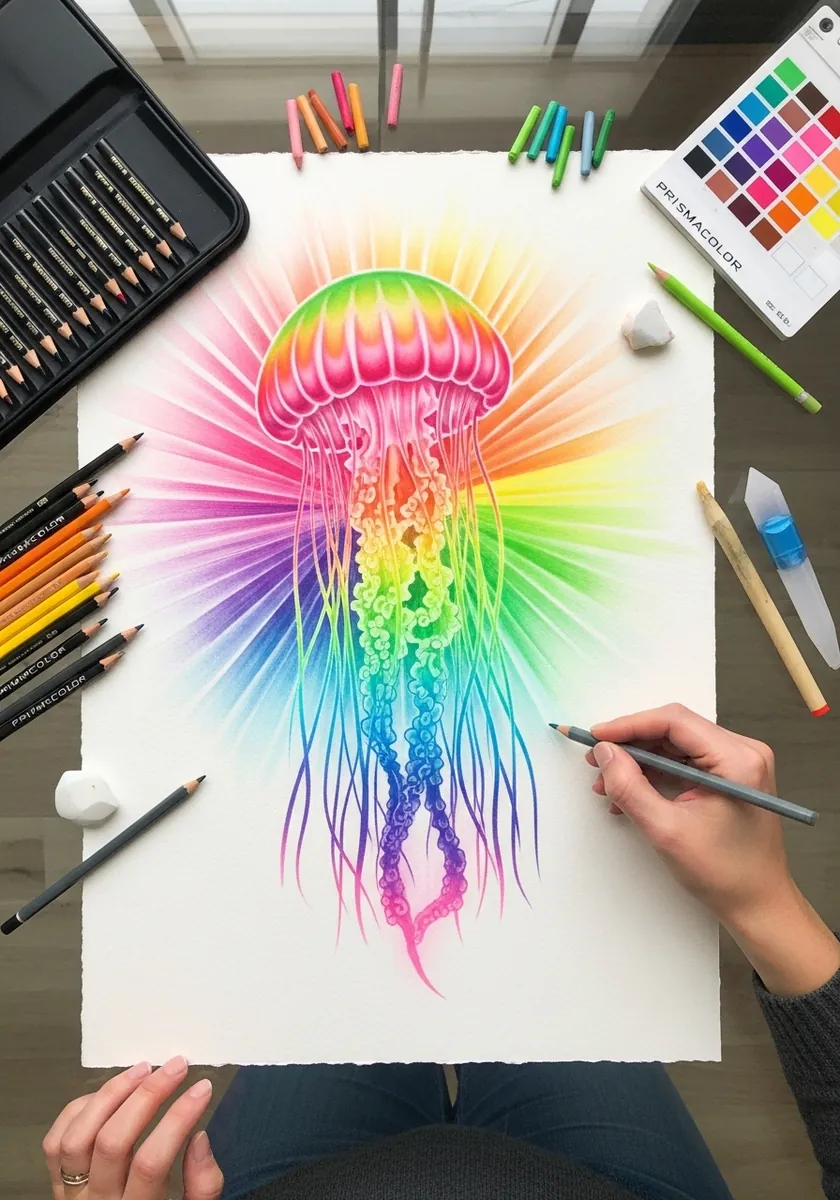
A complete spectrum halo needs an order that never reverses. Run the hues outward in wheel sequence and keep the innermost ring lightest, which suggests the light originates in the bell. Bright neon markers give the cleanest transition between neighboring hues here.
48. Surreal Jellyfish With a Face
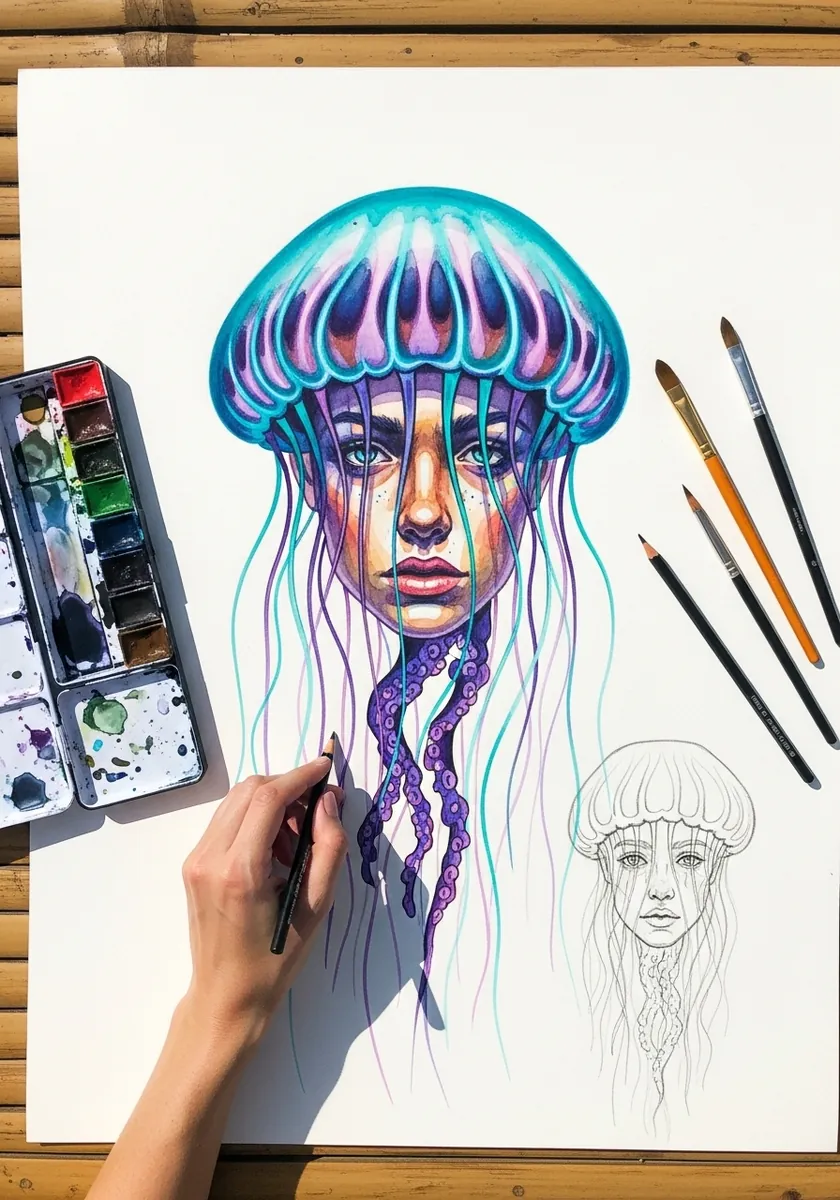
Placing a face inside a translucent form means it has to sit behind something. Paint the face first. Glaze a thin transparent wash of the bell color across it afterward so the features soften. A face drawn on top of the bell instead just looks like a mask.
Frequently Asked Questions
What is the difference between a jellyfish’s tentacles and oral arms?
Oral arms are the four or more thick, frilly structures hanging from the center of the underside of the bell, and they carry food to the mouth. Tentacles are much finer, hang from the rim of the bell, and are the stinging parts. Drawing both makes the animal read correctly.
How do you draw a glowing jellyfish?
Work on black or navy paper. Draw only the light: a soft halo around the bell, brighter cores along the tentacle lines, and a small hard white highlight at the top of the bell. Leave everything else as bare dark paper, because unlit areas are what make the lit ones glow.
What color is real jellyfish bioluminescence?
Blue-green, roughly 470 to 490 nanometers. That wavelength travels furthest through seawater, so most marine bioluminescence sits there. The hot pinks and oranges you see in neon jellyfish art are artistic license rather than biology, which is a perfectly reasonable choice for a stylized piece.
How do you show a jellyfish moving?
Pulse the bell and lag the tentacles. Squeeze the bell slightly narrower than a resting dome, then let every tentacle and oral arm curve backward, away from the direction of travel. Straight vertical tentacles under a domed bell always read as a jellyfish sitting still.
What is the easiest jellyfish to draw for a beginner?
A simple dome with four wavy oral arms and six to eight fine tentacles. Keep the dome slightly wider than tall, hang everything from beneath it, and vary the tentacle lengths. Skip the shading entirely on your first few, since the silhouette carries the whole drawing.
References and Further Reading