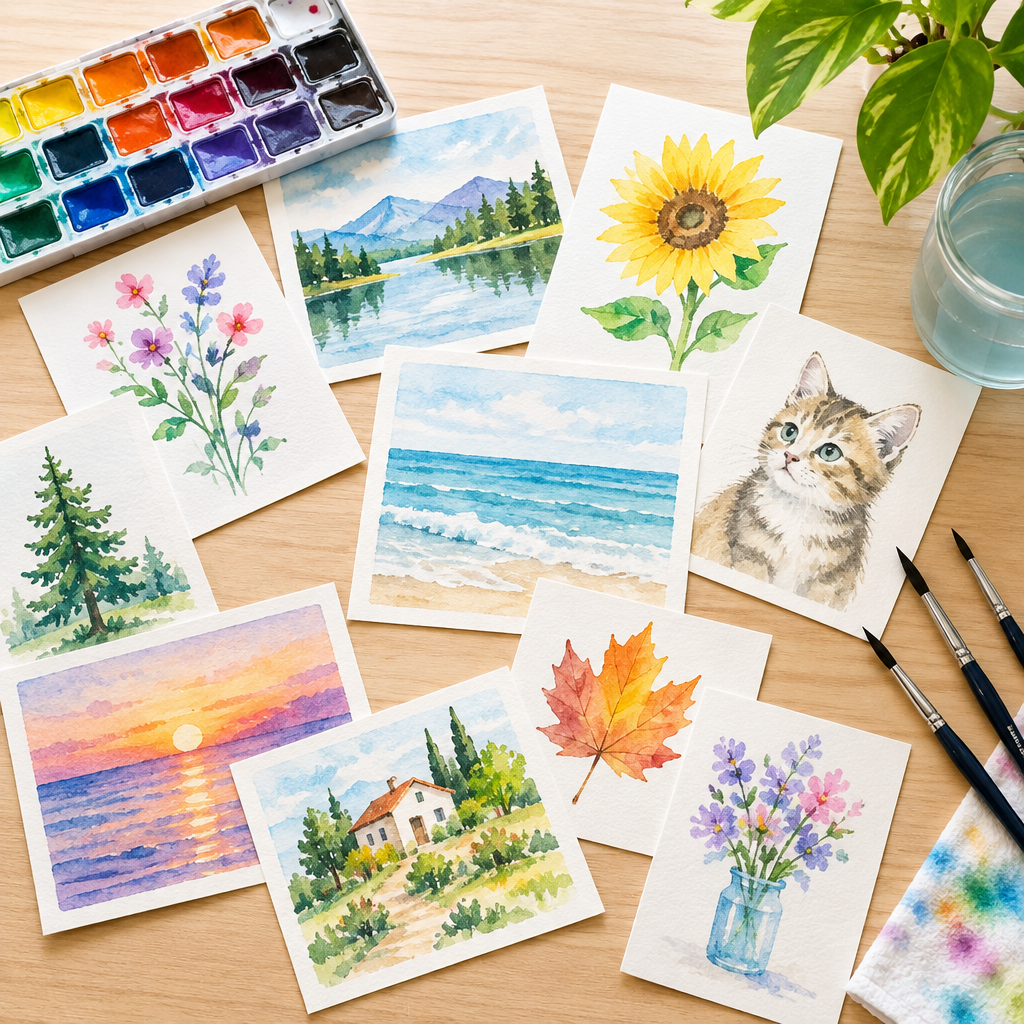
Easy watercolor painting ideas for beginners are simple projects that practice one skill at a time, such as gradients, leaves, flowers, small landscapes, animal silhouettes, everyday objects, and abstract washes. Start small, use a limited palette, and repeat basic exercises to improve water and brush control.
Key takeaways
- Start with small watercolor projects that isolate one technique.
- Use a limited palette to make color mixing easier to understand.
- Practice wet on wet and wet on dry separately before combining them.
- Use simple subjects such as skies, leaves, flowers, silhouettes, and everyday objects.
- Repeat the same exercise to improve water and brush control.
The best easy watercolor painting ideas for beginners include simple skies, basic leaves, abstract color washes, and minimal landscapes. These projects isolate core skills like water control, value building, and color mixing, helping you build confidence without managing complex details.
What Are the Key Takeaways for Beginner Watercolor Artists?
- Start small: Smaller paper keeps projects manageable.
- Limit your palette: Two or three colors make mixing easier to understand.
- Master basic washes: Flat and gradient washes are foundational skills.
- Use simple shapes: Focus on the main form before tiny details.
- Repeat exercises: Repeating a simple subject improves brush and water control.
Why Are Easy Watercolor Painting Ideas for Beginners So Important?
Starting with simple watercolor paintings reduces the number of decisions you need to make at once. New artists often become frustrated when they choose highly detailed subjects before learning how water, pigment, paper, and brush pressure interact. If you have wondered why watercolors can feel difficult, simplifying the subject is a practical place to begin.
Beginner watercolor guidance commonly emphasizes small projects, limited palettes, simple shapes, washes, and repeatable exercises. You can also use our watercolor painting guide for a broader introduction.
What Materials Are Needed for Beginner Watercolor Projects?
- Watercolor paper: Cold pressed paper is a practical starting point. Paper quality affects how water and pigment spread and dry. See our guide to the best watercolor paper for beginners.
- Paint: A small pan set or a few tubes is enough to begin. Our watercolor paint set guide explains what to look for.
- Brushes: A medium round brush plus a larger wash brush can cover many beginner exercises.
- Water jars: Two jars make it easier to keep one source of cleaner water.
- Paper towel: Useful for lifting paint and controlling excess water.
How Can Beginners Paint Simple Skies and Landscapes?
Landscapes are useful beginner studies because their natural shapes do not require perfect geometry. They also let you practice soft washes, layered values, silhouettes, and negative space.
1. Simple Gradient Sunset
What to paint: Blend yellow, orange, and red across a wet sheet to create a simple sunset. Skill: Wet on wet blending.
2. Monochrome Mountain Range
What to paint: Paint overlapping mountain shapes with increasingly darker versions of one color. Skill: Value and layering.
3. Fluffy Cumulus Clouds
What to paint: Paint a light blue sky and lift soft cloud shapes with a clean damp brush or paper towel. Skill: Lifting highlights.
4. Minimalist Pine Forest
What to paint: Build pine trees from simple downward brush strokes. Skill: Brush pressure and texture.
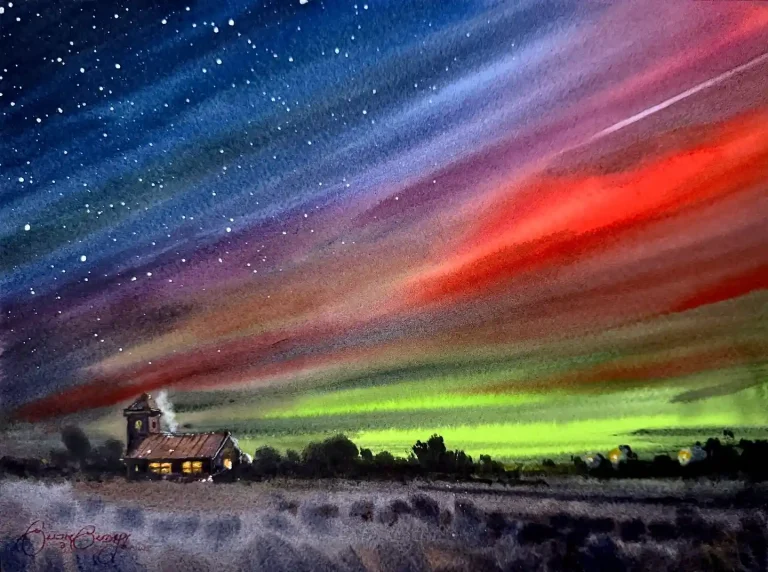
5. Glowing Night Sky
What to paint: Create a deep blue night wash and preserve a moon shape. For more inspiration, see our watercolor moon drawing ideas. Skill: Preserving white space.
6. Peaceful Ocean Horizon
What to paint: Separate a simple sky and water with a clean horizon and leave small white streaks for waves. Skill: Edge control and negative space.
Which Flower and Botanical Watercolor Ideas Are Best for Beginners?
Leaves and simple flowers are excellent practice because a round brush can create many organic shapes with changes in pressure.
7. One Stroke Leaf
What to paint: Press and lift a loaded round brush to make pointed leaves. Skill: Brush pressure.
8. Loose Watercolor Roses
What to paint: Build a loose rose from curved strokes that become broader toward the outside. Skill: Paint consistency and value.
9. Simple Lavender Stalks
What to paint: Add purple dabs around thin green stems. Skill: Stippling and organic grouping.
10. Tropical Monstera Leaf
What to paint: Paint a broad green leaf and lift small openings after establishing the main shape. Skill: Lifting and shape control.
11. Soft Cherry Blossoms
What to paint: Combine a loose branch with watery pink flower clusters. Skill: Wet on wet color drops.
12. Cacti in Terracotta Pots
What to paint: Paint a simple pot and cactus, then add small details after the base layer dries. Skill: Layering and drying time.
How Can Beginners Paint Nature and Animals?
Animals become approachable when you reduce them to silhouettes, circles, ovals, and a few defining marks.
13. Colorful Butterflies
What to paint: Fill simple wing shapes with watery colors and let them blend. Skill: Controlled wet on wet effects.
14. Silhouetted Flying Birds
What to paint: Add small V shaped bird silhouettes across a soft sky. Skill: Fine brush control.
15. Simple Ladybug
What to paint: Start with a red body, then add the head, central line, and spots after drying. Skill: Light to dark layering.
16. Abstract Jellyfish
What to paint: Pull pigment downward from a wet dome to suggest translucent tentacles. Skill: Pulling pigment from a wet edge.
17. Round Little Owls
What to paint: Use an oval body, reserved white eyes, and a few texture marks. Skill: White space and texture.
18. Easy Watercolor Feather
What to paint: Paint a curved central shaft and pull quick strokes outward. Skill: Directional brushwork.
What Are Good Food and Everyday Object Watercolor Projects?
Everyday objects are easy to reference because you can place them beside your painting area and simplify them into basic shapes.
19. Slice of Watermelon
What to paint: Build a red half circle, green rind, and simple seeds. Skill: Edge control.
20. Steaming Coffee Mug
What to paint: Paint a cylinder and add a simple side handle and shadow. Skill: Basic form and shading.
21. Bright Citrus Slices
What to paint: Use a circle, radial white gaps, and a colored rind. Skill: Negative painting.
22. Stack of Books
What to paint: Layer simple rectangles in different colors. Skill: Geometric shapes and edges.
23. Colorful Popsicles
What to paint: Use a rounded rectangle and preserve a narrow highlight. Skill: Highlight preservation.
24. Cute Macarons
What to paint: Stack pastel ovals with darker filling lines. Skill: Smooth washes and texture.
Why Should Beginners Try Simple Abstract and Pattern Studies?
Abstract exercises remove the pressure of making a recognizable object. They let you concentrate on water movement, transparency, color mixing, and brush handling.
25. Color Mixing Grid
What to paint: Create a grid and mix two colors at each intersection. Skill: Color relationships.
26. Overlapping Transparency Circles
What to paint: Layer pale transparent circles and observe the darker overlaps. Skill: Transparency and glazing.
27. Wet on Wet Color Blooms
What to paint: Drop concentrated pigment into a wet area and observe its movement. Skill: Water control.
28. Geometric Triangles
What to paint: Use tape to create crisp triangular sections and fill them with simple washes. Skill: Masking and even washes.
29. Monochrome Value Scale
What to paint: Paint five squares from concentrated pigment to very diluted pigment. Skill: Value and water control.
30. Drip and Splatter Art
What to paint: Flick wet pigment across paper and tilt the sheet to create runs. Skill: Texture and controlled experimentation.
How Does Water Control Work in Beginner Watercolor Projects?
Water control depends on both the moisture in the paper and the moisture carried by the brush. Wet on wet means applying wet paint to wet paper, which creates softer edges and flowing blends. Wet on dry means applying wet paint to dry paper, which generally produces clearer edges and more defined shapes.
Paper absorbency also changes how long a wash remains workable. This is one reason paper choice matters when learning watercolor.
What Are Common Beginner Watercolor Mistakes and How Can I Fix Them?
| Mistake | Why it happens | Practical fix |
|---|---|---|
| Muddy colors | Too many pigments or too much brushing | Use a limited palette and stop brushing once the wash is placed |
| Unwanted blooms | Adding watery paint to a partially drying area | Keep the area consistently wet or let it dry before the next layer |
| Warped paper | Heavy water on lightweight paper | Use heavier paper or tape the sheet to a board |
| Colors dry lighter | Watercolor changes appearance as it dries | Test the pigment strength on scrap paper before committing |
How Can I Follow a 7 Day Watercolor Practice Plan?
- Day 1: Paint the monochrome value scale.
- Day 2: Practice the gradient sunset.
- Day 3: Fill a page with one stroke leaves.
- Day 4: Practice overlapping transparent circles.
- Day 5: Paint a minimalist pine forest.
- Day 6: Practice geometric taped sections.
- Day 7: Combine a sky wash with a simple landscape silhouette.
Frequently Asked Questions About Beginner Watercolors
Do I need to sketch before I paint?
No. Loose florals, skies, and abstract exercises can be painted directly. A light sketch can help with structured subjects where proportions matter.
Can I use cheap paper for practice?
You can use inexpensive paper for quick color tests, but paper that handles water poorly can make it harder to learn blending and layering. Smaller sheets of better paper can be a useful compromise.
How do I make white watercolor?
Traditional transparent watercolor usually preserves the paper as the lightest value. White gouache or another opaque medium can be added later when you need an opaque highlight.
About GS Art Zone
GS Art Zone is an art inspiration and learning platform where readers can explore drawing ideas, watercolor projects, creative techniques, and practical art guidance.
Sources and References