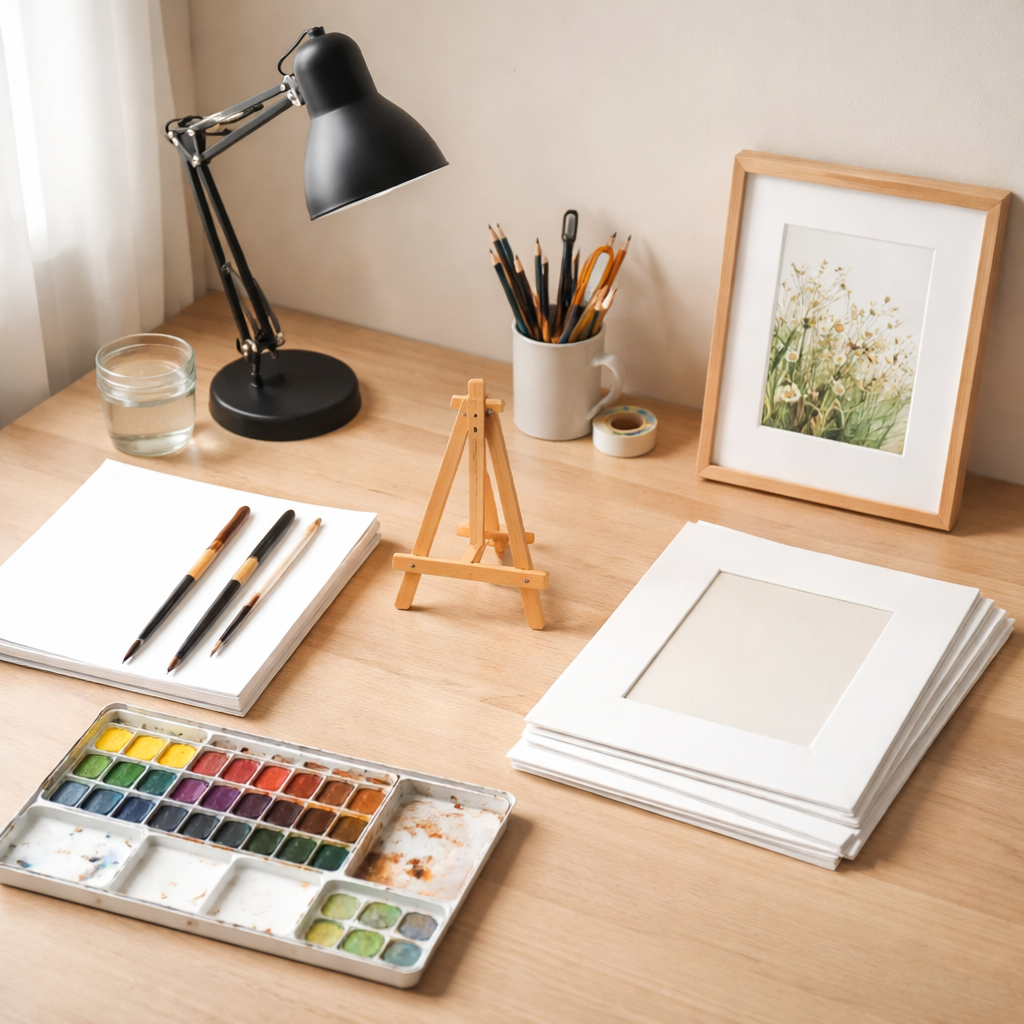
Buy art supplies in this order: paper first, then paint or pencils, then lighting and a permanent working corner, and only then reproduction gear. Paper decides what techniques are physically possible, so it is the wrong place to save money.
Key takeaways
- Paper matters more than paint; cotton content decides what techniques are possible.
- Six to eight colors cover most work, so a huge set is not an upgrade.
- Lighting and a permanent corner unlock more progress than new materials do.
- A drawing tablet is worth it for construction errors and layered files, not for practice.
- Selling starts with a good scan; a printer cannot fix a bad capture.
Some links on this page are affiliate links. As an Amazon Associate we earn from qualifying purchases, at no extra cost to you.
Almost everyone buys art supplies in the wrong order. Paint first, paper last. A fancy tablet before a decent lamp. A hundred colored pencils before knowing whether they prefer wax or oil. The result is a drawer full of things that did not make the work better.
This page is the buying order that actually works, split into three stages. Each stage links to the full guide for that decision, so you can go deep only where you are right now.
The Order That Works
| Stage | Buy this | Why now |
|---|---|---|
| 1. Starting out | Paper, then paint or pencils | Surface decides what is even possible |
| 2. Getting serious | Light, then a working corner, then an easel | You cannot fix what you cannot see |
| 3. Selling | Scanner, then printer, then mats | Reproduction is where the money is |
Stage 1: Starting Out
The single biggest jump in quality for a beginner is not better paint. It is paper that holds water long enough to let you work. Student paint on cotton paper looks like watercolor; professional paint on cheap pulp looks like a blotchy mistake.
- Watercolor paper — cotton content, weight and sizing, and why 140 lb cold press in a block is the correct first purchase.
- Watercolor paint sets — how to read pigment codes, why your mixes go muddy, and whether pans or tubes suit how you work.
- Colored pencils — wax core versus oil core, what wax bloom is, and why paper tooth limits how many layers you get.
If you are still deciding what to paint while you shop, our flower drawing ideas and watercolor sky ideas are the two subjects that teach the most per hour.
Stage 2: Getting Serious
The second stage is not about materials at all. It is about the conditions you work in. Two things quietly cap most people’s progress: they cannot judge color under the light they have, and they have nowhere to leave a half-finished piece.
- Studio lighting — the color rendering index rule nobody explains, and why a warm bulb makes every blue you mix wrong.
- Home studio setup — building a corner in a normal room, so work stays out and gets finished.
- Easels — the angle each medium needs, and why drawing flat on a table distorts your proportions.
- Drawing tablets — worth it when perspective mistakes and layered studies are eating your time.
Stage 3: Selling Your Work
Almost nobody makes a living selling originals. The money is in reproduction: one painting becomes prints, cards, bookmarks and downloads. That chain starts with a good capture and ends with presentation.
- Scanners for artwork — resolution and bit depth that preserve granulation, and why phone photos flatten a watercolor.
- Printers for selling prints — pigment versus dye, cost per print, and when printing at home stops making sense.
- Matting and framing — why a mat is a spacer and not decoration, and the border rule galleries use.
What to Skip
- Huge color sets early. Most working painters use six to eight colors. A 48-pan tin mostly teaches you which eight are yours, which a 24 does just as well.
- Expensive brushes before expensive paper. A cheap brush on good paper beats a sable on pulp, every time.
- A pigment printer for bookmarks and cards. Dye ink on a refill-tank machine costs a fraction per copy and looks fine at that size.
- 300 lb paper as a first buy. It costs roughly double and solves a buckling problem that a 140 lb block already solves.
Frequently Asked Questions
What art supplies should a complete beginner buy first?
A 140 lb cold press watercolor block, one mid-range 24-color paint set, two round brushes and a graphite pencil set. That covers watercolor and drawing for the first year, and paper is the part worth spending the most on.
Does expensive paint actually make a difference?
Yes, but less than paper does. Artist-grade paint carries more pigment and fewer fillers, so mixes stay clean instead of going grey. On absorbent paper, though, even the best paint dries blotchy.
When is a drawing tablet worth buying?
When you are repeatedly restarting drawings over construction errors, or when you want to sell layered digital files. For traditional painting practice it changes nothing, and a lamp would help you more.
What do I need before I can sell prints?
A flatbed scanner that captures at 600 dpi and 48-bit color, a printer matched to the paper you sell on, and acid-free mats. In that order — a bad capture cannot be fixed by a good printer.
Where to Go Next
Supplies only matter once you are painting regularly. If you need something to make, start with our watercolor abstract ideas for loose practice, or tree drawing ideas if you would rather work in pencil.